ch 9, 10, 11, 14 Packet Questions
 Call Kai
 Learn
 Practice Test
 Spaced Repetition
 Match
 Flashcards
 Knowt Play
1/39

There's no tags or description
Looks like no tags are added yet.
40 Terms
b
Ch 9 - Packet
Under free trade, if the world price of computer components is above the U.S. price of computer components:
a. foreign countries will export computer components to the U.S.
b. the U.S. will export computer components to foreign countries
c. U.S. producers of computer components will be worse off
d. U.S. consumers will be better off
e. the U.S. will import computer components from foreign countries.
d
Ch 9 - Packet
2. Which of the following about international trade is FALSE?
a. GATT and NAFTA are trade agreements to decrease trade restrictions between countries
b. tariffs and quotas increase the price of imported goods, restrict trade and create a DWL
c. the loss of domestic jobs is an argument against free trade
d. one advantage of quotas over tariffs is that quotas raise revenues for the domestic government
a
Ch 9 - Packet
3. All of the following are arguments for restricting trade except
a. domestic producers getting a higher price for their exports
b. unfair competition
c. national security
d. the loss of domestic jobs
a
Ch 10 & 11 - Packet
1. Which of the following should be used to internalize a negative production externality?
a. a Pigovian tax equal to the external costs
b. a subsidy equal to the external costs
c. a Pigovian tax equal to the social costs
d. a subsidy equal to the private costs
e. a Pigovian tax equal to the private costs
b
Ch 10 & 11 - Packet
2. Private markets fail to reach a socially optimal level when positive externalities are present because
a. social costs equal private costs at the private market solution
b. external benefits are not taken into account
c. the market over-produces the good
d. consumption externalities lead to production externalities
e. both b and c
1. Why the S curve is labeled \(S_{\text{private}} = S_{\text{social}}\)
Your professor is graphing a positive externality of consumption (like vaccines or education).
In a consumption externality, the "spillover" effect happens when people use the good, not when it is made.
Because the factories making the good don't create any extra pollution or special side-benefits during manufacturing, the costs to the firm are exactly the same as the costs to society.
Therefore, the Supply curve (\(S\)) is safely labeled \(S_{\text{private}} = S_{\text{social}}\).
2. Why Option A is still the wrong answer to the question
Option A states: "social costs equal private costs at the private market solution."
While that statement is true for a consumption externality graph, it does not explain why the market fails.
The Definition of Market Failure: A market fails because it misses something vital.
What is it missing here? The market fails strictly because buyers ignore the external benefits (Demand side).
Why Option A doesn't explain the failure: The fact that costs are equal (\(S_{\text{private}} = S_{\text{social}}\)) is actually a good, perfectly normal thing. It means the supply side is behaving perfectly. It doesn't cause any failure.
To use an analogy: Imagine a car that won't start because it is completely out of gas (missing benefits). If someone asks you, "Why won't the car start?" and you answer, "Because the tires are perfectly inflated" (Option A), you are stating a true fact about the car, but you haven't explained the reason it is failing to run.
e
Ch 10 & 11 - Packet
3. A lighthouse is a classic example of a public good because
a. there is no demand for lighthouses
b. it is difficult to exclude people from receiving the benefits from a lighthouse once it is provided
c. lighthouses benefit all passing ships equally
d. lighthouses are often open to the public
e. both b and c
b
Ch 10 & 11 - Packet
4. The government provides public goods because
a. private markets are incapable of producing public goods
b. free-riders make it difficult for private markets to supply the socially optimal quantity
c. markets are always better off with some government oversight
d. public goods always cause negative externalities
e. public goods are non-excludable but rival in consumption
a
Ch 10 & 11 - Packet
5. The Tragedy of the Commons occurs because
a. a common resource is rival in consumption
b. a common resource is underutilized
c. crimes are committed in public places
d. common resources are subject to exclusionary rules
d
Ch 10 & 11 - Packet
6. Examples of common resources are all of the following except
a. fish in the ocean
b. oil pools that lie under several private properties
c. congested non-toll roads
d. cattle raised on a privately owned ranch
b
Ch 10 & 11 - Packet
7. Suppose that a steel factory emits a certain amount of air pollution and that this pollution constitutes a negative externality. The social costs of producing the steel includes
a. the private costs of the steel producers and the price consumers pay for the steel
b. the private costs of the steel producers and the costs to the bystanders affected by the pollution
c. the costs to the bystanders affected by the pollution only
d. the price consumers pay for the steel
e. the private value to the consumers of steel and the external costs
e
Ch 14 - Packet
1. Which of the following is FALSE?
a. accounting profits = total revenue – implicit costs
b. economic profits = accounting profits – explicit costs
c. opportunity costs = explicit costs + implicit costs
d. economic profits = total revenue – explicit costs – implicit costs
e. both a and b.
a
Ch 14 - Packet
2. Increasing marginal product of labor occurs when adding another unit of labor
a. increases output, by more than the margin of the previous unit of labor
b. decreases output, by more than the margin of the previous unit of labor
c. increases output, by less than the margin of the previous unit of labor
d. increases output by the same margin as the previous unit of labor
c
Ch 14 - Packet
3. As part of an estate settlement Mary received $1 million. She decided to use the money to purchase a small business in Anywhere, USA. If Mary would have invested the $1 million in a risk free bond fund she could have made $100,000 each year. She also quit her job with Lucky.Com Inc. to devote all of her time to her new business; Her salary at Lucky.Com Inc. was $75,000 per year.
At the end of the first year of operating her new business, Mary's accountant reported an accounting profit of $150,000. What was Mary's economic profit?
a. $25,000 profit
b. $150,000 profit
c. $25,000 loss
d. $50,000 loss
e. $175,000 loss
Math:
Implicit costs are foregone wages (75,000) and foregone interest (100,000) = 175,000
Eco Profit = Accounting profit (150,000) - (175,000) implicit cost → -25,000 (loss)
e
Ch 14 - Packet
4. Which of the following statements best describes a production function with output (q) on the vertical axis and the number of workers (l) on the horizontal axis?
a. the shape of the production function depends on the marginal product of labor
b. technology and other factors of production, such as capital, are assumed to be fixed along the production function
c. a production function is the same thing as a production possibility frontier (PPF)
d. a production function is always a straight downward sloping line
e. both a and b
b
Ch 14 - Packet
According to the table below, what is the marginal product of the fourth worker?
a. 40
b. 110
c. 260
d. 275 Number of Workers
Output (Boxes of Premium Chocolates Produced per Week) | Marginal Product of Labor | |
0 | 0 | ------- |
1 |
| 330 |
2 | 630 | |
3 |
| 150 |
4 | 890 |
• MPL is missing: MPL = ΔQ / ΔL
• Output (ΔQ) is missing: ΔQ = MPL × ΔL
• Labor (ΔL) is missing: ΔL = ΔQ / MPL
WORK:
MPL = change in Q/change in L
BOX 1:
Q: (Q - 0)
L: (2-1)
(Q - 0)/(1-0) = 330
Q/1=330
Multiple each side by the denominator of 1
1 x (Q/1) = (330) x 1
Q = 330
BOX 2:
(630-330) / (2-1) =300/1 —> 300
BOX 3:
(Q-630)/(3-2)=150
(Q-630)/1 = 150
Multiple both side by denominator
1 x ((Q-630)/1) = (150) x 1
Q-630 = 150
Add 630 to both sides
Q - 630 = 630 = 150 + 630
Q = 780
BOX 4:
(890-780)/(4-3)=110

A
Practice Question 1: Production Table (Varying Worker Steps)
According to the table below, what is the total output when 6 workers are employed?
Number of Workers | Total Output (Units per Day) | Marginal Product of Labor |
|---|---|---|
0 | 0 | ------- |
2 | * | 50 |
5 | 340 | * |
6 | ? | 60 |
9 | 520 | * |
Answer Choices:
a. 400
b. 346
c. 420
d. 360
From 0 to 2 workers (Change in Labor = 2):
With an MPL of 50, the change in output is 50 * 2 = 100 units.
Output at 2 workers = 100 units.From 2 to 5 workers (Change in Labor = 3):
Output goes from 100 to 340 (Change in Output = 240 units).
MPL for this interval = 240 / 3 = 80.From 5 to 6 workers (Change in Labor = 1):
With an MPL of 60, the change in output is 60 * 1 = 60 units.
Output at 6 workers = 340 + 60 = 400 units.
C
Sarah leaves a corporate consulting role paying $90,000 a year to open a local bakery. She funds the bakery by pulling $200,000 out of a mutual fund that was earning a 5% annual return ($10,000 per year). In her first year of operation, her total revenue is $300,000, and her explicit business expenses (rent, ingredients, employee wages) total $160,000.
What is Sarah's economic profit for her first year?
Answer Choices:
a. $140,000 profit
b. $50,000 profit
c. $40,000 profit
d. $10,000 loss
Calculate Accounting Profit:
Accounting Profit = $300,000 Revenue - $160,000 Explicit Costs = $140,000Calculate Total Implicit Costs:
Implicit Costs = $90,000 Forgone Salary + $10,000 Forgone Interest = $100,000Calculate Economic Profit:
Economic Profit = $140,000 Accounting Profit - $100,000 Implicit Costs = $40,000
C, c
Extra Practice
Practice Question 3: Economic Profit
An entrepreneur generates $400,000 in total revenue and incurs $250,000 in explicit costs. To start this business, she quit a job that paid $60,000 per year and used $100,000 of her savings that was earning 5% interest ($5,000 per year). What is her economic profit?
Answer Choices:
a. $150,000 profit
b. $90,000 profit
c. $85,000 profit
d. $65,000 loss
Correct Answer: c. $85,000 profit
Accounting Profit = $400,000 - $250,000 = $150,000
Implicit Costs = $60,000 + $5,000 = $65,000
Economic Profit = $150,000 - $65,000 = $85,000
Practice Question 2: Economic Profit
David leaves a software engineering role paying $120,000 a year to launch a startup. He funds the venture by liquidating a investment portfolio worth $500,000 that was reliably generating a 6% annual return ($30,000 per year). In his first year, his startup earns a total revenue of $500,000 and incurs $330,000 in explicit operational costs (rent, materials, software licensing).
What is David's economic profit for the first year?
Answer Choices:
a. $170,000 profit
b. $50,000 profit
c. $20,000 profit
d. $10,000 loss
Calculate Accounting Profit:
Accounting Profit = $300,000 Revenue - $160,000 Explicit Costs = $140,000Calculate Total Implicit Costs:
Implicit Costs = $90,000 Forgone Salary + $10,000 Forgone Interest = $100,000Calculate Economic Profit:
Economic Profit = $140,000 Accounting Profit - $100,000 Implicit Costs = $40,000
A, C
Extra Practice
Practice Question 1: Production Table
Use the table below to find the marginal product of the third worker:
Number of Workers | Total Output (Units per Day) | Marginal Product of Labor |
|---|---|---|
0 | 0 | ------- |
1 | 50 | 50 |
2 | 110 | 60 |
3 | 155 | ? |
4 | 190 | 35 |
Answer Choices:
a. 45
b. 55
c. 155
d. 35
Correct Answer: a. 45 (Calculated as \(155 - 110 = 45\))
Practice Question 2: Missing Table Values
Find the total output when 3 workers are employed given the following data:
Number of Workers | Total Output (Units per Day) | Marginal Product of Labor |
|---|---|---|
0 | 0 | ------- |
1 | 80 | 80 |
2 | 140 | 60 |
3 | ? | 40 |
4 | 210 | 30 |
Answer Choices:
a. 100
b. 170
c. 180
d. 210
Correct Answer: c. 180 (Calculated as \(140 + 40 = 180\))
d
Ch 14 - Packet
6. The amount by which total cost rises when the firm produces one additional unit is called
a. variable cost
b. average total cost
c. fixed cost
d. marginal cost
e. average variable cost
c
Ch 14 - Packet
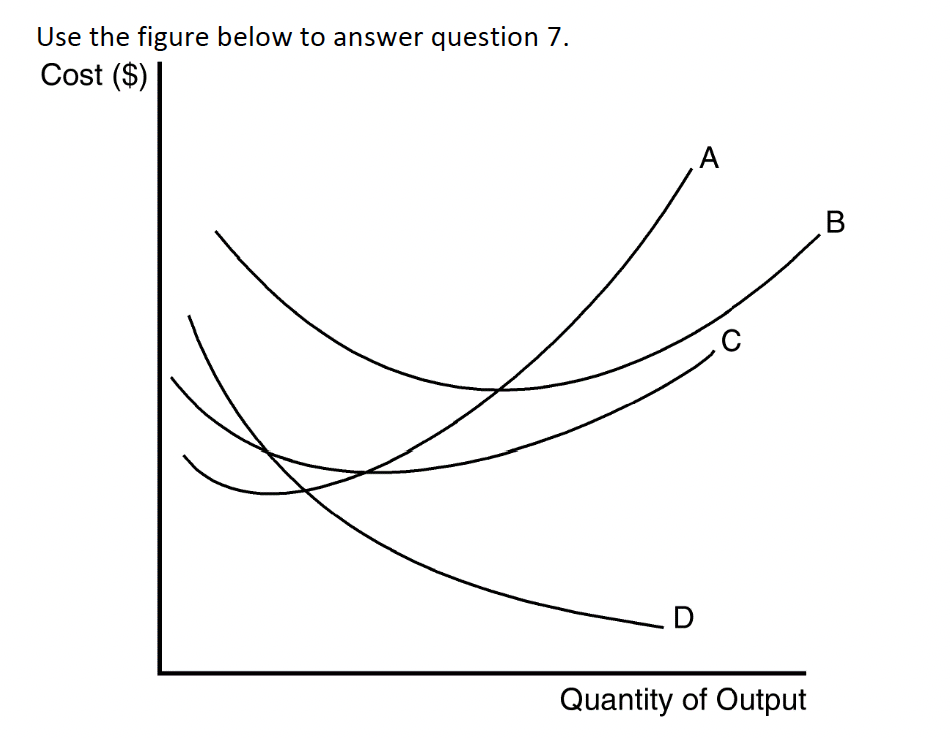
Use the figure below to answer question 7.
Note: MC is marginal cost, ATC is average total cost, AVC is average variable cost, AFC is average fixed cost, TC is total cost, VC is variable cost and FC is fixed cost.
7. In the above graph, the curves labeled A, B, C, D represent respectively:
a. MC, ATC, AFC, AVC
b. TC, VC, FC, MC
c. MC, ATC, AVC, AFC
d. ATC, AVC, AFC, FC
c
Ch 14 - Packet
8. Which of the following statements about a firm's typical cost curves in the short run is FALSE?
a. the marginal cost (MC) curve crosses the average variable cost (AVC) and the average total cost (ATC) curves at their minimum points
b. the typical ATC curve is U-shaped
c. the AFC curve is an horizontal line since fixed costs do not vary with output
d. the difference between the AVC and ATC curves are average fixed costs (AFC)
e. the efficient scale occurs at the minimum ATC
c
Ch 14 - Packet
9. If the marginal cost (MC) is below the average total cost (ATC)
a. it is impossible to say if ATC is increasing or decreasing
b. ATC is increasing
c. ATC is decreasing
d. ATC is equal to fixed costs (FC)
140, f, e, i, importing, 150, i, f, g, h, e, g, h
Ch 9 - Packet
Pd represents the domestic price and Pw represents the world price.
[graph]
Before trade,
a. how much is produced domestically? _____ units
In terms of area(s),
b. what is the producer surplus? ______
c. what is the consumer surplus? _____
Under free trade,
d. is the domestic country importing or exporting? How many units?
(importing or exporting:) _______
How many units? _______ units
(220 - 70 =150)
In terms of area(s),
e. what is the consumer surplus? ______
f. what is the producer surplus?
g. what is the gain from free trade?

v, u, p, r, s, exporting, 150, p, r, s, q, v, u, q
Ch 9 - Packet
2. Pd represents the domestic price and Pw represents the world price.
[graph]
Before trade,
In terms of area(s),
a. what is the producer surplus? ______
b. what is the consumer surplus? ______
Under free trade,
c. is the domestic country importing or exporting? How many units?
(importing or exporting:) _______
How many units? _______ units
(250 - 100 = 150)
In terms of area(s),
d. what is the consumer surplus? _______
e. what is the producer surplus? _______
f. what is the gain from free trade? _______

false, false, false
Ch 9 - Packet
3. True/False statements. If true, no need to explain. If false, explain why.
a. If the world price is below the domestic price, domestic consumers would be worse off under free trade.
_______, because price decreases thus making consumers better off (because law of demand, if price decreases then quantity demanded increases)
[If the world price is below the domestic price, the country will import the good, causing the domestic price to fall to the world price level. This lower price allows domestic consumers to buy more units at a cheaper rate, making them better off (their consumer surplus increases).]
b. One advantage of using a quota over a tariff is that a quota raises Government’s revenue.
____, because government revenue is from tariffs
[A tariff raises government revenue, whereas a quota typically generates quota rents that go to the holders of the import licenses rather than the government (unless the government auctions the licenses).]
c. A quota does not create a dead weight loss (DWL).
________, because quotas have the same problems as tariffs which create DWL
[A quota restricts the quantity of imports below the free-trade level, which prevents mutually beneficial trades from happening and creates a deadweight loss (DWL), just like a tariff does.]
b, c, d, e, b, c, l, d, k, j, i, e, l, k, j, i, 75, 40, 50, b, c, l, d, e, d, k, j, i, j, k, i, 12.50
Ch 9 - Packet [On EXAM]
In the graph below: P1 is the domestic price, P2 is the world price under free trade, and P3 is the world price + tariff. Areas are determined by solid lines.
Consider first the situation of 'no trade' versus 'free trade'.
In terms of areas:
a. What is the consumer surplus before free trade? ______
b. What is the producer surplus before free trade? ______
(TS = b, c, d, e)
c. What is the consumer surplus under free trade? ______
d. What is the producer surplus under free trade? ______
e. What are the (net) gains from free trade? ______
In terms of quantity (Q):
f. How much was produced domestically before free trade? ____ units
g. How much is imported under free trade? ______ units
(Qd 90 - 50 Qs = 40)
h. How much is produced domestically under free trade? ______ units
Consider next the situation ‘free trade’ versus ‘tariff ‘.
In terms of areas:
i. What is the consumer surplus after the tariff is imposed?
j. What is the producer surplus after the tariff is imposed?
k. What is the reduction in consumer surplus caused by the tariff.
l. What is the government's revenue from the tariff?
m. What is the DWL (dead weight loss) from imposing the tariff?
n. In terms of $, if the tariff is $0.50 per unit imported what is the government's revenue from the tariff? $_______
(85 - 60 = 25 x $.50 = 12.50)

the club, lojack
Ch 10 - Packet [not on exam]
1. There are two ways to protect your car from theft. The Club makes it difficult for a car thief to take your car. Lojack makes it easier for the police to catch a car thief after he has stolen it.
a. Which of these types of protection conveys a negative externality?
________.
Why? The Club is a highly visible deterrent. When a car thief approaches a parking lot and sees a car with The Club, they don't give up stealing cars altogether; instead, they simply move on to the next closest car that doesn't have a lock. By visibly protecting your own car, you inadvertently shift the risk of theft onto your neighbors, increasing their likelihood of being targeted.
[TEACHER STATED: The club is a physical deterrent people can see thus they will then pick a bystanders car to steal/target]
b. Which conveys a positive externality?
__________,
Why? Lojack is a hidden tracking system. Because thieves cannot tell which cars have Lojack installed, two positive spillovers happen:
1. General Deterrence: Thieves become more hesitant to steal any car in the area out of fear that it might secretly be tracked.
2. Getting Thieves Off the Street: When a car with Lojack is stolen, the police use it to quickly locate and arrest the car thief. Catching that criminal reduces the overall number of active car thieves in the city, making the entire community safer for everyone.
[TEACHER STATED: it is a hidden system that is a better deterrent because the thieves do not know who has it and who doesn’t]
Sprivate cost, Ssocial cost, Dsocial value, Dprivate value, Ssocial cost, Sprivate cost, D private value, Dsocial value, positive, negative, B
Ch 10 - Packet
2. In the graphs (a) and (b) below, label each curve as Sprivate costs , Ssocial costs , Dprivate value , or Dsocial value.
Labels:
A) _______ = _______
B) _______
C) _______
D) _______
E) _______
F) _______ = _______
Which graph represents a negative externality, a positive externality?
Graph A) _______ externality
Graph B) ________ externality
In which case would a Pigovian tax be appropriate?
Graph _______

false, higher, above, false, non-excludable, false
Ch 10 - Packet
3. True/False statements. If true, no need to explain. If false, explain why.
a. Private markets fail to reach a socially optimal level when negative externalities, such as pollution, are present because private costs exceed social costs at the private market solution.
A) _____ because the negative externalities happen when social costs is ____ than private cost. Graphically the social curve is ____ (higher than) the private cost because social cost consists of the external cost plus the private cost.
[Explanation: When negative externalities like pollution are present, the social costs exceed the private costs at the market solution, not the other way around. Social cost is the sum of private costs plus the external costs imposed on society Social Cost = Private Cost + External Cost. Because producers do not pay for the external damage, they only consider their lower private costs, leading to overproduction relative to the socially optimal level.]
b. A good that is non-rival leads to the problem of free riding.
____, The free-rider problem is fundamentally caused by a good being ___-______, not non-rival. Non-excludability means it is impossible or highly impractical to prevent people who haven't paid for the good from using it. Because individuals cannot be excluded from consumption, they have an incentive to "free ride" on the payments of others, which leads to underprovision by private markets.
d. Private markets fail to reach a socially optimal level when positive externalities, such as education, are present because private benefits exceed social benefits at the private market solution.
______ because social benefits exceed private benefits when positive externalities are present.
Definition of Social Benefit: Social benefit equals private benefit plus external benefit (such as a more productive workforce or lower crime rates).
Relationship: Because external benefits are positive, social benefits exceed private benefits (Social Benefit > Private Benefit).
Market Failure: Consumers only look at their private marginal benefits, leading them to underconsume (and producers to underproduce) relative to the socially optimal level.
c. When dealing with externalities, the Coase Theorem always leads to an efficient outcome, therefore the government should never interfere. [not on exam]
false, The Coase Theorem states that private bargaining can reach an efficient outcome only if property rights are clearly defined and transaction costs are negligible (zero). In reality, real-world bargaining often involves high transaction costs, a large number of affected parties, or asymmetric information. When these assumptions fail, private negotiations cannot resolve the externality, making government interventions (like taxes, subsidies, or regulations) necessary to achieve efficiency
public good, non-excludable, non-rival,
public good, non-excludable, non-rival,
private good, excludable, rival,
public good, non-excludable, non-rival,
private good, excludable, rival,
club good, excludable, non-rival,
private good, excludable, rival,
common resource, non-excludable, rival,
public good, non-excludable, non-rival,
common resource, non-excludable, rival,
common resource, non-excludable, rival
Ch 11 - Packet
Classify each as non-excludable or excludable and non-rival or rival. Which ones are public goods? Which ones are common resources?
1) Southern Pines provides police protection to its residents [national defense]
Type: ________
non-excludable or excludable: ______
non-rival or rival: _________
Why? Non-excludable (difficult to deny protection to a specific resident) and Non-rival (protecting one neighbor doesn't reduce safety for another).
2) Rural roads in the Sandhills area [example of uncongested, non-toll road]
Type: ________
non-excludable or excludable: ______
non-rival or rival: _________
Why? Non-excludable (anyone can drive on them) and Non-rival (rural roads are uncongested; one car doesn't block another).
3) College education
Type: ________ (Neither)
non-excludable or excludable: ______
non-rival or rival: _________
Why? Classification: Excludable (you must pay tuition/be admitted to attend) and Rival (seats in a classroom or advisor time are limited).
4) A mathematician proves that 2 + 2 = 4 [general knowledge]
Type: ________
non-excludable or excludable: ______
non-rival or rival: _________
Why? Classification: Non-excludable (once mathematical knowledge is shared, anyone can use it) and Non-rival (you using the math proof doesn't stop anyone else from using it).
5) Shrubs and flowers you bought at Lowe’s to improve the look of your front yard
Type: ________ (Neither)
non-excludable or excludable: ______
non-rival or rival: _________
Why? Excludable (you have to buy them) and Rival (if you plant them in your yard, someone else cannot plant those same flowers). (Note: While your neighbors get a positive externality by looking at them, the physical plants themselves are private).
6) Yosemite National Park during the winter months when the entrance fee is $10 per car
Type: ________ (Neither)
non-excludable or excludable: ______
non-rival or rival: _________
Why? Excludable (there is a fee at the gate) and Non-rival (winter months have very low crowds, so visitors do not crowd each other out).
7) Yosemite National Park during the summer months when the entrance fee is $20 per car
Type: ________ (Neither)
non-excludable or excludable: ______
non-rival or rival: _________
Why? Excludable (there is a gate fee) and Rival (summer brings extreme congestion, where crowds, full parking lots, and packed trails diminish the experience for others).
8) Pinehurst streets during the U.S. Golf Open [congested, no-toll road]
Type: ________
non-excludable or excludable: ______
non-rival or rival: _________
Why? Non-excludable (public streets remain open to walk/drive on) and Rival (the massive crowd creates heavy congestion and traffic).
9) Cap Hatteras lighthouse.
Type: ________
non-excludable or excludable: ______
non-rival or rival: _________
Why? Non-excludable (any ship at sea can see the light) and Non-rival (one ship seeing the light doesn't dim it for others).
10) The free services of a doctor who volunteers for Doctors Without Borders.
Type: ________
non-excludable or excludable: ______
non-rival or rival: _________
Why? Non-excludable (open to the public) and Rival (the doctor's time is strictly limited; treating one patient means they cannot treat another at that exact moment).
11) Unprotected gorillas in the Congo basin.
Type: ________
non-excludable or excludable: ______
non-rival or rival: _________
Why? Non-excludable (there is no protection/fencing keeping poachers or tourists away) and Rival (if a gorilla is hunted or captured, it is removed from the population)
Which ones are public goods? Items 1, 2, 4, and 9. - non-excludable and non-rival
Which ones are common resources? Items 8, 10, and 11. - non-excludable and rival
free-rider
Ch 11 - Packet
2. Your economics instructor listens to NPR (National Public Radio) but she has never sent any money to support the station.
_____-_______.
Because NPR's radio broadcast is non-excludable (anyone with a radio can tune in) and non-rival (your instructor listening doesn't reduce the signal quality for anyone else), it is a classic public good. This structure gives listeners a strong incentive to "free ride" on the voluntary donations of others.
false, steeper, false, false, zero, false, quantity
Ch 14 - Packet
1. True/False statements. If true, no need to explain. If false, explain why.
a) With increasing marginal product of labor (MPL), the production function gets flatter.
______, because
Diminishing MPL → production function the curve get flatter
When MPL increase → production function the curve gets ______
Diminishing MPL → Total-cost function the curve get steeper
When MPL increase → production function the curve gets flatter
b) The average fixed costs (AFC) are always the same no matter how much the firm produces.
______, While FC stays the same, AFC is equal to FC / Q. As there is an increase in Q produced it means the AFC gets smaller because the fixed cost is distributed over more units resulting in a smaller and smaller AFC.
c) Variable costs equal fixed costs when nothing is produced.
_____, Vc will be ____ and fixed costs are the same no matter the amount of Q produced.
d) The efficient scale is the price that minimizes average total cost (ATC).
_____, it is the _____ (output level) that minimizes ONLY ATC.
50, qfirm, lfirm, FC, VC, VC, q, FC, q, TC, q, AFC, AVC, TC, q, 5, increases
Ch 14 - Packet
2. According to the table below,
a. What are the fixed costs (FC) for this firm? _____
[hint look at TC when qfirm = 0]
b. Write the formulae for MPL, TC, MC, AVC, AFC, and ATC. Fill in the table below (round to one decimal place).
MPL = Δ_____ / Δ_______ (change in output / change in Labor)
TC = ____+____
AVC = ____/____
AFC = ____/____
ATC = ____/____ OR =___+_____
MC = Δ_____ / Δ_______ (change in total cost / change in quantity produced)
lfirm (number of workers) | qfirm | MPL = | VC | TC = | MC = | AVC = | AFC = | ATC = |
0 | 0 | ----- | 0 | 50 | ----- | ----- | ------ | ------- |
1 | 5 | 100 | ||||||
2 | 11 | 200 | ||||||
3 | 19 | 300 | ||||||
4 | 29 | 400 | ||||||
5 | 35 | 500 | ||||||
6 | 40 | 600 | ||||||
7 | 43 | 700 | ||||||
8 | 43 | 800 |
c.Draw the production function and the total cost function (Make sure you label the axes).
d. At what lfirm does diminishing MPL kick in? lfirm = ______
e. When MC is above ATC, what happens to ATC?
When MC is above ATC, ATC ____. This is because the cost of producing one additional unit (Marginal Cost) is higher than the current average. This pulls the average cost upward, exactly like a high test grade pulling up a GPA.

j, k, m, n, j, k, l, m, o, p, r, n, l, o, p, r, 40, j, k, l, m, n, p, o, r, 75
Ch 9 - Extra
Question 23.
In the graph below: P1 is the price before trade, P2 is the world price under free trade (price without tariff), and P3 is the world price + tariff. Areas are determined by solid lines.
Consider first the situation of 'no trade' versus 'free trade'.
In terms of areas:
a. What is the total surplus before free trade? ________
b. What is the total surplus under free trade? ________
c. What are the (net) gains from free trade? ________
In terms of quantity (Q):
d. How much is imported under free trade? ______ units
Consider next the situation ‘free trade’ versus ‘tariff ‘.
In terms of areas:
a. What is the consumer surplus after the tariff is imposed? _____
b. What is the producer surplus after the tariff is imposed? _____
c. What is the government's revenue from the tariff? _____
d. What is the DWL (dead weight loss) from imposing the tariff? _____
e. In terms of $, if the tariff is $3.00 per unit imported what is the government's revenue from the tariff? $_____
(Qd - Qs = 85 - 60 = 25 units x $3 = $75

Negative externality, Neither, Positive externality, Positive externality, Neither, Positive externality, Neither, Negative externality
Ch 10 - Extra
Question 28. Classify each situation below as a negative externality, a positive externality, or neither.
a. A person littering in a public park.
___________.
Why? It degrades the public space and reduces the enjoyment of the park for other visitors (bystanders) who have to look at or clean up the trash.
b. Local college professors have pizza delivered every Friday for lunch.
__________.
Why? This is a standard market transaction. The professors pay for the pizza, and the restaurant is compensated for making and delivering it. No third parties are unintentionally harmed or benefited.
c. The emergence of green technologies.
__________.
Why? Innovations in green tech create spillovers of knowledge and reduce overall environmental degradation, benefiting society as a whole beyond just the companies inventing or purchasing them.
d. The mayor of a small town plants flowers in the city park.
__________.
Why? The beautiful landscape benefits all citizens and visitors who use the park, providing them with visual enjoyment without them having to pay directly for it.
e. Sue does not get the flu because she got a flu vaccine.
__________.
Why? This measures the direct, private benefit to Sue herself. She paid for/received a vaccine, and she got the direct health protection from it.
f. Mary does not get the flu because Sue got a flu vaccine.
__________.
Why? This is a classic externality (often called "herd immunity"). Because Sue got vaccinated, she cannot transmit the flu to Mary. Mary receives a bystander benefit from Sue's private health decision.
g. Paul has an adverse reaction to a medication his doctor prescribed.
__________.
Why? While a bad reaction is a negative outcome, it is a private risk accepted between the patient, doctor, and pharmaceutical product. It does not spill over to impose costs on uninvolved bystanders.
h. The overuse of antibiotics leads to the development of antibiotic-resistant diseases.
__________.
Why? When individuals or livestock overconsume antibiotics, it reduces the overall effectiveness of those drugs for everyone else in society. Future bystanders suffer from harder-to-treat infections due to others' usage.
falling, above, below
With a U-shaped average total cost (ATC) curve for any quantity less than the minimum average total cost output, the average total cost is _____, because the marginal cost (MC) curve is below the ATC curve. To visualize this, consider the following graph:
Margin < Average = decrease in average
The relationship between average and marginal values dictates that whenever the average total cost is rising, the marginal cost must be _____ the average total cost; and whenever the average total cost is declining, the marginal cost must be ____ average total cost. Therefore, the marginal cost curve must intersect the average total cost curve at its minimum.

diminishing marginal product of labor, labor, output, average total cost (ATC), efficient scale. implicit costs, average fixed cost (AFC)
ch 14 - extra credit
Question 25. Use the terms below to fill in the blanks:
Output, explicit costs, implicit costs, fixed cost (FC), average fixed cost (AFC), average total cost (ATC), labor, marginal cost (MC), diminishing marginal product of labor, increasing marginal product of labor, efficient scale. Note: some of the terms are not used and some may be used more than once.
a) When adding another unit of labor leads to an increase in output that is smaller than the increase in output that resulted from adding previous units of labor, we have _____________________________________ .
b) A production function is a relationship between ___________________ and ___________________ .
c) ________________________________ is the cost of a typical unit of output.
d) The firm’s ____________________ is the quantity that minimizes average total cost.
e) _________________________ are costs not taken into account by an accountant.
f) _________________________ consistently decrease as output increases.
60, 80
ch 14 - extra credit
Question 26. Suppose that when 2 units of labor are hired the total cost of production is $100 and that when 3 units of labor are hired the total cost of production is $120. Labor is the only variable input into the production process and the variable cost per unit of labor is the same regardless of the number of units of labor hired.
What is the firm’s fixed cost? $_____ = FC
2 workers —> $100
3 workers —> 120
120-100 =$20 per worker
$20 × 2 workers = $40
$100 - $40 = $60
What is the firm’s total cost when 1 unit of labor is hired? $_______
Fc —> $60 + $20 (wage od 1 worker) = $80
18, 5, diminishing MPL, increase, capital, overcrowding, less, 700, 11.1, 14.3
ch 14 - extra credit
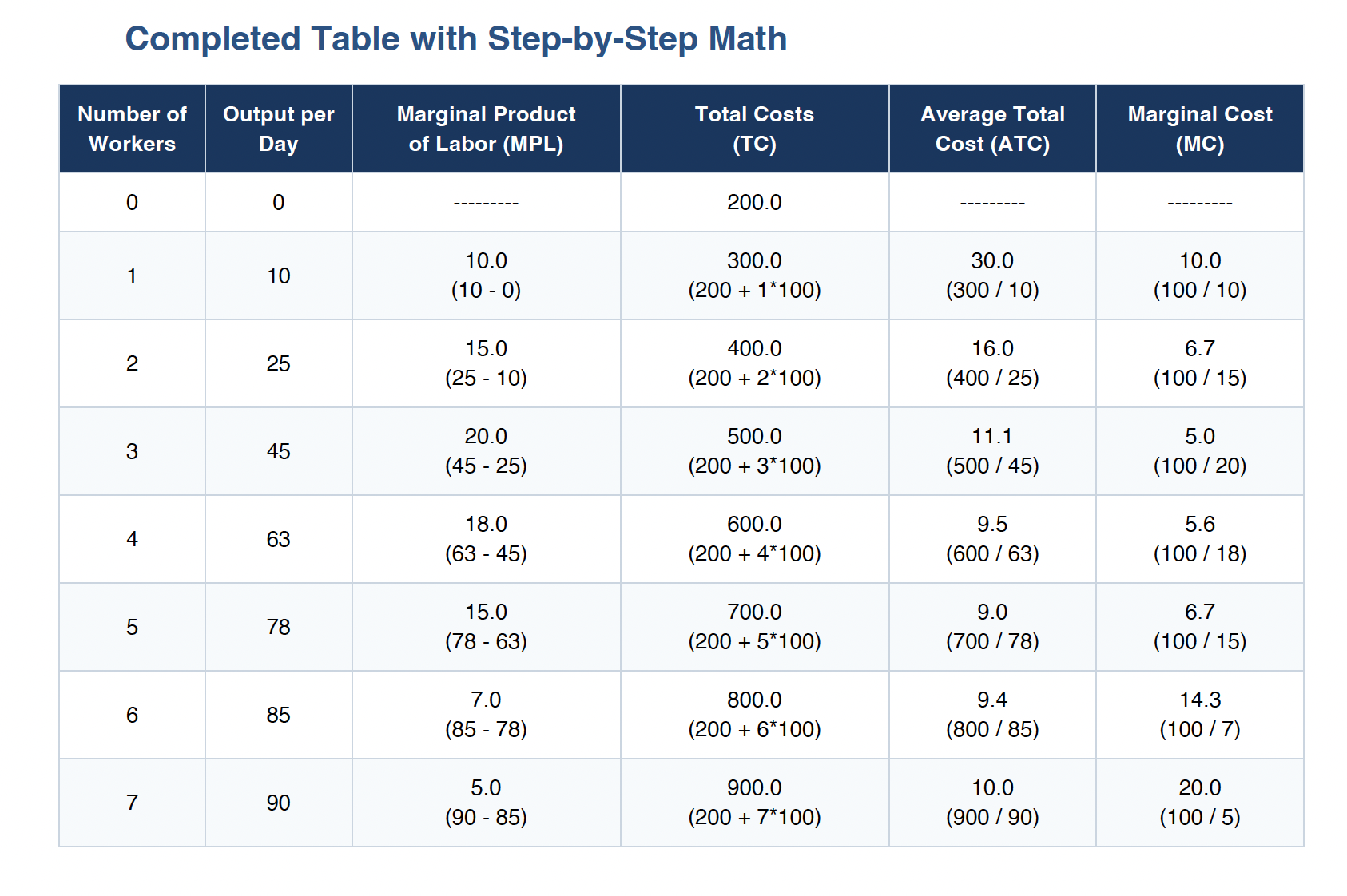
Question 27. You will need to fill in the columns to answer the questions below. The dashed lines mean that you cannot fill in those spaces. A worker costs $100 a day and the firm has fixed costs of $200. Round your answers to 1 decimal.
Number of workers | Output per day | Marginal product of labor | Total costs | Average total cost | Marginal cost |
0 | 0 | ------------------ | ------------------ | ------------------ | |
1 | 10 | ||||
2 | 25 | ||||
3 | 45 | ||||
4 | 63 | ||||
5 | 78 | ||||
6 | 85 | ||||
7 | 90 |
a. What is the marginal product of labor of the 4th worker? Of the 7th worker?
4th worker = ______
7th worker = ____
MPL = change in qfirm/chang in l firm
[4th —> q firm (63- 45=18) & lfirm (4-3=1). 18/1 = 18]
[7th —> q firm (90- 85=5) & lfirm (7-6=1). 5/1 = 5]
b. What pattern do you see in the column of marginal product of labor? How might you explain it?
The MPL increases at first (workers 1 to 3). However, starting with worker 4, the MPL decreases continuously. This is because of the law of _____ _____. At first, more workers means they can divide up tasks to work efficiently and _____ marginal output. Eventually, because _____ is fixed, adding more workers leads to _____ and waiting for equipment, which results in each additional worker adding ____ to total output than the previous one.
c. What are total costs for 5 workers? TC of 5 workers = ________
[VC + FC —> 500 + 200 = 700]
d. What is the average total cost for 3 workers? ATC for 3 workers = ________
[ATC = AFC +AVC or TC/q —> 500 / 45 = 11..11 —> 11.1]
e. What is the marginal cost of the 6th worker? MC for 6th worker = ______
[MC = change in change in TC/change in Q
TC —> 900 - 800 = 100
Q —> 85 - 78 = 7
100/7 = 14.28 —> 14.3]