Learn: Historical Astronomy & Planetary Motion
 Call Kai
 Learn
Learn Practice Test
 Spaced Repetition
 Match
Match Flashcards
 Knowt Play
1/37

There's no tags or description
Looks like no tags are added yet.
Name | Mastery | Learn | Test | Matching | Spaced | Call with Kai | Chat |
|---|
No analytics yet
Send a link to your students to track their progress
38 Terms
Why did ancient Greeks think the Earth was round?
It casts a curved shadow on the Moon during a lunar eclipse. (Arositile confirmed)
Who developed the first geocentric model?
Claudius Ptolemy (the Ptolemaic System).( used epicycles to account for retrograde motion)
What is the geocentric model?
A model where Earth is at the center and planets and the Sun orbit it.
What is retrograde motion?
An apparent backward movement of a planet caused by Earth passing a slower outer planet.
What are epicycles?
Small circular orbits used by Ptolemy to explain planetary retrograde motion. NOT REAL
What is an Astronomical Unit (AU)?
The average distance between the Earth and the Sun (about 93 million miles).Baseline of measurement within the solar system
What did Nicolaus Copernicus propose?
The first modern heliocentric (Sun-centered) model of the solar system. (polish), Launched the scientific revolution/figured out how retrograde motion can be accounted for in heliocentric
What was Tycho Brahe's major contribution?
Taking extremely precise measurements of Mars' position over 20+ years and never did anything with his data, had pet moose durlen duel and had a pet moose (works with keplr)
What did Johannes Kepler do?
Used Tycho Brahe's data to develop the Three Laws of Planetary Motion using tycho brayhes data
What were Galileo's key telescope discoveries?
Jupiter's four largest moons, Venus phases, sunspots, and lunar craters (DID NOYtINVENST TELESCOPES), PLANTS HAD VISIBLE disks + got in trouble when presend data
What were Isaac Newton's major contributions?
Invented calculus and physicas, formulated Laws of Motion and Universal Gravitation, and built a reflecting telescope.
What does the Law of Universal Gravitation state?
Every object attracts every other object with a force depending on masses and distance.
What is Kepler's First Law of Planetary Motion?
Planets orbit the Sun in oval-shaped paths (ellipses), not perfect circles.
What is Kepler's Second Law of Planetary Motion?
Planets move faster when closer to the Sun and slower when further away.
What is Kepler's Third Law of Planetary Motion?
if you know the distance you know the orbital period ( they have a proportional relationship)
What is perihelion?
The point in an object's orbit where it is closest to the Sun.
What is aphelion?
The point in an object's orbit where it is furthest from the Sun.
What is the difference between rotation and revolution?
Rotation is spinning on an axis; revolution is orbiting around another object.
What causes Earth's seasons?
The 23.5-degree tilt of Earth's axis as it revolves around the Sun.
What is a solar eclipse?
When the Moon passes between Earth and the Sun, casting its shadow on Earth.
What is a lunar eclipse?
When Earth passes between the Sun and the Moon, casting Earth's shadow over the Moon.
What is the dominant geologic feature of the Moon?
Impact craters caused by a lack of an atmosphere to burn up debris.
What are lunar maria?
Large, dark, flat basaltic plains formed by ancient volcanic lava flows.(ancient from billion of years ago when volcanic eruption filled huge basins with molten lava)
What evidence supports the giant-impact hypothesis of the Moon?
The Moon's composition matches Earth's crust/mantle but lacks a large iron core.
Moon and earth are arounfthr same age
Earth and moon are made out of the same material (basaltic rock)
Physiscas cheaks out
Moon lacks an iron core (if formed alone would have one)
Which type of telescope did Galileo use?
A refracting telescope.
Which type of telescope did Isaac Newton use/invent?
A reflecting telescope.
How are constellations used in modern astronomy?
As a grid system to divide the night sky into 88 official regions. Findnf. things in the sky, scpace missions, stalites
What is the difference between a constellation and an asterism?
Constellations ( ursa major) are official sky areas; asterisms are popular (big dipper inside ursa major) unofficial star patterns.
Full moon

waning gibbous
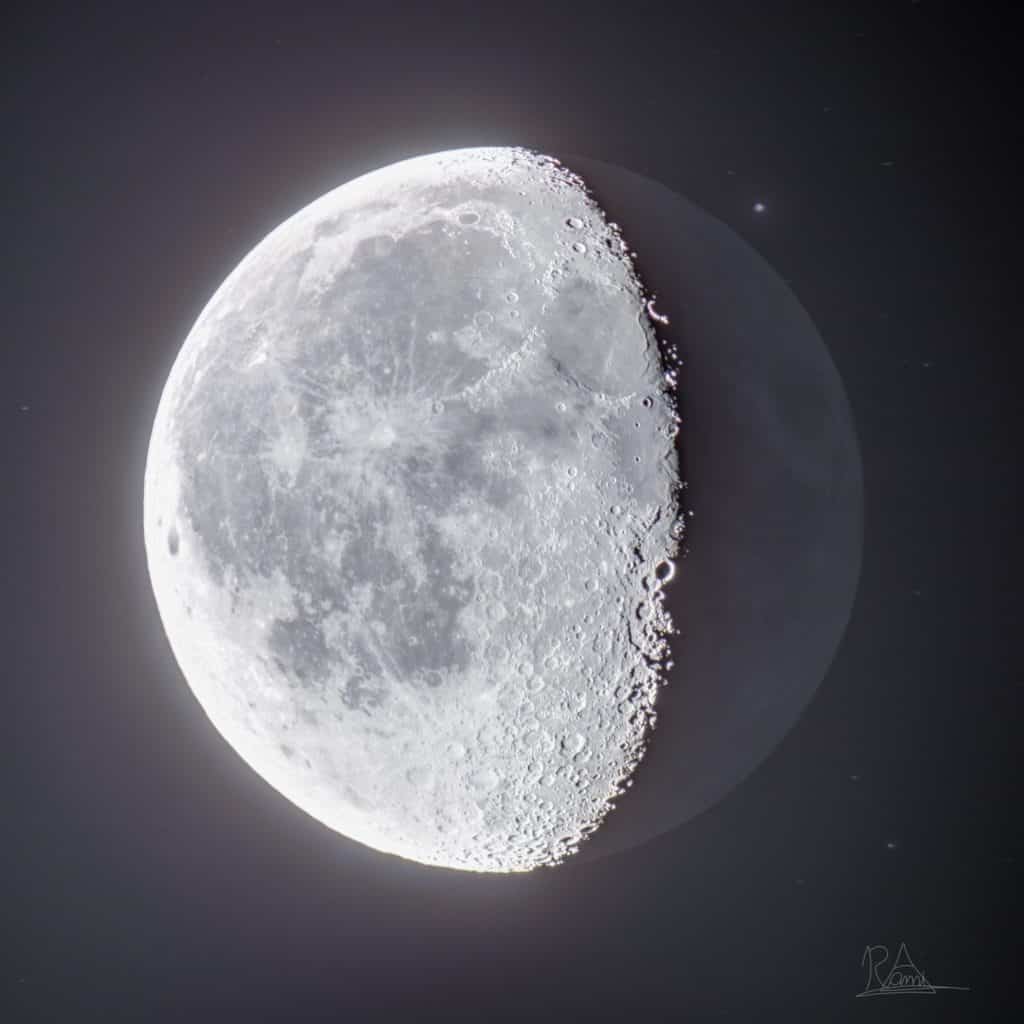
waxing vs. waning
Waxing means the illuminated portion of the Moon is growing larger, while waning means it is shrinking
3rd quarter

waning crescent

New moon

Waxing crescent

1st quarter

waxing gibbois

What are Nweton’s 3 laws
Inertia—> out in motion stay in motion unless outside force vice versa
F=ma Force is mass times acceleration
every action has its equal opposite reaction