Physics Exam 3
 Call Kai
 Learn
 Practice Test
 Spaced Repetition
 Match
 Flashcards
 Knowt Play
1/41

There's no tags or description
Looks like no tags are added yet.
42 Terms
What does “quantum” mean?
the smallest discrete amount of something
Which of the following has the lowest frequency?
Infrared light
Interference effects seen when light passes through a narrow opening provides evidence ....
of the wave nature of light - light sometimes behaves as a wave
When an atom undergoes a "quantum jump" into a lower-energy state, the atom
emits a photon.
What carries more energy: a photon of ultraviolet light, or a photon of red light?
The ultraviolet light photon
The difference between the "ground state" and an "excited state" for a hydrogen atom is
They excited state has more energy, and the atom can radiate when it is in an excited state, but not when it is in a ground state.
Which travels faster in a vacuum, visible light or radio waves?
they travel with the same speed

A certain type of atom has only four energy levels, as shown in the diagram.
The "spectral lines" produced by this element are all visible, except for one ultra-violet line. The quantum jump that produces the UV line is
state 4 to 1.
The spectrum of the hydrogen atom differs from the spectrum of the helium atom due to
Their different energy levels and the different frequencies of their emitted photons
What is the ONLY difference in electromagnetic waves?
frequency and wavelength
what are the similarities in electromagnetic waves?
All created by a vibrating charged object, they all have the same speed: “c”, the speed of light (300,000 km/s), All can travel through empty space, all carry energy (radiant energy), They can all be “received” by an appropriate detector
Light is a…
wave
what are the different types of electromagnetic waves?
Gamma rays, X-rays, Ultra-violet, inferred, microwaves, and radio
is this order of electromagnetic waves low to high or high to low frequencies?
Gamma rays—>X-rays—>Ultra-violet—>inferred—> microwaves—>and radio
High to low
Which travels faster: visible light or radio waves
Same speed for both
Frequency and wavelength is related to…
color
Is ROY G BIV in order from lower to higher or higher to lower frequency?
Lower to Higher
Brightness is related to…
amplitude

Which color has more energy – green or orange?
Green
What was Einstein awarded the Nobel Prive in Physics for in 1921?
discovery of the law of the photoelectric effect
Discrete vs. continuous
Individual steps- you can’t just be at any height!
No specific places- can be at any height
Light has dual nature meaning it…
Travels as a wave and interacts as a particle
The _______ _______ is caused by the wave nature of light (wave interference)
Overall pattern
The __________ ____ are cause by the particle nature of light
individual dots
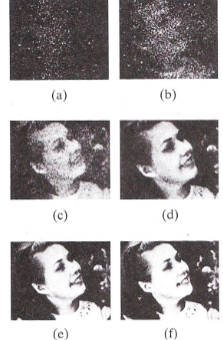
What determines how the shape of the face of this woman will ultimately look in the photo?
Interference of light waves, to form the pattern
How do modern camera sensors work?
They detect one photon at a time
Excited atoms put out light when they…
de-excite
QUANTUM THEORY OF MATTER: 1923-1924
Louis de Broglie
suggests if light (a wave) can sometimes act like a particle (a photon), maybe matter (particles) can sometimes have associated waves.
The wavelength is very ____ for normal-sized objects
Small
For small objects the wavelength is ______.
larger
In general, the ______ the mass, the _______ the wavelength
Bigger, Smaller
Is it easier to see wave interference effects if the wavelength is longer or shorter?
Longer
A proton’s mass is about 2000 times more than an electron.
Assuming that a proton and an electron have the same speed, which one has the longer wavelength?
The electron
With light, the wave is an __________ wave
*And the “particle” is the photon – which is a bundle of light energy
electromagnetic
With matter — what are the waves?
The particle is the matter itself – electron, proton, baseball, etc.
In the electron double slit experiment the electron is more likely to hit where the ______ areas are, and the electron is _____ likely to hit where the dark lines are
More, Less
_____________ suggested that the “wave” is a wave of probability: the probability to find the particle somewhere.
In 1926, Max Born
Probability
the likelihood that a particular event or outcome will occur.
What happens when one eave goes through both slits? (both slits open)
Get the interference pattern
What happens when one wave goes through only one slit? (only one slit open)
No interference pattern
what happens when we have a detector set up to see which slit the wave goes through? (Observations can change the result of an experiment)
No interference pattern
Advantage of quantum computer?
do many calculations at the same time