oral health and prevention - unit 5
 Call Kai
 Learn
 Practice Test
 Spaced Repetition
 Match
 Flashcards
 Knowt Play
1/48

Earn XP
Description and Tags
dental plaque in relation to dental caries
49 Terms

What are ameloblasts?
Enamel cells
What is the function of ameloblasts?
Pumps calcium and phosphate ions into the enamel, allowing hydroxyapatite crystals to fill in the matrix
What is the term when ameloblasts are laid down?
Incremental lines or Striae of Retzius


What do Incremental lines represent?
How the layers of enamel are laid.
Lines are parallel to the dentoenamel junction (DEJ)

What are enamel rods also called?
Enamel prisms
What is the structural unit of enamel?
Enamel rods (enamel prisms)
What are enamel rods made of?
Tightly packed columns of hydroxyapatite
Where do enamel rods start and end?
They start at the dentin surface and end at the enamels outer surface
How are enamel rods positioned relative to the DEJ?
Perpendicular to DEJ (dentinoenamel junction)
What is the shape of enamel rods?
Prism-shaped
How do enamel rods contribute to teeth?
They help give enamel its strength
What percentage of enamel is inorganic matter?
96%
What is the DEJ?
The dentinoenamel junction, where dentin meets enamel.
It is hypomineralized (enamel contains less minerals = is softer & weakened)
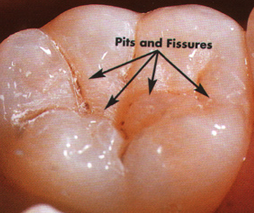
Where are fissures commonly found?
In the central grooves of molars

What is an enamel lamella?
A crack-like mark in enamel

Where can an enamel lamella extend from a fissure?
From the bottom of the fissure to the DEJ
Why can fissures increase the risk of tooth decay?
They can provide pathways for acids to reach deeper into the tooth
What are the 3 stages of caries development?
Demineralization
Incipient caries
Overt lesion

Define demineralization (decalcification)
The acids produced by bacterial plaque dissolve the calcium phosphate minerals of the tooth enamel or dentin
What acids are produced during demineralization?
Lactic acid and formic acid - stronger
Acetic, propionic, butyric – weaker
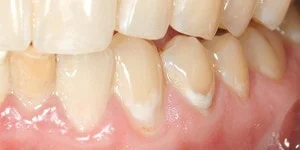
Define Incipient caries
Represents an area that may become a cavity
White spot
Explorer will not stick into this type of caries
Define Overt lesion
Enamel has been penetrated by acids.
Enamel rods collapse due to lack of support
Dentin usually decays
Define Recurrent/Secondary caries
A carious lesion occuring around a restoration
Micro-leakage is suspected
Radiograph needed to detect it
Define Rampant caries
When there is a widespead decay in the oral cavity over a short period of time
Define arrested caries
Previously diagnosed as a cavity, or an incipient lesion BUT never progressed, therefore no restoration required
usually black/dark brown
Which tooth surfaces are most prone to caries? (3)
Pit and fissures (occlusal, facial, lingual)
Smooth surfaces (facial, lingual, interprox.)
Root surfaces (cementum - cervical caries)
What are the primary microorganisms that cause caries? (4)
Those that produce lots of lactic acid
Streptococcus mutans
Lactobacillus (cariogenic if high in #’s)
as well as Aciduric bacteria & Acidogenic bacteria
What are some causative factors affecting the process of decay? (2)
Bacteria
Carbohydrates (sugars)
Provides food sources streptococcus mutans and lactobacillus which results in excreting lactic acid
What are some protective factors affecting the process of decay?
Adequate saliva flow
Fluoride toothpaste 5000ppm, 2x/day
Fluoride mouth rinses
Professionally applied toothpaste
How does saliva help with the prevention & reversal of the caries process?
Calcium & phosphate maintain level of calcium in plaque
Proteins & lipids form protective pellicle
Neutralizes acids (buffers/antibacterial substances)
Clears carbohydrates and acids from mouth
How does Xerostomia increase the risk of caries?
This is a condition where less saliva is produced. Less saliva = higher risk of caries
High mineral content in saliva reduces risk of….?
Demineralization
Glycoproteins in saliva act to…..?
Lubricate and aid in swallowing
Proteins, bicarbonate, and phosphate in saliva help with…..?
Buffering the acids produced by bacteria
How does thick saliva affect caries susceptibility?
Less it is able to wash away carbohydrates = increases risk
How does thin saliva affect caries susceptibility?
Dilutes and removes acid more efficiently = decreases risk
What is the best predictor of future caries?
Past and recent caries history
sidenote: measured by looking at the # of caries in the last 3 years
How long does it take for the highest amount of acid content in the mouth to occur after eating carbohydrates?
5-20 minutes
What is the normal pH for plaque?
6.2 - 7 (before eating)
At what plaque pH level will enamel start to decalcify?
below 5 - 5.5
As a Level II DA, how can you suspect the presence of caries?
Look for chalky white lesions
Look for gray-white spots around interproximal areas
Look for darker gray spots around restorations
May be recurrent decay
What is “tactile sense”?
When DDS or DH use an explorer for detecting decay, the interpretation of what is felt is tactile sense
How do radiographs help in examining caries?
It allows the view of caries between teeth (mesial/distal) and under existing restorations
Gray areas in interprox. areas represent caries processing
Why does a basic plaque record fail to help assign caries risk?
It only notes presence, not the specific types of bacteria that are active.
What is the main purpose of a plaque control record?
To measure a patient's efforts and effectiveness at home plaque removal.
What level of caries risk value does visible plaque contribute to?
A moderate risk value.

How does a DiagnoDent machine detect dental decay?
It emits a laser beam into the tooth
Decay causes an altered wavelength at the bottom of the fissure
Producing a numerical reading

What is a major advantage of the DiagnoDent?
It can detect cavities smaller than the tip of a dental explorer
Name two advanced technologies listed for caries detection
DiagnoDent
Spectra Caries Detection Device