Memory
 Call Kai
 Learn
 Practice Test
 Spaced Repetition
 Match
 Flashcards
 Knowt Play
1/38

There's no tags or description
Looks like no tags are added yet.
39 Terms
What is the processing flow of visual information?
(Visual world) —> sensation —> perception —> recognition —> (response)
What does a fully functioning memory system require?
The capacity to encode, store and retrieve information
What did William James say about primary memory?
The ‘after-image of the impression’
What did William James say about secondary memory?
‘The knowledge of an event, or fact which meantime we have not been thinking, with the additional consciousness that we have thought or experienced it before’
What is Atkinson and Shiffrin’s modal model of memory?
(stimulus) —> sensory memory —> short-term —> long-term
What is the problem with the Modal Model of Memory?
How does retrieval work if the flow of information is strictly serial?
Why do illusions work?
Sensory memory stores the incoming visual information long enough to bridge the gao between the separate static images
Is our image of the world continuous?
YES even when we blank or move our eyes
What is iconic memory?
For visual information
What is echoic memory?
Auditory information
How long do we retain information in our sensory memory?
VERY SHORT duration
<1 second for iconic
~2 seconds for echoic
What did Sperling (1960) show about sensory memory in the WHOLE REPORT?
Iconic memory
12 letters presented for 50ms, you must report as many as possible
Average of 4 letters reported at recall
Items fade away before you can report them
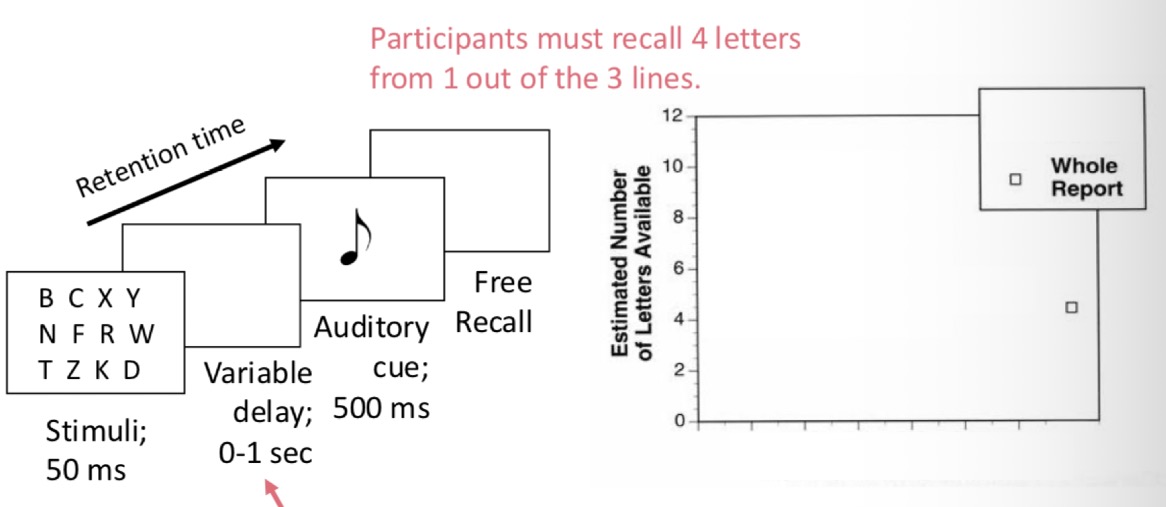
What did Sperling (1960) show about sensory memory in the PARTIAL REPORT?
If the cue comes simultaneously with the stimuli performance is maximal (3/4 relevant letters were retrieved)
Short cue delay = 2/4 letters retrieved
Long cue delay = 1.3/4 letters retrieved
What was the speech suffix effect (Crowder, 1971)?
Auditory presentation of 9 digits
Must repeat the 9 digits in the correct order
An auditory cue prompts recall at the end of the trial (Non verbal buzzer vs speech)
What did Crowder’s experiment on the speech suffix effect show?
Speech suffix overwrites the verbal memory traces
Buzzer suffix doesn’t affect echoic memory performance for verbal material
How long is our short term memory?
<1 minute
What is the capacity of the short term memory?
3-4 items
What is the capacity of sensory memory?
Up to 9 items
What is attention?
The mechanism by which we select information that is relevant for our current behaviour
How long does our long term memory last?
Minutes to years
How many things can we store in our long term memory?
Unlimited amounts of information
How is Short term memory represented?
Phonologically
What did Conrad and Hull (1964) test about short term memory?
Serial recall of constants (either phonologically similar, B D G, or distinct, D, F, L)
What were the results of Conrad and Hull’s (1964) test on phonology
Error rates increased for phonologically similar letters, which shows that STM seems to store info phonologically and is therefore disrupted by phonological similarity
How many items did Miller (1956) say our STM capacity is?
7 (+/- 2)
What is chunking?
Converting high numbers of low-information content items into low numbers of high-information content items
When does STM decay?
10-30 seconds
What are the two sub-components of the ‘Phonological loop’
1) Phonological short term store
2) Vocal rehearsal refreshes your memory and prevents decay, or translating visual info into a speech based code allows for storage in the phonological store
What are the 3 prominent effects of verbal STM?
1) The phonological similarity effect
2) The word length effect
3) The irrelevant sound effect
What did Phillips (1974) show about non-nameable visual material? (3)
Small amounts of non-nameable visual material are retained for short periods of time
Retention of larger amounts of such material for longer periods of time is error prone
There is a temporary short term store with a limited capacity for non-nameable visual material
What is articulatory suppression?
A secondary verbal task occupies the articulatory control process of the loop
What did Luck and Vogel (1997) show about visual material with prevented vocalisation?
We have a limited capacity mechanism storing non-vocalized visual material independently of the Loops articulatory control process
What are the two stores in the short term memory?
Auditory and vocalised visual information
Non-vocalised visual information
What are the two components of visual STM?
Visual object memory
Spatial location memory
What is working memory?
Temporarily stores information (STM) but also serves as a mental workspace allowing to manipulate information to perform complex cognitive tasks
What is Baddeley and Hitch’s (1974) multicomponent model of WM

What is the Central executive?
The controller of storage systems- divides limited central resources between subsystems
What is the phonological loop?
deals with auditory material and is involved in learning new words/languages
What is the visuospatial sketchpad
Deals with visual/spatial material and is involved in mental imagery