Acids, Bases, and Titrations
 Call Kai
 Learn
 Practice Test
 Spaced Repetition
 Match
 Flashcards
 Knowt Play
1/36

Earn XP
Description and Tags
Comprehensive vocabulary flashcards covering acids, bases, neutralisation, standard solutions, and acid-base titration procedures and calculations.
37 Terms
Acid
A compound that releases hydrogen ions as protons, H+, into solution when dissolved in water.
+aq= excess of water present
Strong acid
An acid that completely dissociates in aqueous solution, releasing all of its hydrogen atoms into solution as H+ ions (eg. Hydrochloric acid: HCl(aq)→H+(aq)+Cl−(aq)).
Weak acid
An acid that only partially dissociates in aqueous solution, releasing a small proportion of its available hydrogen atoms into solution as H+ ions
(eg.ethanoic acid:CH3COOH(aq)⇌H+(aq)+CH3COO−(aq) ).
⇌- means forward reaction incomplete
Remember
Not all compounds that contain hydrogen are acids.
Can contain lots of hydrogen and still be weak→ eg. ethanoic acid contains 4 hydrogens but only releases one hydrogen as H+ and only abt 1/100 molecule dissociates so is a weak acid
Common acids I need to know the formula of- Hydrochloric acid
HCl
Common acids I need to know the formula of- sulfuric acid
H₂SO₄
Common acids I need to know the formula of- nitric acid
HNO₃
Common acids I need to know the formula of- ethanoic acid
CH₃COOH
Base
A substance that neutralises an acid to form a salt.
metal oxide, metal hydroxide, metal carbonate, or ammonia (NH3)
Alkali
A base that dissolves in water, releasing hydroxide ions (OH−) into the solution
eg. NaOH(s)+aq→Na+(aq)+OH−(aq)
Common alkalis I need to know the formula of- sodium hydroxide
NaOH
Common alkalis I need to know the formula of- potasium hydroxide
KOH
Common alkalis I need to know the formula of- ammonia
NH₃
Neutralisation
In neutralisation of an acid it’s reaction where H+(aq) ions from an acid react with a base to form a salt and neutral water (H2O), represented by the ionic equation H+(aq)+OH−(aq)→H2O(l).
The H+ ions from the acid are replaced by metal/ ammonium ions from the base to form a salt
(Find acids and their salts table to the right)
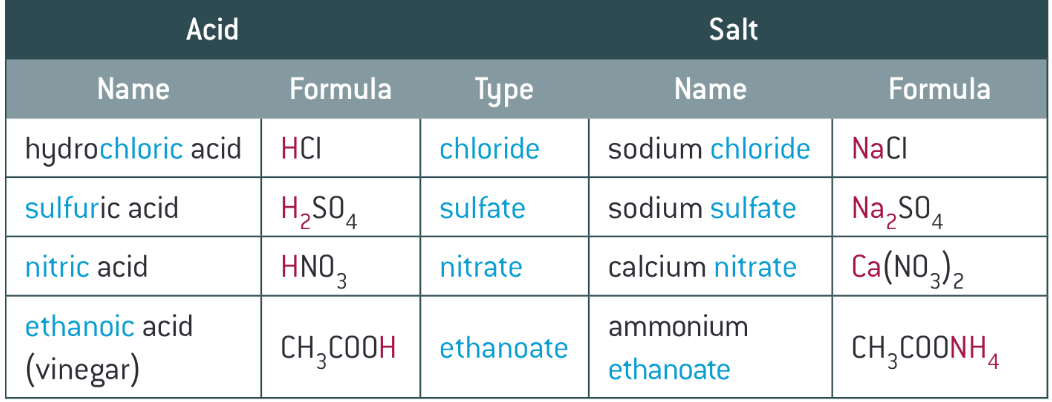
Neutralisation of acids with metal oxides/ metal hydroxides
acid+ metal oxide/ hydroxide→salt+ water
eg.

Neutralisation of acids with alkalis
acid+alkali→ salt+water
(alkali=metal hydroxide)
eg. NaOH

Neutralisation of acids with carbonates
acid+metal carbonate→salt+water+carbon dioxide
Acid- base titrations- new topic
Titrations and their uses

mean titres

Titration calculations

Redox reactions- next topic
Oxidation number
Number of electrons involved in bonding to a diff element
Based on a set of rules that apply to atoms
Helps write formula + check that all electrons have been accounted for
oxidation number- rules for elements
Oxidation number always = 0 in an element
Pure element→only bonding is to other atoms of same element
so even for H2, O2, P4, S8 the oxidation number of the element is still 0
oxidation number- rules for compounds+ions
Each atom in compound has oxidation number
Oxidation has a sign placed before the number (eg. +1)
Oxidation number is same as its ionic charge but the sign goes before (eg, Mg2+ has oxidation number of +2)
Oxidation number-Special rules
Oxygen (O) has oxidation number of -2 (except -1 in peroxides)
Hydrogen (H) is +1 (except -1 in metal hydrides)
Fluorine (F) is -1
Working out oxidation numbers
Sum of oxidation numbers= total charge
Oxidation numbers apply to each atom of an element eg. if oxidation number of Ag is +1 per atom so if there were 2Ag the oxidation number would still be +1 for Ag
What is the oxidation number of sulfur in sulfuric acid, H2SO4? (oxidation number in compounds)

What is the oxidation number of nitrogen NO3- ? (oxidation number in ions)

Roman numerals in naming
used in names of compounds of elements that form ions with diff charges
shows oxidation state/ number (not sign +/- bc its obvious from overall charge):
Iron (II)- represents Fe2+ with oxidation number +2
Iron (III)- represents Fe3+ with oxidation number +3
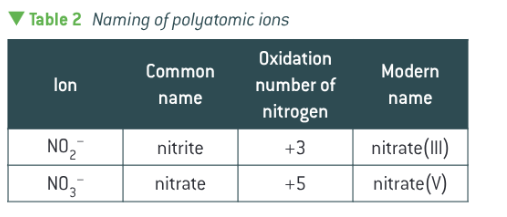
Polyatomic ions containing oxygen eg. NO2- and NO3- have old fashioned names use -ite and -ate vs modern names use oxidation numbers in roman numerals.
Usually roman numerals not used for more common ion (usually with more Oxygen):
Nitrate is assumed to be NO3-
Sulfate SO42-
REDOX REACTIONS- new section
Oxidation
Addition of oxygen
eg. CuO+H2→Cu+H2O- hydrogen has gained oxygen in this reaction so is oxidised
Reduction
removal of oxygen
eg.CuO+H2→Cu+H2O- Copper (II) Oxide has lost oxygen and been reduced
REDOX reactions
involve REDuction and OXidation
If one happens so must, other
Ox +red now also applied to reactions that don’t involve Oxygen
Reduction in terms of electrons- eg. "2Fe+3Cl2→”FeCL3
OILRIG
Oxidation
Is
Loss of electrons
Reduction
Is
Gain of electrons
eg. doesn’t involve oxygen but does involve gain+loss of electrons

Redox in terms of oxidation number-eg. Cu+2AgNO3→2Ag+Cu(NO3)2
Reduction is decrease in oxidation number
Oxidation, increase in oxidation number
Use oxidation no. rules

Redox reactions of acids
Acids can produce salts in neutralisation reactions. Dilute acids also undergo redox reactions with metals to form salt and hydrogen gas
metal+acid→salt+hydrogen
