Dynamics Exam 2
 Call Kai
 Learn
 Practice Test
 Spaced Repetition
 Match
 Flashcards
 Knowt Play
1/33

There's no tags or description
Looks like no tags are added yet.
34 Terms

Gradient Wind Balance
PGF, Coriolis, Centrifugal Balance, (ex: low pressure troughs, high pressure ridges)

Cyclostrophic Balance
PGF & Centrifugal Balance, only supports low pressure system with CW or CCW flow, R » 1 (ex: tornado)

Geostrophic Balance
PGF & Coriolis Balance, R « 1 (ex: jet stream)

Inertial Balance
Coriolis & Centrifugal Balance, R ~ 1
PGF force
due to pressure differences, always flows from high to low
Coriolis Force
due to Earth’s rotation
NH: f>0 to right of motion
SH: f<0 to left of motion
Centrifugal Force
due to the rotating flow, outward always
Rossby Number
ratio of the centrifugal force to the Coriolis force = v/fr or u/fl
subgeostrophic
the flow around a regular gradient low, when the actual wind speed v is less than the geostrophic wind speed
supergeostrophic
the flow around a gradient high, when the actual wind speed v is faster than the geostrophic wind speed
for the same pressure perturbation and radius, there are _____ winds around a gradient _____ than a gradient ____.
stronger, higher, low
for the same wind speed, a gradient low is _____ (larger pressure perturbation) than a gradient high
deeper (trough steeper than a ridge)
Gradient low pressure systems can in theory have counterclockwise or clockwise flow (in NH).
true
Gradient high pressure systems can only have clockwise flow (in NH).
true
In Northern Hemisphere…
Air flows counterclockwise around a low, clockwise around a high
surface friction
reduces wind speed and messing with balance so that flow becomes cross-isobaric (CCW and inward around a low, CW and outward around a high)
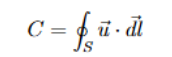
Circulation
macroscopic measure of rotation of a flow field; always CCW

Stokes Theorem
circulation is equivalent to the area integral of the vorticity normal to the surface enclosed by the path S
*For the simple case of a circular ring of fluid where |~dl| = Rdθ and the wind is in the same direction as ~dl, the circulation about the circular path is C = integral from 0 to 2π |~u|Rdθ, which, according to Stokes theorem, is equal to the average vorticity within the circle * πR² (the area enclosed by the circular path)

The (Bjerknes) Circulation Theorem
governs the evolution of circulation of the flow relative to Earth’s rotation, first term on the right hand side of the equation is the Coriolis term and the second term on the right hand side of the equation is the pressure gradient term
AE
= Asinφ, the projection of the area enclosed by the material circuit onto the equatorial plane; changes in AE are a unified interpretation of divergence and beta terms
if s and A are in xy plane
n = k
if s and A are in yz plane
n = i
if s and A are in the xz plane
n = -j

The Coriolis Term of the Bjerknes
can generate circulation through changes in area (because of divergence/convergence of flow) and through changes in latitude and thus the projection of the area of the circuit in the equatorial plane, by changing the orientation of the circuit relative to omega via meridional motion

The Pressure Gradient Term (aka baroclinic term or solenoidal term)
generates circulation if the pressure gradient force is non-uniform in space, does NOT generate circulation if atmosphere is barotropic (density is only a function of pressure)
barotropic state
surface or contours of pressure are parallel to contours of density (or temp) and that the pressure gradient is parallel to density (or temp) gradient, no vertical wind shear
∇ρ × ∇p = 0
baroclinic state
density (or temp) varies on a pressure surface
∇ρ × ∇p does not = 0

continuity equation in pressure and height coordinates

Divergence Term
coriolis deflects the flow
In NH:
Area Dec, Circ Inc —> Convergent Flow
Area Inc, Circ Dec —> Divergent Flow

Beta Term
meridional motion changes orientation of the circuit relative to Earth’s axis of rotation, changing strength of coriolis
potential vorticity
A measure of fluid particle spin that is conserved following adiabatic, frictionless flow, PV conservation can be used to understand the generation of vorticity when a column of air shrinks and stretches as it moves over topography
vertical contribution to isentropic Ertel PV

simple term of PV

incompressible fluid of PV
