Freshwater Ecology Exam 1
 Call Kai
 Learn
Learn Practice Test
 Spaced Repetition
 Match
Match Flashcards
 Knowt Play
1/73

There's no tags or description
Looks like no tags are added yet.
Name | Mastery | Learn | Test | Matching | Spaced | Call with Kai | Chat |
|---|
No analytics yet
Send a link to your students to track their progress
74 Terms
limnology
study of lakes
oceanography
study of water
lentic
standing water, lake
lotic
running/moving water. streams, rivers, spring
E.A birge and C. Judy did what
influential work on plankton at the university of Wisconsin
the river continuum concept (RCC)
attempt to describe structure and function of lotic systems from source-to-mouth using an analogous approach to hydro-geomorphical approaches
water is only one of __ inorganic substances that can exist as a liquid on the surface of the earth at an ambient temp and position , the second substance is mercury
two
total global water
97.5% salt water
2.5% freshwater
unique properties of water that make life possible include
surface tension
soluble
has high specific heat
weak hydrogen bonding between water molecules permits association of water molecules as a liquid
dynamic structure
as h2o freezes what happens
molecules stop and expand, forming a lattice like structure. this makes ice LESS dense than liquid water
with increased temp, h20 molecules:
tighter packing of molecules, leading to increased density and flowing water molecules
the hydrologic cycle
continuous cycling of water from atmosphere to earth
name the components of the hydrologic cycle
evaporation
precipitation
surface runoff
groundwater runoff
the watershed
drainage basin/containment. all water drains to the same place
determination of direction of why water flows based on ridges of the land, anything that happens in a watershed could have effects downstream
do lakes have watersheds
yes
loss of water from lakes
evaporation
evapotranspiration
direct outlet
groundwater seeping out
origins of lakes
typical product of natural disasters
not meant to be there forever
in a geologic sense; wont be able to support changing environment , will fill up with sediment through time.
shifts in tectonic activity, glaciers, etc
inland water makes up _ of earths surfacr
2%
caspian sea
largest inland body of water
lake superior is the largest lake in terms of __
area
lake baikal is the largest lake in terms of __
volume
why is light important in aquatic ecosystems?
heating
photosynthesis
vision
ultimately drives water movement
what is light?
part of the electromagnetic spectrum , photons/quanta
plants operate in the same range of __
light
when energy is it behaves as a __
propagated, wave
long wavelength + low frequency =
low energy
short wavelength + short frequency =
high energy
infrared energy is essentially heat
photosynthetically active radiation is __
400-700 nm
maxes out at violet/blue and red
plants reflect and dont absorb __ light, making it useless to photosynthesis
green
plants use diff __ to increase spectrum of light they can absorb
pigments, in this case chlorophyll
quantity and quality of light striking the surface of a lake depends on factors such as
latitude, season, time of day, elevation, meteorological conditions
reflections of light on the water surface depends on
angle of the sun
waves
average reflection is 6.5%
as light enters water, what 3 things occur
transmission: transit between anything in the water
absorption as heat
scattering by h2o solutes of suspended particles
__ penetrates the furthest down in water
UV light
humic substances(tannins) important in lake water are
decomposing plants , they reduce the potential for photosynthesis, creating a brownish lake color due to aromatic compounds
__ __ absorbs and scatters light
particulate matter
turbidity
ability to scatter light , plankton cause turbidity in water
two zones of lakes
photic zone: photosynthesis occurs here
aphotic zone: no light
heat in aquatic ecosystems
regulate chemical reactions and metabolic rate
__ __ is the greatest source of heat
light absorption
geothermal
earth itself is warmer than the surrounding air
losses of heat
thermal radiation
evaporative cooling
convection (At night)
thermocline
plane of fastest temperature change within metalimnion
What is the epilimnion
Warmest water
What is metalimnion
Transition zone
Thermocline ?
Plane of fastest temperature change within a metalimnion
Hypolimnion
Coldest water temperature
Resistance to mixing is proportional to __ differences between two water layers
Density
Wind mixes ___ waters
Shallow
As temp begins to cool, the gap in the thermocline gets smaller, eventually temp at the top is the same as the bottom and water density (is the same) mixes, what is this called?
Turnover
During fall turnover what happens
Lake mixes from top to bottom, nutrients get mixed
During winter the temp at the top of a lake is different, colder, then the temp at the bottom, this is called
Inverse stratification
During spring turnover
Lake mixes from top to bottom , same as fall
amictic stratification
Ice covered year round, mostly in Antarctica
Cold Monomictic stratification
Water temp never exceed 4* C
Only 1 period of mixing (summer) a year
Deep lakes
Arctic / mountain lakes
Warm Monomictic stratification
Circulate freely in winter
Do not freeze typically
Great Lakes
Dimictic Stratification
Circulate freely twice a year
Stratified in summer
Inversely stratified in winter
Oligomictic
Stratified year round
Only rarely cools sufficiently to circulate
Never ice covered
Polymictic Stratification
Frequent, continuous periods of mixing
Shallow lakes in temperature regions
Cold Polymictic
Circulate at night
Warm polymictic
Circulate often , tropical lakes
Holomictic lakes
Lakes discussed so far
Circulate top to bottom
Meromictic
Only partially circulate
Chemcially stratified
Divided into monimolimnion: deep isolated stratum, does not mix
Mixolimnion: stratum that periodically mixes
What effects heat in lotic systems
Ground water, run off
What is diel temperature change
Temp change over 24 h
Streams that are ground water fed tend to be ___ in the winter, making them less likely to freeze over
Warmer
If stream is too small/big the temp won’t change much, __\ change more
Average
Oligotrophic lakes often have ___ productivity
Low
Clinograde oxygen profiles are found at ___ lakes
Eutrophic (photosynthesis occurs here)
What causes the curve to the right in positive heterograde curve
Lots of plants / algae at this level, there could be phytoplankton here
Phytoplankton drop with temp to a place where they can remain bouyant
What causes the graph in negative heterograde curve?
Respiration of organic matter that is sinking into the metalimnion and stopping when it hits more dense water
Due to large numbers of zooplankton
RARE
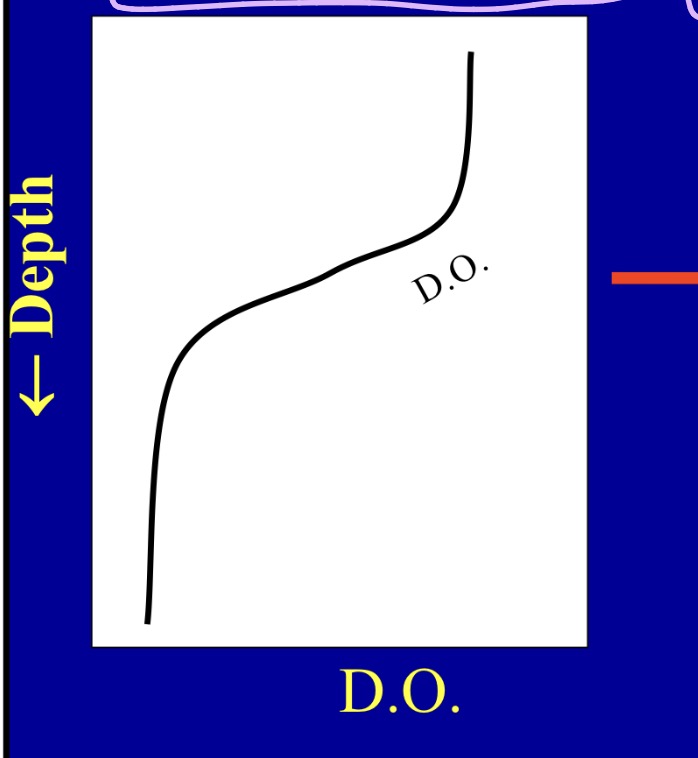
What kind of D.O curve is this?
Clinograde
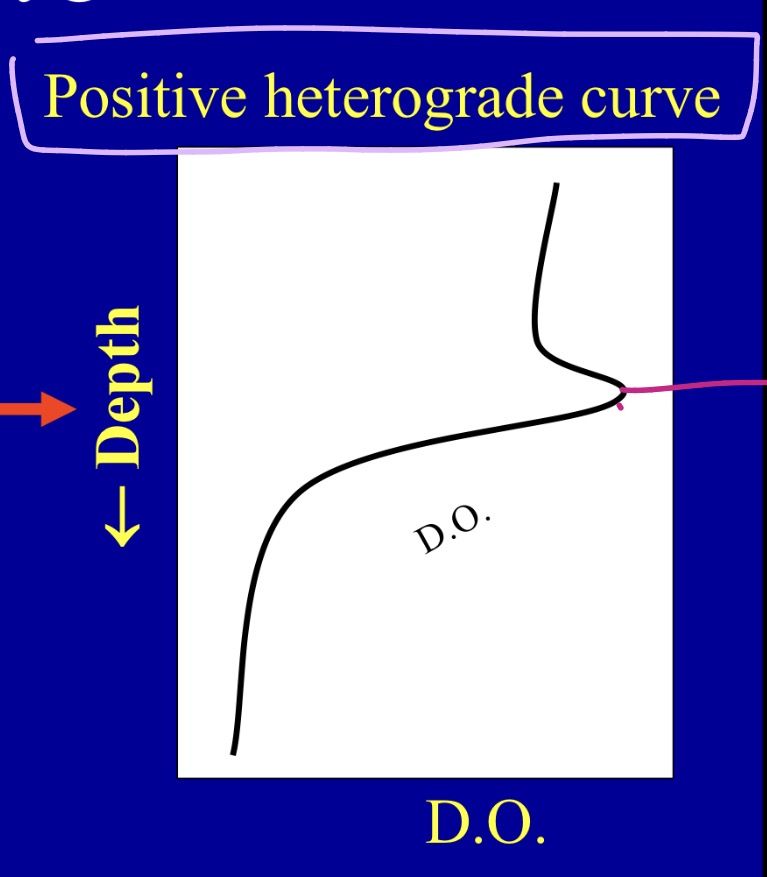
What kind of D.O curve is this?
Positive heterograde

What kind of D.O curve is this?
Negative heterograde