BIO HEAD AND NECK: SALIVARY GLANDS
 Call Kai
 Learn
 Practice Test
 Spaced Repetition
 Match
 Flashcards
 Knowt Play
1/70

There's no tags or description
Looks like no tags are added yet.
71 Terms
Salivary glands function
Exocrine tubuloacinar structures whose excretory ducts open into the oral cavity
Main function: secrete saliva
What is the function of seromucous liquid within the oral cabivity
Lubrication, digestion, physiochemical/immune defense, and taste transmission
What are the major salivary glands
Paired parotid
Submandibular
Sublingual

How many minor salivary glands are scattered throughout the oral cavity?
600
Who is the largest salivary gland among the three?
Parotid gland

Where is the parotid gland found?
Found in the preauricular area (flattened region of the ear) on each side of the face

What is the characteristic of each parotid gland?
Irregular, consisting of a superficial and deep lobe
What is the function of the parotid gland?
Produces serous saliva - watery solution rich in enzymes
What is the function of the serous saliva?
Secreted into the oral cavity to lubricate and helps breakdown food
Where is the parotid gland found superiorly, inferiorly, anteriorly, posteriorly
Superiorly: zygomatic arch (connection between the temporal and zygomatic bone)
Inferiorly: inferior border of the mandible
Anteriorly: masseter muscle
Posteriorly: external ear and sternocleidomastoid

What is the parotid gland separated into and what separates it?
Separated into superficial and deep lobes by the facial nerve (CN VII)

Where does the nerve enter and leave the parotid gland?
Enters the posterior border of the parotid gland
Leaves the stylomastoid foramen
What does the facial nerve CN VII bifurcate into when in the gland?
Bifurcates into superior (or temporofacial) and inferior (cervical facial) division
T/F the facial nerves innervate the parotid gland?
FALSE
They do not
What other structure passes through and divides within the parotid gland?
The external carotid which enters from the inferior border of the gland passing posterior to the gland

What artery supplies the parotid?
External carotid artery
What does the external carotid split into?
Two terminal branches: superficial temporal artery and the maxillary artery
What does the superficial temporal artery give off?
The transverse facial artery which runs anteriorly to the parotid duct and supplies the parotid duct, parotid gland

What artery supplies the medial portion of the parotid.
Maxillary artery
What vein passes through the parotid gland
The retromandibular vein (two branches)
Runs deep to the gland (posterior to the gland)
Provides venous outflow for the parotid

What does the retromandibular vein drain into?
External jugular vein and internal jugular vein (via facial vein)
True or false the parotid lymph nodes do not drain the parotid gland
True
What does the superficial parotid gland drain?
Superficial scalp, abode the parotid gland, auricle, lateral eyelids
Deep drainage of the external and middle ear, nose, deep nose, nasopharynx (eustachian tube)

What is the superficial cervical lymph node associated with and what does it drain?
Associated with the external jugular vein
Drain the angle of the mandible, parotid gland, and ear region

What forms the stensen duct?
Two major ducts joining together inside the parotid duct

What is the path of the stensen duct?
Passes horizontally over the masseter muscle then moves medially towards the anterior border of the muscle
Then turns to the right to cross the buccinator muscle and Buccal fat pad

Where does the stensen duct open into?
Oral cavity at the upper jaw near 2nd molar
PAROTID GLAND AND DUCT INNERVATION
What sensory nerve innervates the parotid gland and duct?
Auriculotemporal nerve (branch of Mandibular n.)
Great auricular nerve (branch of cervical plexus) (fascia tissue which covers gland)
What do these sensory nerves do?
Allows you to feel touch, pain, cold, hot
What increases saliva production?
Parasympathetic stimulation
What does the parasympathetic stimulation begin with?
Glossopharyngeal nerve (cranial nerve IX)
What does the glossopharyngeal nerve synapses with?
The optic ganglion (collection or neuron cell bodies)
What does the auriculotemporal nerve carry?
The parasympathetic fibers from the optic ganglion to the parotid gland
What inhibits saliva production?
Sympathetic stimulation
Where does sympathetic Innervation originate from?
The superior cervical ganglion which is part of the paravertebral chain
Where do the fibers of this ganglion travel along?
Travel along the external carotid artery to reach the parotid gland
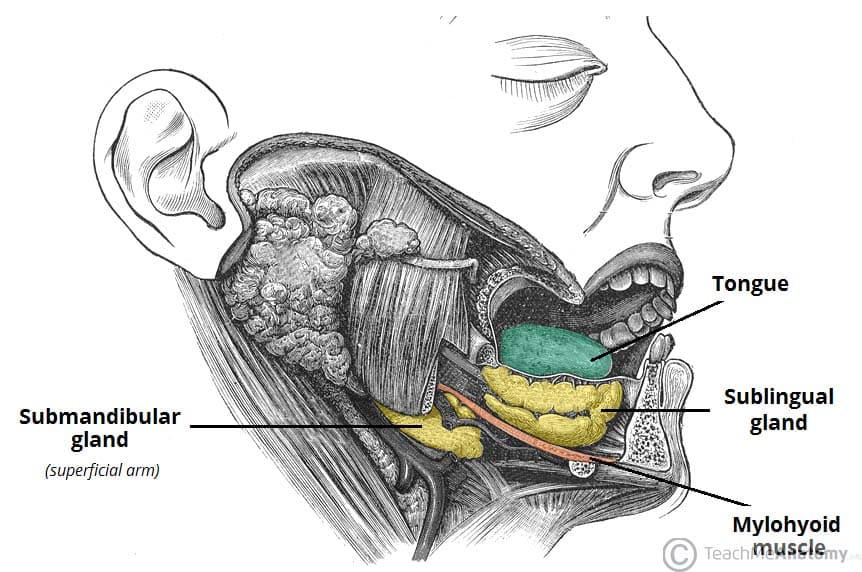
What is the submandibular gland?
The second of the three major heads of the salivary glands
Comes after the parotid and before tje sublingual gland

Where is the submandibular gland found?
Found inferior and deep to the ramus of the mandible

What sections the submandibular gland into superficial and deep parts?
The mylohyoid muscle

Where can the superficial portion of the submandibular gland be seen?
Can be seen in the submandibular triangle of the neck

Where is the deep part of the submandibular gland found.
Found deep in the floor of the oral cavity
What gland is responsible for the production of 70% of the over salivary output during mastication rest?
The submandibular gland
What duct is part of the submandibular gland?
Wharton’s duct
What does the whartons duct open to?
Opens at the side of the tongue frenulum on the oral floor (sublingual caruncle)
What does the whartons duct open into?
Opens into the side of the tongue frenulum at the oral floor (sublingual caruncle)
What does the Whartons duct open into?
Opens at the side of the tongue frenulum found at the oral flor (sublingual caruncle)

What arteries supply the submandibular gland?
The facial and lingual artery

What veins drains the submandibular gland?
The facial and lingual vein
What is the secretory mechanism innervated by for the submandibular gland?
The parasympathetic nervous system (stimulates)
The sympathetic nervous system (inhibits)
What fibers are included in the parasympathetic fibers?
The facial nerve (CN VII) fibers via the chord art pain to the submandibular gland

What does the sympathetic fibers stir from?
Stirs from the superior cervical ganglion
What does the lymph nodes of found at the submandibular gland drain?
Drain the lips, anterior nose, frontal, maxillary, and ethmoidal sinuses
Upper and lower teeth (except lower incisors), tongue, and floor of mouth
Hard and soft palate

Sublingual gland
The smallest of the three paired salivary glands and the most deeply situated in the oral cavity proper floor
Almond shaped

How much saliva does the sublingual gland contribute to for the salivary volume?
Only 3-5% of overall salivary volume, producing mixed secretions which are predominately mucous in nature
What are these secretions important for?
Lubricating food, keeping the oral mucosa moist and initial digestion
Where are the sublingual glands found?
The floor of the oral cavity proper
What does the sublingual gland form?
A shallow groove in the medial surface of the mandible known as the sublingual fossa

What are the ducts called that the sublingual gland drain into?
Ducts of Rivinus that open into the floor of the mouth

What is the largest gland of the sublingual gland?
The Bartholin duct

Bartholin duct fuses…?
Fuses with the submandibular major duct and will open into an opening known as the caruncle
What arteries supply the sublingual gland?
The sublingual and submental artery which arise form the lingual and facial arteries from the external carotid artery

Wht innervates the sublingual gland?
The same innervations of the submandibular gland
What are rate secretory mechanism, of the sublingual gland regulated by?
The parsasympathetic nervous system (stimulates) and indirectly bye the sympathetic nervous system (inhibits)
What do the parasympathetic fibers include?
Include fibers form the facial nerve (CN VII) via the chorda tympani to the sublingual gland

Where do the sympathetic fibers stir from?
The superior cervical ganglion
Key points of salivary glands
Salivary gland definition
Salivary glands are tubuloacinar exocrine glands whose ducts open into the oral cavity and secrete saliva.
Parotid gland Location, Type, Excretory duct, innervations
Location: Preauricular region
Type: Serous gland
Excretory duct: Parotid duct (of Stensen) (opens on buccal wall at the level of maxillary second molar)
Innervation: Auriculotemporal nerve, glossopharyngeal nerve
Submandibular gland Location, type, excretory duct, innervation
Location: Submandibular triangle
Type: Mixed gland
Excretory duct: Submandibular duct (of Wharton) (opens at sublingual papilla undertongue)
Innervation: Chorda tympani (CN VII)
Sublingual gland location, type, excretory duct, innervation
Location: Beneath the sublingual fold
Type: Mucous gland
Excretory duct: Major sublingual duct (of Bartholin), minor sublingual ducts (of Rivinius) (open along sublingual folds)
Innervation: Chorda tympani (CN VII)