Pterygopalatine Fossa
 Call Kai
 Learn
 Practice Test
 Spaced Repetition
 Match
 Flashcards
 Knowt Play
1/242

There's no tags or description
Looks like no tags are added yet.
243 Terms
Trigeminal ganglion -> foramen rotundum -> pterygopalatine fossa -> inferior orbital fissure -> infraorbital groove and canal -> infraorbital foramen (as the infraorbital n.)
Full course of V2 from the trigeminal ganglion to the face
Lower eyelid, side of the nose, and upper lip (inside and out)
Skin territory of the infraorbital nerve's terminal branches
Zygomaticofacial and zygomaticotemporal foramina
Through which small foramina does the zygomatic nerve reach the skin?
From the infraorbital nerve, in the infraorbital groove/canal
Where do the middle and anterior superior alveolar nerves branch off?
The interconnection of the anterior, middle, and posterior superior alveolar nerves
What is the superior dental plexus?
Maxillary molars (2nd and 3rd, part of the 1st), their buccal gingiva, and the maxillary sinus lining
Region numbed by a posterior superior alveolar (PSA) block
The middle superior alveolar nerve supplies the other half (mesiobuccal part)
Why does a PSA block only partly numb the maxillary first molar?
Premolars and the mesiobuccal part of the first molar
Region numbed by a middle superior alveolar (MSA) block
Incisors, canines, and premolars
Region numbed by an anterior/middle superior alveolar block
Anterior and middle superior alveolar territories plus the skin of the lower eyelid, side of the nose, and upper lip
Region numbed by an infraorbital nerve block
Anterior hard palate, lingual to the incisors and canines
Region numbed by a nasopalatine block
Posterior hard palate, lingual to the premolars and molars (often the soft palate too, via the lesser palatine n.)
Region numbed by a greater palatine block
Puncturing the pterygoid venous plexus, causing rapid facial swelling (hematoma)
Main complication risk of a PSA block
Gland secretion (nasal, palatal, pharyngeal glands) and lacrimation
Function of the parasympathetic fibers through the PPG
Vasomotor control of blood vessels (and sweat glands)
Function of the sympathetic fibers through the PPG
Posterior superior lateral nasal branches and nasopalatine n. (nasal mucosa), greater and lesser palatine nn. (palate), pharyngeal n. (nasopharynx)
Which V2 branches carry autonomic fibers to the nasal and palatal glands?
No; they follow the same route (zygomatic -> zygomaticotemporal -> communicating branch -> lacrimal n.)
Do sympathetic fibers to the lacrimal gland take a different route than parasympathetics?
Parts 1 and 2 in the infratemporal fossa; part 3 (pterygopalatine part) in the pterygopalatine fossa
Where are the 3 parts of the maxillary artery located?
External carotid artery
The maxillary artery is a terminal branch of the:
Through the pterygomaxillary fissure
How does the 3rd part of the maxillary artery enter the pterygopalatine fossa?
Anterior and middle superior alveolar branches
Which branch of the infraorbital artery supplies the anterior maxillary teeth?
Sphenopalatine artery (enters the nasal cavity via the sphenopalatine foramen)
What is the terminal branch of the maxillary artery?
Greater and lesser palatine arteries
What does the descending palatine artery give rise to?
The nasopharynx, via the pharyngeal canal
What does the pharyngeal artery supply, and how does it get there?
It links the external and internal carotid circulations
Why is the infraorbital-ophthalmic anastomosis important?
Kiesselbach's plexus on the anterior nasal septum
What is the most common site of nosebleeds?
Sphenopalatine artery
Main source of posterior epistaxis
The arteries are deep, making them difficult to reach during maxillary surgery or trauma
Why is bleeding from pterygopalatine fossa arteries hard to control?
Into the pterygoid venous plexus
Where does the pterygopalatine fossa drain venously?
Through the valveless pterygoid venous plexus
How can an infection in the pterygopalatine fossa reach the cavernous sinus?
Cancer traveling along nerve branches (e.g., V2) back toward the skull base
What is perineural spread?
V2 branches radiate from and converge on the fossa, then V2 runs through the foramen rotundum to the middle cranial fossa
Why is the pterygopalatine fossa a key route for perineural spread?
Foramen rotundum (along V2) and the pterygoid canal
Through which opening can cancer spread from the PPF to the middle cranial fossa?
Infection from the maxillary teeth spreading into the maxillary sinus, which can reach the PPF and neighboring regions
Odontogenic maxillary sinusitis
Pterygomaxillary fissure -> ITF; foramen rotundum -> middle cranial fossa; inferior orbital fissure -> orbit; sphenopalatine foramen -> nasal cavity; palatine canal -> palate; pharyngeal canal -> nasopharynx; pterygoid canal -> skull base
Spread routes from the PPF (opening -> region)
- Maxillary nerve blocks
- Panoramic radiograph interpretation
- Bleeding complications
- Facial trauma
- Odontogenic maxillary sinusitis
- Maxillary surgery
Why study the nasal cavity and PFF?
Pyramidal space medial to the infratemporal fossae between the sphenoid, maxilla, and palatine bone
- Posterior to the maxillary sinus
- Posteroinferior to the orbit
What is the pterygopalatine fossae?
- Maxillary artery (3d part or pterygopalatine part)
- Maxillary nerve (V2, 2nd division of the trigeminal)
- Pterygopalatine ganglion-associated autonomic nerves
The pterygopalatine fossa is the major distribution site for:
Major somatic sensory nerve for:
- Face
- Nasal cavity and nasopharynx
- Maxillary sinuses
- Meninges (dura)
- Oral cavity: maxillary teeth, hard and soft palate, gingiva
What does CN V2 do?
Greater petrosal n (from CN VII)
What parasympathetic autonomics are associated with the pterygopalatine ganglion?
Deep petrosal n (from internal carotid plexus)
What sympathetic autonomics are associated with the pterygopalatine ganglion?
pterygomaxillary fissure
what structure leads to the pterygopalatine fossa?
pterygopalatine fossa
traveling medially from the pterygomaxillary fissure will place you in the:
inferior
The pterygopalatine fossa is ________to the apex of the orbit.
lateral
The pterygopalatine fossa is ________ to the sphenopalatine foramen
foramen rotundum
pterygoid canal
pharyngeal canal
what 3 foramen are located on the posterior wall of the pterygopalatine fossa?
sphenopalatine foramen
if you move a probe medially in the pterygopalatine fossa to get to the nasal cavity, you must go through the:
Pterygoid process of the sphenoid
the posterior boundary of the pterygopalatine fossa is the:
Posterior border of the maxilla
the anterior boundary of the pterygopalatine fossa is the:
Perpendicular plate of the palatine
the medial boundary of the pterygopalatine fossa is the:
Part of the greater wing of the sphenoid
the superior boundary of the pterygopalatine fossa is the:
pterygomaxillary fissure, open to the infratemporal fossa
the lateral boundary of the pterygopalatine fossa is the:
Pyramidal process of the palatine
the inferior boundary of the pterygopalatine fossa is the:
pterygopalatine canal
the floor of the pterygopalatine fossa is the:
maxilla
the anterior wall of the pterygopalatine fossa is formed by the:
maxilla
sphenoid
palatine
what 3 bones make up the pterygopalatine fossa
sphenoid bone
the posterior wall and roof of the pterygopalatine fossa is formed by what bone?
- 3rd part of maxillary a.
- Maxillary nerve (V2)
- Pterygopalatine ganglion
What three main contents are in the pterygopalatine fossa?
pterygomaxillary fissure
inferior orbital fissure
name the 2 fissures associated with the pterygopalatine fossa:
foramen rotundum
sphenopalatine foramen
name the 2 foramen associated with the pterygopalatine fossa:
vidian canal/ pterygoid canal
pterygopalatine canal
pharyngeal canal
name the 3 canals associated with the pterygopalatine fossa:
inferior orbital fissure
what hole is located anterior and superior on the maxilla bone in the pterygopalatine fossa?
orbit
a probe from the pterygopalatine fossa through the infraorbital fissure, you would arrive in the:
inferior orbital fissure
if you wanted to go from the orbit to the pterygopalatine fossa, you'd take the
sphenopalatine foramen
what hole is located superiorly on the palatine bone?
nasal cavity
a probe from the pterygopalatine fossa through the sphenopalatine foramen, you would arrive in the:
sphenopalatine foramen
if you wanted to go from the nasal cavity to the pterygopalatine fossa, you'd take the
middle cranial fossa
a probe from the pterygopalatine fossa through the foramen rotundum, you would arrive in the:
foramen rotundum
what hole is located superiorly on the sphenoid bone?
foramen rotundum
if you wanted to go from the middle cranial fossa to the pterygopalatine fossa, you'd take the
nasopharynx
a probe from the pterygopalatine fossa through the pharyngeal canal, you would arrive in the:
pharyngeal canal
if you wanted to go from the nasopharynx to the pterygopalatine fossa, you'd take the
foramen lacerum in the middle cranial fossa
a probe from the pterygopalatine fossa through the vidian canal/ pterygoid canal, you would arrive in the:
vidian canal/ pterygoid canal
if you wanted to go from the foramen lacerum to the pterygopalatine fossa, you'd take the
oral cavity
a probe from the pterygopalatine fossa through the pterygopalatine canal, you would arrive in the:
pterygopalatine canal
if you wanted to go from the oral cavity to the pterygopalatine fossa, you'd take the
Palatine canal
If you wanted to go to the palate from the pterygopalatine fossa, you'd take the
Pterygomaxillary fissure
If you wanted to go to the infratemporal fossa from the pterygopalatine fossa, you'd take the
Zygomatic n.
Infraorbital n.
Infraorbital vv.
What are the nerves and vessels that travel through the infra-orbital fissure?
3rd part of maxillary artery
Posterior superior alveolar nn.

What are the nerves and vessels that travel through the pterygomaxillary fissure?
Opening for posterior superior alveolar n.
Identify the structure at the arrow

Sphenopalatine a.
Nasopalatine n.
Posterior superior lateral nasal n.
What are the nerves and vessels that travel through the sphenopalatine foramen?
Descending palatine artery
Greater palatine n.
Lesser palatine n.
What are the nerves and vessels that travel through the palatine canal?
Pharyngeal n.
Pharyngeal a.
What are the nerves and vessels that travel through the pharyngeal canal?
N. of the pterygoid canal (greater petrosal n. and deep petrosal n.)
A. of the pterygoid canal
What are the nerves and vessels that travel through the pterygoid canal?
Greater petrosal n. (parasympathetic)
Deep petrosal n. (sympathetic)
What nerves make up the nerve of the pterygoid canal (vidian n.)?
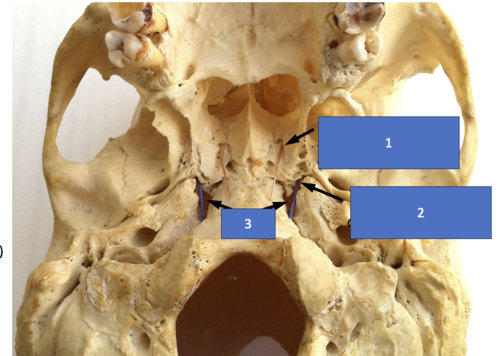
Pharyngeal canal (aka palatovaginal canal)
Identify the structure at #1

Pterygoid (vidian) canal
Identify the structure at #2

Foramen lacerum
Identify the structure at #3
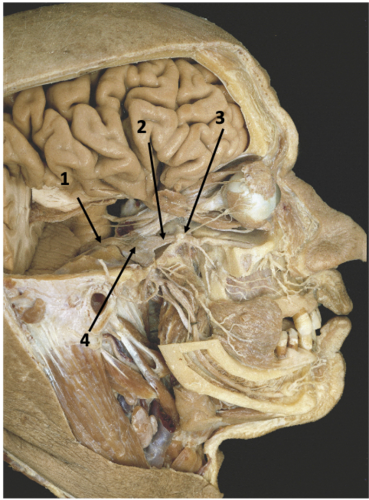
CN V
Identify the structure at #1

V2
Identify the structure at #2

Foramen rotundum
Identify the structure at #3
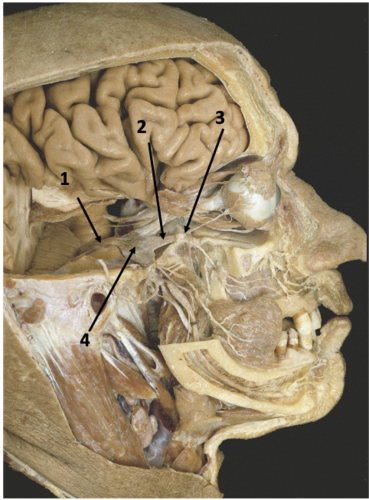
Trigeminal ganglion
Identify the structure at #4
Pterygomaxillary fissure
Identify the structure at #1

Sphenopalatine foramen
Identify the structure at #2
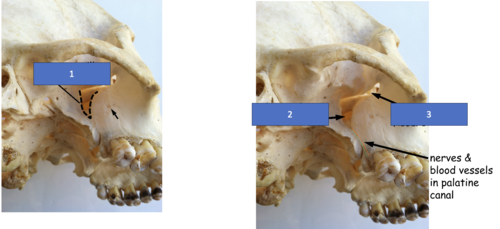
Inferior orbital fissure
Identify the structure at #3

Infraorbital foramen
the infraorbital nerve (ION) passes through the inferior orbital fissure, travels through the infraorbital groove and exits onto the face through the...
True - there are NO somatic motor fibers
T/F: V2 is entirely somatic sensory
Dura
Lacrimal gland
Face
Maxillary teeth/sinus
Nasal cavity
Palate
Pharynx
What are the targets of V2?
Face > Orbit > Pterygopalatine fossa > Middle cranial fossa > Trigeminal ganglion
What spaces does V2 travel from the face to the trigeminal ganglion?