Management - Accounting
 Call Kai
 Learn
Learn Practice Test
 Spaced Repetition
 Match
Match Flashcards
 Knowt Play
1/158

Earn XP
Description and Tags
Sem 1 - 1st Partial
Name | Mastery | Learn | Test | Matching | Spaced | Call with Kai | Chat |
|---|
No analytics yet
Send a link to your students to track their progress
159 Terms
Define institutional equilibrium
Sustainable relationship between the organization and its core stakeholders: they remain willing to participate
What are the two conditions of an institutional equilibrium
All core stakeholders share the values, objectives, governance and organization of the firm
All core stakeholders recieve rewards and benefits which are considered fair given the contributions provided
Organizations (esp. corporations) are often characterized by:
Transferability
Participants or ownership interests can change while the organization continues
Autonomous existence
The organization has its own identity and decision-making structure
Durability
The organization can exist for a prolonged period
To remain autonomous and exist over time, organizations need __
To remain autonomous and exist over time, organizations need economic sustainability
What are the four dimensions of economic sustainability?
Profitability: Does the firm generate enough income to cover costs over time
Solvency: Can the firm make payments when they are due — debt generates financial charges and increases corporate risk
Efficiency: How well does the firm turn resources into outputs
Fairness of remuneration of input: does the business earn enough to compensate contributors adequately?
Define profitability
A firm’s ability to cover negative components (including loan and equity capital) with positive components of income at market conditions without systematically getting support from third parties
Define solvency
The firm’s ability to cover debt at any given moment
Draw a diagram showing how the: profit and loss account, balance sheet, and cash-flow statement relate to: profitability and solvency

Define a balance sheet
A snapshot of the assets used by the company and the funds that are related to these assets at an instant in time
Define the profit and loss account
Measures the gains or losses from both normal and abnormal operations over a period.
Define a cash flow statement
A report of the inflows and outflows of cash. It links the most significant elements of B/S and income statement.
What are the 5 boxes of the balance sheet?

Define inventories
Goods and raw materials held for purpose of resale such as ingredients for a food manufacturer
Define account receivable
Amount due from customers within a year (trade credit)
when customers purchase goods or services on credit
Define cash and equivalents
Liquidity means available to the firm
Define miscellaneous
Other readily payable credits such as pre-paid taxes
e.g. a business pays €1000 in taxes but only owes €800, it has €200 of prepaid tax. It can get that money back or use it to reduce a future tax payment. That makes it an asset
Define issued common stock
Ordinary shares the company has given investors in exchange for investment
Define capital reserves
Equity from sources other than normal business profits
e.g. re-evaluation of assets such as buildings or investors paying ‘share premium’s
Define revenue reserves
Accumulated profits that the company keeps instead of distributing them to shareholders as dividends (trading profits), often used to finance firm growth
How is the value of issued common stock calculated
Number of shares issued x their face value, or par value (official value, not market price)
How are capital reserves calculated
Amounts recorded from capital transactions or adjustments, such as money paid above face value
How are revenue reserves calculated
Profits kept over the years, after losses and payments to shareholders
Define long term loans
Debts that shall be paid within 2-5 years (medium-term) or even more than 20 years (long-term) such as issued bonds and mortgage loans
What are corporate bonds?
Loans investors give to a company. The company promises to pay interest and repay the borrowed money on an agreed date
What are mortgage loans?
Loans secured by property, such as land or a building. The borrower repays the loan plus interest over time. If they fail to repay, the lender can take and sell the property to recover the money
Define short term loans
Debts towards financial institutions or other entities (debt-holders) which are due within one year, such as bonds to be paid within 12 months.
Define accounts payable
Amount due to suppliers within one year
Define miscellaneous
Other debts that should be paid within one year such as current taxes and due dividends
How do we calculate total assets
Fixed assets + current assets = total assets
the whole ‘assets’ side of the table
How do we calculate capital employed
Total assets - current liabilities = capital employed
(or Owner’s funds + long-term loans )
How do we calculate working capital
current assets - current liabilities
(also owners’ funds + long term loans - fixed assets)
Define working capital
Indicates the companys’ short-term financial cushion/operating liquidity for its day-to-day operations
What is the purpose of the profit and loss (P&L)?
A profit and loss account shows whether a business made a profit or a loss over a period, such as a year
What does the p&l account do?
compares the business’s revenue with its expenses
revenue - expenses = profit or loss
We define Profit And Loss as:
Gains or losses from both normal and abnormal company operations over a period
What are normal operations?
The company’s usual business activities.
For a bakery, selling bread generates revenue, while rent is an expense.
What are abnormal operations or events?
Unusual operations/events or outside the company’s main business.
For example, a bakery may make a gain by selling an old delivery van for more than its recorded accounting value
What are revenues
Mainly refer to the value of a company’s sales of goods and services to its customers
Define operating costs
The expenses a company incurs in running its regular business activities
Define overhead costs
The indirect costs of running a business - costs that cannot easily be traced to a specific product or service
What does EBITDA stand for
Earnings before interests, taxes, depreciations, amortizations
What is EBITDA
It represents the cash that is thrown off from the normal trading activities of the business
What is a good thing of EBITDA
It’s largely free from distortions that can arise from accounting policies
What basic job do depreciation and amortization do?
Spread an asset’s cost over the years it is used, instead of recording the whole cost as an expense immediately.
What is depreciation used for?
Tangible assets - physical things
What is amortization used for?
Intangible assets - nonphysical rights or resources
What does EBIT stand for
Earnings before Interests and Taxes
What is EBIT
It is largely the operating or trading profit of the business - It captures the total operating income and total operating cost of the business
Why is EBIT significant
It is from EBIT that a company generates resources to pay interest to bankers, tax to the government, dividends to shareholders
What is interest expense
Interest expense is the cost a firm incurs on borrowed funds, such as bank loans and bonds. It excludes returns paid to shareholders, such as dividends.
How do we calculate net interest expense and net interest income
Net interest expense = Interest expense - Interest income
Net interest income = Interest income - Interest expense
What is pre-tax income
Earnings before payment of taxes
What are income taxes
The amount a company records as an expense to reflect the income taxes it expects to owe on its profits for the period
How is net income used
This is the bottom line, which is the most commonly used indicator of a company’s profitability
It is used to give an idea of the general wealth of the company
Define dividends
Dividends are distributions of a company’s earnings to shareholders, usually paid in cash
Define retained earnings
The percentage of net earnings not paid out as dividends, but retained by the company to be reinvested in its core business or to pay debt
Define EPS
Earnings Per Share
It tells us the profit that shareholders get for each share held (the higher the better)
How do we calculate EPS
Earnings per share
Net income (EAT)
— — — — — —
No of stocks
What is a downside of EPS
Not comparable across companies (firms may have few/many shares of low/large value)
What is the P/E
Price to earnings ratio
Reflects the number of years of earnings to pay back the purchase price
How do we calculate Price to earnings ratio
Share price
— — — —-
Earning per share
What does a high P/E mean
The investors are paying more for each share of current net income
the market loves the company
it also may:
Make hostile takeovers more expensive, potentially discouraging bidders
Help the company finance acquisitions by offering its own shares as payments
What does a today share price of 50€ and an earnings per share of €5 mean?
P/E = 50/5 = 10
10 years of earnings to pay back todays share price
P/E is __ across companies
P/E is comparable across companies
What does MtB reflect?
Market to book ratio
How the market values a company’s equity compared with its accounting value. It reflects expectations of future profitability and growth, as well as value not fully captured on the balance sheet
How do we calculate MtB
Market capitalisation = Total market value of company’s outstanding shares
— — — —
Owners’ funds = Book value of equity (assets - liabilities)
What does MtB > 1 mean
Market value exceeds book equity
Investors may expect strong future profits
What does MtB < 1 mean
Market value is below book equity
This may reflect weak profit expectations, financial difficulties, concerns about asset values
What is DPS
Dividend per share
Like EPS, but with dividends in place of net income
It determines the dividend earned by each shareholder.
How do we calculate DPS
Dividends paid
— —- —- —- —
Number of stocks
What is the payout ratio
The fraction of earnings that is paid out to shareholders
How do we calculate the payout ratio
Dividends paid
— — — — —
Net income (EAT)
Name the 4 profitability ratios
ROTA
ROS
Asset turnover
ROE
Write out the calculations of the 4 profitability ratios

Write out the calculations of the 2 financial strength ratios

Write out the calculations of the 3 liquidity ratios
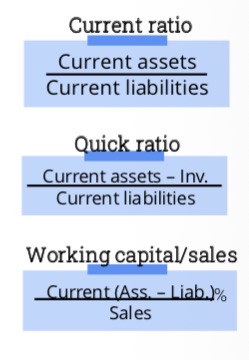
What are the three types of financial ratios
Profitability ratios
Financial strength ratios
Liquidity ratios
Define profitability ratios
Profitability ratios measure the capacity to preserve the income equilibrium in the future
Define financial strength ratios
Financial strength ratios measure the capacity to preserve the income equilibrium in the future
Define liquidity ratios
Liquidity ratios measure (short/long-term solvency) i.e. the capacity for the company to pay bills as they arrive
What are the two types of analysis approaches for these ratios
Time series: over time within the same firm
Cross-sectional: At one point in time, across firms
How do we calculate ROTA
Return on Total Assets
EBIT
——————-
Total Assets
(earnings before interests and taxes) / (current assets + fixed assets)
How do we caclulate EBIT
Revenues - operating costs - amortizations - depreciations
What does ROTA measure
The rate of return a company generates on its total assets
Measures how well management uses its assets to generate an operating surplus
What are 3 problems with ROTA
Hides product differences: Shared assets/cost can make individual product contributions hard to isolate
Affected by sales volume: ROTA can rise or fall with demand even without changes in operational efficiency
Depends on asset valuations: Asset age and depreciation affect ROTA: older assets can make returns appear higher
When are ROTA comparisons most meaningful and what might an above-average ROTA indicate?
Most meaningful between companies in the same industry
ROTA above the industry average may indicate a competitive advantage
Into what calculation can ROTA be ‘decomposed’
ROS x Asset Turnover
What does ROS measure
ROS measures operating profit as a percentage of sales, also called the operating profit margin
How do we calculate ROS
EBIT / Total Sales
What may increases in ROS over time reflect?
Higher prices
A more profitable product mix
Better cost control
What does a ROS of 10% mean
The company earns $0.10 in operating profit per $1 of sales
What does asset turnover measure
Sales generated per dollar of assets
How do we calculate asset turnover
Total sales / Total assets
What does an asset turnover of 2 mean
$2 of annual sales for every $1 of assets
What can high asset turnover compensate for?
High asset turnover can compensate for low profit margins
What values are included in total assets on a balance sheet?
idk if this is the full list of values
Fixed assets
Inventories
Accounts receivable
Cash
What does ROE measure
Return on equity
Measures the absolute return delivered to shareholders
How do we calculate ROE
Net income / Owners’ funds
What does a good ROE enable
Makes it easy to attract new funds and enables the company to grow
Why should ROE be high
It should be high enough to compensate shareholders for the specific risk of investing in the company. Riskier companies should earn higher ROE to convince shareholders to invest