Maths need to know - Owen Shepherd
 Call Kai
 Learn
 Practice Test
 Spaced Repetition
 Match
 Flashcards
 Knowt Play
1/116

There's no tags or description
Looks like no tags are added yet.
117 Terms
Role of a in quadratic
Control the width and direction of quadratic
Higher = steeper
Role of b in a quadratic
Control the axis of symmetry
Where it is reflected
Role of c
Y intercept
Sampling methods
Census, Sampling
Census sampling sampling methods
Simple random sampling, systematic, stratified, quota
Sample sampling methods
Opportunity (Convenience sampling)
Simple random sampling
Every person allocated a number (1-n), random numbers selected, Draw numbers until sample size is met
Simple random sampling pros and cons
Pros: Not biased - random spread
Cons: Time consuming, whole population needed, difficult to set up and manage
Systematic sampling
The whole population is sampled at regualr intervals,
Number 1-n, select every 5th number etc, until sample size is met
Systematic sampling pros and cons
Pros: Easy to set up, likely to be unbiased
Cons: Whole population needed, if the sleection interval coincide with a pattern it is biased
Stratified sampling
Population divided into groups of similar characteristic, same proportion taken from each group
Groups are called strata
Group data, split into groups, fine relevant number from each group for sample size
Stratified sampling pros and cons
Pros: If categories are mutually exclusive gives a good representation, useful when results differ
Cons: The process to select who to select and in what proportion can be difficult and inefficient
Cluster sampling
Population divide into distinct groups, randomly select a group of people to sample
Cluster sampling
Pros: Can be easy, More practical
Cons: Risk of bias in the group, could be less representative
Opportunity / convenience sampling
Sample chosen from a section of the population mose convenient for the sampler
e.g. the first people they see
Opportunity / convenience sampling pros and cons
Pros: Data gathered easily and quickly
Cons: There is no method to remove bias, could be not representative
Quota sampling
Sampler is given a quota of data from each group of x they need to collect
e.g. 3 male and 2 female
Quota sampling pros and cons:
Pros: It is easy for the interviewer, access select groups
Cons: Can be biased, groups excluded
Volunteer sampling
People choose to be part of the sample
Volunteer sampling pros and cons
Pros: Little time and effort, encourage engagement
Cons: Can be a lot of bias, people volunteer with strong oppinions
Linear function form
Y = mx + c
M = gradient
C = intercept
Straight line, of gradient m passing through point (a,b) is?
Y - b = m(x - a)
Same gradient means
Parallel lines
Perpendicular if
Gradients multiply to -1
Midpoint equation?
(X1 + X2)/2 + (Y1 + Y2)/2
Perpendicular bisector is?
The line that passed perpendicularly thought the line of AB, at the Midpoint of AB
X axis is when
Y = 0
Y axis when
X = 0
Translated quadratic form
Y = (x - a)² + b
By vector (a/b)
How to find vertex of quadratic
Complete the square
Discriminant
b² - 4ac
Discriminant greater than 0
2 real roots
Discriminant = 0
One real root
Discriminant < 0
No roots
Quadratic equation 3 ways to solve
Factorise
Complete the square
Quadratic Formula
Surd rules
root a x root b = root ab
Square numbers cancel out into multiples
Rationalise the denominator by times by 1 = surd / surd
Rationalise denominator when sued in form (root a) - b
Times by (root a) + b
ab x ac =
ab + c
ab / ac =
ab - c
(ab)c =
abc
a-b =
1/ab
a1/b =
root b a
a0 =
1
loga(b) + loga(c) =
loga(bc)
loga(b) - loga(c) =
loga(b/c)
c x loga(b) =
loga(bc)
loga(a) =
1
loga(1) =
0
(-(x))² =
x²
Two pairs of equal roots means?
Solve the hidden quadratic
Use Discriminant for 1 root
Then, that root is the root for the + value
Other root is the negative of the value
ax x bx =
(ab)x
How to divide / multiply polynomials with other polynomials?
Grid method
Factor theorem
If factor = (x-a)
Then f(a) = 0
Factor theorem 2
(ax - b)
f(b/a) = 0
If polynomial factored in to three brackets does it have three roots
Can but not always
What is it known as if = (x-3)(x-2)(x-2)
Repeated real root of x = 2
Describe: f(x-a) + b
Translation by vector (a b)
Describe: f(kx)
Stretched parallel to the x axis by Scale Factor 1/k
Describe: kf(x)
Stretched parallel to the y axis by Scale Factor k
Describe: f(-x)
Reflection in the y axis
Describe: -f(x)
Reflection in the x axis
Circle equation
(x-a)2 + (y-b)2 = r2
compare how a line intersects a circle?
line in form y = mx + c
Substitute into circle equation
Solve out to form quadratic = ax2 + bx + c
Use the discriminant
Three Circle theorems to know
Tangent and radius at 90
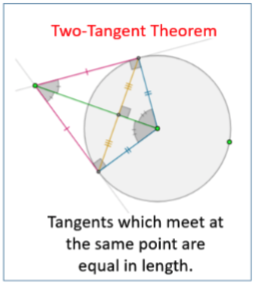
Two tangents that meet at same point are equal in length - makes kite - see image
Three points, with a 90 degree angle are three points on the circumference of a circle - with long edge being diameter
Tangent and raidus at 90 degrees
Perpendicular
Visualise the two tangents at one point being same length - image other side
Same length
Three points on a circle which make a 90 degree triangle are
Three points on a circumference of a circle

If given three co ord points - how work out if on a circle?
Compare all of the lines between the points
Gradients product = -1 = circle
where the hypothesis is the diameter
Two types of reduction to linear form
Y = ax^b
Y = ab^x
Leads to difference of?
Whether the graph is plotted logy logx
Or logy x
What happens if multiply an inequality by a negative?
The sign flips!!!
Process to solve quadratic inequalities
Solve the quadratic for roots
Compare roots to shape of quadratic
Determine outcome for inequality
How to solve for k within a quadratic inequality?
Use the Discriminant!
Real roots etc will be mentioned
How to solve an exponential inequality?
ln of both sides
NEVER log of one side over to the other
X² +- 2xy + y² =
(X +- y)²
To find tangent of function
Calc gradient function
Calc x co ord
Put it into line equation to form tangent
-1 / gradient = gradient of normal
Use second differential to?
Determine type of stationary point
Second derivative <,>,=0 means?
Less than means decreasing so local maximum where going down
Greater than means local minimum as trending up
0 means potential point of inflection, but trend = 0
Potential Point of inflection
The point where the second derivative = 0
Now need to compare the gradient before and after
If gradient, first derivative, before and after = same
E.g. positive to positive or negative to negative
Then it is a point of inflection
Trend has not change, but second did reduce to 0
Concavity has changed, as second pass through 0
If before and after the potential POI gradient, first derivative, is different?
Local maxima / minima
Trend has changed to go up / down
So it has reached a max or min, stationary point, with second also at 0, but not a POI
As trend is not continued
What happens at a POI
Concavity changes
Maximum rate of change of the original graph
First derivative is at a maximum or a minimum
How to determine if concave or convex?
Pilot graph and look from below
Convex second < 0
Concave second derivative > 0
Process to follow to diagnose a point:
On wall
Diff between p(A u B) and p(A n B)
u is all overlapped so whole of both
n is intersection, where they overlap
Independent if
One doesn’t affect the other
P(A) X p(B) = P(A n B)
Mutually exclusive if
Can’t happen at same time
P(A n B) = 0
Grouped data
Data within one set which has clear distinct groups
How to ESTIMATE mean / median of groups
Midpoint of the values in the group
Modal group
Group with the largest frequency
Outliers how to classify
More than 2 SD from mean
More than 1.5 IQR from median
The WHOLE IQR, not half
Everything you need for anything binomial is in?
Formulae booklet
What does a discrete random variable sum to
sumP = 1
Conditions for a binomial distribution
All trials must be independent of each other
Probability must remain constant
There are only two outcomes
Steps in a binomial hypothesis test
Define x
Define H0
Define H1
Assume H0 is true
Define binomial expression
Test
Take critical value and compare to significance level
If significant = reject
If not significant = fail to reject
Then provide a concluding statement = there is insufficient evidence to suggest …….
Calculating the critical region
Set up the binomial distribution
Calculate the values that are WITHIN the critical region
First value to be inside it and onwards
Integration is
The reverse of differentiation
integrating and indefinite
DO NOT FORGET TO ADD C
How to integrate
Add 1 to the power
Divide that term by the new value of the power
Definite vs indefinite
Defensive to calculate area under x
Don’t need c