Quiz 5 + everything so fourth-- conceptual
 Call Kai
 Learn
 Practice Test
 Spaced Repetition
 Match
 Flashcards
 Knowt Play
1/25

There's no tags or description
Looks like no tags are added yet.
26 Terms
How does the lecture distinguish sex from gender, and why can sex-related traits overlap?
The lecture treats sex as a biological classification and gender as a separate concept.
Primatologists may classify sex using anatomy, genetics, hormones, or a combination.
Two gamete types can coexist with variation and overlap in other traits.
Hughes adds that human expectations about gender can shape how we interpret animal behavior.

What do the orangutan box plots show about body-size variation within and between the sexes?
Flanged adult males are generally the largest.
Adult and young adult unflanged males differ from flanged males, and some of their measurements overlap with adult females.
The categories describe female and male body-size variation, including different male developmental forms.
My note about “three genders” was picking up on those different male forms.
Why can mating be seasonal, and how does seasonality affect competition for mates?
Seasonal food availability and predation risk can favor breeding at times that improve offspring survival.
A short mating season can concentrate competition, but monopolization depends on how much female fertile windows overlap.
A short season can still contain several females becoming fertile in sequence.
Why does male dominance rank predict reproductive success in some groups more strongly than in others?
High rank can help males gain access to fertile females and exclude rivals.
But subordinates can mate out of sight, females can favor other males, and several females can be fertile at once.
A formerly dominant male may also retain traits that females favor.
Use genetic paternity to test whether the rank advantage translates into offspring.
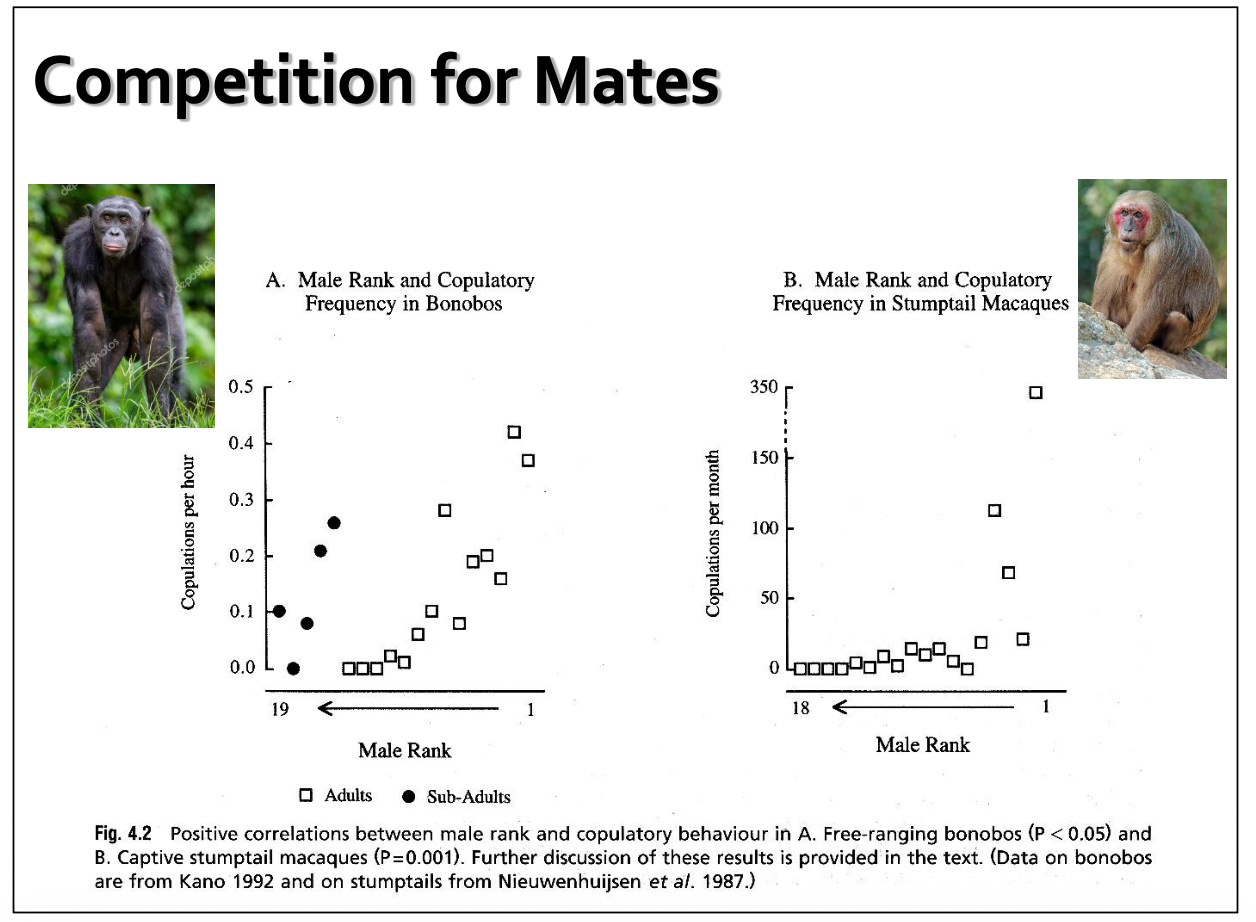
How do the bonobo and stumptail macaque rank graphs differ?
Rank 1 is the highest rank and appears on the right in both panels.
Higher-ranking males generally copulated more in both studies, but bonobo copulations were more spread across ranks.
A few top-ranking stumptail macaques accounted for a much sharper peak.
So Basically: The bonobos trend is more linear, and the macaques are more exponential in a way.
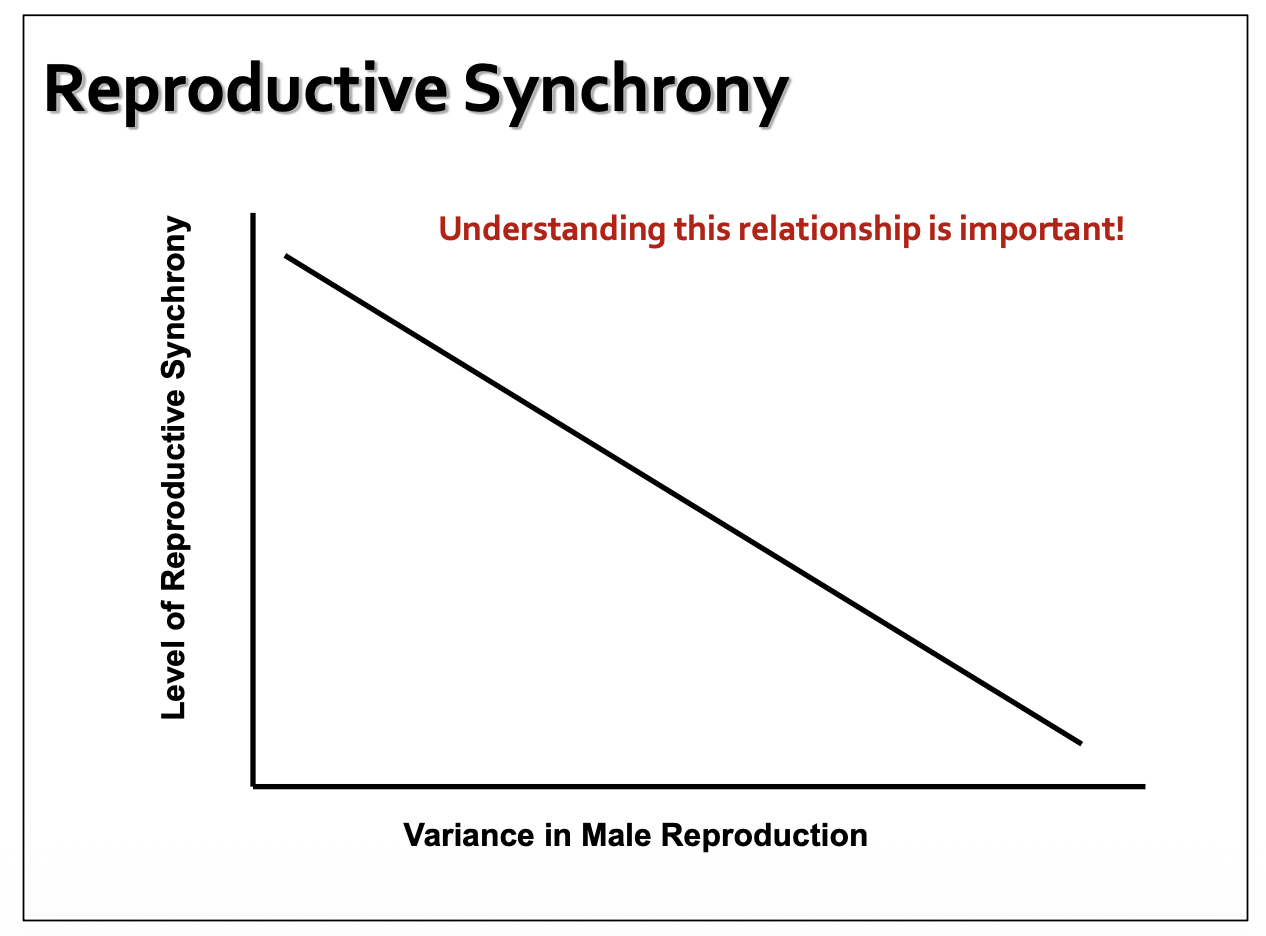
What does the reproductive synchrony graph predict about variance in male reproduction, and why?
High synchrony means several females are fertile at once.
A dominant male has limited ability to guard them simultaneously, so more males get reproductive opportunities and male reproductive outcomes tend to be less unequal.
Low synchrony is different:
fertile windows occur one after another, making it easier for one male to monopolize several females and increasing reproductive skew.
Why can female-female competition be intense even when females gain little from additional mates?
Females can compete for food, safe space, and help raising young because these resources affect reproduction and offspring survival.
The lecture’s chimpanzee graph links higher female rank with better offspring survival.
When mates or paternal care are scarce, females can also compete directly for mates.
How does sexual selection explain Darwin’s puzzle about costly ornaments?
Sexual selection is a form of natural selection:
Rivals and potential mates create selection pressures through differences in mating or fertilization success. An ornament can spread when its reproductive advantage outweighs its survival or energetic costs.
The lecture contrasted selection from rivals and mates with selection from factors such as predators and the physical environment.
Why does access to more mates often affect male and female reproductive success differently?
In many mammals, sperm are plentiful and replenished, so access to additional fertile partners can substantially increase male reproduction.
Ovulation, pregnancy, lactation, and offspring care often constrain the rate at which females can produce or raise offspring.
Females may therefore gain more from resources, offspring survival, or partner quality.
Care demands and mating opportunities can shift these patterns.
What are the five lecture mechanisms of competition for mates?
Scramble rewards finding mates quickly.
Endurance rivalry rewards staying reproductively active through more of the breeding season.
Contest rewards winning access through fighting, threats, or tactics that bypass stronger rivals.
Mate choice favors traits or resources that influence partner decisions.
Sperm competition occurs when sperm from multiple males can fertilize the same eggs.
A testable connection: The lecture grouped scramble, endurance, contest, and sperm competition under intrasexual selection and mate choice under intersexual selection.
How do marmosets show that the direction of sexual selection can change?
In some polyandrous marmosets, infants depend heavily on care from males.
When caring males are a limited reproductive resource, females can compete for them and males can be choosy.
Greater female scent-marking was the lecture example of a trait that can be favored under those conditions.
How do body-size dimorphism, relative canine size, and relative testes size vary across the mating systems shown?
Polygynous species show the greatest body-size dimorphism and largest relative canines, consistent with strong contests for mating access.
Monogamous species show the least body-size dimorphism and smallest relative canines in the figure.
Polygynandrous species are intermediate on those measures and have the largest relative testes, consistent with stronger sperm competition.
A species can face intense competition for access and relatively little sperm competition, as in the lecture’s gorilla example.

What does the northern giant mouse lemur illustrate about sperm competition?
Its testes are roughly 5.5% of body mass and about eight times larger than expected for its body size.
The important point is the relative size.
When sperm from several males can compete for fertilization, greater sperm production can be favored even in a very small primate.
Why might female sexual swellings evolve, and how common are they in primates?
Proposed functions include advertising fertility or reproductive quality, attracting multiple males, and prompting male-male competition.
The lecture describes exaggerated swellings as a derived trait that evolved independently three times.
Their role and reliability can vary by species.

What does the baboon swelling graph show about the relationship between swelling size and ovulation?
Swelling stays large over a broader stretch of the cycle than the narrow peak in ovulation probability.
Ovulation is most likely around peak swelling, close to when swelling starts to subside, but its timing varies.
Males can use swelling size to estimate fertility.
Setchell used this kind of cue to estimate the fertile window in her mandrill study.
How can female mate choice reinforce or weaken male-male competition, and what does that imply about social organization?
Choice reinforces competition when females favor the same males that win contests, as Setchell proposed for mandrills.
It can weaken the rank advantage when females mate with males across ranks, as in Japanese macaques.
Guarding and coercion can constrain which preferences females can act on.
Group composition or pair-living tells you who lives together.
Observed mating and genetic parentage tell you more about the mating system, as extra-pair mating in gibbons illustrates.
When is male mate choice favored, and what does the priority-of-access model predict?
Male choice is more likely when competition or guarding is costly, females vary in fertility or offspring-survival prospects, or several females are fertile at once. Males may attend to traits such as female rank or age.
The priority-of-access model predicts that high-ranking males get first access to fertile females, with more opportunities for lower-ranking males as fertile windows overlap.
How did Setchell test whether female mandrills responded to male facial color independently of rank?
She tracked five adult males and nine females that had previously given birth in a semifree-ranging colony in Gabon.
She measured male facial redness and recorded female behavior near ovulation.
She compared how color and rank related to that behavior, used partial correlations to account for rank, and examined a male whose rank dropped while his color stayed bright.
What female behaviors supported Setchell’s conclusion that coloration mattered?
Females spent more time near brighter males, initiated more of their approaches, presented sexually more often, and were more likely to accept approaches and cooperate with inspections.
Only the brightest male received grooming from periovulatory females.
These patterns generally tracked color more closely than rank, and some color associations remained significant after accounting for rank.
Why was the case of mandrill male 18 especially informative?
He fell from alpha to fifth in rank and kept his bright coloration.
Female approaches, sexual presentations, and positive responses did not decline significantly, though he was no longer observed mating.
His case suggests that female attraction can track color while actual mating access also depends on competitive status.
What limits Setchell’s conclusions, and how could researchers test the color preference more directly?
This was an observational study with five adult males in one closed colony.
Color and rank tended to go together, responses were pooled across females, and ovulation was estimated from swelling.
Controlled color manipulations with otherwise comparable stimuli could isolate the visual cue.
More groups and genetic paternity data could help establish how it relates to reproduction.
Why might female mandrills favor bright males, and how could that preference affect reproductive skew?
Possible benefits include protection from harassment or choosing a male whose color signals condition, competitive ability, or heritable traits.
Because brighter males also tend to be dominant, female preference and contest success can favor the same males, concentrating paternity and potentially favoring more elaborate coloration.
What was Hughes’s main argument, and how did she use data-label swaps to explore it?
Students can bring expectations about sex roles into class and use them to interpret evidence.
Hughes presented the same data under different species or sex labels and compared the explanations students gave.
The patterns came from one class in one semester and were preliminary.
What did Hughes’s three label-swap examples show?
Students read the testosterone increase after a dominance task as evidence that dominance was typical for females when the subjects were labeled small mammals, but as evidence that dominance was atypical for women when labeled humans.
They more often identified female aggression as intrasexual competition in baboons and invoked male attraction more often with the human label.
In the alarm-call example, students invoked female caregiving whichever sex was shown calling more, and neither group mentioned relatedness.
Why might a counterexample fail to change a student’s mental model about sex differences?
A mental model is an explanation built from prior experience that guides how a person interprets evidence.
Students may treat contradictory evidence as a special case and retain the original expectation.
Hughes’s students had already studied and discussed the relevant concepts, yet some did not apply them when the data challenged their expectations.
What does Hughes recommend for teaching and interpreting sex differences more carefully?
Present variation across individuals and species as expected, and explain how historical assumptions shaped which questions researchers asked.
Use surveys or label swaps to surface prior expectations, then invite students to explain and reflect on their reasoning.
The goal is to evaluate the evidence before deciding whether it supports a general pattern.