Energy flow
 Call Kai
 Learn
 Practice Test
 Spaced Repetition
 Match
 Flashcards
 Knowt Play
1/36

There's no tags or description
Looks like no tags are added yet.
37 Terms
what do living organisms need to do to carry out the functions of life? (3) How is it accomplished?
continually capture/acquire, store, and use energy to carry out the functions of life
All 3 are accomplished through cellular chemical processes (eg cellular respiration)
Cells are a _____ that obey ____ & ______
Cells are CHEMICAL MACHINES that obey FUNDAMENTAL CHEMICAL & PHYSICAL LAWS OF NATURE
what is the sum of a cell’s chemical reactions?
metabolism
what is energy?
ability to do WORK
what is work
transfer of energy from one body or place to another
what do cells use catabolic reactions for? How does this happen?
Purpose: to convert CHEMICAL POTENTIAL ENERGY → KINETIC ENERGY
process:
hydrolysis of ATP transfers chemical potential energy (stored energy) → protein pump to move particles through a membrane (kinetic energy)
What does anabolic reactions do? How does it do this?
Purpose: convert kinetic energy into chemical potential energy
How: photosynthesis captures light energy and stories it as chemical potential energy
What do biological molecules (carbs, proteins, lipids, etc) have stored in their chemical bonds?
potential energy
What is cellular respiration?
the process by which a cell enzymatically breaks these energy containing bonds to release their energy and harness it to fulfill a cellular function
What are 3 things about bond energy?
measure of the stability of a COVALENT BOND
equal to the minimum amount of energy required to break the bond
the stronger the bond, the more energy required to break it
In chemical reactions when is energy added? What state is this?
when the bonds between reactants are broken → reach a transition state
When is energy released in chemical reactions?
when product bonds form and if the bonds are more stable than the reactant bonds
what is thermodynamics?
study of energy transformation
what do the laws of thermodynamics describe?
what energy transformations can and cannot do
What does the first law of thermodynamics state? (3)
The total energy in a closed system is CONSTANT.
Energy cannot be created or destroyed. (conservation of energy)
It can only be converted from one form to another
What happens when a chemical reaction occurs? What is something important to remember about this?
What happens:
some of the energy can be transferred from one type of energy to another/others
eg: potential → thermal & light
Note:
the transfer is not 100% efficient, some energy is ALWAYS lost as WASTE (does not perform work)
What is wasted energy? What type of energy is it? What is important to remember abt it?
What: does NOT perform WORK
Type:
Can be any type, but usually heat (thermal) energy is referred to as waste (enthalpy)
Note:
ultimately, all energy in the universe will be transformed into heat energy
What is the 2nd law of thermodynamics about? (2) What does it say?
About:
transformation of potential energy into heat, or random arrangement of energy
RANDOMNESS IS CONTINUOUSLY INCREASING
Statement:
the total energy of an ISOLATED SYSTEM ALWAYS increases over time or remains CONSTANT
entropy can never be negative
What is entropy? What is it’s relation to the universe?
The disorder of the universe. It is CONTINUOUSLY increasing.
For what must energy be spent to achieve?
must be spent to RETAIN ORDER
spending of energy usually releases heat → increases entropy elsewhere
What is free energy?
portion of the systems energy that can perform work
What is a open, closed, and isolated system?
Open: Both matter and energy can enter and leave.
Closed: Only energy can enter and leave.
Isolated: Neither matter or energy can enter or leave.
Why is free energy “free”?
this is the energy that can perform WORK, not because there is no energy cost to the system
What is activation energy?
Amount of energy needed to strain and break reactant bonds, causing a reaction to proceed
What is an EXERgonic reaction?
Process with a net RELEASE of free energy
eg: burning paper (needs initial energy input; activation energy, once it starts it releases more energy than it requires to begin)
What is an ENDERgonic reaction?
Process with a net STORAGE of free energy
eg: most synthesis reactions
What kind of reactions do living systems depend greatly on? What does this reaction type do?
ENDERgonic reactions
Purpose: build larger organized structures that create the phenomenon called life
Which reaction “violates” the 2nd law of thermodynamics and why?
ENDERgonic reactions (synthesis; anabolic; organized) because the 2nd law says that entropy increases, but endergonic reactions decrease energy (organization of molecules)
What do endergonic reactions need to occur? define that term
they must be COUPLED: energy released by one reaction drives the 2nd reaction
explanation:
building protein needs energy (endergonic), it cant happen ON ITS OWN bc it needs an ENERGY INPUT
solution → paired with another reaction
so another reaction that does not violate the 2nd law of thermodynamics
THEREFORE:
even though it can decrease entropy (more organized molecule), the coupled process involved energy transfers that INCREASE entropy in the SURROUNDINGS → entire couple process considered = total increase in entropy
In biological systems what is the second reaction? (coupled to the endergonic) How does it work?
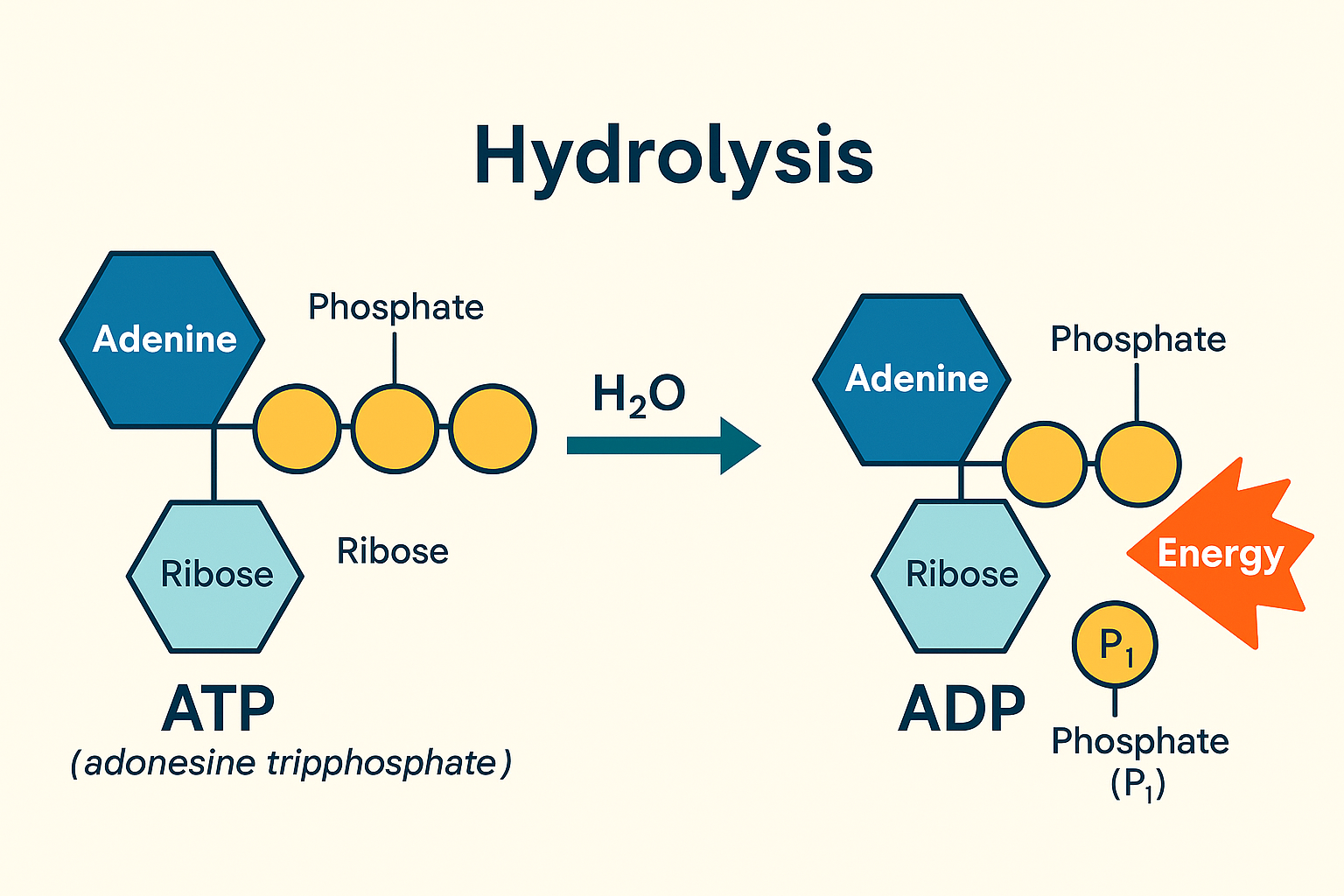
ALWAYS the HYDROLYSIS of an ATP molecule
Purpose:
ATP hydrolysis RELEASES the energy that “POWERS” the endergonic reactions
also INCREASES ENTRYOPY of the overall chemical changes so that the 2nd law is not violated
Why is ATP important in living cells and endergonic reactions? How does it work?
because it is the PRIMARY source of FREE energy
process:
when free energy is needed, and enzyme (ATPASE) hydrolyses the terminal (end; 3rd) phosphate from the ATP molecule and release 31kJ/mol free energy
What happens when endergonic and exergonic reactions are coupled?
there is a release of MORE FREE ENERGY than can be stored in the PRODUCTS of the endergonic reaction
some of the extra energy is lost as HEAT
What something to remember about the coupled exergonic reactions
increase in entryopy from the hydrolysis of ATP is ALWAYS GREATER than the DECREASE IN ENTROPY from the reaction it is COUPLED WITH
What is oxidization?
process of LOSING ELECTRONS
oxidized = lose electrons
What is reduction?
process of GAINING ELECTRONS
reduced = gain electrons
What are redox reactions?
reactions that involve the transfer of electrons between two substances, where one substance is OX-IDIZED and the other is RED-UCED
What are electron carriers? What are 2 examples in metabolic processes?
compounds that PICK UP electrons from energy RICH compounds and then DONATE them to LOWER ENERGY compounds
example:
NAD+ and FAD (ELECTRON TAXIS)
NAD⁺ and FAD: pick up electrons
NADH and FADH₂: carry electrons