MEDCHEM MIDTERM 2
 Call Kai
 Learn
 Practice Test
 Spaced Repetition
 Match
 Flashcards
 Knowt Play
1/85

There's no tags or description
Looks like no tags are added yet.
86 Terms
where is Phi?
between N and Calpha
Where is Psi?
between CO and Calpha
Which angle cant rotate and is locked at fixed position?
omega
What bond is essential for secondary structures such as alpha helices and beta sheets?
H-bonds
__ is the concentration of free protein [P], free ligand [L] and complex [PL] at equilibrium→ ([P][L]/[PL])
dissociation constant (KD)
high KD=
complex less favored (weak binder; need more ligand)
more potent= __KD= __ IC50
lower, lower
__ is the spatial arrangement of atoms and includes:
bond length (C-H distance)
bond angles
dihedral angle
can interconvert through bond rotation (eclipsed, anti, gauche)
conformation
__ is arrangement of covalent bonds and includes:
cis/trans double bonds
chiral center
interconversion only by breaking/reforming covalent bonds
configuration
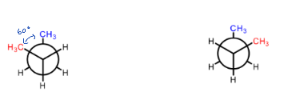
what confirmation?
Gauche

what conformations?
eclipsed
rank in priority group in cis/trans configuration: Cl, N, F, S
Cl>S>F>N
Many fatty acids have side of __ & all natural FAs are cis (Z)
unsaturation
__= not superimposable with its own mirror image
chiral
__= mirror image of eachother (non-superimposable)
enantiomer
__= stereoisomers that arent mirror images of eachothers
diastereoisomer
± come from chiral molecules’ interactions with __
- dextrorotatory (+)
- levorotatory (-)
light
in racemic mixture, there is __ optimal rotation
net zero
RR→ SS (both changed)
Enantiomers
RR→SR or SS→RS (1 changed)
diastereomer
RS→ SR
meso
priority rule: C=O has__ to C-OH
higher priority
On earth, nearly all amino acids are __ confirmation
L
__= only 1 stereoisomers has a specific biological activity
stereospecific
___= Both stereoisomers have biological activity, but magnitude of activity varies.
stereoselective
Can Pt be stereocenter?
yes (same as C)
can P become stereocenter?
yes (5 bonds)
can S become stereocenter?
yes (4 bonds+ LP)
can N become stereocenter?
yes (without LP)
cyclopropane has bond angle of __
60
cyclobutane has bond angle of __
88 (puckering up)
cyclopentane has bond angle of __
108 (envelope confirmation)
cyclohexane has bond angle of __
109.5
cycloheptane & cyclooctane have bond angle __109.5
greater than
anomer is found at __ and its reducing end could be alpha/beta
C1
which form is anomer better, beta vs alpha?
beta
beta conformation is also _
equatorial
__ determines D vs L configuration
C5
D is __ direction (most abundant form in sugars)
right
how many stereoisomers does glucose have?
32
transition state energy is mostly about __ of rxn (barrier between the ground state and TS)
speed (fast/slow)
Gibbs free energy is mostly about __ of rxn (energy difference between reactant and product)
favorability (favored vs not)
higher Keq=__ Gibbs free energy
lower
Catalysts __ Gibbs free energy and __ transition state energy
dont affect, decrease
kinetics= rate which rxn occurs= __
transition state energy (k)
thermodynamics= rate which rxn goes to completion= __
Gibbs free energy (Keq)
__ is favored for enthalpy to get favorable rxn (-G)
-H (exothermic)
__ is favored for entropy to get favorable rxn (-G)
+S (high disorder)
Gibbs free energy=
H-TS
G° is different from G because it denotes __
standard condition (T= 298K or 20C)
Keq=
product/reactants
__ is the relationship between reactants concentration and reaction kinetics (how fast rxn if more reactants added?)
order
__ order:
Independent of reactant concentration
Bottleneck is rate-limiting, usually catalysis
dP/dt=k
zero
__ order:
Unimolecular reaction
Dependent on the concentration of a single reactant
dP/dt= k[A]
first
__ order:
Bimolecular reaction
Dependent on concentration of two reactants, or the square of one reactant
dP/dt= k [A][B] or k[A]²
second

WHAT RXN ORDER?
0
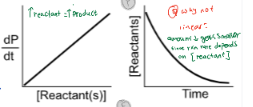
WHAT RXN ORDER?
1

WHAT RXN ORDER?
2
__ order:
Technically a second order reaction, but one reactant is very abundant so its concentration does not affect the rate
Common when water, acid, or base are reactant
pseudo-first
rate is governed by the rxn __
mechanism
__ rxns:
:Nu initiated rxn to form new covalent bond
LG is kicked off
substitution (SN)
(S rxn)
substitution, nucleophilic, bimolecular
Bond formation and breaking occurs simultaneously
Stereochemistry is inverted (R→ S)
focus on stereocenter access (NONBULKY)
SN2
(S rxn)
substitution, nucleophilic, unimolecular
Carbocation formed
stereochemistry lost→ racemic mixture product
SN1
stable LG= faster __
SN1 & SN2
More resonance= __ nucleophile
weaker
stronger nucleophile= more __ rxn
SN2

WHAT RXN IS PINK?
E2
Elimination rxns are __ than Substitution rxns
slower & unfavored
__ form= more lipophilic, increase transport across lipid membrane, promoting absorption into circulation from site of administration, inhibit excretion
unionized
__ form= more hydrophilic, promote a wide systemic distribution through blood and other fluids, promote excretion through urine
ionized
__ is needed so that drug has the possibility to be absorbed and is needed to transport in blood
water solubility
__ is s needed to cross lipid membrane and therefore, ability to partition between lipid and aqueous environment is essential
lipid solubility
(Lipinski Rule of 5) The substance should have a calculated log P (clog P) between ___, no greater than __. Log P = the distribution of the drug between the non-aqueous phase (1-octanol) and water ([1-octanol]/[H2O])
–1 and +5, 5
(Lipinski Rule of 5) The substance should have a molecular weight of __ or less
500
(Lipinski Rule of 5) It should have fewer than __ hydrogen-bond donating functions, e.g. OH, NH groups
5
(Lipinski Rule of 5) It should have fewer than ___ hydrogen-bond accepting features, e.g. sum of Ns and Os
10
__ is the Distribution coefficient of the ratio of Total Drug in each phase.
LogD
LogP is ___ of pH,
independent
For ionizable compounds, LogD is pH ___
dependent
for un-ionizable compounds, LogP __ LogD
=
intramolecular H-bonding __ water solubility.
decreases
LogP < 0.5=
hydrophilic