BIOL MID 2
 Call Kai
 Learn
 Practice Test
 Spaced Repetition
 Match
 Flashcards
 Knowt Play
1/88

There's no tags or description
Looks like no tags are added yet.
89 Terms
Difference of Scale Between Shallow Time and Deep Time
Difference of Scale Between Shallow Time and Deep Time
Human scale vs. deep time: The instructor contrasts recent history with deep time by walking backward from human language and culture (1,000 to 10,000 years ago) to human origins (100,000 to 1 million years ago), early primate ancestors (10 million years ago), shrew-like mammalian ancestors living alongside dinosaurs (100 million years ago), and single-celled life (1 billion years ago).
Deep time concept: Deep time encompasses massive timescales, changes, and events fundamentally beyond everyday human perception and experience.
Chronological Time vs. Geological (Relative) Time
Chronological Time vs. Geological (Relative) Time
Chronological time: Defined as the literal "ticking of a clock" (seconds, years), which is very difficult to measure directly in deep time because there is no continuous stopwatch from Earth's early history.
Geological (relative) time: The primary framework used in deep time, based on the sequential relationships between rock layers.
Who came up with the law of superposition? What are the limitations of stratigraphy?
Rock Record Organized in Layers & Stratigraphy
Law of Superposition: Formulated by Nicolas Steno in the 1600s, this principle states that sedimentary rocks form in sequential layers (via lithification), meaning the oldest layers are at the bottom and younger layers are deposited on top (illustrated using a pile of dirty clothes).
Limitations: Determining absolute age from relative stratigraphy alone is difficult, and estimates can easily be off by tens of millions of years.
Radiometric Dating: What is the radioactive decay mechanism? What is a decay curve?

What is a half-life? What are the 2 scales relating to it? How does the law of large numbers come into play?
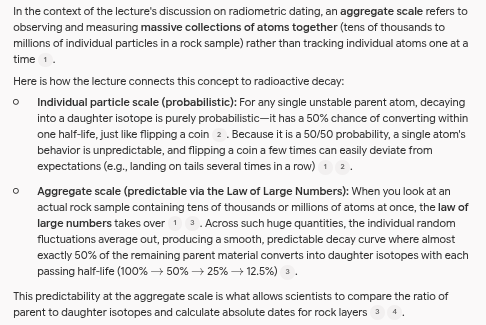
What are longer-lived isotopes? How do their half lives differ? How far back do they allow scientists to date?

Short lived isotopes can measure what units of time and how far back?
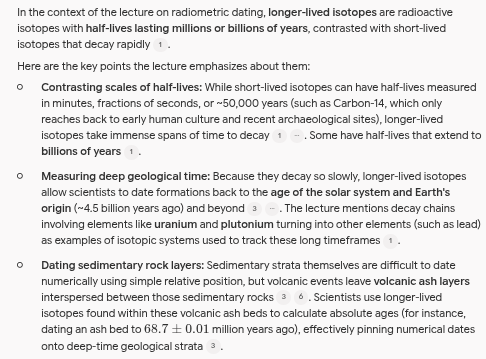
What type of isotope allows scientists to date sedimentary rock?

The three primary lines of evidence used to reconstruct Earth's deep history…
The Fossil Record (traces of ancient life).
Phylogenetics (evolutionary relationships and molecular/morphological trees).
The Geological Record (rock types, depositional environments, and stratigraphy).
What are fossils? How far back must an impression be in order to be considered a fossil?
What are fossils? Remnants or traces of once-living organisms preserved in the rock record and traditionally defined as older than 10,000 years. They are not limited to petrified bone; they include shells, impressions, footprints/tracks, pollen grains, and frozen soft tissues (such as mammoths preserved in permafrost).
What were the class examples of humans and early hominins being aware of fossils?
Historical awareness: Humans and earlier hominins have recognized fossils for millennia (e.g., an Acheulean handaxe intentionally knapped around a fossilized Cretaceous shell, and fossils placed in Mayan and ancient Greek temples).
3 pieces of information can be gained from fossils
Information gained from fossils:
Co-occurrence & ecosystems: Identifies which species lived in a specific geographic location and time period, allowing researchers to infer shared ecological constraints and ancient communities.
Evolutionary transitions: Stepwise acquisition of modern traits can be mapped onto phylogenies. The instructor illustrates this with mammal origins: tracing the evolutionary sequence of hair, lactation, warm-bloodedness, diphyodont dentition (two sets of teeth), and the mobility of the shoulder girdle.
Deep time diversity dynamics: Quantifying fossil discoveries through time and space using mathematical models to map major biodiversity shifts.
What is stepwise aquisition? What was the class example involving mammals?
Stepwise acquisition refers to the gradual, sequential evolution of modern anatomical and physiological traits mapped along a phylogenetic lineage over deep time. Rather than all modern defining characteristics appearing at once, ancestral organisms accumulate these specialized traits piece by piece over evolutionary transitions.
In the lecture, the instructor illustrates this concept through the evolutionary transition of mammals from their early reptilian-like ancestors:
Modern mammalian traits: Modern mammals share a suite of defining characteristics, including hair/fur, lactation (and suckling), endothermy (warm-bloodedness), diphyodont dentition (having only two successive sets of teeth: baby and adult), and a flexible, mobile shoulder girdle.
Tracing through the fossil record: By examining the fossil precursors of mammals, paleontologists look for when specific traits first appear:
Early forerunner lineages lacked these specialized mammalian features and resembled primitive reptiles.
Over time, fossil intermediate lineages show some features appearing before others—such as changes in shoulder girdle mobility, skull bone reduction, or the ability to suckle.
Step by step, each successive transitional group acquires more of these defining traits, appearing progressively more "mammal-like" until the full set of modern features is established.
By mapping these observable physical traits onto evolutionary trees (phylogenies), researchers use the fossil record to demonstrate how complex modern body plans and biological systems were assembled gradually through deep time.
What fossil types make up the bulk of the fossil record? What fossil type is often used to determine rock ages? What is this method called?
Microfossils and pollen: Fossil pollen and microscopic marine organisms make up the bulk of the fossil record. Because distinct pollen grains only occur within narrow timeframes, they are used to determine rock ages (biostratigraphy) and determine which plant species lived in the same environment.
While the fossil record is incomplete and cannot be read strictly literally, it reveals what?
Incompleteness vs. large trends: While the fossil record is incomplete and cannot be read strictly literally, it reveals broad patterns in biodiversity, major evolutionary transitions, and how ancient species lived in ways no living animal does today (e.g., Tyrannosaurus rex).
What does the Canadian fossil of Tiktaalik illustrate?
Fish-to-tetrapod transition: The instructor uses Canadian fossils like Tiktaalik to trace the transition from fin supports in lobe-finned fish to limbs with digits (fingers and toes)
Phylogenetic classification: The class works through phylogenetic definitions using this transition: lobe-finned fish and "fishapods" are paraphyletic groupings, while true tetrapods (animals with true digits) form a monophyletic clade.
The Sepkoski curve: What does it represent? What periods of prehistory does it encompass? What ecosystem? What do drops in the curve mean?
Measuring biodiversity: The lecture introduces the Sepkoski curve, which plots marine diversity counts across the Phanerozoic, showing major shifts across evolutionary faunas (Cambrian, Paleozoic, Modern).
Extinction dynamics: Drop-offs in the Sepkoski curve illustrate how extinction events fundamentally reorganised global ecosystems.
What are molecular clocks? What do they illustrate? What were the 4 examples used in class?
In the lecture, a molecular clock is introduced as a phylogenetic method used to estimate the age of evolutionary groups and dates of diversification events on a phylogenetic tree.
Key details highlighted from the lecture and study guide include:
Estimating Evolutionary Timing: It uses biological/genetic data within a phylogeny to estimate how much time has passed and determine when lineages branched apart.
Molecular clocks & diversification: Molecular clocks help date evolutionary branch points. For birds, the tree demonstrates that while flightless paleognaths (ostriches, emus) branched early, the explosive diversification of modern birds (Australaves / songbirds) took place rapidly right after the K–Pg boundary.
Cell cleavage patterns: Under comparative embryology, the lecture presents microscope footage of cell division:
Radial cleavage: Cells divide cleanly along perpendicular planes (characteristic of deuterostomes, including humans).
Spiral cleavage: Dividing cells twist as they split (characteristic of protostomes).
Ancestral organs & ecology: Lungs in ancestral bony fishes (such as sturgeon, gar, and lungfish) demonstrate that lungs are an ancestral trait of bony fish evolved for oxygen-depleted, stagnant aquatic habitats, rather than an invention that first arose on land.
What was the k-pg mass extinction event? What was the cause?
The K–Pg (Cretaceous–Paleogene) mass extinction event—also referred to as the End-Cretaceous mass extinction—was a catastrophic global extinction event that occurred approximately 66 million years ago, marking the end of the Cretaceous period and the Mesozoic Era.
1. The Trigger: The Chicxulub Asteroid Impact
Location: The event was triggered when a massive extraterrestrial rock (asteroid) slammed into Earth at the Yucatán Peninsula in Mexico, centered near the modern-day city of Mérida.
Physical impact: The collision formed a giant impact depression that extends across the land and out into the ocean. The energy from the impact shattered, melted, and fractured the underlying rock layers across the entire region.
2. Extinction and Climate Shifts
Ecosystem collapse: The sudden catastrophe caused widespread extinction across global ecosystems, wiping out major dominant lineages—most notably the non-avian dinosaurs—and bringing an end to Cretaceous fossil assemblages.
Climate transition: The boundary represents a major environmental transition, shifting the global climate from the warmer conditions of the dinosaur era toward the cooler temperatures of the Paleogene.
3. Evolutionary Opportunities and Diversification
Opening ecological niches: In mass extinctions, the removal of dominant species and ecosystems fundamentally reorganizes how biodiversity works.
Explosive bird radiation: While early bird lineages (such as flightless paleognaths) had been evolving for a long time, the K–Pg boundary served as an evolutionary turning point. Immediately following the impact, surviving lineages experienced explosive diversification—most prominently modern birds (Australaves and songbirds), which radiated rapidly into vacated niches worldwide.
4. Long-Term Geological and Human Legacy
The impact fractures throughout the Yucatán Peninsula created extensive underground caverns and sinkholes (cenotes) that hold subterranean freshwater.
Because surface water is scarce on the peninsula, these impact-generated water systems directly enabled the development of ancient Mayan cities and continue to supply water to human communities today.
What was the treatise on invertebrate paleontology?
The Treatise on Invertebrate Paleontology: A multi-volume compendium listing every genus and species of fossil marine invertebrate along with the geological ages in which they appear.
Jack Sepkoski and David Raup: In the early 1980s, Sepkoski converted the information in the Treatise into a quantitative database of first and last occurrences. Using early mainframe computers and punch cards, Sepkoski and Raup plotted these occurrences over time, transitioning paleontology from descriptive "arm-waving" into a data-driven science where hypotheses could be tested mathematically.
Jack Sepkoski and David Raup. What did they do?
Jack Sepkoski and David Raup: In the early 1980s, Sepkoski converted the information in the Treatise into a quantitative database of first and last occurrences. Using early mainframe computers and punch cards, Sepkoski and Raup plotted these occurrences over time, transitioning paleontology from descriptive "arm-waving" into a data-driven science where hypotheses could be tested mathematically.
The Sepkoski Curve: A global diversity curve of marine invertebrates across the Phanerozoic, showing an overall upward trend in genus and family diversity through time punctuated by sharp drop-offs.
The Sepkoski Curve: What were the 3 great evolutionary faunas?
The Sepkoski Curve: A global diversity curve of marine invertebrates across the Phanerozoic, showing an overall upward trend in genus and family diversity through time punctuated by sharp drop-offs.
The Three Great Evolutionary Faunas:
Cambrian Fauna: An early burst of marine diversity that disappeared relatively quickly.
Paleozoic Fauna: Dominated marine habitats until being devastated around 252 million years ago at the End-Permian extinction.
Modern Fauna: Diversified during the Mesozoic alongside the dinosaurs, survived the End-Cretaceous extinction, and extends to the present day.
The "Big Five" Mass Extinctions: Quantitative drops on the curve that separate geological periods and mark major ecosystem restructurings, including the End-Permian (the most severe) and the End-Cretaceous (Chicxulub impact).
Challenges of Understanding Biodiversity Dynamics in Deep Time
Challenges of Understanding Biodiversity Dynamics in Deep Time
The lecture details several sampling artifacts, geological biases, and methodological challenges discussed in the Marshall paper:
The Signor–Lipps Effect: Because the fossil record is patchy and incomplete, we rarely find the absolute final individual of a species before it goes extinct (analogous to leaving a busy house party without everyone noticing the exact minute you walked out). Consequently, an abrupt, instantaneous mass extinction (such as the asteroid impact 66 million years ago) appears artificially gradual in the rock layers over hundreds of thousands or millions of years.
Temporal and Stratigraphic Resolution:
Stratigraphy is the study of layered sedimentary rocks.
Temporal resolution refers to the precision with which we can date an assemblage. Lumping an entire 50-million-year period (like the Carboniferous) obscures gradual ecological transitions that can only be seen when analyzing narrower time slices (such as 10-million-year intervals).
Geological and Preservation Biases:
Rock availability: The Law of Superposition dictates that older rocks lie deeper, meaning older strata are more likely to be deeply buried, deformed, or eroded away, leaving less surface rock to sample.
Taphonomic bias: Organisms with hard parts (shells, bones) fossilize readily, while soft-bodied organisms (like worms) decay quickly and are rarely preserved.
Biological and Interpretive Challenges:
Modern analogs: For fossils from 1 million years ago, living species or close relatives still exist, allowing scientists to verify species boundaries and determine environmental tolerances (e.g., salinity, temperature). For 500-million-year-old fossils, independent verification of physiology and true biological species boundaries is far more difficult.
Human and Global Inequity Factors:
Differences in where fossils are collected stem from unequal scientific infrastructure, funding, education, and political stability (e.g., extensive sampling in Alberta vs. under-sampled areas like the Congo).
The instructor critiques "parachute science" and "scientific colonialism," where researchers extract fossils from lower-income nations without developing local infrastructure or collections.
Analytical Solutions:
Paleobiologists use standardized sampling, subsampling, and rarefaction to account for differing sample sizes and rock volumes between time periods
The Signor–Lipps Effect:
The Signor–Lipps Effect: Because the fossil record is patchy and incomplete, we rarely find the absolute final individual of a species before it goes extinct (analogous to leaving a busy house party without everyone noticing the exact minute you walked out). Consequently, an abrupt, instantaneous mass extinction (such as the asteroid impact 66 million years ago) appears artificially gradual in the rock layers over hundreds of thousands or millions of years.
What is temporal resolution?
Temporal and Stratigraphic Resolution:
Stratigraphy is the study of layered sedimentary rocks.
Temporal resolution refers to the precision with which we can date an assemblage. Lumping an entire 50-million-year period (like the Carboniferous) obscures gradual ecological transitions that can only be seen when analyzing narrower time slices (such as 10-million-year intervals).
What are the geological and preservation biases?
Geological and Preservation Biases:
Rock availability: The Law of Superposition dictates that older rocks lie deeper, meaning older strata are more likely to be deeply buried, deformed, or eroded away, leaving less surface rock to sample.
Taphonomic bias: Organisms with hard parts (shells, bones) fossilize readily, while soft-bodied organisms (like worms) decay quickly and are rarely preserved.
Taphonomic bias:
Taphonomic bias: Organisms with hard parts (shells, bones) fossilize readily, while soft-bodied organisms (like worms) decay quickly and are rarely preserved.
What are modern analogs?
Modern analogs in paleobiology are living organisms, ecological communities, or environmental processes used as models to understand and interpret the biology, behavior, and habitats of extinct life forms. [1, 2]
Modern analogs: For fossils from 1 million years ago, living species or close relatives still exist, allowing scientists to verify species boundaries and determine environmental tolerances (e.g., salinity, temperature). For 500-million-year-old fossils, independent verification of physiology and true biological species boundaries is far more difficult.
Global Inequity Factors challenging the understanding of biodiversity dynamics in deep time? What are they?
Human and Global Inequity Factors:
Differences in where fossils are collected stem from unequal scientific infrastructure, funding, education, and political stability (e.g., extensive sampling in Alberta vs. under-sampled areas like the Congo).
The instructor critiques "parachute science" and "scientific colonialism," where researchers extract fossils from lower-income nations without developing local infrastructure or collections.
Scientific colonialism vs parachute science. Both contribute to what?
1. Scientific Colonialism (The Historical and Structural Extraction)
What it refers to: The extraction and removal of scientific materials from a region—often by colonial or wealthier foreign authorities—without benefiting or empowering local communities.
The hallmark example in the lecture: Foreign expeditions collecting fossils and shipping them overseas to institutions in cities like London, Paris, or Berlin.
The consequence: The specimens end up stored in foreign museums, meaning local scientists, students, and citizens in the country where the fossils were found cannot access, study, or view their own geological heritage.
2. Parachute Science (The Modern Operational Practice)
What it refers to: The research practice where outside researchers "drop in" (like parachutists) to do fieldwork or gather samples in lower-income or less-developed regions, and then leave immediately without engaging with local scientists.
The defining feature: Outside scientists extract the data for their own publications, but they do not contribute to the development of local infrastructure, local expertise, or local institutional collections.
Both practices contribute directly to global sampling biases in the fossil record. Areas with historical wealth, funding, and institutions (such as Alberta) have extensive fossil documentation, while regions subjected to resource extraction without local institutional investment (such as parts of the Congo) remain under-sampled and scientifically under-resourced. The instructor notes that ethical modern research requires actively investing funding, time, and training into local infrastructure to build long-term local expertise.
How do paleobiologists overcome challenges to understanding biodiversity in deep time?
Paleobiologists use standardized sampling, subsampling, and rarefaction to account for differing sample sizes and rock volumes between time periods.
Assemblages. What are they and what do they tell scientists?
In paleontology and geology, an assemblage refers to a group or collection of fossils found together in the same geological layer (stratum) and location.
1. Co-occurring Organisms and Ancient Communities
An assemblage represents a group of co-occurring organisms—such as marine invertebrates living together in ancient shallow seas or coral reefs—that were preserved together in the rock record.
By analyzing which species are preserved together in an assemblage, paleontologists reconstruct ancient ecosystems, food webs, and ecological communities from that specific slice of time.
2. Temporal and Stratigraphic Resolution
Temporal resolution asks: How certain are we that an assemblage of fossils belongs to a specific, narrow window of time?
If you lump an assemblage over a broad, 50-million-year period (like the Carboniferous), you cannot track subtle ecological transitions.
To understand what was happening to actual faunal communities, researchers must narrow the temporal resolution of fossil assemblages down to smaller time intervals (such as 10-million-year slices), allowing them to compare how one assemblage transitioned into the next.
3. Evolutionary Faunas as Great Assemblages
The lecture describes how Jack Sepkoski grouped global fossil records into three major types of broad assemblages or "Evolutionary Faunas" through the Phanerozoic:
Cambrian Fauna: Early trilobite- and primitive-dominated marine assemblages.
Paleozoic Fauna: Brachiopod-, crinoid-, and coral-dominated reef assemblages.
Modern Fauna: Mollusc-, gastropod-, and bony fish-dominated marine assemblages that arose alongside the dinosaurs and extend to today.
What is Temporal resolution?
Temporal and Stratigraphic Resolution
Temporal resolution asks: How certain are we that an assemblage of fossils belongs to a specific, narrow window of time?
If you lump an assemblage over a broad, 50-million-year period (like the Carboniferous), you cannot track subtle ecological transitions.
To understand what was happening to actual faunal communities, researchers must narrow the temporal resolution of fossil assemblages down to smaller time intervals (such as 10-million-year slices), allowing them to compare how one assemblage transitioned into the next.
What is standardized sampling? What things does it correct for? How does it work? What does it reveal?
Standardized sampling is an analytical method used by paleobiologists to correct for unequal sampling effort, varying rock volume, and differing levels of scientific attention across geological time intervals.
Unequal rock availability: Due to the Law of Superposition and geological erosion, older rock layers are deeper and far more scarce, whereas younger rocks are more exposed and abundant.
Disproportionate research effort: Certain regions and time intervals have received vastly more attention, funding, and paleontological fieldwork than others (e.g., thousands of fossil collections in Alberta versus few in under-resourced regions like the Congo).
Raw counts are misleading: If scientists simply tally up all documented species and genera without standardizing, time intervals with more exposed rock or more active paleontologists will artificially appear to have had much higher biodiversity.
How It Works: Subsampling and Resampling (Rarefaction)
Instead of comparing raw specimen or genus counts directly, researchers equalize the sampling playing field across time intervals:
Equalizing the sample size: Paleobiologists standardize to a common baseline. For example, if a poorly preserved or under-sampled time interval only has four fossil localities available, researchers restrict their analysis of all other time intervals to samples of just four localities.
Iterative resampling: For intervals that actually have hundreds or thousands of localities, computers randomly sample four localities, tally the diversity, and repeat this process over and over again.
Generating statistical confidence: By resampling repeatedly across the dataset, researchers can estimate the number of species or genera likely to be found at that standardized sampling level and calculate statistical error bars and confidence intervals.
What It Reveals
Standardizing the data removes sampling artifacts, allowing researchers to determine whether observed biodiversity peaks and drops represent real biological phenomena—such as genuine ecosystem collapse versus sampling biases—and to distinguish between turnover-based extinctions (where diversity numbers stay steady despite high extinction rates) and depletion-based extinctions (where total diversity genuinely crashes).
Turnover-based extinctions vs depletion based extinctions.
Standardizing the data removes sampling artifacts, allowing researchers to determine whether observed biodiversity peaks and drops represent real biological phenomena—such as genuine ecosystem collapse versus sampling biases—and to distinguish between turnover-based extinctions (where diversity numbers stay steady despite high extinction rates) and depletion-based extinctions (where total diversity genuinely crashes).
What are sampling artifacts?
In the context of the lecture on deep-time biodiversity dynamics, sampling artifacts (or sampling problems) are false patterns, distortions, or misleading signals in fossil and diversity data that arise from how the rock record formed, preserved, and was collected, rather than reflecting actual historical biological events.
How was the Chicxulub asteroid an example of the Signor-Lipps Effect?
The Signor–Lipps Effect (Artificial Gradual Extinctions)
The issue: The fossil record is patchy and incomplete, making it extremely rare to locate the very last surviving individual or generation of a species before it disappears.
The artifact: When a sudden, instantaneous catastrophe occurs—such as the Chicxulub asteroid impact 66 million years ago—the species appear to vanish at different rock levels over hundreds of thousands or millions of years. This creates the false impression that an extinction was gradual when it was actually abrupt.
What is the superposition problem?
Unequal Rock Volume and Preservation (The Superposition Problem)
The issue: By the Law of Superposition, older sedimentary rocks are deposited beneath younger layers. Over deep time, older rocks are far more likely to be deeply buried, structurally deformed, or eroded away, leaving vastly less rock available to study.
The artifact: Younger time periods have substantially more exposed rock and better-preserved fossils. This creates a broad, upward-trending curve in raw biodiversity that makes modern times look far more diverse than ancient periods, partly because scientists simply have more accessible rock to count.
Spurious Extinctions & Temporal Coarseness
Spurious Extinctions & Temporal Coarseness
The issue: Clumping fossils into overly broad time bins (e.g., analyzing an entire 50-million-year period as one single data point) obscures real ecological transitions.
The artifact: An analysis can produce a "spurious extinction"—a mathematical signal of an extinction event that didn't actually happen, caused simply by arbitrary boundary definitions or inconsistent time-slice intervals.
What are the benefits of uni-cellular and multi-cellular life?
Benefits of unicellular life: Unicellular organisms reproduce quickly and simply, rapidly capitalize on available environmental resources, and maintain small, streamlined genomes because they do not require instructions to build complex bodies.
Benefits of multicellular life: Multicellularity enables large physical size. Organisms can traverse long distances (e.g., walking 10–40 km), better regulate their internal state and body temperature, utilize specialized cells and tissues to compartmentalize tasks, and consume complex resources (such as eating whole food items rather than engulfing microscopic particles).
Prokaryotes vs. Eukaryotes & Traits of Eukaryotes
Prokaryotes vs. Eukaryotes & Traits of Eukaryotes
Phylogenetic status: Prokaryotes (encompassing Archaea and Bacteria) form a paraphyletic grouping; eukaryotes originated from within Archaea.
Four distinguishing eukaryotic features:
Membrane-bound internal compartmentalization: Eukaryotic cells separate chemical reactions into distinct, membrane-bound organelles (analogous to municipal industrial zoning separating noisy, polluting factories from residential areas) so processes do not interfere with one another.
Linear chromosomes vs. circular plasmids: While prokaryotes maintain circular DNA (plasmids), eukaryotes package DNA into linear chromosomes in homologous pairs (one from each parent), which facilitates sexual recombination and coordinates multi-gene regulation.
Mitochondria: Dedicated organelles that burn sugar to produce ATP, driving higher metabolic rates and heat generation.
Cytoskeleton: An internal framework made of proteins like actin and myosin that allows eukaryotic cells to change and stabilize distinct functional shapes (e.g., elongated neuronal axons or motile immune cells), whereas bacteria are constrained by the rigid shape of their outer capsules.
Endosymbiosis theory. What are the lines of evidence?
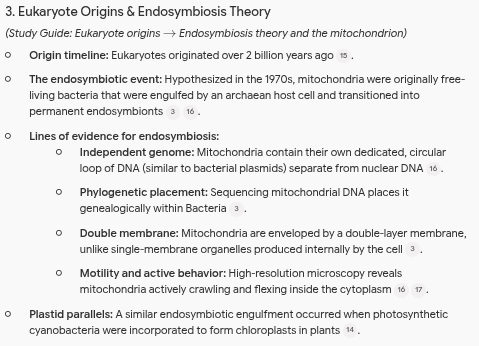
How is multicellularity polyphyletic?

Plants evolved from what? What challenges do terrestrial plants face?
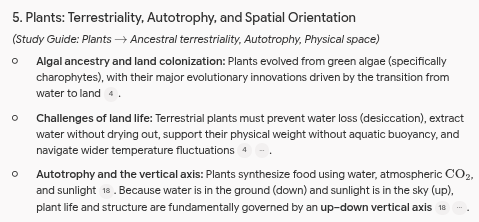
How is the vertical axis significant for plants? What is desiccation?

What are the major plant adaptations and lineages? Wood evolved (PARAPHYLETICALLY OR POLYPHYLETICALLY?)
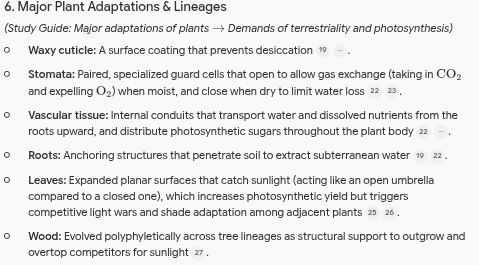
What are the major plant groupings?

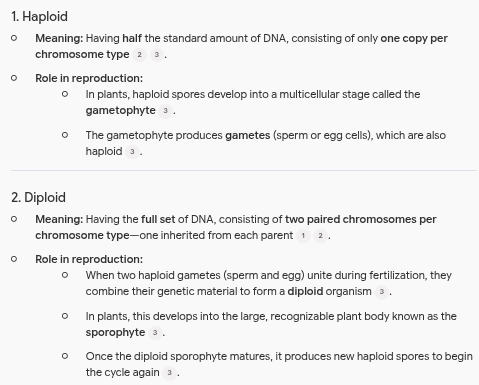
What are the 2 alternating life cycle multicellular stages for plants?

What plants reduce gametophyte generation? How is this significant to avoiding desiccation?
Seed plant modification: In conifers (gymnosperms) and flowering plants (angiosperms), the gametophyte generation is reduced and enclosed entirely inside protective reproductive structures (pollen grains, ovules within flowers or cones, and seeds), shielding reproduction from external desiccation.
Haploid vs diploid
All animals share what 2 things in common?
Multicellularity: All animals are multicellular.
Ancestrally marine: All animals are ancestrally marine organisms that originated in the water.
Bilateria
Bilateral symmetry and body axes: Most animal diversity belongs to Bilateria, defined by a single plane of division separating left and right halves. This body plan allows animals to navigate along primary coordinate axes: forward/backward, up/down, and left/right.
Segmented musculature:
Segmented musculature: The body exhibits anterior–posterior segmentation with repeating blocks of muscle (analogous to the divided blocks of human abdominal muscles).
Different species arriving on land is evidence of BLANK evolution.

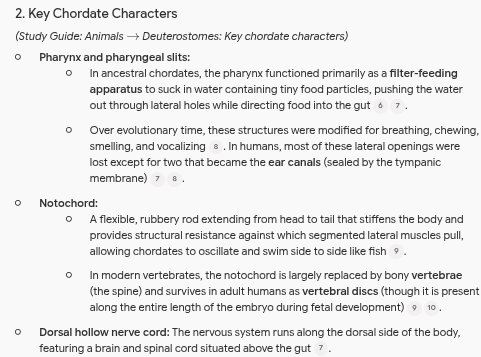
What are the 3 key chordate characteristics?

How did the pharynx evolve for humans? What was its original function? How did the notochord evolve for humans? What was its original function?
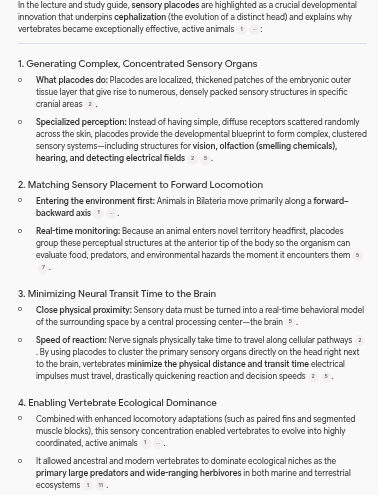
What are sensory placodes and how did they fuel cephalization? What are the 4 benefits of sensory placodes?
Why did heads evolve? What do the forebrain, midbrain, and hindbrain fo?

What were the 2 key vertebrate locomotive innovations?

For arthropods terrestrialization was an example of what?

Early Evidence of Life & The Great Oxygenation Event. There are 3 major pieces of evidence?Exactly how long ago did life first emerge?

The boring billion
The "Boring Billion": Following the GOE, atmospheric oxygen stabilized at a low baseline for roughly a billion years, characterized primarily by single-celled life and rare, microscopic multicellular algae (imaged with synchrotron scans at ~1.6 billion years ago).
Second Oxygen Rise & The Avalon Biota
Second Oxygen Rise & The Avalon Biota: Around 700–800 million years ago, oxygen levels rose again due to the diversification of multicellular eukaryotic algae. By ~600 million years ago, fossilized embryos displaying modern cleavage patterns appear, along with the Avalon Biota (found in Newfoundland, Australia, and Namibia)—large, geometrically shaped, enigmatic multicellular animals.
Origin of Modern Animal Body Plans (Burgess Shale):
Origin of Modern Animal Body Plans (Burgess Shale): By ~500 million years ago, oxygen neared modern levels, supporting the rapid diversification of modern marine body plans (the Cambrian Fauna). Localities like the Burgess Shale preserve early representatives of major modern phyla, including Pikaia (an early chordate relative) and Waptia (an early arthropod/shrimp relative), as well as diverse worms and crawling invertebrates.
The Challenges of Terrestrialization

For plants: Early Microbial Land Cover, First Land Plants & Early Communities, Origin of Forests (~380 Ma), Plant–Animal Interactions & Herbivory:

Timeline of Animal Evolution: Terrestrialization & Gigantism: Vertebrate Transition (Tiktaalik), Late Devonian Mass Extinction, and Carboniferous Gigantism (~300 Ma).
What caused the end-permian mass extinction?

What was mesozoic radiation and what did it bring?
End-Permian vs. End-Cretaceous Causes and Kill Mechanisms
Physical evidence in the fossil record of the end-cretaceous asteroid

Protosomes vs deutosomes. They are both part of what group of animals? How do they differ in terms of cleavage?
Comparative embryonic cleavage diagrams across Bilateria, contrasting spiral cleavage (snails/protostomes) with radial cleavage (echinoderms/deuterostomes)

What did fishapods transition into?
Evolutionary transitions: Illustrated with the classic "Fishapods" transition diagram showing lobe-finned fishes evolving weight-bearing limb bones into tetrapods (Tiktaalik, Acanthostega).
What are the 5 things heterotrophs must worry about?
Slide Deck: Features a slide titled “Animals are heterotrophs”, explicitly stating the main consideration as “finding food, avoiding becoming food”. It details how this requirement drives animals to:
Move around the environment.
Consume and digest food.
Sense the environment.
Hide or defend from predators.
Study Guide: Lists “Body axes and forms of symmetry” under Animals.
Slide Deck: Features the slide “Animals must orient in space”, showing anatomical diagrams of body axes across different body forms:
Bilaterians (fish and human): Anterior–posterior, dorsal–ventral, and left–right axes.
Radiata (sea anemone): Oral–aboral axis.
Gastrulation, and body layers
3. Gastrulation, Germ Layers, and Body Cavities (Coelom)
Study Guide: Outlines “Gastrulation (head first or head second)” and “Body layers”.
Slide Deck:
Displays a detailed step-by-step diagram of gastrulation, illustrating the invagination of the vegetal pole, archenteron growth, and blastopore formation.
Details the three embryonic germ layers—ectoderm (outer), mesoderm (middle), and endoderm (inner gut lining).
Illustrates the development of the gut and the coelom (body cavity) formed within mesodermal derivatives.
Basic timeline of events
Origin of Earth / Hadean Eon begins — ~4,567.3 Ma
Formation of the Moon — ~4,510 Ma
Prokaryotes appear — ~4,000 Ma
Earth's magnetic field established — ~3,500 Ma
Earliest photosynthesis — ~3,200 Ma
Banded Iron Formations (BIFs) & Great Oxygenation Event
Permanent atmospheric oxygen established — ~2,200 Ma
Origin of Eukaryotes — ~2,200 Ma
Multicellular life (e.g., Chitrakoot fossils at ~1.6 Ga) — ~1,600 Ma
First animal fossils (Animalia) (e.g., Avalonian fauna / Ediacaran fossils at ~575–650 Ma) — ~650 Ma
Phanerozoic Eon begins / Origin of modern animal body plans (Cambrian Explosion) — ~538.8–540 Ma
Origin of land plants — ~500 Ma
Early plant communities & First vascular plants (Silurian) — ~444–418 Ma
Ordovician–Silurian (O–S) Mass Extinction
Terrestrialization of vertebrates (First vertebrate land animals, e.g., Tiktaalik) — ~395 Ma
Late Devonian Mass Extinctions (Kellwasser & Hangenberg events)
Origin of forests & Giant terrestrial arthropods (Carboniferous)
Vertebrate herbivory & Plant–animal interactions (Carboniferous–Permian)
End-Permian (P–T) Mass Extinction (Siberian Traps flood basalts & extreme global warming) — ~252 Ma
Non-avian dinosaurs appear — ~243 Ma (spanning ~243–66 Ma)
Mammalia appears — ~225 Ma
Triassic–Jurassic (T–J) Mass Extinction
End-Cretaceous (K–Pg) Mass Extinction (Chicxulub asteroid impact & Deccan Traps volcanism) — 66 Ma
Hominins appear — 2 Ma
Chitrakoot fossils represent what? What about Ediacaran, and specimens from the Burgess shale?
Origins of Eukaryotes, First Animal Fossils, and Modern Body Plans
Study Guide: Covers “Origin of eukaryotes, first animal fossils, origin of modern animal body plans”.
Slide Deck: Presents the fossil evidence for each evolutionary stage:
Chitrakoot fossils (~1.6 Ga): Filamentous multi-chambered microfossils representing early multicellular eukaryotic life.
Ediacaran animal fossils & embryos (~575–600 Ma): Cross-sectional scans of fossilized embryonic cleavage stages and macroscopic fossils of the Avalonian fauna (such as Dickinsonia).
Modern body plans (Cambrian): High-resolution fossil specimens from localities like the Burgess Shale showing early chordates (Pikaia) and stem-arthropods (Waptia).
The timeline of early plant evolution

What are deccan traps?
In your selected course materials, the Deccan Traps are identified as a major episode of vulcanism that occurred around the End-Cretaceous Mass Extinction (~66 million years ago).
Within the discussion of End-Cretaceous kill mechanisms:
The primary cause of the extinction is identified as an asteroid impact.
The Deccan Traps are noted as volcanic activity that was "possibly associated" with the extinction, representing an internal Earth volcanic event that may have contributed to or compounded the global crisis alongside the extraterrestrial impact.
The end Pemian mass extinction vs the end cretaceous

Eukaryotic traits:
Details that eukaryotes feature internal compartmentalization by membranes, linear chromosomes, mitochondria, and a cytoskeleton.
What are the challenges that plants face on land?
Terrestriality & Charophyte ancestry: Identifies the origin of land plants from charophyte green algae ancestors and outlines the fundamental challenges of life on land: transporting water, collecting sunlight, and keeping water.
What kind of autotroph is a plant?
Autotrophy: Identifies plants as photoautotrophs whose main consideration is acquiring all necessary resources for photosynthesis.
The evolutionary sequence of plants from green algae onward.

What are the Germ layers? Animals with 3 layers are BLANK, and animals with 2 layers are BLANK#2
Ectoderm, mesoderm, and endoderm are the primary embryonic germ layers (or body layers) that form during early animal development
In the lecture materials, animals with all three layers are classified as triploblastic, whereas simpler animals with only two layers are diploblastic. These three layers are established during gastrulation and differentiate into the distinct tissues and organ systems of the animal body plan:

What is gastrulation?
Gastrulation is a fundamental stage in early embryonic development where a hollow ball of cells reorganizes into a multi-layered embryo, establishing the primary germ layers and the embryonic gut tube.
The step-by-step process and its major evolutionary consequences include:
1. How Gastrulation Occurs
Flattening at the vegetal pole: The process begins at the vegetal pole of the hollow blastula, where specific cells change shape to form a flattened region.
Migration of mesenchyme cells: Cells that will become the future mesoderm (primary mesenchyme cells) detach and migrate inward into the internal fluid-filled cavity (the blastocoel).
Invagination and formation of the blastopore: The flattened vegetal pole—made of future endoderm cells—begins to invaginate (fold inward like pushing a finger into an inflated balloon). The circular opening created by this inward fold is called the blastopore.
Archenteron growth: As invagination continues, the deepening pocket extends upward across the blastocoel to form the primitive embryonic digestive tube, known as the archenteron. Secondary mesenchyme cells form at the tip of the archenteron and send out cellular extensions that attach to the outer layer (the ectoderm).
Germ layer establishment: By the end of this process, the outer ectoderm and inner endoderm are fully defined, with mesoderm cells positioned between them.
What are Gymnosperms
Gymnosperms: "Naked Seed" Plants
First Seed Plants: Gymnosperms evolved as the earliest seed plants, appearing around ~305 million years ago.
Reproduction & Seeds: The term gymnosperm literally means "naked seed." Unlike flowering plants, their seeds develop exposed on the scales of cones rather than enclosed inside an ovary or fruit.
Diversity: Modern gymnosperms represent approximately ~1,000 extant species, grouped into four main lineages:
Conifers (~500 species): Includes pines, firs, spruces, and ancient bristlecone pines.
Cycads (~145–300 species): Palm-like seed plants with large crown cones.
Ginkgo (1 surviving species: Ginkgo biloba).
Gnetophytes (~120 species): Includes desert-adapted plants like Welwitschia and Ephedra.
Angiosperms
Angiosperms: Flowering Plants
Dominance & Diversity: Angiosperms are the most abundant and diverse plants on Earth, with over ~260,000 living species dominating terrestrial ecosystems today.
Key Evolutionary Innovations:
Flowers: Angiosperms possess specialized reproductive structures—flowers containing reproductive organs such as the stigma, style, and ovary enclosing the ovules.
Enclosed Seeds (Ovaries & Fruits): After fertilization via a pollen tube, ovules develop into seeds housed within a protective ovary, which typically matures into a fruit.
Pollinator Coevolution: Unlike the wind-dependent pollination common in gymnosperms, angiosperms diversified explosively through coevolution with animal pollinators. Flowers evolved specialized colors, scents, and nectar rewards tailored to bats, hawkmoths, hummingbirds, and bees.
Underground Sugar Storage: Many angiosperms evolved underground carbohydrate storage structures to support survival and regrowth, such as onion bulbs, potato tubers, ginger rhizomes, and crocus corms.
In triploblastic animals, how the mesoderm arranges itself determines
In triploblastic animals, how the mesoderm arranges itself determines whether an animal has a true body cavity:
Acoelomate: No body cavity; solid mesodermal tissue fills the entire space between the gut and the body wall.
Pseudocoelomate: A fluid-filled pseudocoelom forms directly between the endodermal gut and the mesodermal body wall.
Coelomate: A true coelom (body cavity) forms entirely within and is completely lined by mesoderm-derived peritoneum.