STEEL AND TIMBER 1
 Call Kai
 Learn
 Practice Test
 Spaced Repetition
 Match
 Flashcards
 Knowt Play
1/25

There's no tags or description
Looks like no tags are added yet.
26 Terms
Shear
certain type of stress inside a structural member due to some applied load
type of stress inside a structural member
a construction method of resisting wind and earthquake loads.
Shear Stress
a resistive force developed per unit area in a body due to the applied
Shear force
causes shape changes without changing the volume of the body
Strength
it is the ability of a material to resist external load against failure
a property and fixed for a particular material
the primary design factor
Shear strength
is the ability of the material to resist shear load until failure
is a property and is constant for material
is the maximum shear stress developed at the time of failure
When is a body considered to be in equilibrium?
A body is said to be in equilibrium if no net force acts on it.
Two cases in which a body can be inequilibrium:
When the body is at rest.
When the body is moving at a constant speed without changing direction
Moment
also sometimes called a torque
"tendency of a force to rotate a body".
Pivot
Forces that create a moment act around a point.
The point around which the object can rotate or turn
Principle of Moments
also known as Varignon's theorem
is a fundamental concept in physics and engineering that describes the equilibrium of a rigid body under the influence of external forces
Equation for Varignon’s theorem
ΣM = Mr
ΣM represents the sum of the moments of the individual forces about a point.
Mr represents the moment of the resultant force about the same point.
Dead loads
Self-weight of the structure, and which are always present,
To calculate the dead load of a building: By calculating the volume of each member and multiplying it by the unit weight of the materials from which it is composed, an accurate dead load can be determinedfor each component.
Live loads or Imposed loads
Embrace all loads except DEAD LOAD, for example, weight of machinery, stores, vehicles, cranes, and people, as well as loading due to wind or water pressure. Unlike dead loads, imposed loads may, or may not, be present.
TYPES OF BEAMS
SIMPLY SUPPORTED BEAM
CANTILEVER BEAMS
FIXED BEAMS
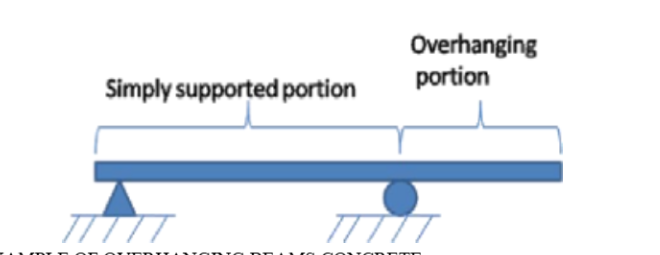
OVERHANGING BEAMS
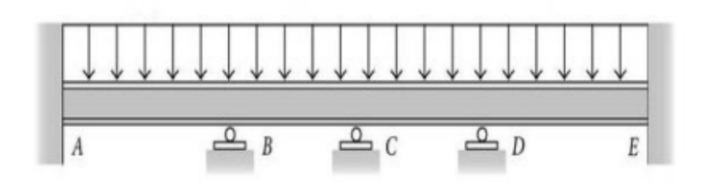
CONTINUOUS BEAMS
SIMPLY SUPPORTED BEAM
rests on two supports and is free to move horizontally or we may say that simply supported beams are defined as having two supports at either end – one pinned and one roller.
simplest type of beam
SCHEMATIC DIAGRAM OF SIMPLY SUPPORTED BEAMS

CANTILEVER BEAMS
are supported from one end, using a fixed support
2 meter to 2.5 meters
Maximum span length of cantilever slab/Beam For normal structure
SCHEMATIC DIAGRAM OF CANTILEVER BEAMS

FIXED BEAMS
have fixed supports at either end – offering moment resistance at either end
SCHEMATIC DIAGRAM OF FIXED BEAMS

OVERHANGING BEAMS
are those with two supports, but unlike simply supported beams, one of the supports is not at the end of the member
SCHEMATIC DIAGRAM OF OVERHANGING BEAMS
CONTINUOUS BEAMS
Are multi-spanned beams that have multiple supports across the length of the beam
SCHEMATIC DIAGRAM OF CONTINUOS BEAM