MRI Physics Review (Quiz 4 - Lec 14 - 17)
 Call Kai
 Learn
 Practice Test
 Spaced Repetition
 Match
 Flashcards
 Knowt Play
1/109

Earn XP
Description and Tags
Safety, sequences, parameter tradeoffs, diffusion
110 Terms
Which zone in an MRI department is considered most at risk for patients and staff?
Zone 4
What kind of psychological effects can be induced by an MRI scanner?
Claustrophobia, anxiety, panic attacks
What kind of artifacts can psychological effects cause?
Motion artifacts or early scan termination
What is a potential solution for patients experiencing severe psychological effects?
Sedation
What is the force that acts on charged particles moving through a gradient magnetic field?
Lorentz force
In a static magnetic field, how would the Lorentz force come into play on the patient?
If the patient is moved too quickly into the MRI bore
Which type of object can become a projectile hazard when present in a room with an MRI scanner?
MR unsafe object or ferromagnetic object
The safety line for the general public is defined as the ______
5 Gauss line
Heating is an effect caused by which component in the MRI scanner?
The RF coil
What is the quantity that defines the rate at which the RF energy converts into heat when absorbed by the body?
Specific Absorption Rate (SAR)
What are the units for SAR?
Watts/kg
What are the parameters used to calculate SAR?
Number of RF pulses, duration of pulse, flip angle, body weight and height
SAR is proportional to what three parameters?
B0 (squared), flip angle (squared), duty cycle
What is RF duty cycle?
The proportion of time during one TR in which the RF is powered on
How do we mitigate RF heating?
Remove saturation RF pulses, lower RF flip angle, increase TR, reduce refocusing pulses in TSE
What is another way in which tissue may heat up other than SAR?
Antenna effect, where the body acts like an antenna
What can rapid gradient changes cause in the body?
An induced current
Currents induced by rapidly changing gradients (time-varying) can cause what in the body?
Depolarization of nerves, inducing peripheral nerve stimulation, causing tingling or twitching
Why do the gradient coils make such loud noises?
They vibrate heavily due to being held in place by epoxy and acted upon by the Lorentz force from the main static field
What are the four main dangers with cryogens?
Thermal sensitivity, asphyxiation, quench, explosions
Why does helium easily cause asphyxiation?
Lighter than air, displaces oxygen from lungs

What kind of pulse sequence is this?
Spin Echo (SE)

What kind of pulse sequence is this?
Gradient Echo (GE or GRE)
What is the primary difference in the diagrams between Spin Echo and Gradient Echo?
SE has a refocusing pulse, GRE does not
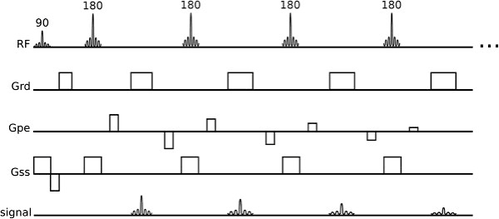
What kind of pulse sequence is this?
Turbo Spin Echo or Fast Spin Echo (TSE or FSE)
What is the main difference between a Spin Echo and a Turbo Spin Echo, excluding the name difference?
A spin echo only has one phase encoding line per TR, whereas a turbo spin echo acquires multiple phase encoding lines per TR
In the TSE sequence, two new additional terms make an entrance: define ES and ETL.
ES = Echo Spacing, the time between echoes in one TR. ETL = Echo Train Length, or the number of echoes generated per TR (you can also use the number of refocusing pulses for this as well)
The definition for TE in TSE changes from how it’s defined in the spin echo. What is it defined as?
The time at which the k-space centre is acquired, when your phase encoding gradient is equal to 0
What is a Single Shot TSE (SS-TSE)?
When all phase encoding lines are acquired within one TR.
What is a Multi-Shot TSE? What is the benefit vs drawback of using it over the SS-TSE?
The benefit: less distortions due to susceptibility and T2 decay/blurring, higher SNR. The drawback: longer scan time
What is Partial-Fourier or Half-Fourier SS-TSE?
The partial filling of k-space to reduce the SS-TSE ETL
What is the HASTE pulse sequence?
Half-Fourier Acquisition Single-Shot TSE
What are three assumptions that we use for any Partial-Fourier sequence?
1) B0 is homogeneous 2) no T2 decay differences 3) no chemical shift
What is the DRIVE pulse sequence?
DRIVen Equilibrium - application of -90 RF pulse at end of TR to “reset” magnetization to avoid long TR wait times
What is the main benefit of DRIVE? The main drawback?
Benefit: shorter TRs so faster scanning. Drawback: High SAR
What is an Inversion Recovery pulse?
A 180 pulse applied prior to 90 degree excitation that starts the NMV in the -z direction.
What do we call the time between the inversion pulse and the excitation pulse in an IR sequence?
Inversion Time (TI) or Tau
What happens if we select a TI such that Mz is zero for a specific tissue?
No Mxy is generated for that tissue after excitation, therefore no signal is generated from that tissue
What is the STIR sequence?
Short Tau Inversion Recovery
What does STIR do? Why is it called “short tau”?
It nulls the fat signal using a short inversion time, because the T1 time for fat is short.
What is the FLAIR pulse sequence?
Fluid-Attenuated Inversion Recovery
What does the FLAIR sequence do?
Nullifies fluid signal, specifically CSF
When would we want to nullify CSF signal?
When we want to look at a T2W image of the brain without being overwhelmed by CSF signal.

What kind of pulse sequence is this?
Inversion Recovery Spin Echo (STIR or FLAIR)

What kind of pulse sequence is this?
Echo Planar Imaging (Gradient Echo variant)
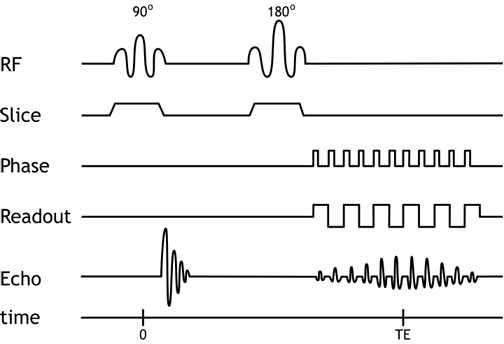
What kind of pulse sequence is this?
Echo Planar Imaging (Spin Echo variant)
Which is faster: GE-EPI or TSE?
GE-EPI due to lack of refocusing pulses
What does this pulse sequence acronym represent: bSSFP?
Balanced Steady State Free Precession (aka True FISP aka TRUFI aka FIESTA)
What is special about the bSSFP?
Recycles signal between TR rather than destroying and recreating it, resulting in SNR boost
What is special about the bSSFP contrast?
Works as a function of the T1/T2 ratio
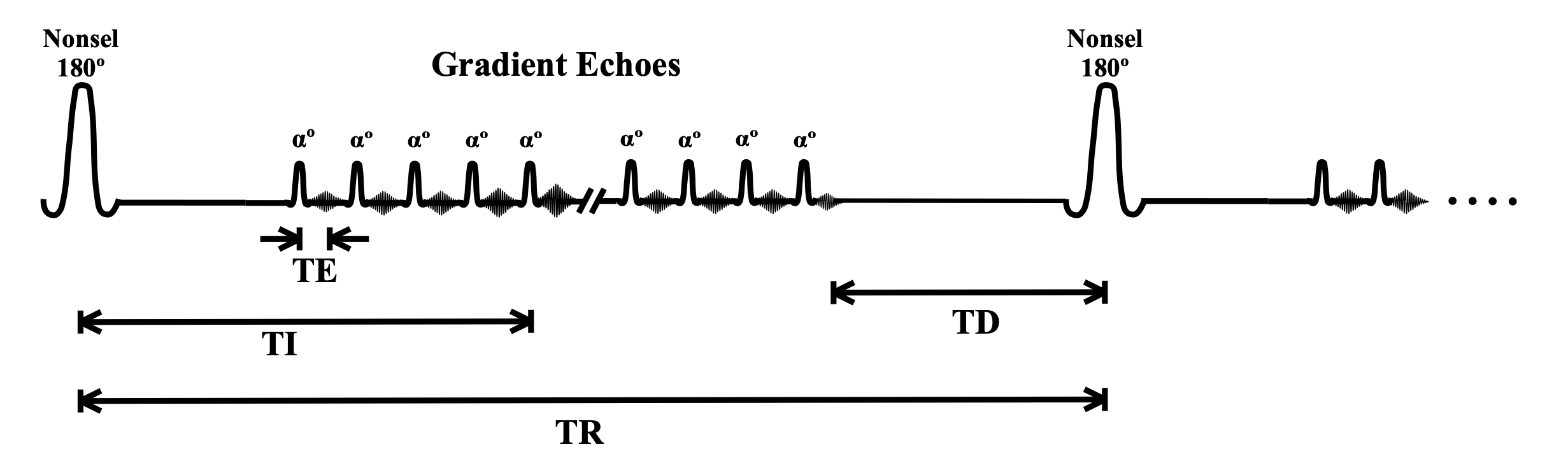
What is this pulse sequence?
Magnetization Prepared RApid Gradient Echo (MP-RAGE)
What is special about the MP-RAGE compared to conventional GE imaging?
Uses a 180 pulse prior to excitation to maximize T1 contrast
The definition of TI is different for MP-RAGE. How is it defined?
The time between the 180 pulse and the acquisition of the k-space centre

What is the contrast of this brain scan?
T1W

What is the contrast of this brain scan?
T2W

What is the contrast for this brain scan?
Proton Density
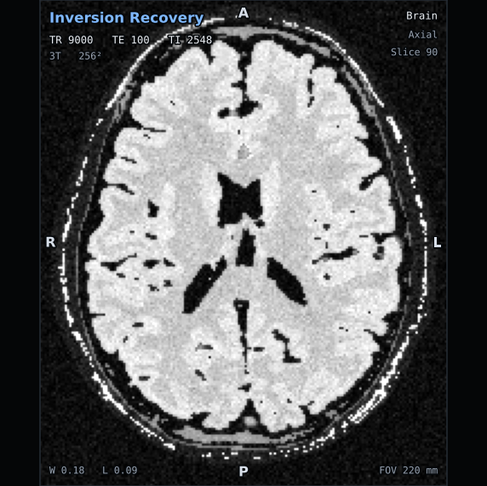
What pulse sequence was used to acquire this image? Hint: Look at ventricles
FLAIR

What pulse sequence was used to acquire this image? Hint: fat is suppressed
STIR
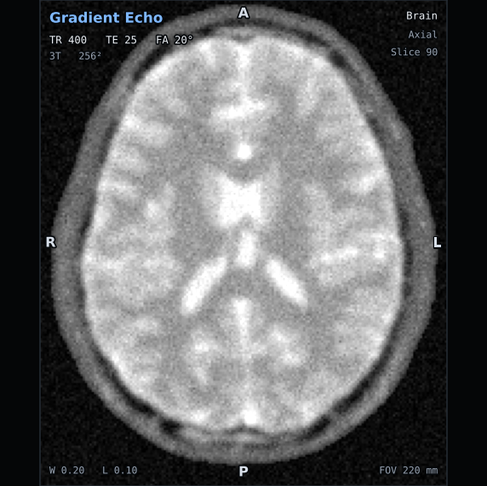
What is the primary contrast in this image? Hint: TE = 25 ms is long
T2*W

What is the primary contrast in this image?
T2W

What is the primary contrast in this image?
T1W

Raising the b-value from 0 to 1000 s/mm² makes this image more sensitive to what?
Diffusion of water in the brain
To detect bone-marrow oedema (e.g. a bone bruise or occult fracture) in the knee without fat signal, which pulse sequence is best?
STIR
List all the ways you can boost your SNR in an MRI scan.
1) Signal averaging 2) Shorten TE 3) Lengthen TR 4) Optimize Flip Angle (Ernst) 5) Increase voxel size (decrease resolution) 6) Decrease Receiver BW 6) Increase B0
What is the main drawback of signal averaging (NSA) for SNR boost?
Increased scan time by a factor of xNSA
If my scan took 10 minutes, and I increased my NSA by 4, how long would my new scan take? What is the expected SNR boost?
New scan time = 10×4 = 40 minutes. SNR boost = sqrt(4) = x2
What are some drawbacks for boosting B0 for increased SNR?
Costs a lot more money and increases SAR quadratically
How does narrowing the receiver BW result in a better SNR?
Filtering out noise
What is the main drawback of narrowing your receiver bandwidth?
Increase chemical shift artifact
If we decrease our TE for better SNR, what does this cost us?
Worse CNR/T2W/T2*W
If we increase our TR for better SNR, what does this cost us?
Worse CNR/T1W + longer scan time
Two voxels have the exact same pulse sequence parameters, except for resolution. One voxel is 1mm³, and the other is 3mm³. Which has the better SNR?
The bigger voxel
What are two main drawbacks of increasing voxel size for better SNR?
1) Image blurring and 2) Harsh partial volume effects
You are running a scan with FOV = 20cmx20cm, matrix size of 200×200. Your SNR is terrible. What can you change to increase your SNR?
Increase FOV or decrease matrix size
You are running a GE scan with TR=250 ms, TE=25 ms, FOV=25cmx25cm, matrix size 250×250, ST=1mm, alpha=60, and NSA=1. You are not happy with your SNR and you want to increase it. You must run a T2* weighted sequence while keeping the voxel size at 1mm³. Your current scan time is approximately 1 minute. What can you try first to boost your SNR?
Increase TR OR Increase NSA - try 4 for a 2x boost
If you absolutely must keep your scan time as short as possible, and you cannot sacrifice your contrast, what option(s) is/are left for you to try to boost SNR?
Increase voxel size or reduce receiver bandwidth
What probability distribution describes how particles diffuse across space?
Gaussian distribution (specifically, time-varying Gaussian)
What is isotropic diffusion?
Diffusion in all three Cartesian directions (x, y, z) freely
What is an example in the human body of isotropic diffusion?
Water in CSF
What is restricted isotropic diffusion?
Diffusion in all 3 Cartesian directions, but contained within a volume
What is an example in the human body of restricted isotropic diffusion?
Water in gray matter
What is anisotropic diffusion?
Diffusion of molecules in a preferential direction
What is an example in the human body of anisotropic diffusion?
Water in white matter (axons)
In normal tissue, diffusive behaviour typically follows what kind of diffusion?
Isotropic or anisotropic
In tissues with some pathology, e.g., cancer, what is the expected diffusion behaviour?
Highly restricted isotropic diffusion
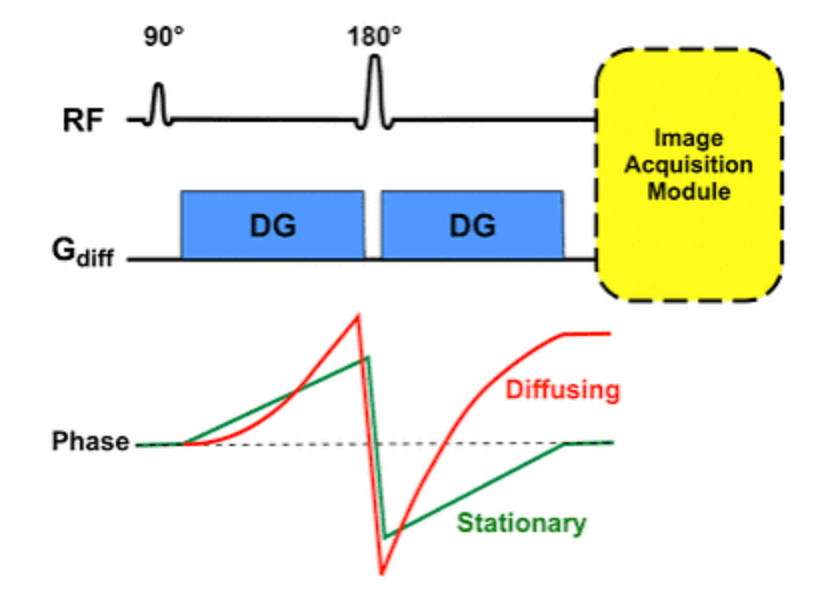
What happens to diffusing molecules under a gradient field?
Each molecule will accumulate phase as they move through the gradient and experience different gradient strengths
What happens to highly diffusive molecules after a rephase gradient is applied?
They will not fully rephase, therefore losing phase coherence and signal intensity
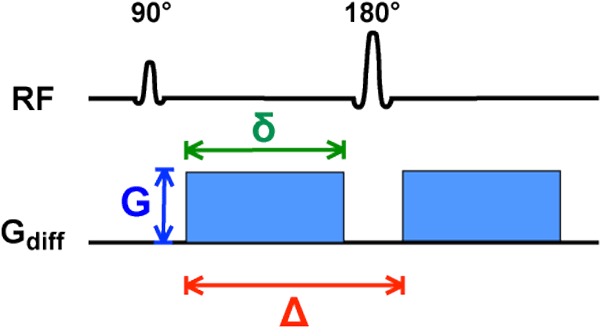
What does δ represent in this image?
The duration of the diffusion gradients

What does Δ represent in this image?
The time between the diffusion gradients
What is DWI?
Diffusion Weighted Imaging

What kind of pulse sequence is this? How do you know?
DWI sequence - very high diffusion gradients before and after the refocusing pulse
What does b represent in the DWI context?
A proportionality constant for the measurable diffusion signal, characterized by the amplitude, duration and separation of the diffusion gradients
Can we apply diffusion gradients on any axis? How?
Yes, by orienting the gradient along that direction e.g., diffusion along y can be measured by changing gradient amplitude along y direction
What are the sources of contrast in a DW image?
T2 and diffusion
Voxel-wise contrast can be achieved by changing which parameter in a DWI?
the b-value / diffusion coefficients
What is the primary way to increase SNR for high b-value scans?
Minimize TE
How do we minimize TE in DWI?
Increase gradient amplitude and shorten the gradients duration
What are two limiting factors for increasing gradient amplitude?
System limitations and safety (Peripheral Nerve Stimulation or Cardiac Stimulation)
What is T2 Shine Through in DWI?
When signal on a DWI scan can be interpreted as diffusion-weighted but is actually T2-weighted
What is one methodology to reduce T2 shine through if we want diffusion weighted information?
Acquiring Apparent Diffusion Coefficient (ADC) maps