Corp Finance Exam 2 (Topics 6-9)
 Call Kai
 Learn
 Practice Test
 Spaced Repetition
 Match
 Flashcards
 Knowt Play
1/49

There's no tags or description
Looks like no tags are added yet.
50 Terms
The common stock of Textile Mills pays an annual dividend of $1.65 a share. The company has promised to maintain a constant dividend even though economic times are tough. How much are you willing to pay for one share of this stock if you want to earn a 12 percent annual return?
B. $14.01
C. $14.56
D. $14.79
A. $13.75
E. $15.23
$13.75
Upper Crust Bakers just paid an annual dividend of $2.80 a share and is expected to increase that amount by 4 percent per year. If you are planning to buy 1,000 shares of this stock next year, how much should you expect to pay per share if the market rate of return for this type of security is 11.50 percent at the time of your purchase?
E. $42.00
D. $40.38
A. $37.33
B. $38.16
C. $38.83
$40.38
An increase in which of the following will increase the current value of a stock according to the dividend growth model?
A. dividend amount
B. discount rate and dividend growth rate
C. dividend amount and dividend growth rate
D. dividend amount and discount rate
E. dividend amount, discount rate, and dividend growth rate
dividend amount and dividend growth rate
The common stock of Auto Deliveries sells for $28.16 a share. The stock is expected to pay $1.35 per share next year when the annual dividend is distributed. The firm has established a pattern of increasing its dividends by 3 percent annually and expects to continue doing so. What is the market rate of return on this stock?
A. 7.42 percent
E. 20.86 percent
C. 19.67 percent
D. 20.14 percent
B. 7.79 percent
7.79 percent
What are the distributions to shareholders by a corporation called?
D. capital payments
B. net income
E. diluted profits
A. retained earnings
C. dividends
dividends
Sessler Manufacturers made two announcements concerning its common stock today. First, the company announced that the next annual dividend will be $1.75 a share. Secondly, all dividends after that will decrease by 1.5 percent annually. What is the maximum amount you should pay to purchase a share of this stock today if you require a 14 percent rate of return?
B. $12.64
E. $14.21
C. $13.27
D. $14.00
A. $11.29
11.29
Atlas Mines has adopted a policy of increasing the annual dividend on its common stock at a constant rate of 2.75 percent annually. The firm just paid an annual dividend of $1.67. What will the dividend be six years from now?
A. $1.88
C. $1.97
E. $2.05
D. $2.02
B. $1.92
$1.97
How much are you willing to pay for one share of Jumbo Trout stock if the company just paid a $0.70 annual dividend, the dividends increase by 1.6 percent annually, and you require a 10 percent rate of return?
E. $8.59
A. $8.29
B. $8.33
C. $8.47
D. $8.53
$8.47
You own one share of a cumulative preferred stock which pays quarterly dividends. The firm has recently suffered some financial setbacks and has failed to pay the last two dividends. However, new funding has been arranged and the firm intends to restore all dividends, both common and preferred, this quarter. As a preferred shareholder, you should expect to receive the equivalent of ____ quarter(s) of dividends when the next dividend is paid.
C. 2
E. either 1, 2, or 3
B. 1
D. 3
A. 0
3
If the required rate of return is 12 percent, what is the net present value of a project with the following cash flows: Year 0 with CF= –$42,398; Year 1 with CF=13,407; Year 2 with CF= 21,219; Year 3 with CF=17,800.
E. $1,311.16
C. -$842.12
A. -$1,574.41
B. -$1,208.19
D. $729.09
-$842.12
The length of time a firm must wait to recoup, in present value terms, the money it has invested in a project is referred to as the:
E. discounted payback period.
D. discounted profitability period.
B. internal return period.
A. net present value period.
C. payback period.
discounted payback period
Which one of the following will decrease the net present value of a project?
A. increasing the value of each of the project's discounted cash inflows
C. decreasing the required discount rate
E. increasing the amount of the final cash inflow
B. moving each of the cash inflows back by a period
D. increasing the project's initial cost at time zero
increasing the project's initial cost at time zero
Average net income divided by average book value is referred to as the average:
D. profitability index.
B. internal rate of return.
C. accounting return.
A. net present value.
E. payback period.
accounting return
Samuelson Electronics has a required payback period of three years for all of its projects. Currently, the firm is analyzing two independent projects. Project A has an expected payback period of 2.8 years and a net present value of $6,800. Project B has an expected payback period of 3.1 years with a net present value of $28,400. Which projects should be accepted based on the payback decision rule?
E. Answer cannot be determined based on the information given.
B. Project B only
D. Neither A nor B
A. Project A only
C. Both A and B
Project A only
What is the profitability index for an investment with the following cash flows given a 14.5 percent required return? Year 0 with CF= –$46,500; Year 1 with CF=12,200; Year 2 with CF= 38,400; Year 3 with CF=11,300.
D. 1.06
E. 1.11
A. 0.94
B. 0.98
C. 1.02
1.02
Required return is 13 percent. An investment has the following cash flows: Year 0 with CF= –$42,000; Year 1 with CF=16,500; Year 2 with CF= 28,400; Year 3 with CF=7,500. Based on IRR, should this project be accepted? Why or why not?
D. Yes; The IRR exceeds the required return by about 0.94 percent
E. Yes; The IRR is less than the required return by about 0.06 percent.
C. Yes; The IRR exceeds the required return by about 0.06 percent.
B. No; The IRR is less than the required return by about 0.94 percent.
A. No; The IRR exceeds the required return by about 0.06 percent.
Yes; The IRR exceeds the required return by about 0.06 percent.
Consider a project with an initial investment and positive future cash flows. As the discount rate decreases, the…..
c. IRR remains constant while the NPV increases
e. IRR decreases while the NPV decreases
d. IRR increases while the NPV remains constant
b. IRR decreases while the NPV remains constant
a. IRR remains constant while the NPV decreases
IRR remains constant while the NPV increases
Which one of the following methods determines the amount of the change a proposed project will have on the value of a firm?
A. net present value
B. discounted payback
D. profitability index
C. internal rate of return
E. payback
net present value
Peters Boats has sales of $760,000 and a profit margin of 5%. The annual depreciation expense is $80,000. What is the amount of the operating cash flow if the company has no interest expense?
e. $123,900
b. $86,400
d. $120,400
c. $118,000
a. $34,000
118,000
Which one of the following costs was incurred in the past and cannot be recouped?
D. opportunity
C. sunk
B. side
A. incremental
E. erosion
sunk
Cash flows that are a direct consequence of accepting a project are called _____ cash flows.
c. after-tax
e. erosion
b. stand-alone
a. incremental
d. net present value
incremental
Ernies Electrical is evaluating a project which will increase sales by $50,000 and costs by $30,000. The project will cost $150,000 and be depreciated straight-line to a zero book value over the 10 year life of the project. The applicable tax rate is 34%. What is the operating cash flow for this project?
a. $3,300
c. $8,300
e. $18,300
d. $13,300
b. $5,000
18,300
Will Do, Inc. just purchased some equipment at a cost of $650,000. What is the proper methodology for computing the depreciation expense for year 3 if the equipment is classified as 5-year property for MACRS? 5-year MACRS percentages in year 1 to 6 are: 20%, 32%, 19.2%, 11.52%, 11.52%, and 5.76%, respectively.
e. $650,000 * (1-.192)
c. $650,000 (1+.20) (1+.32) * (1+.192)
d. $650,000 * .192
b. $650,000 (1-.20) (1-.32)
a. $650,000 (1-.20) (1-.32) * (1-.192)
$650,000 * .192
Kurts Kabinets is looking at a project that will require $80,000 in fixed assets and another $20,000 in net working capital. The project is expected to produce sales of $110,000 with associated costs of $70,000. The project has a 4-year life. The company uses straight-line depreciation to a zero book value over the life of the project. The tax rate is 35%. What is the operating cash flow for this project?
a. $7,000
d. $33,000
b. $13,000
c. $27,000
e. $40,000
33,000
Morris Motors just purchased some MACRS 5-year property at a cost of $216,000. Which one of the following will correctly give you the book value of this equipment at the end of year 2? 5-year MACRS percentages in year 1 to 6 are: 20%, 32%, 19.2%, 11.52%, 11.52%, and 5.76%, respectively.
E. $216,000/[(1 + 0.20)(1 + 0.32)]
B. $216,000*(1 - 0.20 - 0.32)
D. $216,000*(1 - 0.20)*(1 - 0.32)
C. $216,000*(0.20 + 0.32)
A. $216,000/(1 + 0.20 + 0.32)
$216,000*(1 - 0.20 - 0.32)
Betr Bilt Toys just purchased some MACRS 5-year property at a cost of $230,000. Which of the following is the book value of this equipment at the end of year 2? 5-year MACRS percentages in year 1 to 6 are: 20%, 32%, 19.2%, 11.52%, 11.52%, and 5.76%, respectively.
a. the asset cost, minus 20% of the asset cost, minus 32% of 80% of the asset cost
b. the asset cost, minus 20% of the asset cost
c. 68% of 80% of the asset cost
d. 52% of the asset cost
e. 48% of the asset cost
48% of the asset cost
Analyzing a project based on its incremental cash flows is the assumption behind which of the following principles?
A. underlying value principle
E. fundamental principle
B. stand-alone principle
C. equivalent cost principle
D. salvage principle
stand-alone principle
The operating cash flow of a project will increase when:
b. the sales projections are lowered.
e. the earnings before interest and taxes decreases.
a. the depreciation expense increases.
d. the net working capital requirement increases.
c. the interest expense is lowered.
the depreciation expense increases
Which one of the following must equal zero at the cash break-even point?
A. net present value
D. net income
B. internal rate of return
C. contribution margin
E. operating cash flow
operating cash flow
A project has an accounting break-even point of 15,329 units. The fixed costs are $382,000 and the projected variable cost per unit is $29.10. The project will require $780,000 for fixed assets which will be depreciated straight-line to zero over the project's 6-year life. What is the projected sales price per unit?
B. $48.18
A. $47.65
D. $56.67
C. $54.02
E. $62.50
$62.50
An analysis of the change in a project's NPV when a single variable is changed is called _____ analysis.
c. break-even
b. scenario
d. simulation
a. forecasting
e. sensitivity
sensitivity
Steve is fairly cautious when analyzing a new project and thus he projects the most optimistic, the most realistic, and the most pessimistic outcome that can reasonably be expected. Which type of analysis is Steve using?
A. simulation testing
D. rationing analysis
B. sensitivity analysis
E. scenario analysis
C. break-even analysis
scenario analysis
You are in charge of a project that has a degree of operating leverage of 2.64. What will happen to the operating cash flows if the number of units you sell increase by 6 percent?
B. 2.27 percent decrease
E. 15.84 percent increase
C. no change
D. 2.27 percent increase
A. 15.84 percent decrease
15.84 percent increase
Projects A and B are mutually exclusive.
Period | Project A | Project B |
0 | -500 | -400 |
1 | 325 | 325 |
2 | 325 | 200 |
IRR | 19.43% | 22.17% |
NPV | 64.05 | 60.74 |
If required return is 10%, which of the following is correct?
A. None of the other choices are correct
B. Choose project A, because it has higher NPV
C. Choose neither project A nor B, because their NPV > 0
D. Choose project B, because it has higher IRR
E. Choose project A & B, because their IRR > 10%
Choose project A, because it has higher NPV
Denver Shoppes will pay an annual dividend of $1.46 a share next year with future dividends increasing by 4.2 percent annually. What is the market rate of return if the stock is currently selling for $38.90 a share?
A. 6.55 percent
B. 8.59 percent
C. 7.95 percent
D. 7.13 percent
E. 7.46 percent
7.95 percent

Sessler Manufacturers made two announcements concerning its common stock today. First, the company announced that the next annual dividend will be $1.75 a share. Secondly, all dividends after that will decrease by 1.5 percent annually. What is the maximum amount you should pay to purchase a share of this stock today if you require a 14 percent rate of return?
$11.29
$13.27
$14.00
$14.21
$12.64
$11.29
Which of the following is correct?
A. A project may have multiple NPV
B. Decisions based on IRR and PV are always different
C. A project accepted based on IRR are often, not always, accepted by NPV
D. A project accepted based on IRR is also accepted by NPV
E. None of the other choices are correct
A project accepted based on IRR are often, not always, accepted by NPV
Answer this question based on the dividend growth model. If you expect the market rate of return to increase across the board on all equity securities, then you should also expect:
a. a decrease in all stock values.
b. an increase in all stock values.
c. all stock values to remain constant.
d. dividend-paying stocks to maintain a constant price while non-dividend paying stocks decrease in value.
e. dividend-paying stocks to increase in price while non-dividend paying stocks decrease in value.
a decrease in all stock values.
Etling Inc. just paid $2.21 in dividend, which is expected to grow at 3% forever. If required return is 14%, what is the price of the stock?
a. $19.43
b. $23.82
c. $20.65
d. $27.58
e. $29.70
$20.65
Your required return is 8%, you require a payback of 3 years and a discounted payback of 4 years. If your objective is to maximize your wealth, should you take the following project?
Year 0 1 2 3 4 5
Cash Flow –$50,000 $20,000 $20,000 $20,000 $20,000 –$50,000
a. Yes, because the payback is 2.5 years.
b. Yes, because the discounted payback is less than 4 years.
c. Yes, because both the payback and the discounted payback are less than 2 years.
d. No, because the NPV is negative.
e. No, because the project cash flows are not conventional.
No, because the NPV is negative.
If a firm suffers reduced profits to the point of moving into a lower tax bracket, one would expect the depreciation tax shield, all else the same, to become
a. More valuable.
b. Less valuable.
c. Unchanged, since depreciation doesn’t change.
d. Unchanged, because changes in tax rates don’t matter once a project is in place. e. It is impossible to tell how it will change, if at all, without more information.
Less valuable.
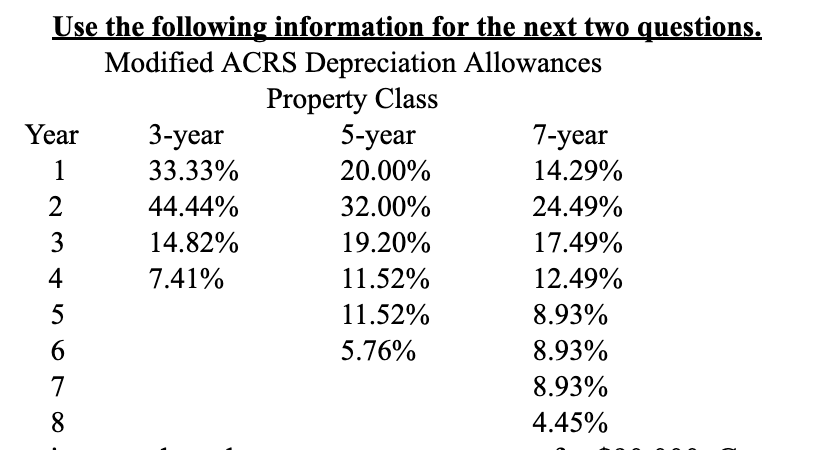
Your company just purchased a new computer system for $90,000. Computers have a 5- year MACRS classification. Tax rate is 40%.
What is the depreciation tax shield in year 3?
a. $ 9,800
b. $11,200
c. $ 8,800
d. $ 6,912
e. $61,200
$ 6,912

What is the book value of the machine at the end of year 2?
a. $ 9,800
b. $11,200
c. $28,800
d. $43,200
e. $61,200
43,200
BV2 = 90,000 - (D1 + D2)
= 90,000 * (20% + 32%)
= 90,000 [1 - 52%]
= 90, 000 * 48 %
= 43,2000
The possibility that errors in projected cash flows can lead to incorrect NPV estimates is called:
a. Forecasting risk.
b. Projection risk.
c. Scenario risk.
d. Monte Carlo risk.
e. Accounting risk.
forecasting risk
What is the accounting break-even point for the following project? An initial investment of $9,000 is required, straight-line depreciable to zero over 6 years. Unit Sales is 4,400; price/unit is $9; variable cost/unit is $5; fixed cost is $6,000 The discount rate is 12%. Ignore interests and taxes.
a. 800
b. 923
c. 1,000
d. 1,875
e. 2,212
1,875
Which of the following requires finding the point where NPV=0?
a. Finding the project AAR.
b. Finding the accounting break-even point
c. Finding the cash break-even point
d. Finding the financial break-even point
e. Finding the project EAC.
d. Finding the financial break-even point
What is the degree of operating leverage? Sales = 40,000 units; price = $20; variable cost = $14; fixed costs = $90,000; depreciation = $60,000; tax rate = 35%. Ignore interest.
a. 0.88
b. 1.09
c. 1.28
d. 1.53
e. 1.76
1.76
You are to calculate operating cash flow using the following information: sales, net income, depreciation, and net initial investment. If interest expenses are zero, then it would likely be easiest for you to use the approach.
a. conventional
b. tax shield
c. bottom-up
d. top-down
e. depreciation first
bottom-up
Your required return is 15%. Should you accept a project with the following cash flows?
Year 0 1 2 3
Cash flow $25 $10 $10 $25
a. No, because the IRR is 5%
b. No, because the IRR is 10%
c. Yes, because the IRR is 20%
d. Yes, because the IRR is 30%
e. Yes, because the IRR is 40%
Yes, because the IRR is 30%
A project requires an initial investment of $5,000, straight-line depreciable to zero over 5 years. Unit sales is 2,000; price/unit is $15; variable cost/unit is $10; fixed cost is $4,000. Discount rate is 12%. Ignore interests and taxes. What is the cash break-even point?
a. 800
b. 923
c. 1,000
d. 1,077
e. 1,212
800