0010 Week 2 — Sensation, Psychophysics & SDT
 Call Kai
 Learn
Learn Practice Test
 Spaced Repetition
 Match
Match Flashcards
 Knowt Play
1/54

There's no tags or description
Looks like no tags are added yet.
Name | Mastery | Learn | Test | Matching | Spaced | Call with Kai | Chat |
|---|
No analytics yet
Send a link to your students to track their progress
55 Terms
Distinguish sensation from perception
Sensation = detection and encoding of physical energy; perception = organization and interpretation of sensory information

Order the sequence from physical stimulation to perceptual experience
Physical stimulus → sensory receptors → transduction → neural coding/neural signals → perceptual experience
What is transduction, and where does it occur in the sequence from physical stimulation to perceptual experience?
Transduction = converting physical energy into neural signals; it occurs after sensory receptors detect the stimulus and before neural coding, on the way to perceptual experience. In vision it begins in the retina.

Is perception a copy of the physical world?
No — perception is constructed from sensory information and influenced by the perceiver
What is bottom-up processing?
Information coming from the sensory stimulus builds perception from smaller pieces (feed-forward)
What is top-down processing?
Knowledge, expectations, and context influence interpretation (feedback — the whole guides perception of smaller features)

What is synesthesia?
Stimulation of one sensory or cognitive system automatically produces an additional experience (e.g., letters evoke colors)
What was the research question in Bor et al. (2014)?
Can synesthesia be learned — would trained letter-color associations become automatic enough to affect perception?
Describe the Bor et al. (2014) training procedure
Non-synesthetic adults did 9 weeks of letter-color training (~30 min/day, 5 days/week): adaptive memory tasks + colored-letter reading on 13 letter-color associations
How did Bor et al. (2014) test whether learned associations became automatic?
Stroop-like task: name the actual ink color of a letter shown in its trained color vs a different color

What did Bor et al. (2014) find?
Learned color associations became increasingly automatic; after training, 9 of 14 participants reported synesthesia-like color experiences
Why does the Bor et al. (2014) result matter?
It shows learned associations can become automatic enough to affect perception, supporting that synesthetic experiences are genuinely perceptual, not just learned associations

Give evidence that perception is constructed rather than passively recorded
Synesthesia (extra experiences added to stimulation); top-down effects (expectations/context shape interpretation); apparent motion (motion seen in stationary stimuli); inattentional/change blindness (looking ≠ perceiving)
What is psychophysics?
The quantitative study of the relationship between physical stimulation and psychological experience (physical stimulus ⇄ perceptual response)
What is the absolute threshold?
The minimum energy needed to detect a stimulus at all — detected 50% of the time
What does a lower absolute threshold indicate?
Greater sensitivity
How is the absolute threshold measured?
Present stimuli of varying intensity and find the level detected 50% of the time
Approximate absolute threshold for vision (Galanter, 1962)
A candle flame seen from ~30 miles
Approximate absolute threshold for hearing (Galanter, 1962)
A clock tick heard from ~20 feet
Approximate absolute threshold for touch (Galanter, 1962)
A fly's wing falling on the cheek
Approximate absolute threshold for smell (Galanter, 1962)
A drop of perfume dispersed across several rooms
Approximate absolute threshold for taste (Galanter, 1962)
A teaspoon of sugar in gallons of water
What is the JND (just noticeable difference)?
The smallest difference between two stimuli detected 50% of the time — "Can I tell that it changed?"
How is the JND measured?
Vary the difference between two stimuli (e.g., 1 lb + ? vs 20 lb + ?) and find the difference detected 50% of the time
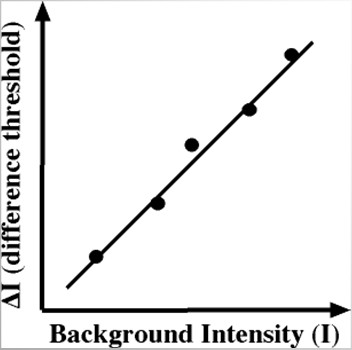
State Weber's law
ΔI/I = k — the JND is approximately a constant proportion of the starting stimulus intensity
Why is the same physical increase easy to detect on a small stimulus but hard on a large one?
Because the JND is a constant proportion (Weber's law): a fixed ΔI is a large fraction of a small I but a tiny fraction of a large I

State Stevens' power law
Perceived intensity = k·I^a — perceived intensity does not always increase linearly with physical intensity
What does Stevens' power law tell us about physical vs perceived intensity?
Equal physical increases do not necessarily produce equal perceptual increases; the exponent determines whether perception grows faster or slower than the stimulus
Stevens exponent for loudness
0.67 (3000-Hz tone)
Stevens exponent for lightness
1.2 (reflectance of gray papers)
Stevens exponent for electric shock
3.5 (current through fingers)
Stevens exponent for warmth
1.6 (metal contact on arm)
Stevens exponent for taste (salt)
1.4
Stevens exponent for smell (heptane)
0.6

Why is detection described as probabilistic rather than occurring at one perfectly defined threshold?
Because of trial-to-trial variability (neural noise): the same stimulus is sometimes detected and sometimes not; detection follows a psychometric function, and different functions can yield the same threshold

Why doesn't the threshold alone tell you how variable or reliable performance is?
Different psychometric functions can yield the same threshold; practice usually reduces response variability, giving a more reliable threshold estimate
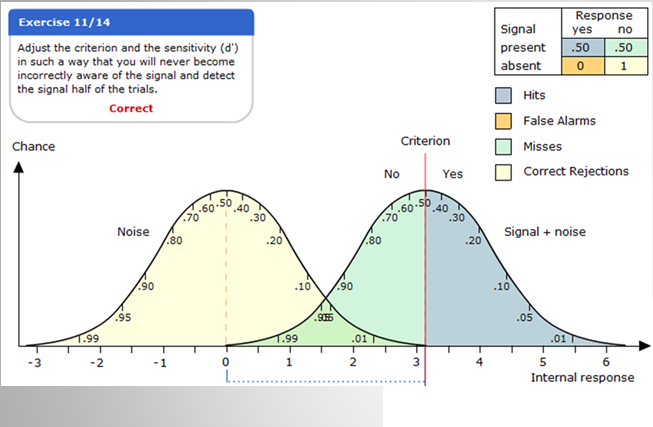
In SDT, what is a hit?
Stimulus present and observer responds "present" — correctly identifying the stimulus
In SDT, what is a miss?
Stimulus present and observer responds "absent" — failing to detect the stimulus
In SDT, what is a false alarm?
Stimulus absent and observer responds "present" — reporting the stimulus when it is not there
In SDT, what is a correct rejection?
Stimulus absent and observer responds "absent" — correctly identifying that the stimulus is absent
What did Drew et al. (2013) find with expert radiologists?
Searching chest CT scans for lung nodules, radiologists missed an embedded gorilla; of the 20 who missed it, 12 looked directly at its location (average dwell 547 ms) — inattentional blindness even in experts
In the Drew et al. (2013) radiology example, what are the signal and the noise?
Signal = disease (nodule) present; noise = disease absent or a competing explanation
How do the costs of misses vs false alarms matter in SDT?
The cost of each error type influences the criterion with which identifications are made

What is d′ in SDT?
Sensitivity — the distance between the noise distribution and the signal+noise distribution; larger d′ = easier discrimination
How does increasing d′ change the four SDT outcomes?
More hits and correct rejections, fewer misses and false alarms
How does decreasing d′ change the four SDT outcomes?
Fewer hits and correct rejections, more misses and false alarms
What factors can influence d′ (sensitivity)?
Stimulus strength/intensity, attention, and sensory noise
What does the response criterion measure in SDT?
The decision rule — the observer's willingness to say "present"

How does a liberal criterion affect the four SDT outcomes?
More hits AND more false alarms
How does a conservative criterion affect the four SDT outcomes?
Fewer false alarms AND more misses
Does changing the response criterion change the sensory evidence?
No — only the decision rule changes; the sensory evidence (d′) is unchanged
What is the core achievement of SDT?
It separates the ability to discriminate (d′, sensitivity) from the willingness to say "present" (criterion)
What factors can influence the response criterion?
Expectations, costs/consequences (payoffs), and base rates
How do observer factors differentially affect sensitivity vs criterion?
Attention affects sensory evidence and the decision; expectations affect primarily the decision/criterion (but potentially perceptual processing); costs/consequences affect the decision/criterion
Summarize the full SDT processing chain
Stimulus → sensory evidence → decision → response; detection reflects BOTH the quality of sensory evidence (d′) and the criterion used to interpret it