Geogenv test 2
 Call Kai
 Learn
 Practice Test
 Spaced Repetition
 Match
 Flashcards
 Knowt Play
1/140

There's no tags or description
Looks like no tags are added yet.
141 Terms
• ___(1)___ is the Central Premise of Biogeography!
• What are biogeographers interested in?
– Factors that influence distribution of ___(2)___
– Other factors that influence the range of ___(3)___
– Influence on a species throughout ___(4)___
• Slide note: The map shows where a single bull bison travelled in one year. He keeps meeting up with a wolf pack, but rarely comes in contact with the herd.
• Class note: Bison were almost eradicated by settlers. Students working with Parks collared the bison to map the herd's movement through the Rocky Mountain valleys.
2) individuals
3) populations
4) history
Slide title: Understanding Geographic Range
• ___(1)___: A place where a species is adapted to live
– Defined by ___(2)___ and ___(3)___
• ___(4)___: The sum of all conditions and resources under which a species can live
– Includes what the animal eats, where it feeds and lives, response to abiotic factors
– Species co-exist in an area but have separate ___(5)___
• Slide note: ___(6)___: small habitats within a habitat, including puddles, rocks, holes in trees. Distinct zonation of prairie pothole marshes indicates strong gradients of limitations, where sedges, cattails and bulrush grow and outcompete other species.
2) plant community
3) physical environment
4) Niche
5) niches
6) Microhabitats
Slide title: Habitat vs. Niche
• ___(1)___: An increase in the range of ___(2)___ that are used by a population, increasing its range
– Occurs especially when there are reduced or no ___(3)___
• Sexton et al. diagram: species in the ___(4)___ of the range are more numerous, have more of the ___(5)___ needed for survival, and receive immigrants. Species near the ___(6)___ (which can vary over time) have lower populations, with fewer individuals moving in and from only one direction.
• Class note: Edge boundaries can shift due to ___(7)___ and many other factors
2) resources
3) predators
4) middle (centre)
5) resources
6) edge
7) predators
Slide title: Niche expansion to geographic range
• Species ranges are ___(1)___: the geographic range is limited by different factors and processes, which can have greater or lesser influences that vary with ___(2)___ and ___(3)___ scales
• The ___(4)___ of the symbols shows when factors have greater (thicker) and lesser (thinner) influences
• Spatial scale on the figure runs from plots (10^2 m) to the size of continents (10^7 m)
• Figure label: shorter-term processes are behavioural and ___(5)___ responses; longer-term processes are geological and tectonic events
2) spatial
3) temporal
4) thickness
5) physiological
Slide title: Species ranges are scale dependent
• Species ranges tend to be full of ___(1)___
• Notice:
– Distribution is complicated
– Clumps are ___(2)___ in areas where it is more difficult to grow
– Gaps between them are ___(3)___
• Mapping of species ranges is difficult and generalized: The larger the ___(4)___, the more likely a species will be found there
• Slide note: At the edge of species ranges, you ___(5)___ have that species (or individuals) occurring there
2) smaller
3) larger
4) cell
5) may or may not
• Species range maps are ___(1)___
• Is this a realistic map of bear populations? Why is this important?
• Geographic ranges of species are highly ___(2)___ and generalize the ___(3)___ and ___(4)___ of individuals
• Class note: For example, London, ON is part of the black bear range, but bears aren't seen there
2) variable
3) habitats
4) likelihood
Slide title: Species range maps are generalized
[L4 S11] Environmental Factors Affecting Organisms
• Organisms are inherently tied to their environment, with a variety of ___(1)___ and ___(2)___ factors impacting them
• ___(3)___: Any factor that varies in space and time but is not used up (Ex. temperature, salinity, etc)
• ___(4)___: A factor that is consumed by organisms → Can result in ___(5)___
• Slide note: If something changes, it can be depleted, creating ___(6)___ or defining where organisms are successful and can grow
• Class note: Examples of conditions: ___(7)___ and possibly soil
1) biotic
2) abiotic
3) Condition
4) Resource
5) limitations
6) competition
7) sunlight
• ___(1)___: a group of members of the same species living in an area
• ___(2)___: populations of ___(3)___ species living together in an area
• Populations grow with ___(4)___ and ___(5)___
– They decline with ___(6)___ and ___(7)___
2) Community
3) different
4) births
5) immigration
6) deaths
7) emigration
Formula: (Births + Immigration) – (Deaths + Emigration) = Change in population number
• ___(1)___: a change in population
• ___(2)___: (births + immigration) = (deaths + emigration)
• ___(3)___: amount the population has changed divided by the ___(4)___ it had to change
– Why is this important? Tells us about the ___(5)___ of species and potential for range ___(6)___
• Slide note: The population growth is typically not ___(7)___
• Class note: A change in population growth is a good indicator of the species but also of the ___(8)___ of the environment itself
2) Equilibrium
3) Population growth rate
4) time
5) density
6) boundaries
7) zero
8) health
Slide title: What is Population Growth?
[L4 S14] 3 Models of Population Growth (model 1) • ___(1)___ Population Growth: adding a constant number of individuals over each ___(2)___ period • Not typically found in ___(3)___, why? • Population number at the start + (A constant × Time) = Population number at the end • Ex: start with 2 individuals and a constant growth rate of 2: at the end of 24 weeks you would have 50 individuals • Slide note: The simplest type of growth to model. It provides a good ___(4)___ to other growth curves.
1) Constant 2) time 3) nature 4) comparison
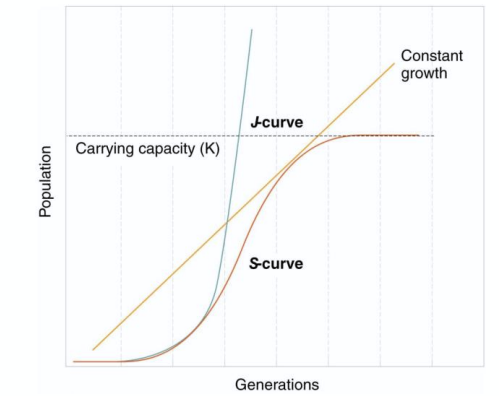
• ___(1)___ (___(2)___-curve): Time it takes to ___(3)___ the number of individuals
– Starting population × A constant (e) multiplied by itself a given number of times = Ending population
• ___(4)___: the number of offspring individuals can produce in a given time if resources are ___(5)___
• Under ___(6)___ conditions, organisms with a high r have rapid population growth. Such growth is called an "___(7)___" but it cannot continue ___(8)___. The population continues to grow and then ___(9)___.
• ___(10)___: the ___(11)___ population of a species a habitat can support without being ___(12)___
2) J
3) double
4) r (or rmax)
5) unlimited
6) unlimited
7) explosion
8) indefinitely
9) dies off
10) Carrying capacity (K)
11) maximum
12) ruined
[L4 S16] 3 Models of Population Growth (model 3)
• ___(1)___ (___(2)___-curve): A process slows the growth, which levels off near ___(3)___
– Starting population + (reproductive capacity (r) × population × a number showing ___(4)___) = Ending population
• As the population approaches K, growth slows, the population remains steady and growth = 0
• The maximum rate of population growth occurs ___(5)___ to K
1) Logistic growth
2) S
3) carrying capacity
4) how far the population is from K
5) halfway
[L4 S18–19] Reproductive Strategies Impacts on Geographic Range • ___(1)___-strategists: produce lots of young, but leave their survival to ___(2)___ – results in low ___(3)___ – rapid reproduction, rapid movement, short life span – adapted to a rapidly ___(4)___ environment – "___(5)___" populations – "___(6)___" or "opportunistic" species, usually small – Class note: They can adapt to changing environments because they have so many offspring • ___(7)___-strategists: produce ___(8)___ young – ___(9)___ for and protect young – live in a ___(10)___ environment already populated by the species – larger, longer lived, well-adapted to normal environmental ___(11)___ – populations fluctuate around ___(12)___ – also called ___(13)___ species
1) r
2) nature
3) recruitment (# of offsprings that survive)
4) changing
5) boom-and-bust
6) weedy
7) K
8) fewer
9) care
10) stable
11) fluctuations
12) carrying capacity
13) equilibrial
[L4 S22 📷] Consequences of Population Growth • Exponential growth may be followed by a ___(1)___, while populations centre around ___(2)___ in logistic growth • Figure: Population explosion → ___(3)___ and then dying off due to ___(4)___ • Figure: Logistic population held in balance by ___(5)___
1) crash 2) K (carrying capacity) 3) overgrazing 4) starvation 5) environmental resistance

[L4 S23 📷] Species live within their environmental limits
• For every factor, there is an ___(1)___ range of resources available
• ___(2)___: The entire range allowing for the growth of organisms
• ___(3)___: high and low ends of tolerance range
• ___(4)___: between the optimal range and high or low limits of tolerance
• Slide note: These zones are often toward the edges of ecological zones and ecosystems. Some species have much broader ranges of tolerance and others much narrower. Population density of a species is greatest where all of the conditions are ___(5)___ for that species.
• Slide example: a vernal pool in the Westminster Ponds area of London (class note: duckweed growing in it)
1) optimum
2) Range of tolerance
3) Limits of tolerance
4) Zones of stress
5) optimal
[L4 S24] Limits to Growth • ___(1)___: the biotic and abiotic factors that limit a population's increase
• It can also lower ___(4)___ – loss of habitat, pollution, changed animal migration – E.g. Many stressors on northern caribou → Impact to people
1) Environmental resistance 4) reproduction 5) pollution
Slide title: Environmental Resistance & Limits to Growth

[L4 S25 📷] Biotic Potential vs. Environmental Resistance • ___(1)___ occur based on factors that increase and decrease the populations over time • Figure: Below the ___(2)___, a population may not recover
1) Stable populations 2) critical number
• ___(1)___: Any factor that limits ___(2)___
• ___(3)___: Any factor that is outside of the ___(4)___ range will:
– Cause ___(5)___ and limit growth, reproduction, and survival
– It may be a problem of too much or too little
– The factors can ___(6)___ over time
• ___(7)___: Factors that ___(8)___ to cause a greater effect than expected, e.g. climate warming increases vulnerability to ___(9)___
2) growth
3) Law of limiting factors
4) optimal
5) stress
6) change
7) Synergistic effects (synergisms)
8) interact
9) mountain pine beetle
Slide title: The Law of Limiting Factors
[L4 S28 📷] Niche model (part 1) • ___(1)___: Species are limited by a number of ___(2)___ environmental factors • Distribution can be examined as a "___(3)___", where two or more factors can have a positive or negative influence • Class note: Combining temperature and salinity gives an oval shape on the figure
1) Hutchinson's multi-dimensional niche concept 2) interacting 3) hypervolume Slide title: Hutchinson's Multi-dimensional Niche Concept

[L4 S29 📷] Niche model (part 2: individuals) • Model of multi-dimensional niche concept • ___(1)___ → Niche of species • ___(2)___ → range of conditions • Figure: The outer boundary around all individuals is the ___(3)___
1) Realized niche 2) Potential individualized niche 3) population niche

• Multi-dimensional niche concept = framework for understanding limits on geographic range and local population ___(1)___. Niche concepts don't account for full range of distribution:
1. Not all locations are equally favourable: Some areas have > birth rates than others = ___(2)___ Habitats; Some unfavourable = ___(3)___ Habitats
2. Some habitats are unfavourable but still have species inhabiting them, e.g. ___(4)___ species. Important to look at the ___(5)___ of ranges
3. Some habitats are inhabited ___(6)___, e.g. via local extinctions and immigration
2) Source
3) Sink
4) invasive
5) history
6) intermittently
[L4 S31] Distribution-Density Factors
• Population density: number of individuals per area
• ___(1)___: increases with increased population density
– Disease, predation, food shortages
– Environmental resistance increases ___(2)___
• ___(3)___: its effects are independent of the density of the population
– Spring freeze, fire
– Is not involved in maintaining population ___(4)___
1) Density-dependent factor
2) mortality
3) Density-independent factor
4) equilibrium
• Variations in density and access to resources will also control population before it reaches ___(1)___
• ___(2)___: competition or rivalry between/among living things for ___(3)___, territory, mates, etc.
• ___(4)___: ___(5)___ competition for resources, thereby limiting the availability of these to other organisms (e.g. a bear catches a fish, so it is no longer available to other bears)
• ___(6)___: interaction between competing species is direct (e.g. ___(7)___), e.g. a vulture and a coyote fighting over the same food
• Class note: A fox competing with a vulture for the same food source is another example of this type of competition
2) Competition
3) resources
4) Exploitation competition
5) Indirect
6) Interference competition
7) aggression
• Relationships between species: Positive (helpful), negative (harmful) or neutral
• ___(1)___: one member benefits, the other is harmed (+−)
– Includes ___(2)___, ___(3)___
• ___(4)___: both species are harmed (−−)
– ___(5)___ competition: between different species
– ___(6)___ competition: between the same species
• ___(7)___: Two unrelated organisms co-exist over a long period of time (usually the lifetime of one of the individuals)
• Slide note: ___(8)___: a type of highly specialized parasite; viruses and bacteria that cause diseases by spreading through contact, fluids, particles, etc.
2) parasitism
3) herbivory
4) Competition
5) Interspecific
6) Intraspecific
7) Parasitism
8) Pathogens
• ___(1)___: both species benefit (++), e.g. honey bee and flowers
• ___(2)___: one benefits, the other is not affected (+0), e.g. egrets sitting on cattle eating insects
• ___(3)___: one is unaffected, the other is harmed (0−), e.g. algae using up all the oxygen and killing fish
2) Commensalism
3) Amensalism

[L4 S36 📷] Hare and lynx graph • ___(1)___: Regulation of ___(2)___ (predators regulate prey populations) • Slide note: The rise in the population of predators is typically ___(3)___ than the prey, though the spike in predators ___(4)___ the rise in prey. Over time, prey can develop ___(5)___ (camouflage, speed, etc.), so those that are easily caught are removed from the population. • Graph: Snowshoe hare and Canada lynx populations cycle roughly every ___(6)___ years (1850–1930)
1) Top-down controls 2) herbivores 3) less 4) follows 5) defenses 6) 10 Slide title: Predators regulate prey populations
• Environmental changes can alter ___(1)___ relationships:
– Impacts to habitats/ecosystems
– Food availability/reproduction
– Climatic anomalies/instabilities
– Parasites (weaken ___(2)___)
• Environmental resistance – ___(3)___ vs. carrying capacity
• Class note: The change in climate we see now is more ___(4)___ than ever experienced
2) hosts
3) Overgrazing
4) rapid
• All species are affected by other species:
– Species also ___(1)___ their environment
– And also impact the ___(2)___ of other species
• Today: Look at the geography of communities to biomes
2) distribution
(Example of a species that does this: beavers building dams that turn streams into ponds and wetlands. This example is mine, not from the slide.)
• Frederic E. ___(1)___ (1916): Ecological communities are like "___(2)___" → Organisms make up the community; ___(3)___ similar to "___(4)___"
• Henry A. ___(5)___ (1917, 1926): ___(6)___ individuals in the same place at the same time (focus on plants) → Depends on ___(7)___ into an area
• Both arguments can occur: Different aspects of communities can be measured, e.g. photosynthesis, metabolism (respiration), use of energy and nutrients
• Slide note: ___(8)___: the ___(9)___ change of an ecosystem over time, e.g. a pond accumulating organic matter, changing into a ___(10)___, and then eventually a ___(11)___
2) super organisms
3) Succession
4) growth
5) Gleason
6) Independent
7) movement
8) Succession
9) gradual
10) wetland
11) forest
• Flora and Fauna exist together in ___(1)___: Grouping of plants into areas of similar ___(2)___, creating distinct zones or areas
• Also distributed within the same zones that host plant species habitats → Similar ___(3)___ distributions
• Example: Palm Warbler and Blackpoll Warbler in the boreal forest
2) climates
3) geographic
• ___(1)___: Species that live together in the same place
• ___(2)___: The major ___(3)___ of plants and animals occurring together (___(4)___ areas), e.g. grassland, boreal
2) Biomes
3) formations
4) large
Slide title: Communities Review + Details
1. Community ___(1)___: Species diversity, composition, biomass (amount (mass) of living organic matter)
2. Community ___(2)___: Dynamic influences on energy flow, nutrient cycling, photosynthesis, decomposition
• Historic view → Look at species existing and interacting in the same area
• Now → Focus on ___(3)___ to regional interactions across scales
• ___(4)___: Local communities linked by ___(5)___ or interactions over broader areas
2) Function
3) local
4) Metacommunity
5) dispersal
• ___(1)___: Includes all species but also all features of the ___(2)___ and ___(3)___ environment and their interactions
• ___(4)___: Studies exchanges of ___(5)___, gases, water, minerals between biotic and abiotic environment
– Try to constrain the interactions to small areas (but can look at much larger areas too)
• Slide note: From puddle to individual swamp to Florida Everglades. ___(6)___: small, constrained ecosystems such as the puddle
2) biotic
3) abiotic
4) Ecosystem ecologist
5) energy
6) Microcosms
Slide title: Ecosystem
• 2 characteristics influence effects on community organization:
1. ___(1)___
2. ___(2)___ (if they are primary producers, herbivores, carnivores, or decomposers)
• General rule: ___(3)___ organisms need more energy for maintenance, growth, and reproduction
• ___(4)___ varies with body mass (M): ___(5)___
• Slide note: It takes about 14,000 times more energy to maintain a 5000 kg elephant than a 15 g mouse. But because the exponent is < 1, it takes about 25 times more energy to maintain 1 gram of mouse than 1 gram of elephant. This is why ___(6)___ are faster in smaller animals.
2) Trophic status
3) Bigger
4) Basal metabolic rate
5) cM^0.75
6) heart rates
[L5 S15] Why is this important? (Body size)
• Body size influences the scale of use of the environment
• Small species: use much ___(1)___ areas than larger species; more prolific
– Small species are better able to respond to change; won't go extinct
• Large animals: much greater requirements, need a larger ___(2)___
– For large animals, the carrying capacity of the environment is ___(3)___ (so they are more spread out)
1) smaller
2) range
3) low
• Photosynthesis → Used to create sugars, ___(1)___
– Biomass is used to provide energy along ___(2)___ (feeding) levels to other organisms
• ___(3)___: describes where ___(4)___ and ___(5)___ go as they move from one organism to another
• ___(6)___: ___(7)___ of food chains to form complex feeding relationships
• Slide note: Energy moves "___(8)___" the food chain. Not all energy and nutrients go to higher levels.
2) trophic
3) Food chain
4) energy
5) nutrients
6) Food web
7) interconnection
8) up
• ___(1)___: produce organic material – requires energy
– Also known as ___(2)___
– Examples: Green plants, some single-celled organisms and ___(3)___ bacteria
• ___(4)___: consume organic material to get energy
– ___(5)___: eat ___(6)___ prey and/or plants
– ___(7)___: eat ___(8)___ organic material
• Slide note: The first group produces organic material from ___(9)___ matter by using an external energy source, such as the sun
2) producers
3) chemosynthetic
4) Heterotrophs
5) Consumers
6) living
7) Decomposers
8) dead
9) inorganic
• Living organisms are categorized based on how they get their ___(1)___
• Producers:
– ___(2)___: use ___(3)___ to absorb light energy
– ___(4)___: use ___(5)___ pigment to absorb light energy
– ___(6)___: use high-energy inorganic chemicals such as ___(7)___
• Consumers also include ___(8)___: plants or animals that become associated with another plant or animal and feed on it over an extended period of time
2) Photosynthetic green plants
3) chlorophyll
4) Photosynthetic bacteria
5) purple
6) Chemosynthetic bacteria
7) hydrogen sulfide
8) parasites
• Consumers include: Animals, fungi (mushrooms, mold), most bacteria
– Range in size from plankton to blue whales
• They are categorized according to their ___(1)___
– ___(2)___ (___(3)___): eat producers
– ___(4)___: feed on primary consumers
– Third (tertiary), fourth (quaternary), or higher levels
• ___(5)___: secondary or higher-order meat eaters
• ___(6)___: feed on both plants and animals
• Slide note: Most terrestrial ecosystems have only ___(7)___ levels; some marine ecosystems have up to ___(8)___
2) Primary consumers
3) herbivores
4) Secondary consumers
5) Carnivores
6) Omnivores
7) 3–4
8) 5
• ___(1)___: dead plant material (leaves, etc.), ___(2)___ wastes, and dead plants, animals
• It is organic, high in potential ___(3)___ for:
– ___(4)___ (vultures): decomposers that break down large pieces of matter
– ___(5)___ (earthworms): decomposers that eat partly decomposed matter
– ___(6)___ (fungi and bacteria): decomposers that break down molecule-sized matter
• Slide note: Most of the energy in the ecosystem goes through this food web, not the grazing one
2) fecal
3) energy
4) Scavengers
5) Detritus feeders
6) Chemical decomposers
• ___(1)___: the total combined (net ___(2)___) weight of organisms
– Each higher trophic level has about ___(3)___% less biomass (or is 10% of the former)
• ___(4)___: the different levels of producer and consumer mass
• How do you measure biomass? Clip, dry, weigh, dry, weigh
• ~___(5)___% of the dry weight is carbon
• Example: If one acre of grassland has 907 kg (2,000 lbs), it can support ___(6)___ kg (200 lbs) of herbivores and ___(7)___ kg (20 lbs) of primary carnivores
• Slide note: Biomass is put in a paper bag and dried at about 60 °C for 48–60 hours until the weight no longer changes
2) dry
3) 90
4) Biomass pyramid
5) 50
6) 90.7
7) 9.07
Note: the slide says 9.7 kg, but 10% of 90.7 is 9.07.
• They estimate there is about ___(1)___ Giga tonnes (Gt) of C on Earth
• About ___(2)___% are plants
• The second largest is ___(3)___ at ___(4)___% of the global biomass
2) 80
3) bacteria
4) 15
• This is further divided into marine, deep subsurface and terrestrial and by consumers and producers. Results interpreted with caution due to various uncertainty
• Figure: terrestrial ≈ 470 Gt C, deep subsurface ≈ 70, marine ≈ 6
• Figure: Terrestrial producers 450 vs. consumers 20. Marine producers 1 vs. consumers 5, so in the ocean ___(1)___ outweigh ___(2)___
2) producers
[L5 S26] The Fate of Food • ___(1)___% of food consumed is oxidized for energy
– ___(2)___% is converted to biomass
– Food that is not used becomes ___(3)___
• ___(4)___: material in plant cell walls
– Forms fiber, bulk, or roughage
• Slide note: Food not used for energy is used for ___(7)___ of body tissues, repair, and maintenance. Waste products also include carbon dioxide, nitrogen, phosphorus, and water.
1) 60–90 2) 10–40 3) waste 4) Cellulose 7) growth
• High trophic level organisms use ___(1)___ energy for the same amount of biomass
– More energy needed to produce a ___(2)___ than a ___(3)___
– More time, water, and resources to produce a consumer than a producer
• ___(4)___: When materials that use water are exported, you are also exporting the water they used to grow. 1 cup of coffee = ___(5)___ litres of water
• Some materials are hard to excrete (e.g. chemicals in fat)
– ___(6)___ of chemicals as you go up the food chain
– They ___(7)___ (build up in tissues) → problems for others that consume them
2) consumer
3) producer
4) Virtual water
5) 140
6) Biomagnification
7) bioaccumulate
• Same process as terrestrial but 2 big differences:
• 1) More ___(1)___ is available at each level
– Transfer of energy is more ___(2)___
– ___(3)___-blooded animals require less energy than warm-bodied animals → Less energy is needed to support body weight
– Food chains can be ___(4)___ (more levels)
• 2) Aquatic systems may have a ___(5)___ biomass pyramid
– Larger, older fish eat algae that turn over rapidly
• Slide note: Lower trophic levels have very high ___(6)___ rates and short lifespans
2) efficient
3) Cold
4) longer
5) reversed (inverted)
6) turnover
• ___(1)___: boundaries that ecological communities often have as they transition
A) Groups of species as ___(1)___ communities with ___(2)___ boundaries
B) Species ___(3)___ each other, sharp boundaries, not closely associated with others
C) Discrete communities with gradual ___(4)___; species evolved to ___(5)___ with gradual replacement
D) Species gradually appear and disappear; don't ___(6)___ or exclude each other
E) Species within the ranges of a few ___(7)___ species along the gradient
2) sharp
3) exclude
4) displacement
5) co-exist
6) compete
7) dominant
[L5 S32] Responses to change
• Ecosystems are highly dynamic with a mosaic of constantly changing patches
• ___(1)___: A significant change that kills or displaces community members → may have ___(2)___ impacts
• ___(3)___: Transition from one biotic community to another
– ___(4)___: Colonize new open area first
– Species can create conditions favourable to ___(5)___ species, but less favourable to ___(6)___
1) Disturbance
2) geomorphic
3) Ecological succession
4) Pioneer species
5) other
6) themselves
Slide title: Ecosystem Responses to Disturbance
[L5 S33] Succession is a complex process… • ___(1)___: Drives succession by improving conditions for subsequent species (succession does not continue ___(2)___) • ___(3)___: Final stage of succession – These communities can also change if new species are ___(4)___ / old ones removed – Patches of disturbance = new space for growth – Fire as a "___(5)___" mechanism for ecosystems • Slide note: Ecosystems that are adjacent to each other can be at different ___(6)___ stages
1) Facilitation (interaction where one species makes conditions better for another) 2) forever 3) Climax ecosystem 4) introduced 5) reset 6) successional
• ___(1)___: The process of initial ___(2)___ and progression from one community to another
• ___(3)___: Occurs following ___(4)___ (e.g. fire, floods, humans)
• Slide note: The first type occurs in an area that lacks ___(5)___ and ___(6)___, e.g. following glacial ___(7)___. The second type starts with soil that is already ___(8)___, e.g. abandoned ___(9)___ fields, or mosses, forbs and grasses invading an area of southern NWT burned by fire decades ago.
2) invasion
3) Secondary succession
4) disturbance
5) plants
6) soil
7) recession
8) pre-existing
9) agricultural
Slide title: Primary Succession
• Succession requires that plants and animals are already in the area
– There are a range of stages of succession → Creates gaps or ___(1)___
– Enhances ___(2)___ (can reduce ___(3)___ spread)
• Natural succession can be ___(4)___ if species are not available to re-establish within an area
– E.g. regeneration prevented due to lack of seeds and grazing sheep; Iceland, Scotland, Haiti, other parts of Europe
• Slide note: ___(5)___ species help prevent intense wildfire spread due to their high foliar ___(6)___ content. Grasses and pines ___(7)___ fire (fire opens cones, spreading seeds), whereas ___(8)___ species are damaged by fire but are often first to come back. Fire also releases nutrients from dead organic matter over time.
2) biodiversity
3) fire
4) blocked
5) Deciduous
6) moisture
7) tolerate
8) broadleaf
• ___(1)___: The ability of an ecosystem to return to normal ___(2)___ after disturbance – maintains ecosystem ___(3)___
• Mechanisms – include processes of:
– Replenishment of ___(4)___
– ___(5)___ by plants/animals
– Regrowth of plants, ___(6)___
• It has limits:
– Highly disturbed ecosystems don't have the same functions/processes
– A less ___(7)___ ecosystem may occur and does not return to previous ___(8)___
• Slide note: C.S. ___(9)___ (1973): ecosystems can undergo a certain amount of stress before they reach a ___(10)___, which causes them to shift to another state (e.g. grassland → woodland/shrub)
2) function
3) sustainability
4) nutrients
5) Dispersion
6) succession
7) productive
8) state
9) Holling
10) threshold
Slide title: Resilience
• Illustrates ___(1)___ dispersal of seeds released from ___(2)___ cones, which have a waxy coating and open up with the ___(3)___ from the wildfire
• Jack pine have about ___(4)___ years of cones accumulated at any one time
• Research by Brad Pinno found that forests with ___(5)___ jack pine trees have greater density of seedlings, while ___(6)___ ones, when burned, have lower densities of post-fire seedlings
• Question from slide: As fires burn more frequently and over larger areas, what happens to jack pine seedling density?
2) serotinous
3) heat
4) 10
5) older
6) younger
Answer to the question: it should decrease, since stands that burn young haven't built up a store of cones (my reasoning from the slide).
[L6 S5] The Distribution of Biomes
• The distribution of biomes corresponds approximately with the distribution of ___(1)___ zones
• Vegetation is also highly dependent on ___(2)___ and the development of ___(3)___
1) climatic
2) elevation
3) soil
• Distribution of global forests occurs across Tropical, Temperate, Dry, Polar/Montane and even Aquatic hydro-climatic zones. But notice too the influence of ___(1)___ areas
• Forests cover about ___(2)___ of the land surface area and ___(3)___% of the total plant biomass
• They have most of the terrestrial ___(4)___ and are very important for ecosystem ___(5)___ (wood, food, pharmaceuticals, etc.)
• Class note: Some of the oldest trees are also the tallest. But in the Canadian and American Rockies the trees are old but not very ___(6)___ due to very cold temperatures, short ___(7)___, and soil conditions (not a lot of soil on mountain slopes)
2) 1/3
3) 80
4) species
5) services
6) tall
7) growing seasons
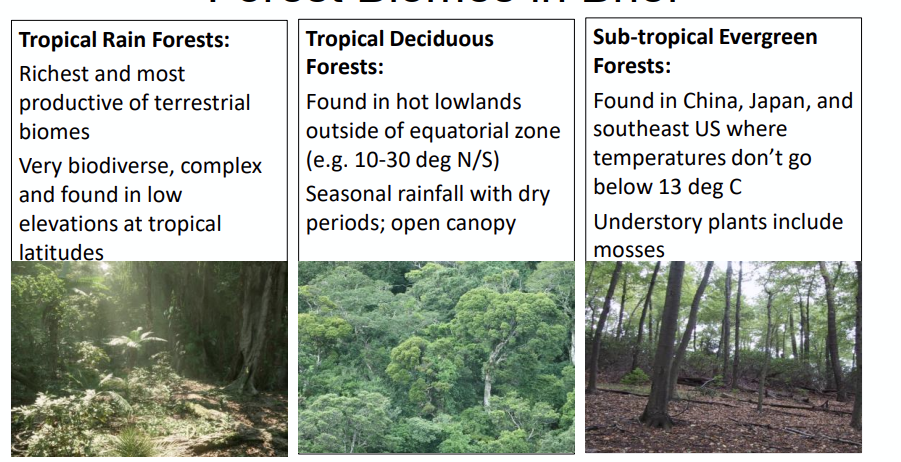
[L6 S8] Biomes in Brief (set 1) ___(1)___ • ___(2)___ and most productive of terrestrial biomes; very biodiverse, complex, found in ___(3)___ elevations at tropical latitudes • Abundant rainfall over ___(4)___ cm annually, mostly seasonal; air temperatures range from 18 to 32 °C • Trees very large with ___(5)___ canopies; the multi-layered canopy is so dense that the forest floor is often quite ___(6)___ • Decomposition occurs ___(7)___ due to heat and moisture • Class note: Very biodiverse in the upper canopy but not the lower canopy ___(8)___ • Found in hot lowlands outside of the equatorial zone (e.g. ___(9)___ deg N/S) • Seasonal rainfall with ___(10)___ periods; ___(11)___ canopy, which lets more vegetation grow in the understory • Influenced by ___(12)___ rains; best known in Asia and India • Class note: Very diverse and productive during the rains; in dry periods, changes in ___(13)___ ___(14)___ • Found in China, Japan, and southeast US where temperatures don't go below 13 deg C (no ___(15)___) • Understory plants include mosses; trees include oaks, laurels, magnolia
1) Tropical rain forests 2) Richest 3) low 4) 180 5) closed 6) bare 7) rapidly 8) Tropical deciduous forests 9) 10–30 10) dry 11) open 12) monsoon 13) senescence 14) Sub-tropical evergreen forests 15) frost Slide title: Forest Biomes in Brief
___(1)___
• Found in temperate latitudes with enough ___(2)___; green in summer, lose leaves in ___(3)___
• Highly variable structures with long near-surface root structures; not strongly influenced by ___(4)___; slow growth rates
• Overstory canopies often closed, so the understory is moist with little light
• Class note: London, Ontario is in this biome
___(5)___
• Contain extensive ___(6)___ and are above ___(7)___, allowing large evergreen trees to grow
• Cooler temperatures reduce growth of deciduous; lots of mosses
• Largely unimpacted by wildland fire; cool moist climate ___(8)___ the rate of decomposition; closed canopy with lots of ___(9)___ (standing dead stems)
• Found in coastal mountain areas: BC to Washington, Oregon, northern California
• Class note: Less productive than tropical rainforests because it is not very warm
___(10)___
• Found in northern North America, Russia, Europe, Asia; can also extend into temperate and some mountain subtropical regions
• ___(11)___ species diversity, due to cool conditions and a short growing season
• High soil moisture reduces decomposition → significant ___(12)___ accumulation; ___(13)___ soils further limit species diversity; canopy typically not very dense
• Class notes: Pine and spruce drop needles, creating acidic soil. An aspen grove is considered a single organism because all trees are genetically identical ___(14)___ connected by one underground root system.
2) moisture
3) Fall
4) fire
5) Temperate rainforest
6) fog
7) freezing
8) reduces
9) snags
10) Boreal forest
11) Low
12) moss
13) acidic
14) clones
Slide title: Forest Biomes in Brief
[L6 S10] Biomes in Brief (set 3)
___(1)___
• Climate: hot and ___(2)___, with a long dry season
• Location: tropics, near tropical deciduous forests
• Vegetation: small thorny shrubs and trees, various ___(3)___; plants lose leaves in the dry season
___(4)___
• Climate: mild, with wet ___(5)___ and hot, dry summers; impacted by fire in summer
• Location: often inland (class note: little precipitation or wind from the ocean, another reason it is dry)
• Vegetation: hardy conifers such as juniper that ___(6)___ from roots after fire
___(7)___
• Climate: hot and dry, with intense seasonal precipitation, wildland fire, and seasonal grazing by migratory animals
• Location: within 25° N and S of the equator, especially ___(8)___
• Vegetation: sparse layer of ___(9)___ (dry-adapted) plants, such as cacti and pineapple
1) Thorn woodland
2) semi-arid
3) succulents
4) Sclerophyllous woodland
5) winters
6) resprout
7) Tropical savannah
8) Africa
9) xerophytic
Slide title: Woodland and Savannah Biomes in Brief
[L6 S11] Biomes in Brief (set 4)
___(1)___: Found at low to moderate elevations from 30–40 deg N and S between tropics and temperate biomes. Rainfall is lower than evapotranspiration – Low diversity of plants adapted to very dry conditions; found in high-___(2)___ bands (the horse latitudes), making them some of the driest places on Earth – Cold deserts are found in the Arctic and also have very low precipitation
Grasslands: Found between ___(3)___ and ___(4)___ forests between about ___(5)___ and ___(6)___ deg N/S. Found in the continental ___(7)___; they are impacted by seasons
– Mostly grasses and sedges; drought, fire, and grazing reduce shrubs
– Most of the biomass is ___(8)___ in roots; deep, fertile soils
– Class note: +35 to 40 °C in summer, −30 to −40 °C in winter
Tundra: Has no trees and is found above the ___(9)___ in mountain environments and north of it in sub-arctic environments. Below freezing temperatures for > ___(10)___ months – Class note: Contains ___(11)___ (ground that thaws in summer and freezes in winter)
1) Hot deserts 2) pressure 3) deserts 4) temperate 5) 30 6) 60 7) interior 8) below ground 9) treeline 10) 7 11) permafrost Slide title: Deserts, Grasslands, and Tundra in Brief
• Terrestrial ecosystems are largely ___(1)___, whereas aquatic ecosystems exist in ___(2)___
– Many aquatic species remain ___(3)___ in water; others grow on the ground
• Physical influences:
– ___(4)___ doesn't vary greatly
– Variations in ___(5)___, ___(6)___, ___(7)___ are very important
– ___(8)___ cycles are often more important than diurnal and seasonal cycles
• Class notes: The first influence listed varies little because of the heat ___(9)___ of water. Tides, caused by the ___(10)___, move nutrients onto shore, affecting shoreline biodiversity.
2) 3D
3) suspended
4) Temperature
5) pressure
6) salinity
7) light
8) Tidal
9) capacity
10) moon
Slide title: Aquatic Communities in 3D!
• Cover ___(1)___% of the Earth's surface with salt concentration ~35 parts per thousand; hold the greatest proportion of living things
• Ecosystems are divided according to ___(2)___
• ___(3)___ zone is sunlit; ___(4)___ zone is dark
• Vegetation grows in the ___(5)___ zone; communities of worms, etc. grow near ___(6)___
• ___(7)___ zone: shoreline between land and ocean, but contains marine organisms
• ___(8)___ zone: includes shelves to about 200 m deep; nutrient-rich waters
• ___(9)___ zone: area of underwater mountains and canyons
• ___(10)___ zone: most of the ocean; 2–6 km deep, dark, enormous pressure
• ___(11)___ zone: where organisms live on the bottom; highly influenced by the underlying substrate
• Class notes: Dead vegetation from the ___(12)___ zone creates ___(13)___ that sinks. Wave action moves it into the ___(14)___ and ___(15)___ zones, increasing nutrients there.
2) sea surface temperature
3) Photic
4) aphotic
5) photic
6) volcanic vents
7) Intertidal
8) Neritic
9) Bathyal
10) Abyssal
11) Benthic
12) photic
13) detritus
14) neritic
15) intertidal
[L6 S14 📷] Freshwater communities • Found in small lakes, wetlands, ponds, and sometimes connected by rivers and streams • Divided into: a) ___(1)___ habitats – running water, highly oxygenated b) ___(2)___ habitats – still water, low oxygen • ___(3)___ zone – Penetration of sunlight; often has rooted vegetation • ___(4)___ zone – Some light penetration and photosynthesis by plants • ___(5)___ zone – No light penetration • Freshwater ecosystems → Highly ___(6)___, but depend on nutrients • Class note: The first of these zones is the ___(7)___ shoreline
1) Lotic 2) Lentic 3) Littoral 4) Limnetic 5) Profundal 6) productive 7) shallow

• Develop on two kinds of soil:
1. ___(1)___: Marshes, shallow open water (swamps)
2. ___(2)___: Accumulation of > ___(3)___ cm peat moss and organic soils; bogs, fens, (swamps)
3. Can also form on the edges of ___(4)___ environments and rivers
• Class notes: Wetlands are considered ___(5)___. Clay soil holds water; a thick layer of moss decomposes slowly because the environment is ___(6)___, forming peat. Coastal example: ___(7)___.
2) Clay bottom organic peatlands
3) 40
4) coastal
5) aquatic
6) anoxic (low oxygen)
7) mangroves
[L6 S18] Framework for Species Dispersion (Lomolino et al. 2016) • Fundamental question: Why do species exist where they are?
• A function of: – Geographic ___(2)___ and conditions → Influence immigration, extinction, evolution – Influence of fundamental ___(3)___ on each other – Ecological ___(4)___ → influence immigration, survival, evolution
2) gradients 3) processes 4) interactions
1. ___(1)___: Environmental factors that influence species; similar and non-random across space (___(2)___) and regular patterns and histories
2. ___(3)___: Expansion of range by ___(4)___; population maintenance or ___(5)___ (opposite of maintenance); and species ___(6)___
3. ___(7)___: Interactions between biogeographic processes
4. ___(8)___: Distribution of species and how they ___(9)___ or ___(10)___ the distribution of other species
2) Tobler's First Law
3) Fundamental biogeographic processes
4) immigration
5) extinction
6) evolution
7) Interdependence between processes
8) Species interactions and feedbacks
9) enhance
10) inhibit
• Focus on #2: Immigration, evolution, and extinction → How biota respond to dynamics of the geographic ___(1)___
• ___(2)___: Movement away from ___(3)___ range
• ___(4)___: Arrival of species to a new site or region
• ** Used interchangeably – ___(5)___ only relevant if it is ___(6)___
• Class note: Arrival of new species usually increases biodiversity, but if the new species is ___(7)___ it reduces biodiversity
2) Dispersal
3) natal
4) Immigration
5) Dispersal
6) immigration
7) invasive
• Amazing variety of methods for dispersal by plants and animals
• Always ___(1)___ with some ___(2)___
• New areas near natal sites are typically more ___(3)___
• Increased distance = less ___(4)___
2) adaptation
3) favourable
4) similarity
[L6 S23 📷] Range changes • Ranges are typically ___(1)___: species remain within their ecological limiting factors
• BUT biogeographers become interested during ___(3)___ cases of movement: Need to know the history of past range and how it has changed; ___(4)___ have increased this
• Class note: If a species moves naturally because the environment changes, range changes are a ___(5)___ for environmental change
1) non-varying 2) limiting 3) exceptional 4) Humans 5) proxy Slide title: Ranges are typically non-varying
• ___(1)___: Occurs with 2 to a group of individuals, can be to other areas that are close or far; often ___(2)___ and unpredictable
• ___(3)___: Occurs over ___(4)___ for a population. Occurs in 3 stages:
1. Initial expansion is very ___(5)___, frequent new events; ___(6)___ to the new environment
2. Once established, range expansion becomes ___(7)___ & symmetrical
3. ___(8)___ due to environmental factors
2) chaotic
3) Diffusion
4) generations
5) slow
6) adaptations
7) exponential
8) Stabilizes

[L6 S25 📷] Alteration of traits and genetics • Species can change ___(1)___ (traits) and ___(2)___ associated with a new environment: Galapagos tortoise • Class notes: The tortoises developed different traits because of the different ___(3)___ on each island. Grey tortoises did not need to adapt much because there was a lot of vegetation. White tortoises have longer ___(4)___ because they needed to adapt to less vegetation. All came from the same original species.
1) phenotypically 2) genetically 3) plants 4) necks
• ___(1)___: Migration over long time scales and many ___(2)___ → ___(3)___ change on a large scale
• Examples:
– European ___(4)___ trees → Began ___(5)___ to ___(6)___ diffusion after the last ice age with receding ___(7)___; new ___(8)___ varieties
– Old World Bactrian and Dromedary ___(9)___
– Spread of ___(10)___: Zebra, Przewalski's horse, Asian wild ass
2) generations
3) evolutionary
4) beech
5) south
6) north
7) glaciers
8) genetic
9) camels
10) horses
Slide title: Secular Migration
1. ___(1)___: Moving under their own ___(2)___
– Some have strong ability to fly, move long distances; travel 1000's of km for migration
– ___(3)___: individuals that end up outside of their range
– Walking (___(4)___) less effective than flying (___(5)___)
2. ___(6)___: Carried by wind, water, another organism → No use of ___(7)___
• Depends on energy used in dispersal and ___(8)___ of the organism (e.g. can it stop at a new area, or is it carried a certain distance without control?)
• ___(9)___ are known to travel long distances on winds
• Class notes: Flying covers long distances because there are no ecosystems or other ___(10)___ in the way. Swimming is ___(11)___ walking and flying in distance and effectiveness.
2) power
3) Vagrants
4) non-volant
5) volant
6) Passive movement/dispersal
7) energy
8) control
9) Spiders
10) barriers
11) between
[L6 S32 📷] Passive Diffusion Plant Modifications
• Seed dispersal by ___(1)___: Gliders, Parachutes, Helicopters, Flutterers
• Seed dispersal by ___(2)___: Date palm fruits, Pandanas seeds, Mangrove propagules, Coconut fruits, Lotus seeds
• Class note: Water-dispersed seeds have ___(3)___ that prevent rotting during dispersal; on land, absorbed water and nutrients in the seed allow new growth
1) wind
2) water
3) shells

• ___(1)___: Dispersal of plant seeds attached to mobile animals
• ___(2)___: Dispersal through the digestive tract; seeds are not able to be broken down or digested
2) Endozoochory
[L6 S34] Obstacles to dispersal
• Successful dispersal requires survival in very different conditions
• ___(1)___: Prevent dispersal, but also depend on organisms characteristics
1) Barriers
• ___(1)___ and other routes allow species dispersion
– Allow many species to move through them; ___(2)___ biodiversity
– Allow a ___(3)___ distribution of species to move through
• ___(4)___: more restrictive; do not let all biota through
• Slide 36: Example of a corridor in BC: the ___(5)___ Collaborative Conservation Program (ecosystem connectivity)
2) increase
3) balanced
4) Filters
5) Okanagan
• Anthropogenic drivers of global change include rising atmospheric concentrations of ___(1)___ and other greenhouse gasses and resulting changes in the climate, as well as nitrogen ___(2)___, biotic ___(3)___, altered ___(4)___ regimes, and ___(5)___ change
• Predicting these effects is crucial because of the ecosystem ___(6)___ vegetation provides, from climate regulation to forest products
2) deposition
3) invasions
4) disturbance
5) land-use
6) services
• Vegetation responses to land use and disturbance can be more ___(1)___ than to climate change and can be long ___(2)___
• The effect of global warming on ___(3)___ balance may have a stronger influence than the direct effects of ___(4)___ on vegetation
• ___(5)___ deployed at multiple ecological scales (populations, communities, landscapes) will be required to forecast vegetation responses
2) lasting
3) water
4) temperature
5) Models
• Framework for understanding effects of global change drivers on terrestrial ecosystems using multiple lines of evidence:
– ___(1)___ (detection) for attribution
– ___(2)___ for elucidating mechanisms
– ___(3)___ deployed at multiple ecological scales for verification
• Detection and attribution requires the change to be attributable to anthropogenic causes, not natural ___(4)___
2) Experiments
3) Models
4) variability
• ___(1)___: use global climate model projections to predict how the footprint of climatically suitable habitat will shift. They describe how climatic niches are likely to shift ___(2)___ but not how species will ___(3)___.
• ___(4)___: incorporate effects of multiple, ___(5)___ global change agents on plant community and species range dynamics
2) spatially
3) respond
4) Models of vegetation dynamics
5) interacting
[Reading: Franklin et al. 2016, p.3728–3729] Model type • ___(1)___: predict the likelihood of a species occurring where conditions are similar to where it has been observed, i.e. habitat ___(2)___ • They assume that species are in ___(3)___ with climate, that climate strongly controls distributions via physiological ___(4)___ to temperature and moisture, and that biotic interactions, population dynamics, and disturbance regimes can be ___(6)___
1) Species distribution models (SDMs) 2) suitability 3) equilibrium 4) tolerances 6) ignored
[L4 S8 📷] On the scale-dependence figure, which factors dominate at small/short-term scales, middle scales, and large/long-term scales?
• Small/short-term: water chemistry and microclimate; dispersal within or among local populations • Small to moderate: interactions among species • Middle (~10^3–10^4 m): habitat/landscape features • Large/long-term: characteristics of ocean basins and continents, regional climates; long-distance dispersal/migration among biotas

• Resource: water used by plants can be used up, creating competition and becoming a limitation
• Little growth on the hill to the left, because moisture is lacking at the top of the slope
• Light and moisture are acting as the limiting factors
(Your notes say "less sunlight", but with the canopy gone more light reaches the ground.)
• Environmental characteristics and resources differ and change over time
• Generations don't increase linearly
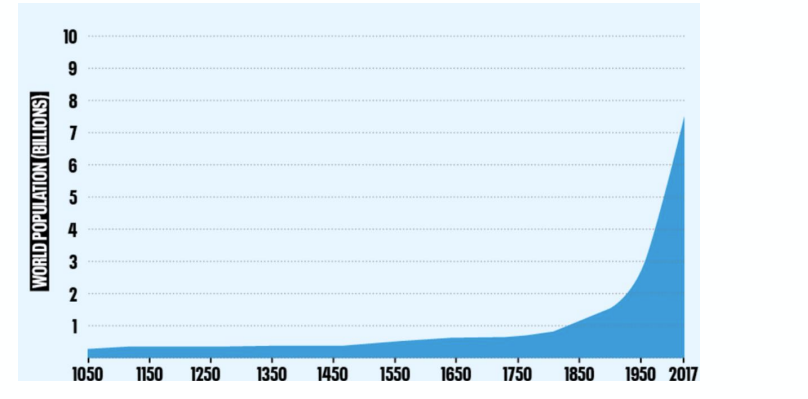
[L4 S17 📷] Do humans experience exponential growth? What has allowed this?
• Yes. The graph is a J-curve, rising sharply since ~1850 • We have not reached our carrying capacity yet • We keep changing our carrying capacity through technology, improving our efficiency • Different human populations have different carrying capacities
[L4 S20 📷] On the K- vs. r-selected species graph, compare how each population changes over time.
• r-selected: rises quickly, overshoots K, and swings in large boom-and-bust oscillations above and below K
• K-selected: slow S-shaped rise that levels off at K with only small fluctuations around it


[L4 S25 📷] List the biotic potential factors and the environmental resistance factors from the figure.

• Poor forest management: single species were allowed to mature without encouraging patches of other species, which would make it harder for the beetle to proliferate
[L4 S27 📷] Describe the response curve for an environmental gradient, from low to high.
Zone of intolerance (species absent) → lower limit of tolerance → zone of physiological stress (low population) → range of optimum (area of greatest abundance) → zone of physiological stress (low population) → upper limit of tolerance → zone of intolerance (species absent) Example gradient: air temperature, from too cold to too hot

[L4 S32 📷] What are density-independent impacts on growth?
• Variations in growth that are not affected by increased population size; physical impacts of the environment (e.g. a polar bear losing sea ice)
• Ice melts earlier, so their peak comes earlier and they decline sooner
• By the time predators feed, the peak has passed (a timing lag)
• Fish can't find enough food → fewer, less robust seals → polar bears go hungry and can't build fat stores for winter
2) More shrubs grow, and caribou food plants peak earlier, before migrating caribou arrive (another timing mismatch).
• Data are scarce for some groups: fungi and protists in the deep subsurface weren't estimated
• Estimates carry large uncertainty, so results are interpreted with caution
B) Competing intertidal barnacle species in separate bands on a rocky shore
C) Deciduous forest grading into grassland across an ecotone
D) Tree species turning over gradually along a mountain elevation gradient (Gleason's view)
E) Understory plants within the range of dominant boreal spruce
(These examples are my suggestions, not from the slide. Check them against what was said in class.)
• Near the upland forest in the background, shrubs and early-succession deciduous trees (like aspen) are starting to grow
2) Avalanches (avalanche slopes at Fortress Mountain, Alberta)
3) Seismic lines
L5 S37] Give an example of primary and secondary succession.
Primary (no soil): Moss spores lodge in cracks in bare rock (e.g. after a glacier retreats) → moss mats trap soil → seeds of larger plants lodge in the moss → enough soil builds up for shrubs and trees.
Secondary (soil already there): An abandoned agricultural field → weeds and grasses grow back → shrubs → trees.
• 1–2 years: Annual plants
• 3–4 years: Grasses and perennials (pioneer species)
• 5–150 years: Grasses, shrubs, pines, young oak and hickory (intermediate species)
• 150+ years: Mature oak and hickory forest (climax community)