5b energy transfer and nutrient cycles
 Call Kai
 Learn
 Practice Test
 Spaced Repetition
 Match
 Flashcards
 Knowt Play
1/14

There's no tags or description
Looks like no tags are added yet.
15 Terms
measuring biomass
biomass is measured through the mass of carbon that an organism contains or the dry mass of its tissue per unit area
to measure dry mass, a sample of the organism is dried, in an oven set to a low temperature. the sample is weighed at regular intervals, and once the mass becomes constant all of the water has been removed. the mass of carbon present is around 50% of the dry mass
this can be scaled up to give the dry mass/biomass of a population
estimating chemical energy stored in biomass (using a calorimeter)
this can be estimated by burning the biomass in a calorimeter, where the amount of heat given off is how much energy there is in it
the energy released is used to heat a volume of water, and the change in temperature calculates the chemical energy
net primary production formula
NPP = GPP - R
GPP is gross primary production, aka the total amount of light energy coverted to chemical energy by plants
R is respiratiory loss, aka the amount of GPP lost to the environment as heat as the plant respires
NPP is net primary production, aka the remaining chemical energy
net production in consumers (formula)
consumers get energy by ingesting plants, or animals that have eaten plants
N = I - (F + R)
I is chemical energy in ingested food, which may not include things like bones, roots, etc
F is chemical energy lost in faeces and urine
R is energy lost through respiration
N is the net production of the consumer
efficiency of energy transfer (formula)
% efficiency of energy transfer = (net production of trophic level ÷ net production of previous trophic level) x 100
food chains and food webs
these show energy transfer between organisms

increasing NPP by simplifying food webs
pests reduce the amount of energy available for crop growth and therefore the NPP of crops, reducing the energy available for humans
by simplifying food webs (getting rid of food chains that don’t involve humans), energy losses will be reduced and NPP will increase
increasing NPP by reducing respiratory loss
farmers control the conditions that their livestock live in. movement increased respiration, so animals are kept in pens, which are often indoors and kept warm so less energy is wasted by generating body heat. therefore, more biomass is produced. this may be considered unethical
saprobionts
saprobionts feed on the remains of dead plants and animals and on their waste products, breaking them down. this makes them a decomposer, allowing chemical elements in the remains to be recycled
they secrete enzymes and digest their food externally, then absorb the nutrients they need (extracellular digestion). organic molecules are broken down into inorganic ions
mycorrhizae
these are symbiotic relationships that fungi form with the roots of plants
the fungi are made up of long, thin strands that connect to the plant’s roots, increasing the surface area of the roots and helping the plant absorb ions from the soil, and increasing water uptake. in return, the fungi obtain organic compounds from the plant
the nitrogen cycle
nitrogen gas in the atmosphere is turned into nitrogen containing compounds (nitrogen fixation). this is carried out by nitrogen fixing bacteria. it turns nitrogen into ammonia
nitrogen compounds from dead organisms and their waste products are turned into ammonia by saprobionts (ammonification)
ammonium ions in the soil are changed into nitrites by nitrifying bacteria, and are then turned into nitrates by other nitrifying bacteria (nitrification)
under anaerobic conditions, nitrates in the soil are converted into nitrogen gas by denitrifying bacteria (denitrification)

the phosphorus cycle
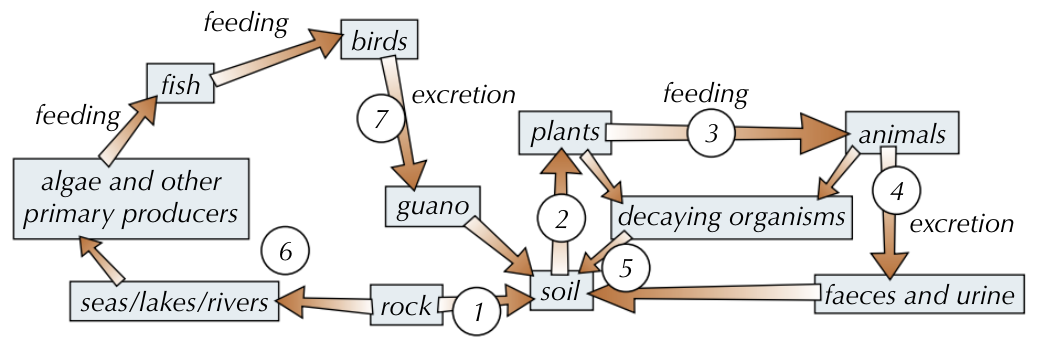
phosphate ions (PO₄³⁻) in rocks are released into the soil by weathering
phosphate ions are taken into the plants through the roots (mycorrhizae help with this)
phosphate ions are transferred through the food chain as animals eat the plants and are in turn eaten by other animals
phosphate ions are lost from the animals in waste products
when plants and animals die, saprobionts are involved in breaking down the organic compounds, releasing phosphate ions into the soil for assimilation by plants. they also release the phosphate ions from urine and faeces
weathering of rocks also released phosphate ions into seas, lakes, and rivers, which is taken up by aquatic producers (algae) and passed along the food chain to birds
guano contains a high proportion of phosphate ions, releasing lots of it to soils. it is used as natural fertiliser
why fertilisers are important
when crops are harvested, they are removed from the field they’re grown instead of decomposing in it. this means that their mineral ions are not returned to the soil. this can also happen when animals are removed from the land
adding fertiliser (artificial or natural) replaces the lost minerals, so more energy can be used for growth, increasing the efficiency of energy transfer
leaching
leaching is when water soluble compounds in the soil are washed away
inorganic ions are soluble, meaning excess minerals are likely to be washed away. it is also more likely before heavy rainfall. these can be washed into ponds and rivers, causing eutrophication
leaching is less likely with natural fertilisers since the nitrogen and phosphorus are still contained in organic molecules that need to be decomposed before they can be absorbed by plants
eutrophication
mineral ions leached from fertilised fields stimulate the rapid growth of algae in ponds and rivers
lots of algae block light from reaching the plants below
eventually, the plants die because they’re unable to photosynthesise enough
bacteria feed on the dead plant matter. the increased numbers of bacteria reduce the oxygen concentration in the water by carrying out aerobic respiration
fish and other aquatic organisms die because there isn’t enough dissolved oxygen
