16- Enzyme Regulation
 Call Kai
 Learn
 Practice Test
 Spaced Repetition
 Match
 Flashcards
 Knowt Play
1/99

There's no tags or description
Looks like no tags are added yet.
100 Terms
Why must metabolic pathways be regulated and coordinated?
To match reaction rates to cellular needs and avoid wasting resources or accumulating unnecessary products
What are the two broad methods of enzyme regulation?
1. Availability of enzyme molecules
2. Control of enzyme activity
What is meant by “availability of enzyme molecules” in regulating metabolic processes?
They control the number of enzyme molecules present
What is meant by “control of enzyme activity” in regulating metabolic processes?
Controlling how well the existing enzymes work
Which two mechanisms primarily regulate enzyme availability?
Synthesis/degradation
Proteolysis
Which two mechanisms primarily regulate control of enzyme activity?
Allostery
Covalent modification
What regulates enzyme synthesis/degradation?
The cell!
What determines the amount of an enzyme in a cell?
The balance between enzyme synthesis and enzyme degradation.
What is enzyme synthesis?
Enzyme synthesis produces enzyme molecules
If a cell needs more of a particular enzyme, it can increase the rate at which that enzyme is produced
What is enzyme degradation?
Enzyme degradation allows the cell to break down/ remove the amount of an enzyme that is no longer needed
Keeping unnecessary enzymes around can waste resources and may allow unwanted reactions to continue.
Why does enzyme regulation through synthesis and degradation require energy?
Protein production and many protein-degradation processes consume cellular energy
What is proteolysis?
The cleavage of peptide bonds in a protein
What is a zymogen?
An inactive precursor that can be converted into an active enzyme
Why are many digestive proteases produced as zymogens?
To prevent premature digestion and protect the cells that produce them from these powerful digestive enzymes
What is the role of enteropeptidase?
It cleaves trypsinogen to initiate the formation of active trypsin.
How does trypsin contribute to an autocatalytic activation process?
Active trypsin can activate additional trypsinogen, amplifying the responses
What is an autocatalytic process?
An autocatalytic process is one in which a product of a reaction helps promote further production of that product
Inteins
Proteins that can self-splice and produce their active form
What is the difference between a zymogen and a prohormone?
A zymogen is an enzyme precursor; a prohormone is a protein hormone precursor.
What is proinsulin?
The prohormone precursor that is processed to produce mature insulin
What is allosteric regulation?
Regulation in which a molecule binds away from the substrate site and changes enzyme activity
What is an allosteric effector?
A regulatory molecule that binds at an allosteric site and alters enzyme function.
Must an allosteric effector resemble the substrate?
No. It can be chemically and structurally different from the substrate
The effector and substrate bind at different sites!
What is the difference between a positive and negative allosteric effector?
A positive effector increases activity; a negative effector decreases it
Why can allostery provide a rapid response?
It regulates enzymes that already exist in the cell
What are the two distinct binding sites in the allosteric model?
Active site for substrate binding
Allosteric site for regulation
How can binding at an allosteric site affect substrate binding
It can alter the enzyme's conformation, changing substrate affinity or catalytic activity
Why can allosteric regulation produce a large change in activity?
Structural changes can be transmitted across the enzyme, particularly between interacting subunits.
What is the active site?
Where the substrate binds and is converted into the product

What is the allosteric binding site?
This is where the regulatory molecule binds
What is feedback inhibition?
Feedback inhibition occurs when the product of a later step in a metabolic pathway inhibits an enzyme that acts earlier in that same pathway.
Why does feedback inhibition conserve cellular resources?
It reduces unnecessary synthesis when enough final product has accumulated.
Where does a feedback inhibitor commonly bind in an allosteric mechanism?
At a regulatory site distinct from the enzyme's active site
Why is a feedback inhibitor a negative allosteric effector?
Its binding decreases the activity of the enzyme
Does the final product in feedback inhibition need to resemble the substrate of the inhibited enzyme?
No. The regulatory site can recognize a structurally different molecule.
What reaction does ATCase catalyze?
Carbamoyl phosphate and aspartate are converted into N-carbamoylaspartate
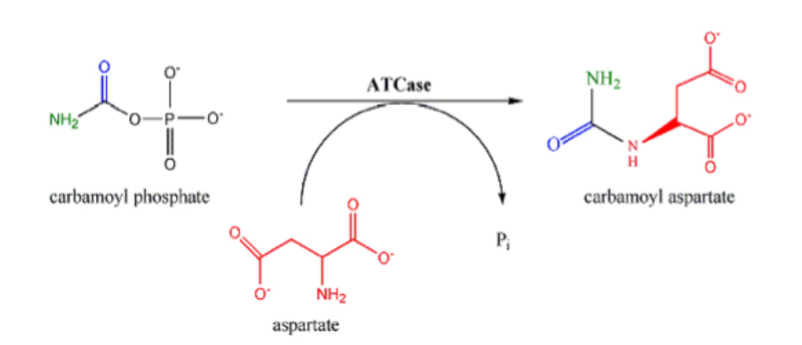
What pathway uses ATCase as an early enzyme?
Pyrimidine biosynthesis
In regards to its shape, what kind of enzyme is ATCase?
Hexameric
Contains 6 subunits, or in this case, a dimer of trimers
What is the difference between catalytic and regulatory domains in ATCase?
Catalytic domains carry out the reaction; regulatory domains help control activity.
What are the effects of ATP and CTP on ATCase?
ATP activates ATCase, whereas CTP inhibits it
How does CTP affect the ATCase conformational equilibrium?
It stabilizes the T-state
How does ATP affect the ATCase conformational equilibrium?
It stabilizes the R-state
What does it mean for ATCase to exhibit positive cooperativity?
Binding of a substrate to one catalytic subunit increases the substrate affinity of the other five subunits
How can cooperativity help ATCase respond to changing substrate concentrations?
It allows a relatively small change in substrate concentration to produce a substantial change in enzyme activity.
What kind of velocity-versus-substrate curve does ATCase have and why?
Sigmoidal
Its cooperative subunits influence one another's substrate binding
What happens to the ATCase curve in the presence of ATP?
It shifts left
ATP is an activator. It stabilizes the R-state, increasing substrate affinity —> lower substrate concentration is needed to reach a given reaction velocity

What happens to the ATCase curve in the presence of CTP?
It shifts right
CTP is an inhibitor. It stabilizes the T-state, decreasing substrate affinity —> higher substrate concentration is needed to reach a given reaction velocity
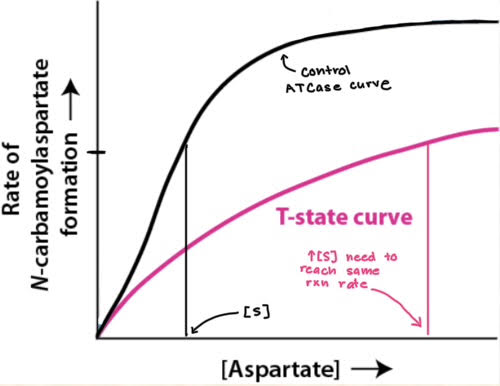
Why is CTP a feedback inhibitor of ATCase?
It is a downstream product of pyrimidine biosynthesis that inhibits an earlier step

What happens when CTP binds ATCase?
It stabilizes the low-affinity T-state and decreases activity.
Does CTP inhibit ATCase by binding to its substrate's active site?
No. It binds at an allosteric regulatory site
Do allosteric enzymes have one or multiple subunits?
Multiple subunits!
Do allosteric enzymes have one or multiple substrate binding sites?
Multiple substrate binding sites!
What kind of kinetics do allosteric enzymes have?
Sigmoidal kinetics!
What kind of substrate binding behavior do allosteric enzymes exhibit? (aka. cooperative or noncooperative?)
Cooperative substrate binding.
Hill coefficient n≠ 1
What two conformations do allosteric enzymes exist in?
R- state (positive allosteric effectors shift equilibrium to favor this state!)
T-state (negative allosteric effectors shift equilibrium to favor this state!)
What determines whether an allosteric enzyme is in the R- or T-state?
Quaternary interactions!
The protein's interactions among its subunits can favor one state over the other and result in a state change (quaternary shift)
What is covalent modification in enzyme regulation?
Chemical attachment or removal of a group that changes a protein's properties
What is phosphorylation?
The addition of a phosphate group to a molecule.
EXAMPLE OF COVALENT MODIFICATION
Which three amino acids are commonly phosphorylated in proteins?
Serine (Ser), threonine (Thr), and tyrosine (Tyr)
These amino acids have hydroxyl groups (–OH) in their side chains that provide the attachment site for the phosphate group
Why can phosphorylation change enzyme activity?
The phosphate's charge and size can alter protein structure and interactions
Does phosphorylation always activate an enzyme?
No. It can activate or inhibit an enzyme depending on the protein
What is the most common covalent modification in eukaryotes?
Phosphorylation and dephosphorylation
What does a protein kinase do?
Transfers a phosphate group from ATP onto a specific amino acid residue of a target protein
What does a protein phosphatase do?
Removes a phosphate group from phosphorylated amino acid residues
What molecule commonly donates the phosphate during protein phosphorylation?
ATP
What does PKA stand for?
Protein kinase A
What are the two types of subunits in the PKA complex?
2 regulatory subunits and 2 catalytic subunits
R2C2 (inactive form)
What does cAMP do to PKA?
It binds the regulatory subunits and releases the catalytic subunits of PKA
Once the catalytic subunits are released, they become active and can phosphorylate the target proteins

What is a second messenger?
An intracellular molecule that relays a signal within a cell.
How can PKA amplify a signal?
Active PKA can phosphorylate multiple target proteins, changing many downstream processes.
What is Glycogen phosphorylase?
Glycogen phosphorylase is an enzyme regulated by two mechanisms:
Allosteric regulation.
Covalent modification.
What reaction does glycogen phosphorylase catalyze?
Phosphorolysis of glycogen, releasing glucose-1-phosphate
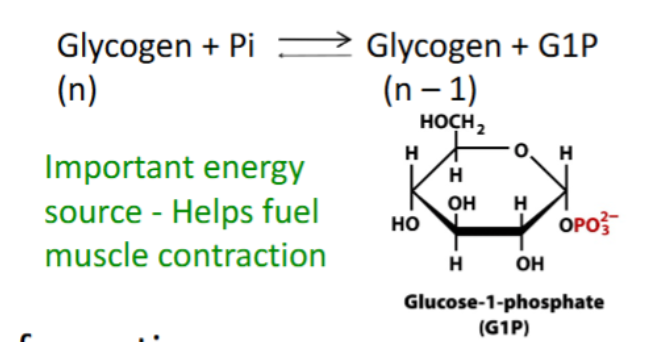
What does phosphorolysis mean?
Breaking a chemical bond using inorganic phosphate
What is the substrate identified for glycogen phosphorylase?
Inorganic phosphate, Pi
How does ATP regulate glycogen phosphorylase allosterically?
It acts as an inhibitor (curve shifts right)
Signals that there is already enough energy, so there is no need to break down glycogen

How does AMP regulate glycogen phosphorylase in muscle?
It acts as a positive allosteric effector (curve shifts left)
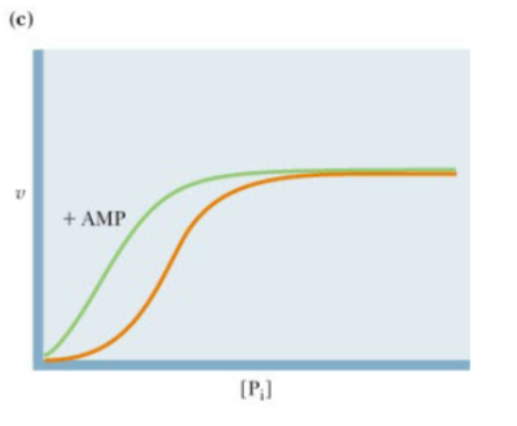
What is the significance of ATP and AMP binding at the same regulatory site?
They provide opposing regulatory signals through the same binding location.
Which molecules stabilize the T-state of glycogen phosphorylase?
ATP and glucose-6-phosphate
Which molecules stabilize the R-state of glycogen phosphorylase?
AMP
Product of ATP hydrolysis
What is the regulatory significance of Ser14 in glycogen phosphorylase?
Ser14 gets phosphorylated by phosphorylase kinase, activating phosphorylase and promoting glycogen breakdown
Serves as an internal allosteric effector
Examples of how glycogen phosphorylase undergoes allosteric regulation:
ATP (inhibitor)
AMP (activator)
glucose-6-phosphate (inhibitor)
Example of how glycogen phosphorylase undergoes covalent modification:
Phosphorylation of Ser14 (stabilizes R-state)
What advantage does combined regulation provide?
It allows enzyme activity to respond to both immediate metabolic conditions and broader signaling pathways
What are isozymes?
Different forms of an enzyme that catalyze the same reaction but have different molecular properties.
Different amino acid sequences!
How can isozymes differ even though they catalyze the same reaction?
KM
Vmax
Regulation
Different isozymes may respond differently to allosteric effectors.
Tissue distribution
Different forms may be expressed in different tissues.
3 Examples of isozymes:
Glycogen phosphorylase
Hexokinase
Glucokinase
How many isozymes are there of Glycogen phosphorylase ?
3
They show different substrate affinities and allosteric responses depending on their location in the body
Are glucokinase and hexokinase isozymes?
Yes!
What reaction do hexokinase and glucokinase catalyze?
The phosphorylation of glucose to glucose-6-phosphate
How does hexokinase's glucose affinity compare with glucokinase's?
Hexokinase generally has higher glucose affinity
Why is glucokinase useful when glucose concentrations are high?
Its activity increases as glucose availability rises, supporting glucose processing and sensing
Used to maintain blood/glucose levels
What tissues are hexokinase found in?
Muscle tissue
What tissues are glucokinases found in?
Liver
Brain
Pancreas
Gut
Examples of covalent modifications:
Phosphorylation
Adenylation
Methylation
Acetylation
Glycosylation
Carboxylation
Prenylation
What is the function of adenylation?
Adds an adenylyl group to a protein
In some regulatory systems, this helps signal cellular nitrogen sufficiency.
What is the function of methylation?
Adds a methyl group to a molecule
In chromatin, methylation can help regulate gene expression as part of epigenetic regulation
What is the function of acetylation?
Transfer of acetyl group from acetyl- CoA to Lysine
What is the function of glycosylation?
Attaches sugar groups to proteins, potentially affecting protein folding, stability, transport, and recognition.
What is the function of carboxylation?
Adds a carboxyl group or incorporates carbon dioxide into a molecule, enabling or altering specific biochemical functions.
What is the function of prenylation?
Attaches a lipid-like prenyl group to a protein, often helping it associate with cell membranes