colostrum quality
 Call Kai
 Learn
Learn Practice Test
 Spaced Repetition
 Match
Match Flashcards
 Knowt Play
1/17

There's no tags or description
Looks like no tags are added yet.
Name | Mastery | Learn | Test | Matching | Spaced | Call with Kai | Chat |
|---|
No analytics yet
Send a link to your students to track their progress
18 Terms

You have requested the heam profile for Fidget as part of your immune diagnostics.
Try your best to extract the information from this report and add it to your admission report.
This is a hot spot activity. You should test yourself if you know what the results are showing and then click the question mark to know more about that result / marker.
The quality of the haematology report is not ideal so try your best to to analyse this.
what does the rbc show
This is the total number of red cells per litre of blood. Notice the units are x1012/l, whereas all other cell values are x109/l. This value will decrease in anaemia and will increase with hypovolemia or in situations where bone marrow RBC production increased although these are rare. RBC counts performed with a haemocytometer have a large degree of error.

hct
this stands for haematocrit and is also called pack cell volume or PCV. This is the percent of blood comprised of erythrocytes. It is a very accurate measurement with small inherent error (+/-1%). It will increase in hypovolemia and decrease in anaemic states. Because it is possible to have more than one factor affecting HCT (for example hypovolemia and anaemia) we always evaluate the reading in conjunction with total protein (TP). PCV can be measured manually using a capillary tube and TP with a handheld refractometer, making them both easy to measure and inexpensive.

hgb
this stands for haemoglobin and measures the amount of haemoglobin per dl of blood. It is an indicator of the oxygen carrying capacity of the blood.

mcv, mch, mchc, rdw
they are involved in the assessment of cell size and haemoglobin content that can be helpful when assessing causes of anaemia, particularly in small animal species.

wbc
This is the total number of white blood cell count per litre of blood. It is made up of neutrophils, lymphocytes, monocytes (macrophages) eosinophils and basophils. The haematocytometer will also give an individual count for each type of WBC and a percentage of the total for each cell type (differential cell count).

plt
This is an automated platelet count. This should always be confirmed on a manual blood smear as platelet clumping can occur. An increased platelet count (thrombocytosis) can be seen in inflammation.

NEU
This is the cell type to focus on today. There are numerous reasons for both an increase in neutrophil count (neutrophilia) and a decrease in neutrophil count (neutropaenia). In general neutrophil count will increase with increased demand. This can be associated with infection (bacteria, rickettsia, viruses, fungi and parasites) or inflammation (immune-mediated disease, burns, necrosis, and neoplasia). Mild/moderate neutrophilia can also be seen with stress and corticosteroid administration.
when can neutropaenia be seen
Neutropaenia can be seen with inadequate bone marrow production but is more commonly seen when neutrophil demand outweighs bone marrow production in per acute or acute inflammation/ infection.

what does this mean
Graph oneL – this is a graphic representation of how the haematocytometer uses cell fluorescence to distinguish RBCs from WBCs
Graph 2 R – this is a graphic representation of how the haematocytometer uses florescence and granularity to distinguish different types of WBC
N-L-M-E-B This is a manual count of 100 WBCs from a blood smear. I am biased but I would advise to always make a manual smear from every haematology sample for evaluation. It will enable you to be sure the haematocytometer has correctly identified cells to the appropriate group which can be very inaccurate in animals with severe disease. It will also confirm changes such as toxic neutrophil and band neutrophil presence which may alert you to significant disease even if total neutrophil count for example is within the reference range.

what does the fibrinogen mean here
Fibrinogen is one of a group of acute phase proteins and is commonly increased in inflammatory and neoplastic disease.
Other acute phase proteins that are used diagnostically include serum amyloid A (SAA) in equine species and C-reactive protein in small animal species.
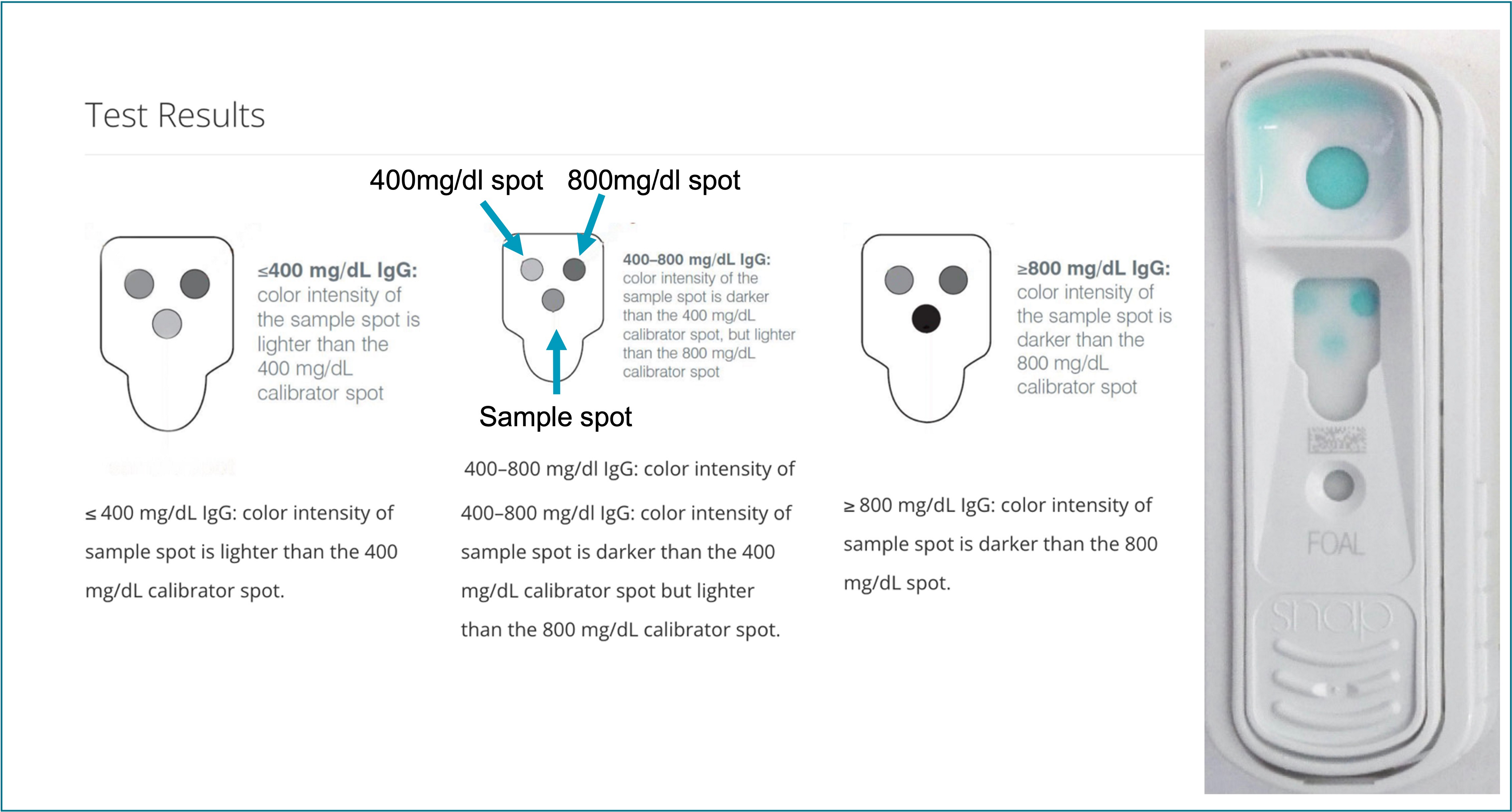
You have also run a foal IgG SNAP test which is a stall side test to measure immunoglobulin concentrations in the foal’s blood.
Using the image presented here, for which Fidget's result is on the right hand side. Interpret the results.
Colostral transfer of immunoglobulins is <400mg/dl. The colour intensity of the sample spot is lighter than the 400mg/dl calibrator, but remember this is a rough assessment.
which answer is most correct:
it is difficult to evaluate PCV as an isolated value
This foal has evidence of no platelet production
This foal is severely dehydrated
This foal is suffering from severe anaemia
it is difficult to evaluate PCV as an isolated value
This foal is dehydrated because its total white blood cell count is increased outside the reference range
The increase in WBC and neutrophil count is a common response to bacterial infection
The increase in neutrophil count both as a percentage and as a total count confirms this foal has a bacterial infection
None of the reported values other than the percentages of WBC types obtained from the manual smear can be evaluated because the haematology machine needs specific calibration to analyse blood from neonates of any species
The increase in neutrophil count both as a percentage and as a total count confirms this foal has a bacterial infection
Fidget has received adequate colostral transfer of immunoglobulins providing he is kept in a clean environment for the first few days of life
Fidget has received inadequate colostral transfer of immunoglobulins and must receive a minimum of 200mls of colostrum with a brix value of >22%
Fidget has received adequate colostral transfer of immunoglobulins
Fidget has received inadequate colostral transfer of immunoglobulins and must receive a minimum of 1L of colostrum with a brix value of >22%
Fidget has received inadequate colostral transfer of immunoglobulins and must receive a minimum of 200mls of colostrum with a brix value of >22%
the provision of colostrum would be on the provision that the foal had not obtaiend any colostrum and what age the foal is.
If the foal was still suckling from the mare, but you werent sure if the colostrum was there for some reason, you might give the foal a plasma drip instead as a security back up.

what colostrum would you give here
A
what should you do after giving colostrum
- Receck the IgG conc using a snap test after administering colostrum to see if have correct the failure of passive transfer
what is indicative of a bact infection in a case like this
Increase total wbc count, incrs neutrophils, and incrs fibrinogen and SAA in a foal with failure of passive transfer
why is it important to correct hte failure of passive transfer
to prevent future infections