NROSCI 1011 U2
 Call Kai
 Learn
 Practice Test
 Spaced Repetition
 Match
 Flashcards
 Knowt Play
1/16

There's no tags or description
Looks like no tags are added yet.
17 Terms
Multipolar neurons
Most common type of neuron, have multiple dendrites and one axon. Always send signal from dendrite → soma → axon terminal

Bipolar neurons
Found in retinal circuitry, have one dendrite and one axon. Always send signal from dendrite → axon terminal

Psuedo-unipolar neurons
Common in the peripheral nervous system, have a single axon with peripheral and central branches but no dendrite. The peripheral tip functions as a dendrite to receive signal and conduct it to axon terminal

Sensory neuron
Can be bipolar or pseudo-unipolar. Receive information from receptors in the PNS and synapse in the CNS (usually spinal cord). AKA afferent neuron

Afferent neuron
A neuron that carries signal from the PNS to the CNS; a sensory neuron
Motor neuron
Multipolar neurons that transmit signals from the CNS to an effector in the PNS (ex. smooth muscle); AKA efferent neuron
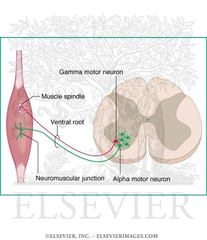
Efferent neuron
A neuron that carries signal from the CNS to the PNS; a motor neuron
Interneuron
A (typically) multipolar neuron that is neither sensory nor motor and is located entirely within the CNS

Neuronal circuit
The reflex arc between a sensory neuron and a motor neuron that involves 2 peripheral nerves and sometimes an interneuron
Glial cells
Non-neuronal cells that are found in the nervous system and perform various functions
CNS glial cells
Microglia, ependymal cells, astrocytes, and oligodendrocytes
PNS glial cells
Schwann cells
Microglia
The smallest of glial cells; act as phagocytes for foreign material following brain injury

Ependymal cells
Line cavities of the CNS and form barriers for ventricles

Astrocytes
Regulate ion concentrations of CSF, neurotransmitter concentration, and blood flow (via regulation of the blood-brain barrier using end-feet)

Oligodendrocytes
Form myelin in the CNS by wrapping around multiple axons per oligodendrocyte

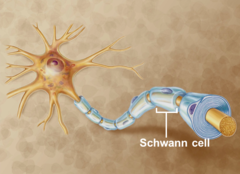
Schwann cells
Form myelin in the PNS by wrapping around a small portion of a single axon