Current trends in circular economy and biorefinary (from a food perspective)
 Call Kai
 Learn
 Practice Test
 Spaced Repetition
 Match
 Flashcards
 Knowt Play
1/18

There's no tags or description
Looks like no tags are added yet.
19 Terms
What is the bioeconomy?
The substitution of fossil carbon with bio-based carbon from biomass (agricultural, forestry, marine), encompassing all sectors and systems that rely on biological resources.
What is the circular economy?
An economic model based on the continuous flow of technical and biological materials through a 'value circle,' rebuilding capital and ensuring enhanced flows of goods and services.
What is biorefining?
The integrated processing of renewable feedstocks into a spectrum of marketable products (food, feed, fuels, chemicals, materials, heat, power) making full use of the potential of biomass.
What is the difference between Food Loss (FL) and Food Waste (FW)?
Food Loss occurs at production, post-harvest, and processing stages before reaching the consumer.
Food Waste is good quality food fit for human consumption that is discarded at the distribution and consumption stages.
What is the top priority in the Food Loss and Waste hierarchy?
Prevention (avoiding surplus food generation throughout the supply chain).
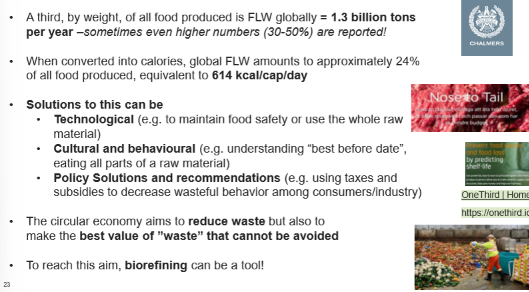
Solutions can be:
Technological
Cultural and behavioural
Policy soluticons and recommendations
What is the least preferable option in the Food Loss and Waste hierarchy?
Disposal (waste incinerated without energy recovery, sent to landfill, or sewerage disposal).
What is a Black Biorefinery?
A biorefinery that uses insects as feedstock.
What is a Blue Biorefinery?
A biorefinery that uses aquatic biomass (algae, fish waste and discard) as feedstock.
What is a Green Biorefinery?
A biorefinery that uses green biomass (grasses, immature cereals, plant shoots) as feedstock.
What is a Red Biorefinery?
A biorefinery that uses seafood waste (crustacean shells) as feedstock.
What is a Yellow Biorefinery?
A biorefinery that uses sugar crops (sugar beet, sugar cane) or starch crops (wheat, corn, rye) as feedstock.
What is a Grey Biorefinery?
A biorefinery that uses organic urban waste and agroindustrial byproducts as feedstock.
What is the value pyramid in biorefining?
A concept where low-volume, high-value products (pharmaceuticals, food) are at the top, and high-volume, low-value products (energy, heat) are at the bottom.

What is the AquaFood project?
A project that upcycles seafood side streams (like fish heads and bones) into intact functional proteins, oil, and bioactive collagen using pH-shift processing.
How can shrimp boiling water be valorized?
It can be used as a cultivation medium for microalgae (Chlorella sorokiniana) and marine yeast, producing new protein sources.
How is a Green Biorefinery applied to grass?
Grass is mechanically fractionated into a "press cake" (fiber for biomaterials/feed) and a "green juice" where proteins are precipitated and extracted.
What is the Fungal Biorefinery approach?
Using filamentous fungi to cultivate on food loss streams (like bread rest raw materials or fish industry side streams) to produce high-protein, fibrous food ingredients.
How can eggshells from egg processing be valorized?
They can be processed into value-added products like Calcium Phosphate, Calcium Carbonate, Calcium oxide, or polyester resin composites.
What are the three overlapping concepts central to this presentation?
Bioeconomy, Circular Economy, and Biorefining.