opioids pt 2
 Call Kai
 Learn
 Practice Test
 Spaced Repetition
 Match
 Flashcards
 Knowt Play
1/34

There's no tags or description
Looks like no tags are added yet.
35 Terms
what are opiates?
exogenous drugs similar in structure to our endogenous opioid system
pain relief, respiratory depression, constipation
makes them a great drug to treat diarrhea
opioid peptides
large molecule NTs
affects large areas of neurons
bioavailability
metabolized by liver within 24 hrs
CYP2D6 needed to demethylate some opiates
small amounts enter the brain
lipid solubility very imp
route of administration is imp
what are the main metabolizers of opiates?
CYP2D6 and CYP3A4
small dose
pain relief, anxiety relief, drowsiness
Mu receptors in LC decrease NE release
larger doses
euphoria, sedation, low body temp
mu receptors in hypothalamus control body temp
shifts to parasympathetic NS
endogenous opioids summary
enkephalins = habitual movement, anxiolytic, pain relief
endorphins = comfort/warmth, euphoria, pain relief during exercise/stress, social bonding
dynorphins = active in overstimulation, counteracts dopamine
opioid receptors
inhibitory and metabotropic
all work to:
open K+ channels
close Ca2+ channels
reduce membrane excitability and slow cell firing
describe the Mu receptors and endorphins. its effects and their mechanism (MOR)
analgesic — activates descending inhibitory pathways + blocks pain neurotransmitters
euphoria — disinhibits DA neurons in VTA
respiratory depression — reduces Co2 responsiveness in brainstem
constipation — dec ACh in enteric nervous system
dependence — LC neuroadaptation and DA reinforcement

delta receptors (DOR) — enkephalins
activation inc brain derived neurotropic factor (BDNF)
promotes dendritic growth and synaptic plasticity
decreases fear reactivity
people with higher DOR handle stress better
reduces emotional unpleasantness of pain
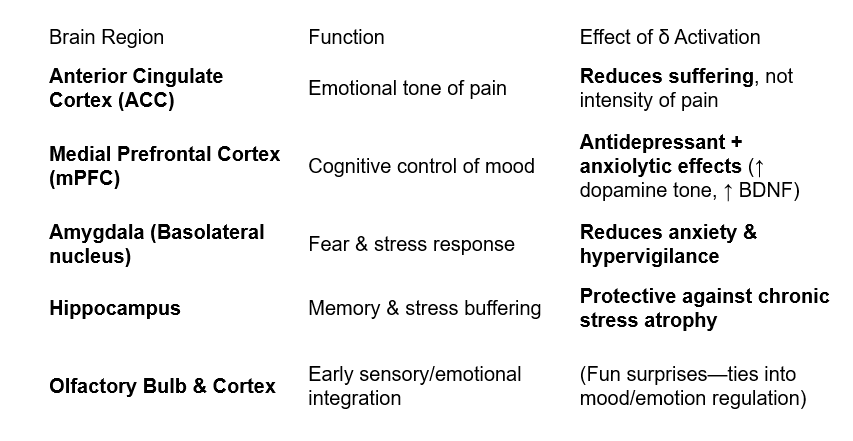
delta receptor — loc, function, effect
ACC — reduce suffering
mPFC — antidepressant effects and anxiolytic effects
basolateral nucleus — reduces anxiety and hypervigilance
hippocampus — protective against chronic stress atrophy
olfactory bulb and cortex — early sensory/emotional integration
kappa receptors (KOR) — dynorphins
dynorphins released during stress, pain, fear, emotional trauma
survival signaling
suppresses DA release from NAc
stop chasing rewards, focus on surviving
Mu inc DA = pursuit
Kappa dec DA = withdrawal
in chronic drug use, kappa is upregulated
ANY drug that enhances DA
kappa receptors — dynorphins — loc, function, effect of activation
NAc — suppresses DA → dysphoria
amygdala — amplifies emotional pain
hypoT — activates CRF → stress intensification
PAG — analgesia, but unpleasant
spinal dorsal horn — spinal level analgesia
doesn’t reduce emotional pain

what is pain modified by
emotion, context, stress, internal environment
explain what happens after smacking finger with hammer
quick sharp pain that fades quickly
transmitted by thick, myelinated axons
prolonged dull ache
transmitted by thin, unmyelinated axons
early pain pathway
spinal cord → thalamus → somatosensory cortex
late pain pathway
thalamus → amygdala → hypothalamus and anterior cingulate cortex
describe the ACC
imp for error monitoring, evaluating, and suggesting action
social exclusion (where this is felt)
turns pain into suffering
is activated the same in physical AND emotional pain
without ACC you would feel pain, but wouldn’t bother you
what is most imp descending pathway?
periaqueductal grey (PAG)
what does electrical stimulation of PAG do?
causes immediate analgesia
has enkephalin-producing cells
lots of Mu and Delta here
when is PAG activated?
when ppl shown pictures of pain
higher empathy scores = more PAG activation
where are higher distributions of opioid receptors?
in striatum, medial thalamus, locus coeruleus, PAG, raphe nuclei
what type of prescription more likely to lead to long term use?
high intensity prescriptions = more long term use compared to low intensity
when are opioids less effective?
in chronic pain
physical and cognitive therapies are more effective
what genetics = higher chance of addiction?
high mu, low kappa (pos reinforcement)
low mu, high kappa (neg reinforcement/self-medication)
trauma history
variants in mu
more DA release
more pleasure from social bonding
opiate drugs inc ___ firing in the ___
DA firing in VTA
indirectly by inhibiting GABA

opiates depress the ___
CNS
withdrawal involves hyperactivity
what depends on the drug?
severity and duration of withdrawals
recap of opioid receptors
mu
endorphins
pain relief
euphoria
respiratory depression
constipation
delta
enkephalins
reduce emotional pain
reduce fear reactivity
inc BDNF for synaptic plasticity
kappa
dynorphins
suppresses DA, focus on survival

ACC vs PAG
acc = suffering component of pain
pag = downstream pain reduction system
where are receptors
widespread
what does chronic abuse do?
upreg kappa, desinsitizes and downregulates Mu, upregulates NE
withdrawal is opposite effects
what drugs contribute to many OD
fentanyl and carfentanyl
2mg fentanyl is lethal for most ppl
what are treatment options?
methadone
long acting, can reduce withdrawal, help weaning process
clonidine
alpha2 agonist, reduces withdrawal symptoms
buprenorphine (Suboxone)
partial mu agonist, weaker effect and longer duration
narcotics anonymous + CBT therapies
naloxone vs naltrexone
naloxone
used to reverse or reduce OD
works for 30-90 min
competitive non-specific opioid antagonist
naltrexone
used to manage AUD or OUD
works for 2-3 days
mu antagonist, delta/kappa weak partial agonist
inverse agonist when morphine is present