c4 c5 sl content
 Call Kai
 Learn
 Practice Test
 Spaced Repetition
 Match
 Flashcards
 Knowt Play
1/23

There's no tags or description
Looks like no tags are added yet.
24 Terms
How does a standing wave form?
send wave down rope or something, it reflects at the fixed end and travels back INVERTED
at every point there are two waves at once: the one going away from your hand and the one coming back. They have the same frequency, the same wavelength and very nearly the same amplitude, and they travel in opposite directions.
WE SEE THE SUPERPOSITION.
Node (N) vs antinode (A)
Node → A point whose amplitude is zero at all times. Adjacent nodes are half a wavelength apart.
Antinode → A point of maximum amplitude, sitting midway between two nodes (adjacent antinodes are also half a wavelength apart)

In standing waves, the wavelength is ____
TWICE distance between adjacent nodes (FOR ALL BOUNDARY TYPES)
o————o—————o (full wave)
In one loop, are points in phase? How about adjacent ones? Why?
Points in the same loop are in phase: phase difference zero. (2 waves constantly moving, nodes stop it from changing)
Points in adjacent loops are exactly out of step. Their phase difference is pi rad, or 180°.
(When one loop is up, the next is down)
Is energy in a standing wave transferred?
No net transfer along wave, energy stays BETWEEN NODES
The rule for nodes in harmonic
N loops → n + 1 nodes
First harmonic pictured → 1 loop → 2 nodes

What sets speed of standing wave? What happens when you shake it faster?
Set by its tension and its mass per unit length. The speed is a property of the string.
Changing the driving frequency changes which harmonic you get, not the speed.It does not depend on how fast you shake it.
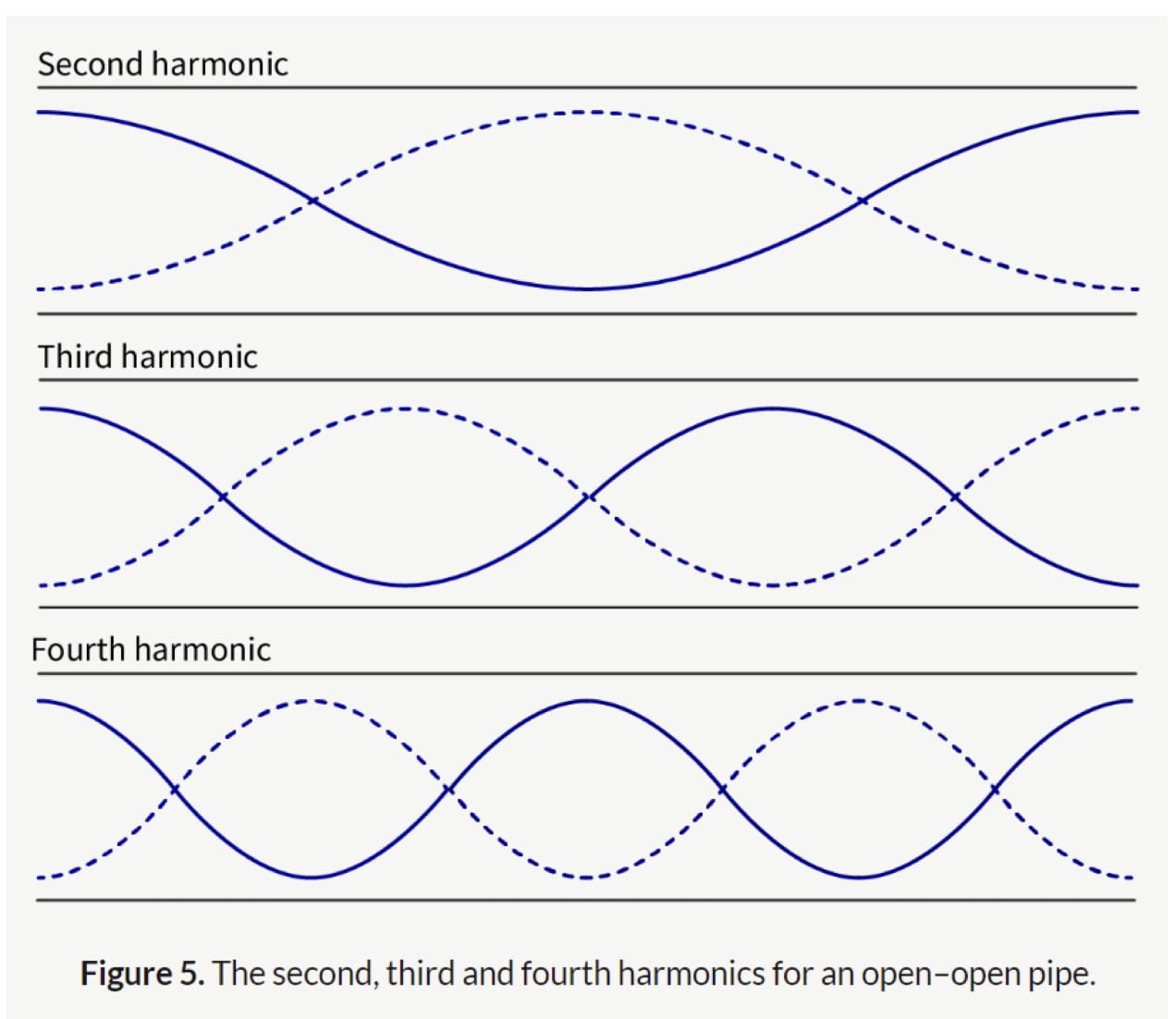
Open ended pipe, which particles oscillate the most? Nodes or antinodes?
The particles at the open ends of the pipe oscillate with maximum displacement (ANTINODES)
The particles in the middle do not oscillate at all. (NODES)

What is the wavelength equation and what can you use it for? (3)
Standing waves in a pipe that is open at each end
Standing waves in a string that has fixed boundaries at each end
Standing waves in a string that has open (freely move) boundaries at each end.

What’s the frequency equation from that?
f_n = f_1 x n

In an open closed OC pipe, are the harmonics odd or even? WHY
ODD because harmonics are (1f, 2f, 3f etc.) and you physically cant have 2 fundamental frequencies because they must
Fit NODE—ANTINODE

Open closed OC pipe/string equation?
Because ¼ of the wavelength can fit for the first harmonic

What is natural frequency?
Natural frequency is the frequency with which an oscillator will move if left alone
(pendulum swinging without too much drag, or a bungee jumper bouncing up and down on the end of a piece of elastic)
What is resonance?
An external driving force (Frequency when it keeps going) / vibration matches a system’s natural (Resonant) frequency, causing it to vibrate with maximum amplitude
How does resonance lead to global warming?
Greenhouse gas molecules vibrate at a natural frequency EQUAL to the infrared radiation emitted from the Earth’s surface
They resonate when excited by the infrared radiation, absorbing the energy and re-emitting it in all directions.
Some of this re-emitted radiation is directed back towards the Earth, causing it to heat up :3
What are the 3 types of damping (when energy dissipates in a system), how does the system oscillate?
Light damping: a small amount of damping only. The system will continue to oscillate, but the amplitude of the oscillations decreases exponentially over time.
HEAVY damping: a large amount of damping. The system gradually dissipates all its energy. It does not oscillate, but returns very slowly to its equilibrium state.
CRITICAL DAMPING: a very large amount of damping. The system returns to its equilibrium state as quickly as possible without any oscillations.

Damping changes the ______ of an oscillator (Explain)
FREQUENCY → as damping increases, resonant frequency DECREASES, amplitude too
Time period INCREASES (cuz T=1/f)

What is the Doppler effect?
The change in the observed frequency (and wavelength) of a wave when the source and the observer are moving relative to each other.
In Doppler, how does speed, frequency and wavelength ‘change’?
Frequency → same by source but CHANGES cuz it’s perceived differently
Speed → set by the air DOESN’T CHANGE
Wavelength → CHANGES when perceived differently
If the wavelength is AHEAD vs BEHIND, how do u get that wavelength
AHEAD → original wavelength - your new one
BEHIND → original wavelength + your new one
bc you’ve traveled more distance vs less
REMEMBER ABOUT v=fY
v = Y/T time period bc FREQUENCY AND TIME PERIOD ARE INVERSE!!
What is RED SHIFT
shifted towards longer wavelength, not that the object looks red.
E.g. Hβ moves from blue-green towards green
How to determine if something is moving towards or away (space) with wavelength AND frequency
TOWARDS → shorter wavelength, higher frequency
AWAY → longer wavelength, lower frequency
If someone’s like ‘why can u use the doppler equation?’ What do u say?
VELOCITY of the thing is MUCH SMALLER than the SPEED OF LIGHT
Non-relativistic doppler approximation is valid