Antidepressants
 Call Kai
 Learn
Learn Practice Test
 Spaced Repetition
 Match
Match Flashcards
 Knowt Play
1/21

There's no tags or description
Looks like no tags are added yet.
Name | Mastery | Learn | Test | Matching | Spaced | Call with Kai | Chat |
|---|
No analytics yet
Send a link to your students to track their progress
22 Terms
Describe the PATHOPHYSIOLOGY of depression
What is the Monoamine hypothesis
List the general prinicples of therapy
PATHOPHYSIOLOGY
Reduced monoamine signaling in key mood circuits
↓ serotonin (5-HT) (mood, anxiety, sleep/appetite)
↓ norepinephrine (NE) (energy, alertness, attention)
↓ dopamine (DA) (reward, motivation, pleasure)
MONOAMINE HYPOTHESIS
Core idea:
Depression linked to ↓ monoamine signaling
Limitation:
Hypothesis explains part, not all, of depression
GENERAL PRINCIPLES OF THERAPY
Delayed benefit
Improvement often begins after 2–6 weeks
Early adverse effects
Side effects may appear before mood improves
Stay consistent
Daily adherence supports treatment success
Do not stop suddenly
Taper to reduce discontinuation symptoms
Individualize therapy
Match drug choice to symptoms and comorbidities
Describe the different ANTIDEPRESSANT CLASSES and their MOA
ANTIDEPRESSANT CLASSES
SSRIs
Target SERT → ↑ serotonin
SNRIs
Target SERT + NET → ↑ 5-HT, NE
TCAs
Target SERT + NET;
also block M1, H1, α1
MAOIs
Target MAO-A/MAO-B → ↓ monoamine breakdown
Atypicals
NET/DAT, α2, 5-HT2, 5-HT1A
Esketamine/Ketamine
Target NMDA receptor
Describe SSRIs
AKA
MOA
Clinical Usage
Describe the effect of SEXUAL DYSFUNCTION
MOA
Effect
Solution
Members/AE
Drugs Interactions
CI
AKA:
Selective Serotonin Reuptake Inhibitors (SSRIs)
MOA:
Specifically inhibit serotonin reuptake
Little blocking activity at
Muscarinic receptor
α-adrenergic receptor
Histamine H1 receptor
Clinical Usage:
First-line therapy in treating depression
Relatively safe in overdose
Effect: SEXUAL DYSFUNCTION
MOA:
increase serotonin & activate 5-HT₂ pathways -> suppresses dopamine and NO signaling
Effect:
↓ libido, erectile dysfunction, delayed orgasm or ejaculation
Solution:
Bupropion
MOA: Increases dopamine & NE ,
minimal serotonergic effect
Members/AE:
MEMTIP: Two Flus and a Parrot went into the City; C for Cardio
Fluoxetine
Long half-life; fewer withdrawal problems
Important CYP2D6 inhibition
Fluvoxamine
Strong CYP inhibitor
Paroxetine
More anticholinergic, weight gain, sexual dysfunction, withdrawal
Important CYP2D6 inhibition
Citalopram
Watch QT; dose-dependent prolongation concern
DRUG INTERACTIONS
MAOIs: Contraindicated → serotonin syndrome risk
Other serotonergic drugs -> serotonin syndrome risk
Triptans, tramadol, linezolid, dextromethorphan, St. John’s wort
NSAIDs/antiplatelets/anticoagulants: ↑ bleeding risk
QT drugs + citalopram/escitalopram: Torsades risk
CONTRAINDICATIONS
Bipolar disorder
may trigger mania
Hyponatremia risk
Caution in elderly / SIADH-prone patients
Pregnancy-specific caution
Paroxetine often avoided if possible


Describe SNRIs
MOA
Members
MEMTIP?
Clinical Usage
MEMTIP:
AE (8)
Interactions
CI
SNRIs
MOA:
Inhibit SERT + NET → ↑ serotonin and norepinephrine in synapse
Members: MEMTIP: Faxines, Xetines, Ciprans
Venlafaxine,
desvenlafaxine,
duloxetine,
levomilnacipran
Clinical Usage:
Duloxetine
MEMTIP: D for 2Ds
Depression + diabetic neuropathy/fibromyalgia
Venlafaxine
MEMTIP: DAPS
Depression, anxiety, panic, social anxiety
ADVERSE EFFECTS
GI effects:
Nausea, constipation
CNS effects:
Insomnia, dizziness, headache
Sexual dysfunction:
Hypertension
Autonomic:
Sweating
dry mouth
Withdrawal risk:
Discontinuation symptoms if abruptly
Serotonin toxicity:
Hyponatremia:
Possible, especially in older adults
DRUG INTERACTIONS
MAOIs:
Contraindicated → serotonin syndrome risk
Serotonergic drugs:
Tramadol, triptans, linezolid, dextromethorphan, St. John’s wort
NSAIDs/anticoagulants/antiplatelets:
↑ bleeding risk
Other BP-raising drugs:
Alcohol/CNS depressants:
increase dizziness/sedation
CYP interactions:
Some SNRIs have hepatic metabolism interactions
Duloxetine: CYP-related interaction potential
CI:
Uncontrolled hypertension
Severe liver disease
Especially w/ duloxetine
Narrow-angle glaucoma:
Bipolar disorder:
May trigger mania
Hyponatremia risk:
Caution in elderly / SIADH- prone patients
Abrupt discontinuation:
Can lead to significant withdrawal


Describe TCAs
MOA
Members/Class
MEMTIP?
Dif between Tertiary/Secondary Amines
Clinical Usage
For Imipramine? Clomipramines? Doxepin?
AE(8)
Describe the relationship between H blockers and weight gain
Drug Interactions (8)
CI (8)
TCAs
MOA:
Inhibit NET + SERT → ↑ norepinephrine & serotonin in synapse
Also Blocks:
M1, H1, α1 receptors
Members/Class:
MEMTIP: Prada? Don’t Pty (pity) me
Tertiary Amines:
Amitriptyline,
clomipramine,
doxepin,
imipramine,
Trimipramine
Secondary amines
Desipramine,
nortriptyline,
protriptyline
Difference between Tertiary and Secondary amines:
Tert:
Highly anticholinergic & strong serotonin & norepinephrine reuptake inhibitor
Secondary:
Less anticholinergic & more potent & more selective norepinephrine reuptake inhibitor
Clinical Usage:
Depression, neuropathic pain, migraine prevention
Imipramine:
Enuresis
Clomipramine:
OCD
Doxepin:
Insomnia (low dose)
ADVERSE EFFECTS
• Anticholinergic (from M1 blockade):
Dry mouth, constipation, urinary retention, blurred vision
Sedation:
H1 blockade
Orthostasis:
α1 blockade
Cardiac toxicity:
Conduction delay, arrhythmias, QT prolongation
CNS toxicity:
Confusion, tremor, seizures
Weight gain:
Sexual dysfunction:
Overdose danger -> life-threatening
H1 BLOCKADE & WEIGHT GAIN
MOA:
Increases appetite + Sedation
Specific Drugs:
TCAs
Mirtazapine
DRUG INTERACTIONS
MAOIs:
Contraindicated → serotonin syndrome / hypertensive risk
Other serotonergic drugs:
↑ serotonin toxicity risk
CNS depressants/alcohol:
↑ sedation and impairment
Anticholinergics:
Additive antimuscarinic toxicity
QT-prolonging drugs:
↑ arrhythmia / torsades risk
Antiarrhythmics:
May worsen conduction abnormalities
Sympathomimetics:
Exaggerated cardiovascular effects possible
CYP inhibitors:
May ↑ TCA levels and toxicity
CONTRAINDICATIONS
Recent MI / serious heart disease:
Conduction abnormalities / arrhythmia
Angle-closure glaucoma:
Urinary retention / BPH:
Seizure disorder:
may lower threshold
Suicidal overdose risk
Elderly patients:
Strong anticholinergic / fall risk
Bipolar disorder:
may trigger mania


Describe MAOIs
MOA
Different types of MAOs
Members/Class
Clinical Usage
AE (7)
Drug interactions (4)
CI (5)
MAOIs
MOA:
inhibit monoamine breakdown → ↑ NE, 5- HT, and DA
Different Types:
MAO A: placenta, gut, & liver
Serotonin & norepinephrine
MAO B: brain, liver, and platelets
Phenylethylamine, methylhistamine, tryptamine
MAO A & B
Dopamine & tyramine
Members: Class
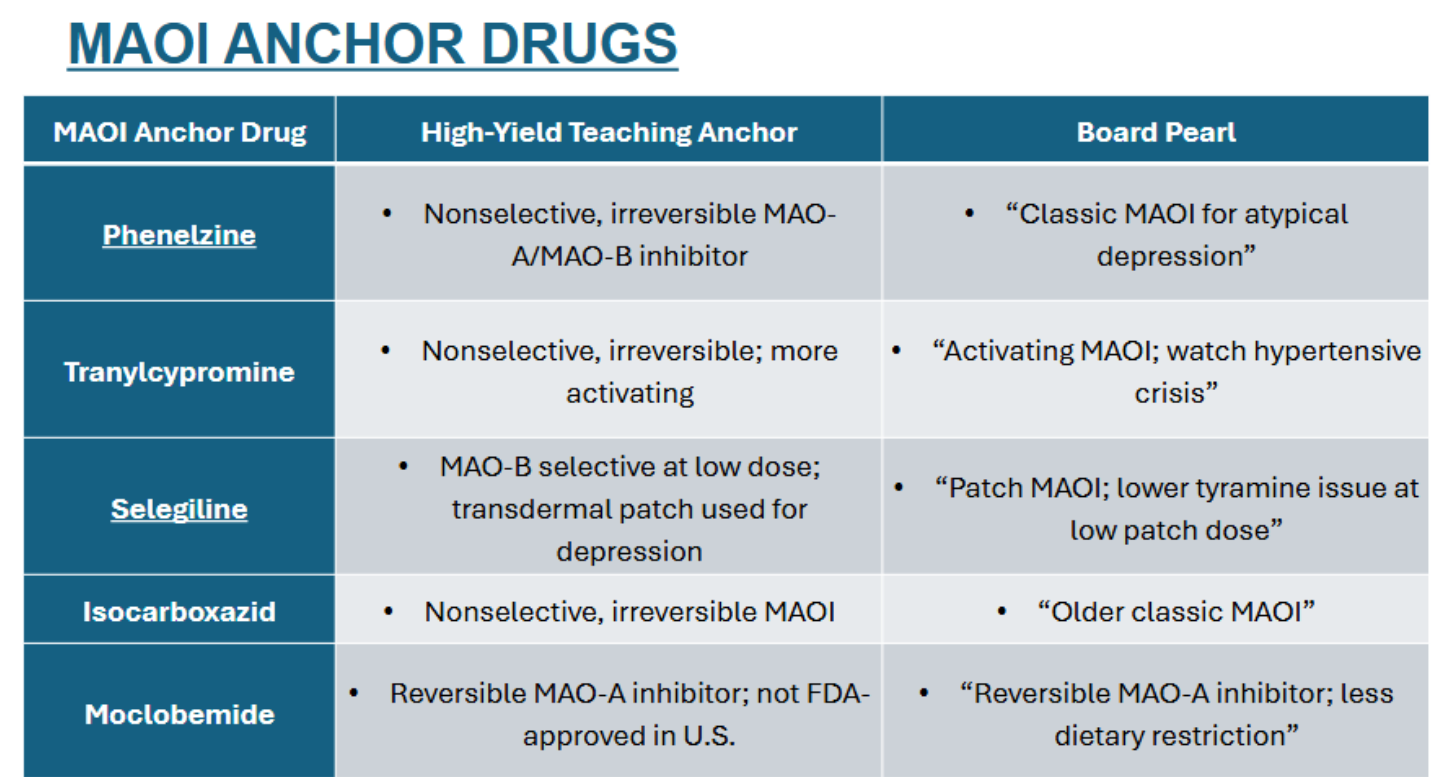
Nonselective/irreversible
phenelzine,
tranylcypromine,
Isocarboxazid
MAO-B selective/ Irreversible MAO B
selegiline, rasagiline
(mainly for parkinson)
Selegiline = selective at low doses, nonselective at higher doses
Selegiline patch = lower tyramine interaction risk
Reversible/Selective MAO B
Safinamide
reversible MAO-A inhibitor
Moclobemide
Clinical use:
treatment-resistant/atypical depression;
selected anxiety disorders
ADVERSE EFFECTS
Orthostatic hypotension:
Hypertensive crisis:
w/ tyramine exposure
Anticholinergic-like effects
Serotonin syndrome:
w/ serotonergic drug Combo
Sexual dysfunction:
CNS effects:
Insomnia, agitation, tremor
Weight gain:
DRUG INTERACTIONS
Tyramine-rich foods:
↑ hypertensive crisis risk
Serotonin Drugs
Sympathomimetics:
Marked hypertension may occur
Levodopa / stimulants:
Excess catecholamine effects
Clinical pearl:
Respect washout periods
CONTRAINDICATIONS
Meperidine/tramadol/dextromethorphan:
Uncontrolled hypertension:
Pheochromocytoma:
Severe liver disease:
Bipolar disorder:
Washout periods are essential

List the different mechanisms of the ATYPICAL ANTIDEPRESSANTS
NDRI
Norepinephrine–Dopamine Reuptake Inhibitor
NaSSA
Noradrenergic & Specific Serotonergic Antidepressant
SARI
Serotonin Antagonist & Reuptake Inhibitor
SPARI
Serotonin Partial Agonist– Reuptake Inhibitor
Describe BUPROPRION
Class
MOA
Clinical Usage (4)
Advantage
AE (4)
Avoid (2)
BUPROPRION
Class:
Norepinephrine-dopamine reuptake inhibitor (NDRI)
MOA:
Targets NET + DAT -> ↑ NE and Dopa
Clinical Usage:
Depression,
smoking cessation
Useful when fatigue or sexual side effects matter
Advantage:
Minimal sexual dysfunction
weight-neutral or weight loss
AE:
Insomnia, agitation, tremor
Major risks for Seizures
Avoid:
Seizure disorders, eating disorders
Describe MIRTAZAPINE
Class:
MOA:
Clinical Usage:
Advantage:(2)
AE: (2)
MIRTAZAPINE
Class:
Noradrenergic and specific serotonergic antidepressant (NaSSA)
MOA:
Targets: α2, 5-HT2/3, H1 -> Blocks α2 → ↑ NE and 5-HT release
Clinical Usage:
Depression w/ Insomnia + poor appetite
Advantage:
Less nausea from 5-HT3 blockade
less sexual dysfunction than SSRIs
AE:
Sedation
weight gain
Describe TRAZODONE
Class
MOA
Clinical Usage (2)
AE (3)
Benefits (2)
TRAZODONE
Class:
Serotonin antagonist and reuptake inhibitor (SARI)
MOA:
Targets: 5-HT2A, SERT, H1, α1 -> Blocks 5-HT2A; weakly inhibits SERT
Clinical Usage:
Depression
Insomnia
AE:
Priapism
α₁ blockade
Sedation
orthostatic hypotension
Benefits:
Less sexual dysfunction than many SSRIs
Common low-dose sleep aid
Describe VILAZODONE
Class:
MOA:
Clinical Usage: (1)
AEs: (3)
Benefits: (2)
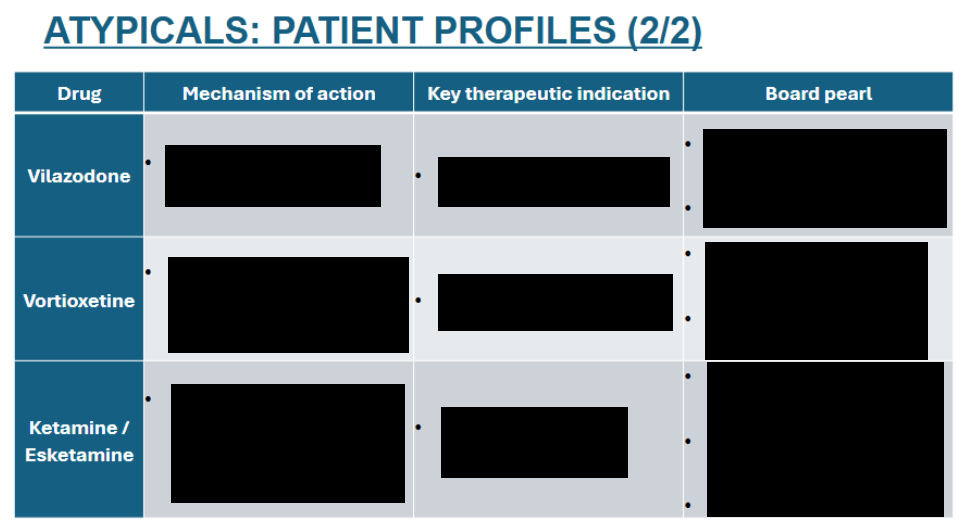
VILAZODONE
Class:
Serotonin partial agonist-reuptake inhibitor (SPARI)
MOA:
Targets: SERT + 5-HT1A -> Inhibits SERT and partially agonizes 5-HT1A
Clinical Usage:
MDD
AEs:
Nausea, diarrhea, insomnia
Benefits:
less sexual dysfunction in some patients
Take with food for better absorption
Describe VORTIOXETINE
Class
MOA
Clinical Usage (1)
AEs (3)
Benefits (1)
VORTIOXETINE
Class:
Multimodal serotonergic antidepressant
MOA:
Targets: SERT + multiple 5-HT receptors
Clinical Usage:
MDD
AEs:
Nausea, headache, dizziness
Benefits:
less sexual dysfunction in some patients
Describe KETAMINE
Class:
MOA:
Clinical Usage:
Benefits:
AEs: (3)
KETAMINE
Class:
Rapid-acting antidepressant / dissociative anesthetic
MOA:
Target NMDA receptor antagonist -> Modulates glutamate signaling; rapid synaptic effects
Clinical Usage:
Treatment-resistant depression
Benefits:
Can reduce depressive symptoms rapidly
AEs:
Dissociation, sedation, dizziness
May increase blood pressure
Misuse/abuse potential



Describe the process of ANTIDEPRESSANT SWITCHING
SSRIs to SNRIs switching
SSRIs to TCAs switching
To MAOI:
From MAOI:
ANTIDEPRESSANT SWITCHING
SSRIs to SNRIs switching
Taper SSRI first, then start SNRI cautiously
Cross-taper = serotonin risk
Fluoxetine needs extra washout
Monitor withdrawal and relapse
SSRIs to TCAs switching
Taper SSRI first, then start TCA low
Cross-taper = serotonin risk
Fluoxetine needs extra washout
SSRIs may ↑ TCA levels
Monitor toxicity / ECG
To MAOI:
Stop old drug first
Usual washout: 14 days
Fluoxetine: 5 weeks
Risk of Serotonin syndrome from residual
From MAOI:
Wait 14 days
Do not overlap / cross-taper
Watch serotonin + hypertensive toxicity
Describe the symptoms of SEROTONIN SYNDROME (3,4,3)
Describe DISCONTINUATION SYNDROME
Highest risk:
Symptoms:
MEMTIP?
Offending Drugs: (2)
Prevention:
SEROTONIN SYNDROME
Mental status:
Agitation,
confusion,
delirium
Autonomic:
Fever,
diaphoresis,
tachycardia,
BP changes
Neuromuscular:
Hyperreflexia,
clonus,
tremor
DISCONTINUATION SYNDROME
Highest risk: Short half-life agents
Symptoms: MEMTIP: DIIF
Dizziness,
irritability,
insomnia
flu-like feelings,
Offending Drugs:
Paroxetine
venlafaxine
Prevention:
Taper gradually
Avoid abrupt discontinuation
How to Choose the right antidepressants
Insomnia
Sexual dysfunction concern
Neuropathic pain
Overdose risk
Poor adherence
What special populations should you be concerned about?
CHOOSING THE RIGHT ANTIDEPRESSANTS
Insomnia
mirtazapine, trazodone
Sexual dysfunction concern
bupropion
Neuropathic pain
duloxetine, some TCAs
Overdose risk
avoid TCAs
Poor adherence
fluoxetine may help
SPECIAL POPULATIONS
Elderly:
Higher risk of hyponatremia,
sedation,
falls,
anticholinergic harm.
Bipolar disorder:
trigger mania w/o mood stabilization.