Lecture 14 - DNA Assesmbly Techniques
 Call Kai
 Learn
 Practice Test
 Spaced Repetition
 Match
 Flashcards
 Knowt Play
1/57

There's no tags or description
Looks like no tags are added yet.
58 Terms
DNA cloning
The process of making multiple, identical copies of a particular piece of DNA fragment
How DNA cloning is defined in terms of vectors
The insertion of a gene (or genes) into a vector that enables amplification and propagation of the gene as a homogeneous population of DNA molecules in cells
Three things DNA cloning is crucial for
1) Purification and amplification of DNA fragments
2) Protein expression
3) Transgenesis (transferring a gene into another organism)
Transgenesis
Transfer of a gene into another organism
DNA assembly
A method to link together multiple fragments of DNA in an end-to-end fashion to achieve a desired, high-order assembly before joining to a vector
The three categories of DNA assembly methods covered
1) Restriction enzyme-based (Regular, Golden Gate, BioBrick)
2) Sequence homology-based (Gibson Assembly)
3) Golden Gate Assembly

The 4 + 1 major steps of traditional cloning
1) Obtain DNA fragment with gene of interest (PCR or gene synthesis)
2) Isolate a suitable plasmid from a bacterium
3) Cut fragment and plasmid with the same restriction enzymes
4) Insert fragment into plasmid with DNA ligase
5) Verify the correct recombinant plasmid construct
When is assembly of multiple DNA fragments needed?
When multiple genes/proteins must be expressed simultaneously

Three examples requiring multi-fragment assembly
1) Multiple enzymes catalyzing a series of biochemical reactions in metabolic engineering
2) Co-expression of a recombinant protein with a chaperone protein
3) Construction of a genome-editing vector with multiple genetic elements (Cas9, sgRNA, homologous arms)

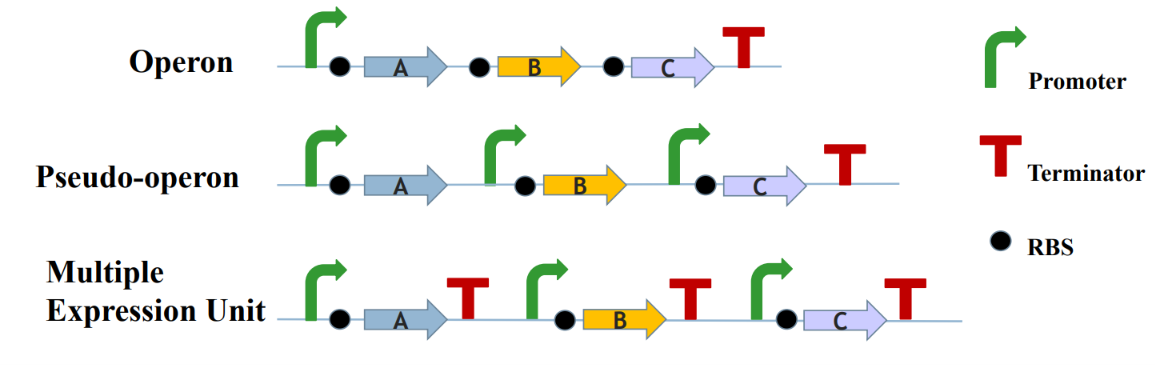
Three architectures for expressing multiple genes
Operon, pseudo-operon, and multiple expression unit

Operon architecture
One promoter drives all genes (A, B, C)
each with its own RBS
ending in a single terminator

Pseudo-operon architecture
Each gene has its own promoter and RBS, but all genes share a single terminator at the end

Multiple expression unit architecture
Each gene has its own promoter, RBS, and its own terminator — fully independent expression cassettes
Restriction enzymes
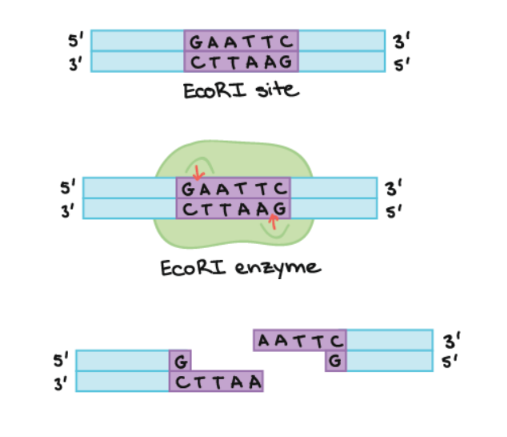
Enzymes that recognize and bind to specific DNA sequences, called restriction sites

What a restriction enzyme does at its target sequence
Makes a double-stranded cut in the DNA molecule
at or near the restriction site
tidy and predictable pattern
Restriction site
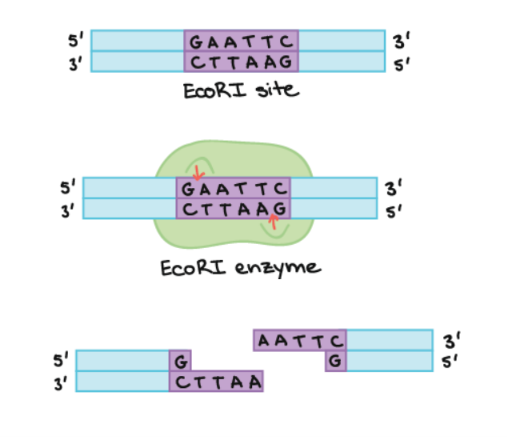
The specific DNA sequence recognized and bound by a restriction enzyme

EcoRI recognition site
5'-GAATTC-3' / 3'-CTTAAG-5'; it cuts between G and A, leaving AATT sticky ends

Sticky ends
Single-stranded overhangs generated by a restriction enzyme cut
base-pair with complementary overhangs
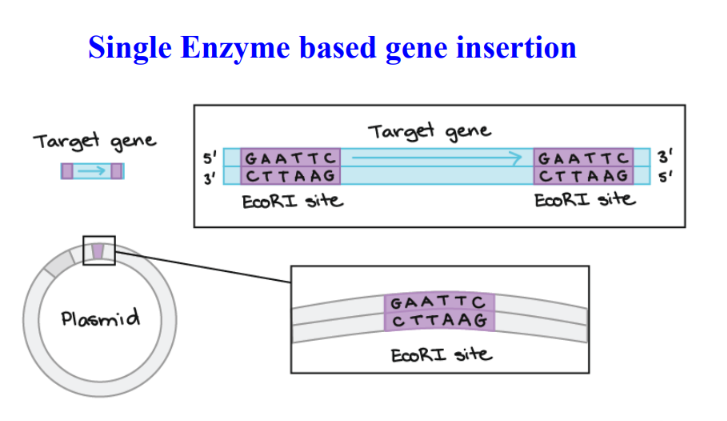
Single enzyme-based gene insertion
One restriction enzyme is used to cut both the target gene (flanked by two identical restriction sites) and the plasmid
then ligase joins them
Why is alkaline phosphatase used in single-enzyme cloning?
To prevent self-ligation of the digested vector (it removes the 5' phosphates so the vector cannot re-close on itself)
Two disadvantages of single-enzyme digestion and ligation
1) Self-ligation of the digested vector (plasmid closes back up)
2) The gene may be inserted in both directions (forwards or backwards)

Three possible outcomes of single-enzyme ligation
Gene goes in forwards (correct)
plasmid closes back up (self-ligation)
gene goes in backwards (wrong orientation)

Double-enzyme digestion and ligation
Two different restriction enzymes (e.g. EcoRI and NotI) cut the insert and vector
two different non-compatible sticky ends
Rule about sticky ends from the SAME restriction enzyme
They can be rejoined by DNA ligase
Rule about sticky ends from DIFFERENT restriction enzymes
They cannot rejoin
Two problems solved by double-enzyme digestion
It prevents vector self-ligation and forces directional (correct orientation) insertion

Example enzyme pair used in the double-digest slide
EcoRI and NotI (NotI site: GCGGCCGC / CGCCGGCG)
How are restriction sites added to fragments for multi-fragment assembly?
They are introduced by PCR (primers carry the restriction sites)
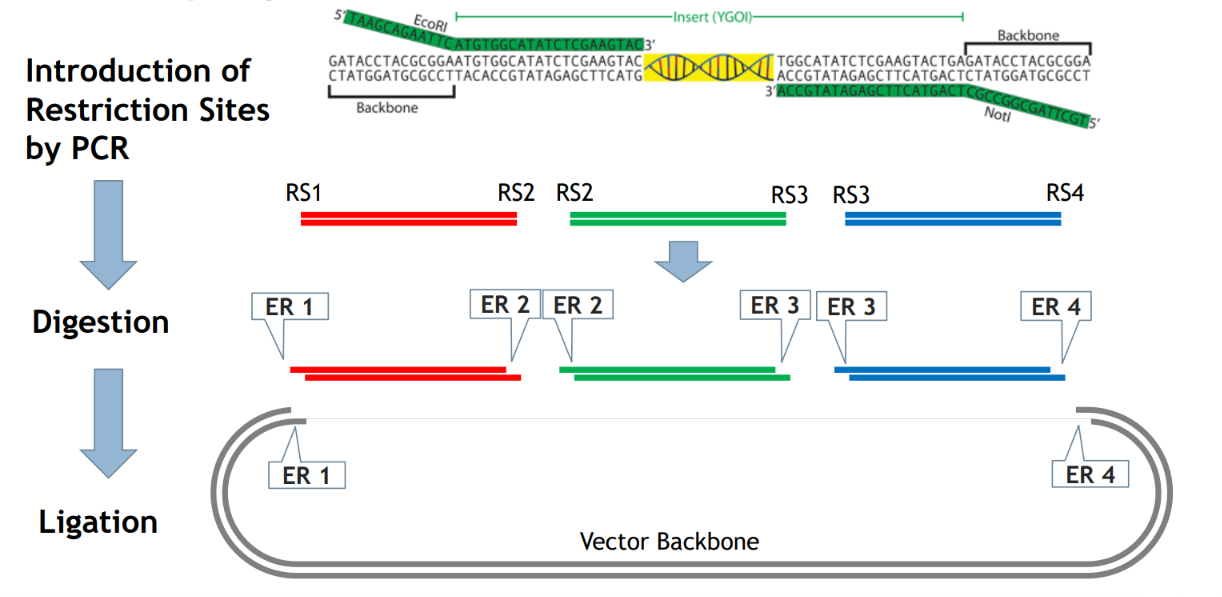
Restriction enzyme-based assembly of multiple fragments: the scheme
Each fragment is flanked by a unique pair of sites (RS1–RS2, RS2–RS3, RS3–RS4)
after digestion the shared sites create matching sticky ends so fragments ligate in order into the vector backbone between ER1 and ER4
Two limitations of restriction enzyme-based DNA assembly
1) Not efficient for assembling many fragments (>5)
2) The restriction sites used for digestion cannot be present inside a gene sequence
What happens if a restriction site occurs inside a gene?
Digestion cuts within the gene itself, destroying the fragment (e.g. an internal RS1 splits the fragment into pieces)

Gibson Assembly definition
A restriction enzyme-independent assembly method that allows joining of multiple DNA fragments via overlapping homologous ends
What do Gibson Assembly fragments need at their ends?
Regions of homology — DNA inserts with 15–20 bp overlapping ends, typically added by PCR amplification

Gibson Assembly step 1
Fragments share identical (homologous) overlapping end sequences

Gibson Assembly step 2
T5 exonuclease chews back DNA in a 5' to 3' orientation
creating single-stranded overhangs

Gibson Assembly step 3
Chew-back exposes complementary single-stranded DNA sequences for base-pairing
T5 endonuclease inactivated with heat (50 C)

Gibson Assembly step 4
Annealing of the two single-stranded DNAs with complementary sequences
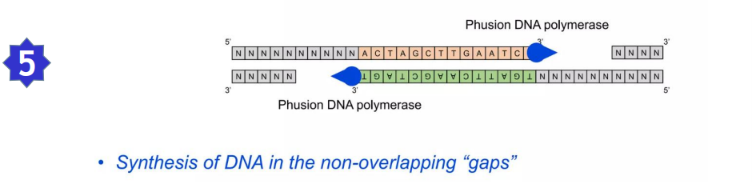
Gibson Assembly step 5
Phusion DNA polymerase synthesizes DNA to fill the non-overlapping "gaps"

Gibson Assembly step 6
DNA ligase seals the "nicks"

Gibson Assembly step 7 (outcome)
Joining of DNA molecules without a "scar" — assembly of two DNA pieces with no addition or deletion of extra DNA sequence
Why doesn't T5 exonuclease destroy the whole fragment?
T5 exonuclease is heat-labile and is quickly inactivated at 50 °C, the reaction temperature
Which polymerase is used in Gibson Assembly?
Phusion DNA polymerase

Six components of a Gibson Assembly reaction
Destination vector
DNA insert(s)
5' exonuclease (T5)
DNA polymerase
T4 DNA ligase
reaction buffer
Restriction enzyme-based cloning: 3 features (comparison)
1) Requires restriction digestions
2) Requires multi-step processing of vector and insert with sequential digestion and ligation reactions
3) Leaves restriction sites in the joints of the final construct
Gibson Assembly: 4 features (comparison)
1) Does NOT require restriction digestions
2) Single-pot isothermal reaction, time saving
3) Can efficiently assemble multiple fragments in one reaction
4) Seamless — no unnecessary sequences left between joints
Golden Gate Assembly definition
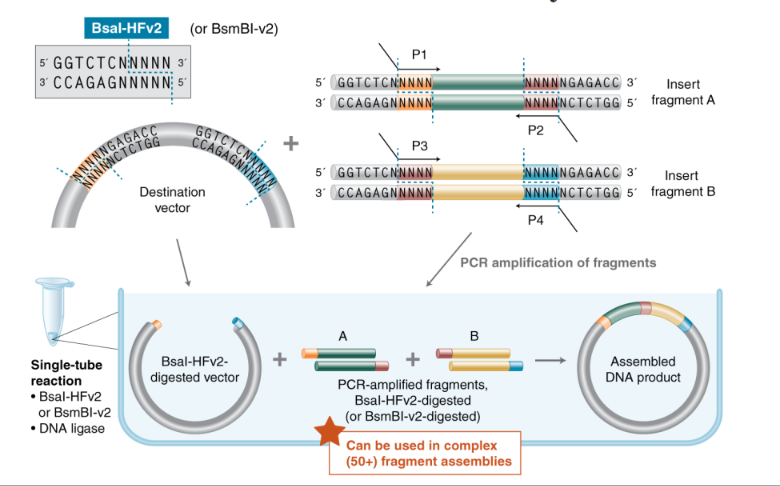
A molecular cloning method that simultaneously and directionally assembles multiple DNA fragments into a single piece using Type IIS restriction enzymes and T4 DNA ligase

Type IIS restriction enzymes
Enzymes that recognize asymmetric DNA sequences and cleave OUTSIDE of their recognition sequence

Type IIP vs Type IIS enzymes
Type IIP (e.g. SacI) recognizes a palindromic sequence and cuts within it
Type IIS (e.g. BsaI) recognizes an asymmetric sequence and cuts outside/downstream of it

Example of a Type IIP enzyme
SacI (GAGCTC)

Example of a Type IIS enzyme
BsaI (GGTCTC, cutting N1/N5 downstream)
How many combinations can a 4-nucleotide overhang have?
256 combinations
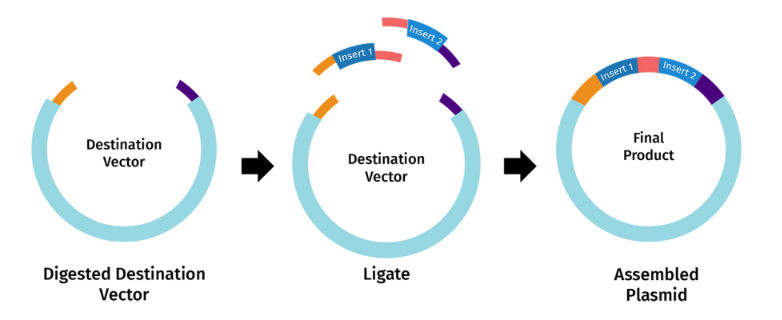
How are fragments ordered in Golden Gate Assembly?
Once the destination vector and inserts are digested, their complementary 4-base overhangs are joined by DNA ligase to create an ordered, directional assembly
Why does the Type IIS site disappear from the final Golden Gate product?
Because the enzyme cuts outside its recognition sequence, the recognition site is removed with the cut-off end and is absent from the final construct
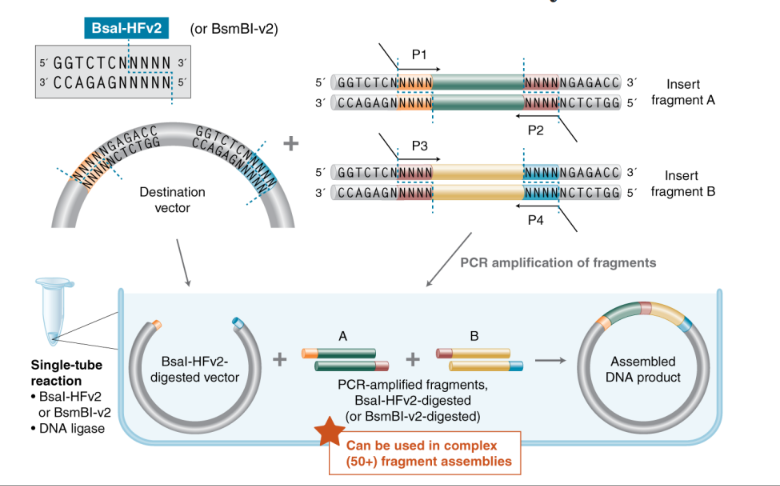
Five components of a Golden Gate reaction
Destination vector
DNA insert(s) (amplicon or pre-cloned)
Type IIS restriction enzyme (e.g. BsaI)
T4 DNA ligase
reaction buffer

Two ways to get a gene of interest ready for Golden Gate
Option 1: the gene is already in a Golden Gate-compatible plasmid containing Type IIS sites
Option 2: PCR amplify the gene to add Type IIS sites and overhangs
How many fragments can Golden Gate assemble?
It can be used in complex assemblies of 50+ fragments
Two advantages of Golden Gate Assembly
1) One-pot reaction, time saving
2) One enzyme can generate different sticky ends (saves money)
Disadvantage of Golden Gate Assembly
It is not 100% sequence-independent — to avoid undesired digestion, the Type IIS site used must not be present within the fragments being assembled