Plant Physiology
 Call Kai
 Learn
Learn Practice Test
 Spaced Repetition
 Match
Match Flashcards
 Knowt Play
1/21

There's no tags or description
Looks like no tags are added yet.
Name | Mastery | Learn | Test | Matching | Spaced | Call with Kai | Chat |
|---|
No analytics yet
Send a link to your students to track their progress
22 Terms
Turgor Pressure
The hydrostatic pressure exerted by the cell’s fluid content against the cell wall
High Turgor Pressure
Well watered

Low turgor pressure
Flaccid state

Surface tension
Energy required to increase the surface area of a gas-liquid interface
Cohesion
Attraction between water molecules
Adhesion
Attraction between water molecules to solid phase

Hypertonic
Plasmolyzed

Isotonic
Incipient plasmolysis
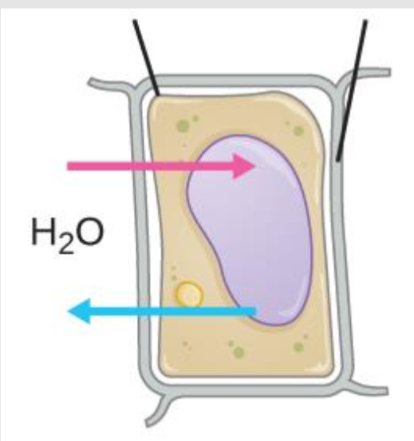
Hypotonic
Turgid state

Osmosis
Net movement of water from high to low water potential across a selectively permeable membrane.
Water potential

Osmotic potential

Water potential in soil
Normal soil: Psi S = 0
Salty soil: Psi S = -0.2
Wet soil: Psi P = 0
Dry soil: Psi P = less
How does water move in soil
Bulk flow
Contributing factor to water potential in dry soil
Negative hydrostatic pressure that lowers soil water potential.
Where water enters root
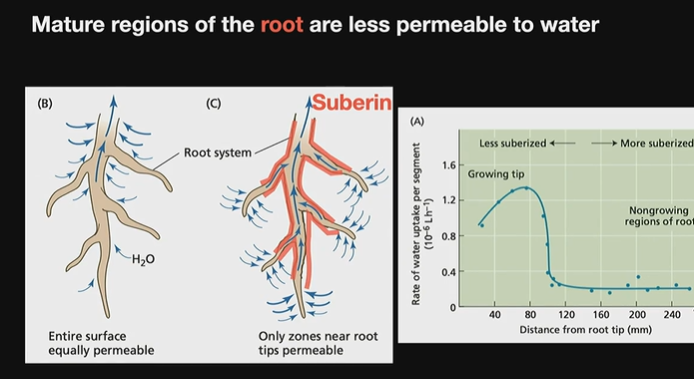
Apoplast pathway
Does not cross any membranes. Casparian strip filters air bubbles from water.
Symplast pathway
Water travels without crossing plasma membrane. Travels through plasmodesmata.
Transmembrane
Crossing plasma membrane
Air bubble in xylem
Pits block off gas-filled vessels or tracheids with primary cell walls.
Cohesion-tension theory
Xylem tension pulls
Roots push
97% of water plants absorb is lost through stomata.
Casparian Strip
Filters out air bubbles to prevent embolism.