1101 Reproduction
 Call Kai
 Learn
 Practice Test
 Spaced Repetition
 Match
 Flashcards
 Knowt Play
1/82

There's no tags or description
Looks like no tags are added yet.
83 Terms
What is gametogenesis?
Production of sperm or eggs (gametes) through processes involving meiosis.
What is a gamete?
A haploid sex cell, such as sperm or egg.
How many chromosomes are in a normal human gamete?
23
Gametes are sperm or egg
Makes sense they have 23 because two need to come together to make a cell with 46 chromosomes
How many chromosomes are in a typical human body cell?
46.
What is spermatogenesis?
Production of sperm cells in the testes.
Where does spermatogenesis take place?
Seminiferous tubules of the testes.
How many functional sperm result from one primary spermatocyte after meiosis?
Four of equal size

Where are spermatogonial stem cells located within a seminiferous tubule?
Basically, sperm cells can reproduce infinitely. Where do these cells come from? They come from stem cells.
The stem cells are on the outermost part of the seminiferous tubule.
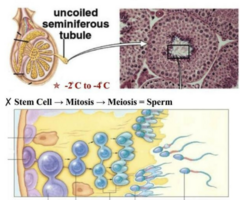
Describe the stages of spermatogenesis broadly speaking in relation to stem cells in the seminiferous tubule
Stem cells in the seminiferous tubule divide via mitosis, then undergoes meiosis to make 4 haploid cells, these are the sperm
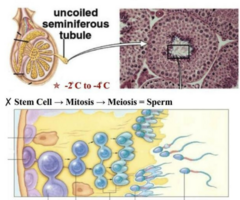
Does spermatogenesis occur more efficiently at cooler or warmer temperatures?
Cooler (-2 Celsius to -4 Celsius below body temp). This is why the male reproductive organ hangs away from the body (away from internal body heat)
What is oogenesis?
Production and maturation of female gametes (egg cells).
How many large functional egg cells are produced from a primary oocyte?
One.
The other three are considered polar bodies

What are the smaller products of oogenesis called?
Polar bodies.
Why does oogenesis produce one large ovum rather than four equal cells?
Cytoplasm is divided unequally to support the egg.
What key difference separates oogenesis from spermatogenesis?
Oogenesis produces one large egg; spermatogenesis produces four sperm.
Women have __ ovaries, but only __ is active each cycle
2
1
Men can produce an infinite number of sperm because they have stem cells in the seminiferous tubules of their reproductive organs.
Can females make an infinite number of eggs? Why or why not? If not, explain the process.
No they have no stem cell to make a continuous supply and are born with a pre-set amount of oocytes.

What are the three broad regions of a sperm cell?
Head/acrosome
midpiece
tail.

What part of the sperm cell is inserted?
None of it, it releases its genetic material into the egg then leaves
What is the acrosome?
An enzyme-containing cap that helps sperm penetrate egg coverings.

What part of a sperm provides swimming movement?
The flagellum, or tail.

What is the main purpose of the sperm midpiece?
Supply energy for motility, using numerous mitochondria.
Where does fertilization typically occur in humans?
In the ampulla of a fallopian tube.

Is the first sperm to reach an egg necessarily the sperm that fertilizes it?
No, later sperm will be able to fertilize
How long does it take for the first sperm to reach the ampulla
3 mins
What sperm-cell structure releases enzymes against the egg's outer coat?
The acrosome during the acrosome reaction.
what does the first sperm cells have to do to the outer of the ovum (egg)
"chew" through the corona radiata and the zona pellucida before fusing with the membrane

What is the cortical reaction?
Egg changes after sperm fusion help prevent additional sperm entry, one provides 23 chromosomes, the oocyte will divide and become ready to merge with the male chromosomes the outside of the oocyte changes configuration so that all other sperm cells detach
About how many oocytes may be present in the ovaries during fetal development?
About 2 million.
Roughly how many oocytes are ovulated over a human reproductive lifetime?
About 400-500, often approximated as 450.
How many oocytes are usually released in one ovulatory cycle?
One, although sometimes more than one is released - fraternal twins!
What may cause fraternal twins to occur in one cycle?
Release and fertilization of two separate oocytes.
How many combinations can independent assortment make in one parent's gametes?
2^23 = 8,388,608.
What is gestation?
The period of pregnancy during which all stages of development takes place.
How long is a typical pregnancy by obstetric dating?
About 40 weeks from the last menstrual period.
What is fertilization?
Fusion of sperm and egg, leading to a diploid zygote.
What is a zygote
fertilized egg cell
It is the resulting diploid (46 chromosome) cell mass that comes from sperm meeting with egg
What is implantation?
Embedding of the blastocyst into the uterine endometrium.
The blastocyst is basically just the evolved version of the zygote, which again, is just a fertilized egg
So in short, implantation is just the embedding of a fertilized egg mass of cells into the uterus
Where does fertilization usually occur, compared with implantation?
Fertilization in a fallopian tube; implantation in the uterus.
What molecule do most pregnancy tests detect?
hCG: human chorionic gonadotropin.
Which body fluids can be used to test for hCG?
Urine or blood.
When does hCG begin to rise during pregnancy?
After implantation
How does hCG prevent menstruation?
By protecting the endometrium
Can men give positive pregnancy tests? Why?
If they have some hormonal issue then their hCG could be spiked (bc men also make hCG just in much lower amounts usually)
What is the first single cell formed by sperm-egg fusion called?
Zygote.

What happens to the chromosome number when two haploid gametes fuse?
It becomes diploid: 23 + 23 = 46.
What determines whether the sperm contributes an X or Y sex chromosome?
Which sex chromosome that sperm carries.
What is the conceptus?
The developmental stages occuring after the zygote formation (fertilization) through two weeks
It is the stage where implantation into the uterus occurs
What is embryo
developmental stages occuring from the 3rd week through the 8th week. Stage in which oragnogenesis occurs
Organogenesis is when specific organs in the embryo occur
What is fetus
the developing human organism from 9 weeks through birth
Primarily a period of growth
What is parturition
act of giving birth - fetus leaving mom
List the order of stages of fetus development by stage name
Fertilization (sperm and egg meet creating zygote)
Conceptus (week 0-2)
- includes the zygote/blastocyst implanting into the uterus
Embryo (week 3-8)
- developmental stages where specific organs are preformed (organogenesis)
Fetus (week 9-end)
- development
Parturition (act of birth)
What weeks after fertilization are traditionally called the embryonic period?
Weeks 3-8.
What is organogenesis?
Formation and early development of the body's organs.
(t/f) Thalidomide is safe for pregnant women
False
What is the major emphasis of the fetal period?
Growth and functional maturation of organs.
What is parturition?
Childbirth or delivery of the baby.
Do early male and female reproductive structures begin from a common pattern?
Yes; early embryonic reproductive tissues are initially similar.

(t/f) male and female reproductive tracts begin as the same tissue, then differentiate.
True
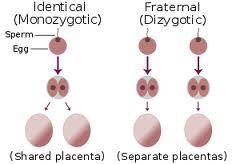
What is a monozygotic twin pair?
Two twins arising from one fertilized egg that splits.
Identical twins because they literally start out as the same genetic makeup
How many placental attachment points do identical twins have
1 - they share (monozygotic cell)

What is a dizygotic twin pair?
Twins arising from two separately fertilized eggs.
How many placential attachment points do fraternal twins have
2 (dizygotic) twins

Can fraternal twins be different sexes?
Yes.
What is a stem cell?
An unspecialized cell that can self-renew and produce differentiated cells, can divide into whatever they want infinitely (kind of)
What are the 4 categories of stem cells
totipotent, pluripotent, multipotent, unipotent
What does totipotent mean?
Able to form all cell types needed for an organism.
What does pluripotent mean?
Able to form nearly any body cell type, but not a whole organism alone.
P is for plenty (but not all)
What does multipotent mean?
Able to produce multiple related cell types within a tissue lineage.
Bone marrow makes blood cells (white and red and plateletes) is an example
M is for many cell types but within ONE family
What does unipotent mean?
Able to form one main specialized cell lineage while self-renewing.
Uni = one. Can do one thing
The stem cells in the seminiferous tubule (that produce sperm) are unipotent
(t/f) when you move on to the next stage of stem cell, you cant go back
true
Youre totipotent for how long
first few divisisons
Put potency categories from broadest to narrowest.
Toto → Pluri → Multi → Uni;
whole organism → many body types → related types → one lineage.
What is the placenta?
A temporary maternal-fetal organ for exchange of nutrients, excretions and pregnancy support.

Do maternal and fetal blood normally circulate in the same vessels in the placenta?
No; their blood circulations are usually separated by a placental barrier.
Only the nutrients between the blood is exchanged, not the blood itself

What is the first time the fetus and mother share blood directly
act of birth, as baby leaves placenta rips and blood mixes. This is not an issue for the first baby, but later could be an issue
What crosses the placenta from mother to fetus?
Oxygen and nutrients, among other substances.
What does Rh-positive blood mean?
Red blood cells carry the Rh(D) antigen.
What combination creates risk of Rh incompatibility?
An Rh-negative mother carrying an Rh-positive fetus.
Rh factor and birth blood mxing
If an RH- mom has two RH+ childrem, the the antibodies will attack the second kids blood. This can be prevented by RhoGam
Why can a later Rh-positive fetus be harmed after an Rh-negative mother is sensitized?
Maternal anti-D antibodies can cross the placenta and destroy fetal red blood cells.
Rh mixing is fatal to mom, baby, or both?
Baby
What is the medical definition of preterm birth?
Birth before 37 completed weeks of pregnancy.