Marketing 2205 Chapter 10: Marketing Channels
 Call Kai
 Learn
 Practice Test
 Spaced Repetition
 Match
 Flashcards
 Knowt Play
1/25

There's no tags or description
Looks like no tags are added yet.
26 Terms
Value Delivery Network
A value delivery network is composed of:
the company,
suppliers,
distributors
the company’s customers
It’s a network of partnerships that improve the performance of the entire system in delivering customer value
Supply Chains & Distribution Channels
Upstream value delivery partners supply the raw materials, components, parts, information, finances, and expertise needed to create a product or service.
Downstream value delivery partners are the distribution channels that link the firm and its customers.
Marketing Channels a.k.a. Distribution Channels
Interdependent organizations that help make a product or service available for use or consumption
Channel decisions
affect every other marketing decision,
can lead to competitive advantage,
may involve long-term commitments to other firms
How a Distributor Reduces the Number of Channel Transactions
Figure 10.1

How Channel Members (Intermediaries) Add Value
Create greater efficiency in making goods available to target markets.
Transform the assortments of products made by producers into the assortments wanted by consumers.
Bridge the major time, place, & possession gaps that separate goods & services from users.
Key Functions Performed by Channel Members
Help to complete transactions
Information
Promotion
Contact
Matching
Negotiation
Help to fulfil the completed transactions
Physical distribution
Financing
Risk taking
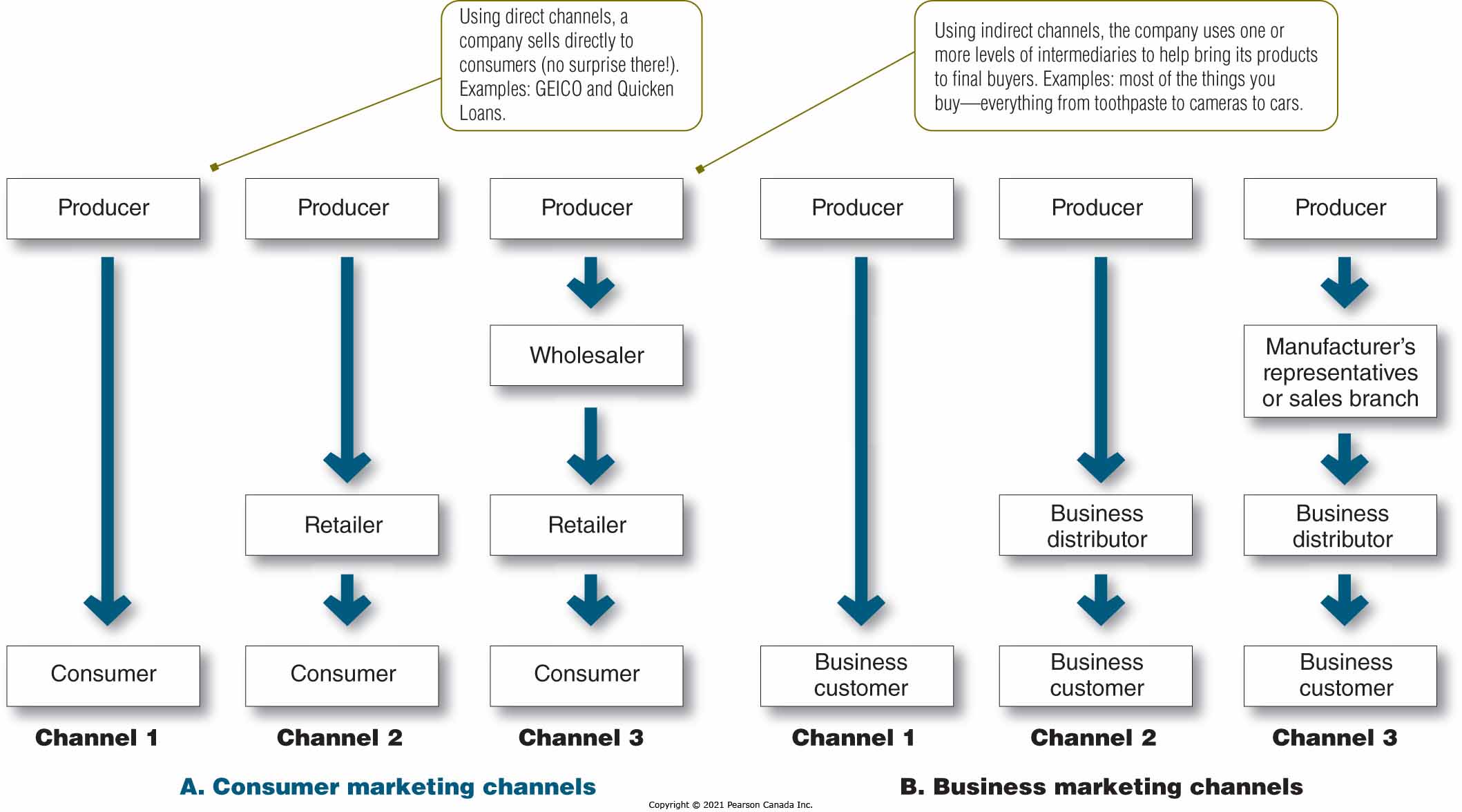
Channel Levels
Channel level: A layer of intermediaries that performs work in bringing the product & its ownership closer to the final buyer
Direct marketing channel: No intermediary levels
Indirect marketing channels: One or more intermediary levels
Consumer & Business Marketing Channels
Figure 10.2
Flows Connecting Channel Members
Types of flows that connect the institutions in the channel:
Physical flow of products
Flow of ownership
Payment flow
Information flow
Promotion flow
Channel Behaviour
Channel conflict: Disagreements among marketing channel members on goals, roles, & rewards
Horizontal conflict occurs among firms at the same level of the channel.
Vertical conflict occurs between different levels of the same channel.
Comparison of Conventional Distribution Channel with Vertical Marketing System
Figure 10.3

Vertical Marketing Systems
A vertical marketing system (VMS) consists of producers, wholesalers, & retailers acting as a unified system.
There are three types of VMSs:
Corporate
Contractual
Administered
Horizontal Marketing System
Two or more companies at one level join together to follow a new marketing opportunity.
(Ex. Tim Hortons & Gas Stations)
Multichannel Distribution Systems
A single firm sets up two or more marketing channels to reach customer segments.
Example: Canada Goose
Advantages:
Expansion of sales & marketing coverage
Tailor-made products & services for the specific needs of customer segments
Disadvantages:
Harder to control
Generates conflict
Multichannel Distribution System
Figure 10.4

Disintermediation
Occurs when product or service producers cut out marketing channel intermediaries or when radically new types of channel intermediaries displace traditional ones
Maytag
Channel Design Decisions
Marketing channel design involves designing effective marketing channels by:
Analyzing customer needs
Setting channel objectives
Identifying major channel alternatives
Evaluating the alternatives
Major Channel Alternatives
Intermediaries (channel members) carry out channel work.
Number of intermediaries to use
Intensive distribution
Exclusive distribution
Selective distribution (electronics, furniture)
Responsibilities of each channel member
Supply Chain Management
Figure 10.5

Marketing Logistics & Supply Chain Management
The goal of marketing logistics is to deliver a targeted level of customer service at the least cost.
Logistics functions include
Warehousing
Inventory management
Transportation
Logistics information management
Marketing Logistics - Physical Distribution
Planning, implementing, & controlling the physical flow of materials, final goods, & related info from points of origin to consumption
Customer-centred logistics ->starts with marketplace then works backwards to the factory or sources of supply
Outbound logistics (factory to resellers)
Inbound logistics (suppliers to factory)
Reverse logistics (recycle and return from consumer to resellers)
Warehousing
Storage warehouses store goods for moderate to long periods.
Distribution centres are large, highly automated warehouses that receive goods, take orders, fill them, & deliver goods to customers.
Inventory Management
Should be done in a cost effective and profitable manner
Just-in-time logistics systems
Radio frequency identification (RFID), smart tag technology, gives the physical location of a product.
Transportation
Companies can choose among many transportation modes, including truck, rail, water, pipeline, & air.
Modes of transportation
Trucks, railroads, water carriers, pipelines, air carriers, & the internet
Factors affected by choice of transportation
Pricing of products
Delivery performance
Condition of goods
Customer satisfaction
Multimodal transportation
Combining two or more modes of transportation
Piggyback, fishyback, trainship, & airtruck
Logistics Information Management
Flows of info are closely linked to channel performance
Info can be shared and managed through
Electronic data interchange (EDI)
Vendor-managed inventory (VMI)
Integrated Logistics Management
Emphasizes teamwork both inside the company & among all the marketing channel organizations
Forming cross-functional teams inside the firm
Building logistics partnerships
Outsourcing to third-party logistics providers for functions required to get a client’s product to market