MARK4000 Dyachenko Final Exam
 Call Kai
 Learn
 Practice Test
 Spaced Repetition
 Match
 Flashcards
 Knowt Play
1/140

There's no tags or description
Looks like no tags are added yet.
141 Terms
marketing intelligence
formal link between the external environment and marketing decision making
-intelligence on customer needs and wants, behavioral patterns on impact and business performance
continuous approach
MIS (marketing info system)
DSS (decision support system)
Marketing Information System
-continuous/ongoing
-future oriented
-systematic
-internal and external info
Marketing Research
-each project has beginning and end
-current decision based on pertinent information
-flexible and situation specific
-mostly external
descriptive function
the gathering and presentation of statements of fact
ex: understand who is the primary user of samsung HDTV
diagnostic function
the explanations of data or actions
ex: investigate reasons for unsubscribing from email services
predictive function
-predict results of planned marketing actions
-specification of how to use descriptive and diagnostic research
ex: inform online book retailer recommendations
Would collecting information from and about customers lead to better marketing decision? Should you always do it?
not always "yes"
-cost/benefit analysis
-timing
-control over decision
-managers point of view
FALSE
FALSEMarketing research guarantee success of a product? True or False?
marketing decision problems (MDPs)
-relatively general
-decision/action-oriented
-multifaceted
examples:
-should a new advertising campaign be introduced to improve sales?
-should the price point of the brand be increased or decreased?
-should a new line of shampoo be introduced?
-should we open a new store in a new geographic market?
exploratory
if little is known about the problem
-used to clarify the exact nature of the problem to be solved
-flexible
-fast
-focus groups
-experience surveys
-interviews
-literature search
INTERVIEW GUIDE!!!
example of exploratory research
"What consumer needs drive purchase?"
Uses
• Formulate problems more precisely
• Develop ideas
• Establish priorities for research
• Eliminate impractical ideas
• Clarify concepts
Tools
• Focus groups
• Experience surveys
• Interviews
• Literature search
descriptive
if the problem is "somewhat" clear
- provides answers to who, what, when, where, how
-surveys/panels
QUESTIONNAIRE
example of Descriptive Research
"Which flavor is preferred most? By whom?"
Uses
• Describe segment characteristics
• Estimate proportion of people who behave a certain way
• Make specific predictions
Tools
• Surveys (cross-sectional)
• Panels (longitudinal)
causal
if the problem is very clear
-provides the answer to why and informs the cause-effect relationships
-large/representative samples
-structured data collection
-quantitative data
-conclusive results that inform decision making
-lab experiements
-field experiments
QUESTIONNAIRE
examples of Casual Research
"Which store layout should we adopt?"
Uses
• Provide evidence regarding causal relationships
Tools
• Laboratory experiments
• Field experiments
marketing research objectives (MRO'S)
identify
describe
generate
define
explore
evaluate
prioritize
select
measure
-specific
-data oriented
-focused (often only addressing only one aspect of the MDP)
primary data
Information gathered to serve the problem at hand
-very involved process
-high cost
-long
secondary data
information gathered for another purpose
-rapid and easy
-relatively low cost
-short
sample
is a subset from a larger population
Narrow AI
AI that focuses on one narrow task
general AI
AI that can understand and learn any intellectual task a human can
-not yet been achieved
super AI
AI that surpasses human intelligence and can understand/experience
-existence is hypothetical
GPT
Generative Pre-trained Transformer
- AI that is based on a large language model (LLM)
- LLM is an ai model trained on massive amounts of text data to act and sound like a human
qualitative research
-probing questions
-small sample size
-substantial amount of info from each respondent
-interviewer with special skills
-subjective, interpretive
-sound recorders, projection devices, video recorders, pictures, discussion guides
-low degree pf replicability
-exploratory research
quantitative research
-limited probing
-large sample size
-varied amount of info from each respondent
-interviewer with fewer special skills or no interviewer
-statistical, summation
-questionnaires, computers, printouts, mobile devices, smartphones, tablets, laptops
-high degree of replicability
-descriptive or causal type of research
observational research
instead of asking respondents directly, researches observe how respondents behave
natural vs contrived observation
natural: observe subjects in natural environment
contrived: observation of an artificial situation in order to speed up data collection
open vs disguised observation
Open: people know they are being watched
Disguised: people do not know they are being watched
direct vs indirect observation
direct: observe current behavior
indirect: infer behavior through some record of past behavior
human vs machine observation
human: a researcher records people or phenomena
machine: a device records aspects of behavior
ethnographic research
study human behavior in its natural context and conduct interviews
-fast growing industry in marketing research
mystery shoppers
-collect data about customer-employee interactions
-gather observational data about stores
one way mirrors
- Popular with focus groups and "in-house" research labs (e.g.,children playing with toys in a Fisher-Price lab).
traffic counters
determines traffic patterns over a particular stretch of road
nielson's TV ratings
identifies who is watching which TV shows and matches with demographic profiles
in depth interviews
an unstructured, direct, personal interview in which a single respondent is probed by a highly skilled interviewer to uncover underlying motivations, beliefs, attitudes, and feelings on a topic.
in depth interview objectives
-obtain detailed comments including feelings, beliefs, or opinions
-produce very detailed qualitative data
in depth interview structure
-may last more than an hour
-lots of probing: questions of what and why
-analysis of surface reactions and subconscious motivations is possible
IDI advantages
can uncover deep insights about underlying motives, in particular when topic is complex (probing!)
IDI disadvantages
-the skilled interviewer is essential - they may be hard to get and they influence the discussion
-the techniques results in very rich qualitative data that can be hard to interpret
-a very small sample is used so you cant generalize findings
focus group characteristics
group size: 8-12
prescreened respondents
-relaxed, informal setting
-1.5 -3 hours
-use of audio and video recording
-moderator is observational, interpersonal, and communication skills are crucial
focus group uses
a group of participants who are led by a moderator in an in depth discussion on one particular topic or concept
-they allow for group dynamics
-generation of ideas, attitudes, perceptions
-reveal consumer needs, motives, perceptions, and attitudes about products and services
focus group online adv
-no physical setup needed
-transcripts are captured on file in real time
-participants can be widely separated geographic locations
-participants are comfortable in their home or office environments
-the moderator can exchange private messages with individual participants
focus group online disadvantages
-online focus group participants are relaxed, but they can become bored or distracted
-group dynamic might be missing
dominant respondent bias
In a focus group, dominant respondents appear occasionally and can influence other respondents
moderator acceptance bias
Some respondents provide answers to please the moderator. Respondents interpret what they believe the moderator wants to hear and their answers may be false.
overstatement bias
Sometimes respondents overstate their intentions or opinions. It happens in concept-testing focus groups. Respondents overstate buying intent.
observer interference
The idea here is that people change their behavior when they know they are being observed.
Reference Bias (Order Bias)
the sequence of topics, questions, and activities produce reference bias.
respondents develop a frame of reference from a previous discussions
reduce by logically ordering questions
concept test bias
• Concept tests ask respondents to write down reactions to concept statements before talking about them. It minimizes respondents from influencing each other about a concept.
• Introducing concept statements after one hour of discussion will bias reactions.
• Consider running your concept test earlier during in-depth interview or focus group.
Focus Groups/IDIs: Advantages
They are easy to execute and very flexible.
• They produce rich information (for different reasons though)
• They provide a good platform for idea generation, brainstorming,
and understanding customer vocabulary.
Focus Groups/IDIs: disadvantages
• They are not representative and thus hard to generalize.•
The data is hard to analyze (subjective, not quantitative).
• The moderator/interviewer makes or breaks it.
FG produce rich info due to...
group and moderator interaction
group dynamic
differences in opinions
IDI produce rich info due to...
-in depth focused conversation about underlying motives, in particular when the topic is complex
-more time per person
-ability to address sensitive topics
FG moderator uses:
discussion guide
IDI interviewer uses:
interviewer guide
projective techniques
respondents are asked to interpret the behavior of others
in interpreting the behavior of others, respondents indirectly project their own motivations, beliefs, attitudes or feelings into the situation and are more likely to speak the truth
-third person technique
-word association : first word that comes to mind
-sentence completion
survey research
-the use of a questionnaire to gather facts, opinions, and attitudes
-questions are fixed and structured
-most popular descriptive research method
survey advantages
1) ease: questionnaires are relatively easy to administer to a large number of respondents
2) reliability: standardization reduces variability in the answers that may be caused by difference in interviewers or the interview process
3) simplicity: coding, analysis, and interpretation of data
survey disadvantages
-motivating respondents to respond truthfully and submit the survey
-structured data collection with fixed response choices may result in loss of validity for some measures
-properly wording questions is not easy
-getting the right sample might be challenging
self administered survey
paper (mail/fax, inserts, in person drop off)
electronic (email, internet, mobile)
not self administered survey
phone (traditional phone, computer assisted)
personal (in home, door to door)
email survey
• Easy to distribute
• Still requires to pre-identify participants
• Cheap to create with numerous platforms
• Highly adaptive
internet surveys
Advantages
• Cost effective
• Fast data collection (instantaneous)
• Web design can be sophisticated and flexible (for instance, skip patterns)
• Respondent is anonymous
• Geographically flexible•
Disadvantages
• Quality of Internet samples varies
• Possible self-selection error (voluntary, have to be on website)
• Related to the sampling issue
random error
differences in the results between the population of interest and the sample
-unless a census is done, there is always a certain amount of random error, but it can be estimated
systematic error
results from mistakes or problems in the research or sampling design
-unlike random error, systematic error must be dealt with
Random
Your survey of 5,000 people finds that the average income level in America is $32,300 while the U.S. Census finds it is $33,500... • Random or systematic error?
Systematic Non-Response Bias (This is a systematic error because you only got responses from one group (the seniors) and not from the whole population of (all Terry College students). This happened because you sent the questionnaire in a way that made the younger classes less likely to answer, and that's called "non-response bias.")
You mailed your survey to all Terry College students, but only the seniors completed and returned the questionnaire...• Random or systematic error?• If systematic, name it
Systematic Response Bias (Response bias occurs when survey respondents provide inaccurate information. The systematic error arises from the behavior of the respondents (lying))
Too embarrassed to admit they drink and drive, 10 subjects lied about their drinking habits on your alcohol-use survey...• Random or systematic error?• If systematic, name it.
acquiescence
tendency to agree with items regardless of content
measurement
the process of assigning numbers or labels to objects, persons, states, or events in accordance with specific rules to represent quantities or qualities of attributes
attitudes
not directly observable, but are measurable by indirect means such as verbal expression or behavior
measure along 3 dimensions:
1. affective- feelings towards an object
2.cognitive- awareness/knowledge of object
3.behavioral-reflects intentions
nominal scale
they give a unique name or label to a category
does NOT show rank order
does NOT have equal intervals
ex:
• What is your gender? 1. Male 2. Female
• Where did you last buy your sunglasses? 1. Amazon.com 2. Target 3. Somewhere else 4. I didn't buy it - it was a gift 5. I found it under a bridge
Mode
What can we calculate with a Nominal scale?
ordinal scale
_____ scales PRESERVE ORDER.
- indicate the relative positions of the object; distance between values is not measurable; (high school diplomas, associates degree, bachelors degree, masters degree)
-highest to lowest, most to least, strongest to weakest
example:
How may movies did you see in a movie theatre last month?
1. none
2. one or two
3. three or more
Mode and Median
What can we calculate with an Ordinal scale?
Mean Median and Mode
What can we calculate with an Interval scale?
Interval scales
numbers from an interval scale not only represent a classification and an order, but also measure distance in units of equal intervals
example:
how likely are you to buy a new pair of sunglasses this year?
1. very likely
2. likely
3. neither likely or unlikely
4. unlikely
5. very unlikely
Ratio scale
possesses all the properties of the nominal, ordinal, and interval scales, plus a natural 0
example:
how old are you? ______.
how many people are in your class? ______.
how many miles do you drive to school? ________.
Mean Median and Mode
What can we calculate with a Ratio scale?
reliability
degree to which measures are consistent
validity
degree to which we measure what we were trying to measure
internal: event to which a causal relationship is warranted
external: the extent to which what you find in your study can be generalized to your target population
construct: actually measuring what you say you are measuring
close ended questions
• Structured with aided recall.
• Respondents choose from a list of answers (quantitative)
open ended questions
• Allows for unaided recall.
• Respondents reply in their own words (qualitative) or with numeric input (ratio data)
Ordinal Data
Rank order scale questions ask respondents to rank a list of alternatives
• Example: Please rank the following plush toys with 1 being the brand that best meets the characteristics being evaluated and 3 being the worst brand on that characteristic.
nominal data
multiple choice and dichotomous questions are ____
scaled response questions
respondents choose a category to describe the intensity of their response
-results in INTERVAL OR RATIO DATA
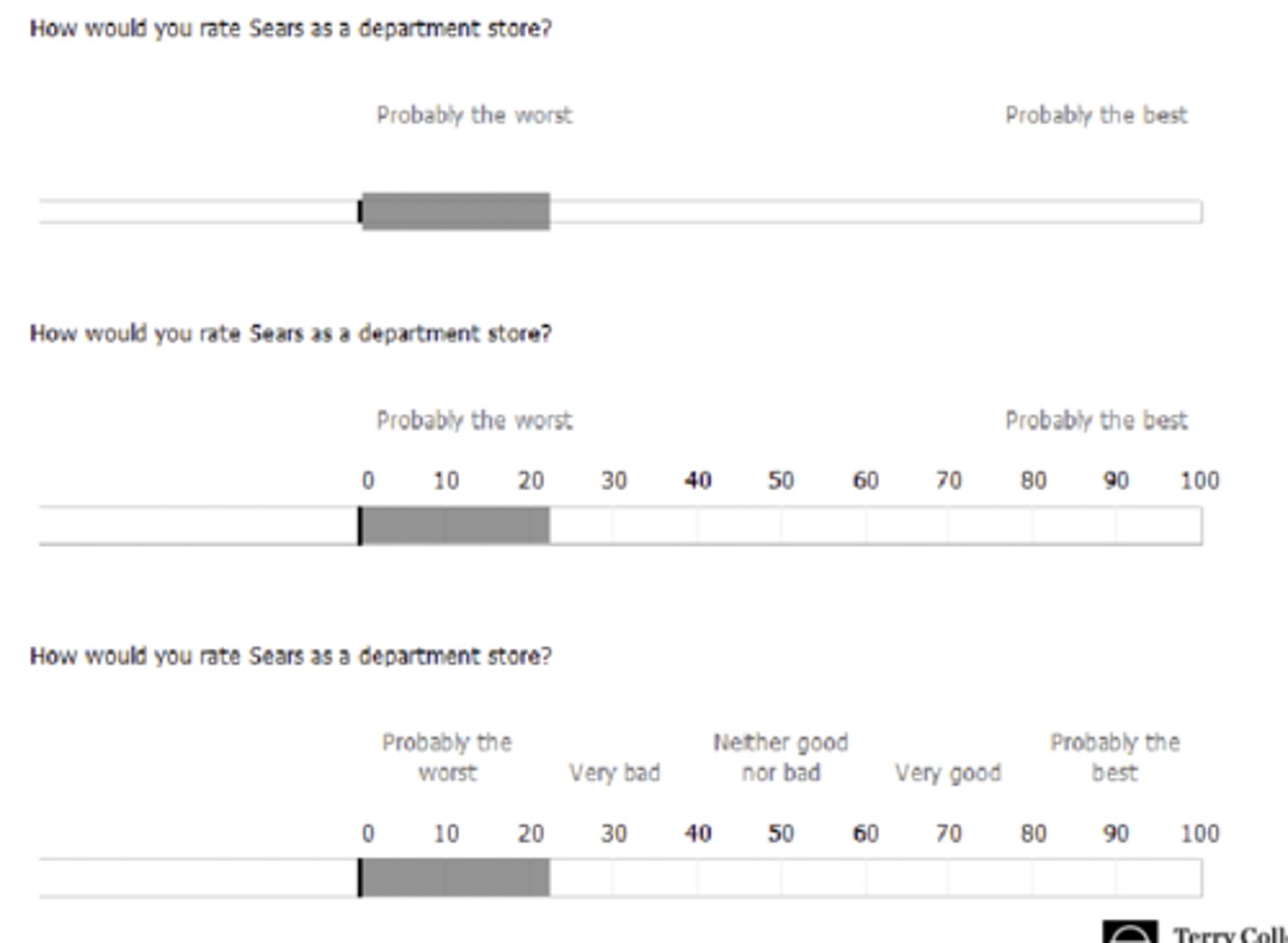
continuous rating scale questions
Respondents rate the objects by placing a mark at the appropriate position on a line that runs from one extreme of the criterion variable to the other.
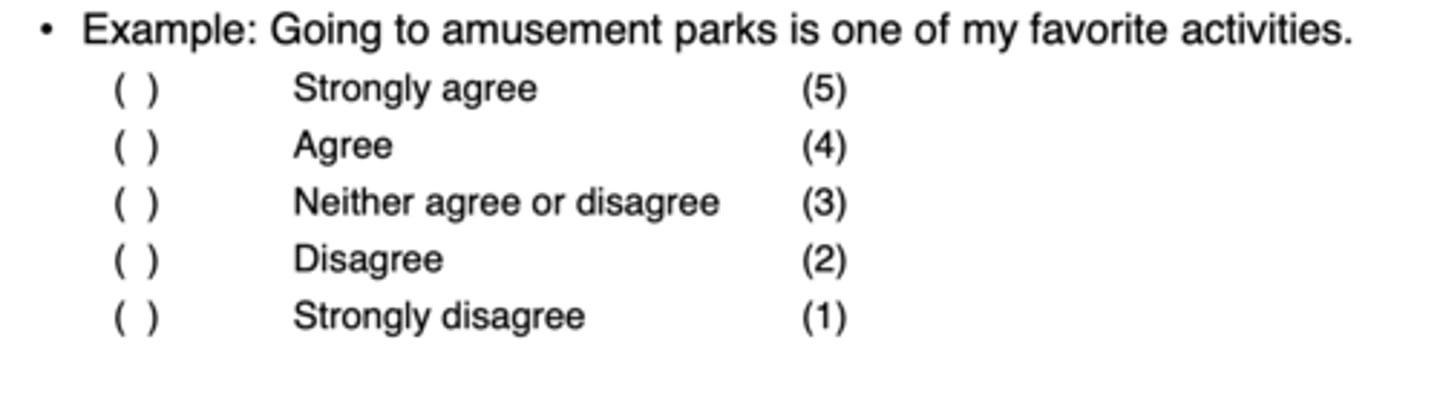
likert scales
questionnaires that require individuals to indicate their degree of agreement or disagreement with a set of statements
-results in INTERVAL DATA
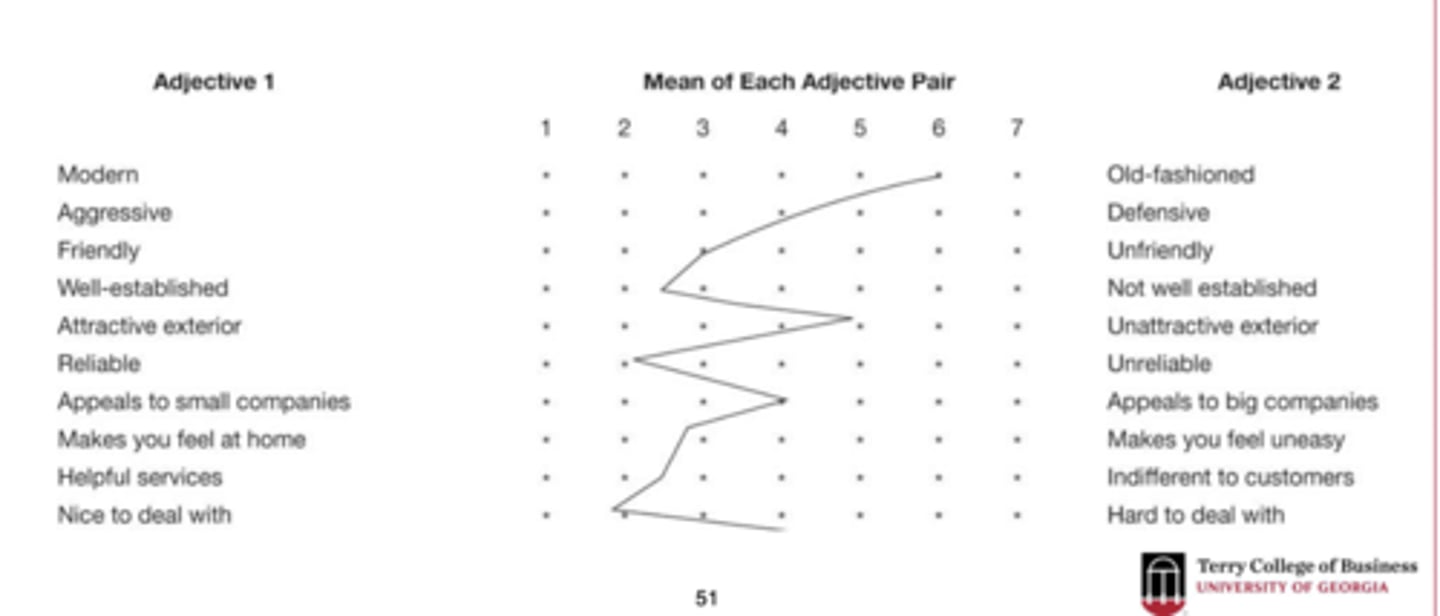
semantic differential scales
select bipolar adjectives to describe a concept on a scale
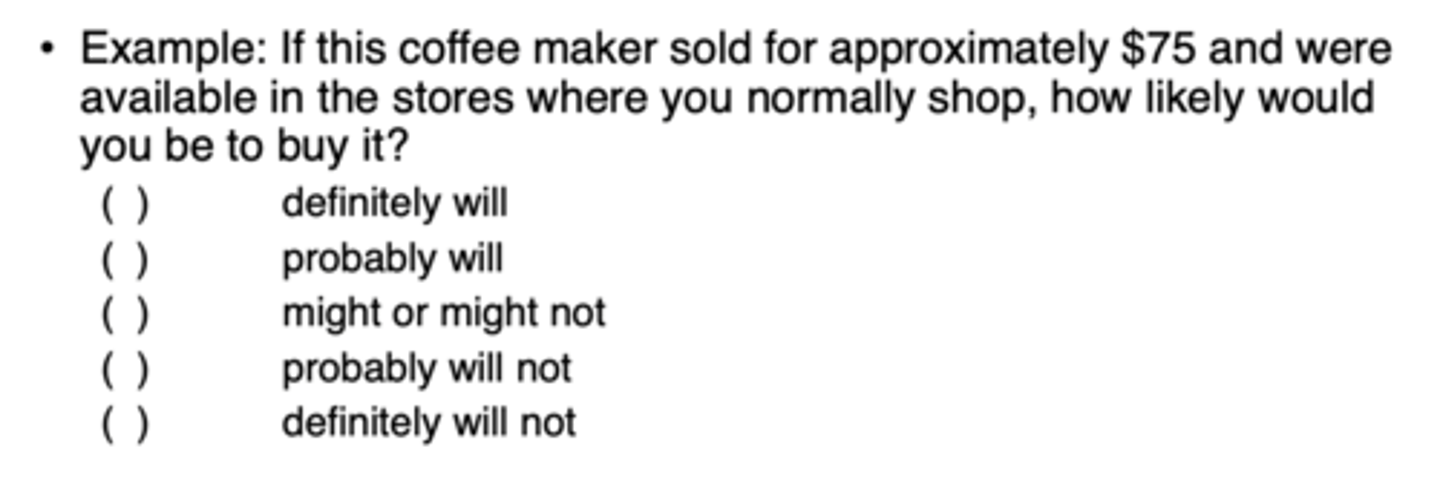
purchase intent scales
are some of the most commonly used scales in marketing research. When combined with estimates about actual purchase likelihood, they can be the basis for go-no-go decisions for product launch
INTRERVAL/RATIO Data
net promoter score
"would you recommend the company to a friend?"
-INTERVAL/RATIO
NPS=% of promoters - % of detractors
should nots of question wording
1. Don't go beyond the respondent's experience or expertise.
• Don't ask for details that cannot be recalled.
2. Don't make assumptions.
3. Don't use ambiguous wording.
• Don't use badly designed response categories.
4. Don't ask double-barreled questions.
5. Don't ask leading and loaded questions.
double-barreled questions
addresses more than one issue
"do you think coca cola is a tasty and a refreshing soft drink?"
"was the front desk staff helpful, efficient, and friendly?"
leading question
includes wording that suggests what the correct answer should be
"How much do you think you would pay for a pair of sunglasses that will protect your eyes from the sun's harmful ultraviolet rays, which are known to cause blindness?"
loaded question
emotionally charged or suggestive of socially desirable answers
"do you think that patriotic americans should buy imported automobiles when that would put american labor out of work?"
statistic
the info from a sample can be summarized through this
descriptive statistics
used to summarize info in a sample
-sample mean, variance, correlation
Measurers of Dispersion
We want to know the variation/spread of values around the mean.
• Sample variance
• Sample standard deviation
• Sample range