Overview of the skeletal system
 Call Kai
 Learn
 Practice Test
 Spaced Repetition
 Match
 Flashcards
 Knowt Play
1/45

There's no tags or description
Looks like no tags are added yet.
Name | Mastery | Learn | Test | Matching | Spaced | Call with Kai | Chat |
|---|
No analytics yet
Send a link to your students to track their progress
46 Terms

long bones
most of bones in extremities , appendicular skeleton minus small bones in wrist and ankles, Phalanges, metatarsals, humerus

irregular bones
have all sorts of projection, ex: vertebrae

flat bones
really thin, lightweight, seen in areas of a lot of movement or where we don't want bones to be super heavy.
ex: Sternum, scapula, ribs , and many bones of the skull

short bones
square-shaped bones of the wrists and ankles
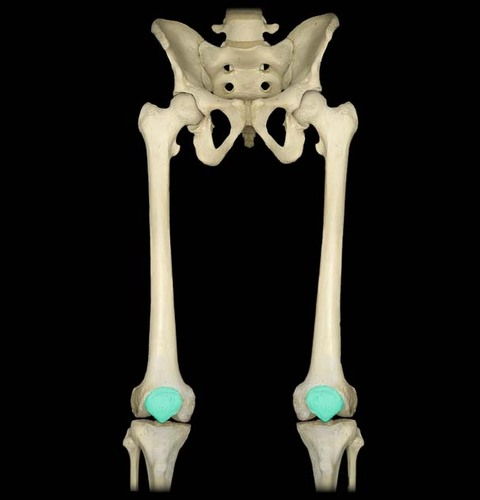
sesamoid bones
floating bones, more round
ex: patella
what cartilage makes up the skeleton?
hyaline
elastic
fibrocartilage
perichondrium
hyaline cartilage
Most common type of cartilage; it is found on the ends of long bones, ribs, and nose
elastic cartilage
cartilage with abundant elastic fibers; more flexible than hyaline cartilage
fibrocartilage
cartilage that contains fibrous bundles of collagen, for shock absorption and seen between major bones that have to absorb forces
Perichondrium
Dense irregular connective tissue membrane covering cartilage
appositional growth of cartilage
cells in the perichondrium secrete matrix against the external face of existing cartilage
interstitial growth of cartilage
Chondrocytes divide and secrete new matrix, expanding cartilage from within
compact bone
external layer, creates smooth surface to bones
spongy bone
internal layer, filled with trabeculae
yellow bone marrow
fatty tissue found in the medullary cavity of most adult long bones
red bone marrow
produces blood cells, are everywhere in children and in adults are found in flat and irregular bones, heads of femur and humerus

structure of short, irregular, flat bones
compact
spongy
compact
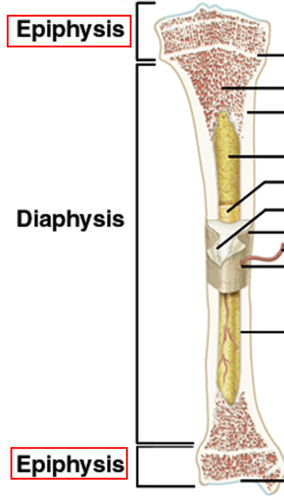
structure of long bones
Proximal Epiphysis
Diaphysis
Distal Epiphysis
proximal and distal epiphysis
have the structure of compact bone then spongy
diaphysis
is compact bone
Epiphyseal line
separation point between diaphysis and epiphysis , only present when bones are done growing in length (adult bones)
epiphyseal plates
Plates which allow for growth of long bone during childhood
Periosteum
Glistening double layered membrane surrounding bone
outer layer of periosteum contains…
dense irregular collagenous connective tissue
inner layer of periosteum contains…
bone cells
endosteum
delicate membrane lining the hollow cavity of the bone, contains same cells are inner periosteum
blood and nerves
Nutrient a. - Travels through the diaphysis and branches to supply bone
Epiphyseal aa. work in a similar way
Nerves travel with aa. (neurovascular bundle)

osteoprogenitor cells
bone stem cells

Osteoblasts
responsible for bone growth, matrix synthesizing cell

osteocyte
mature bone cell, monitors and maintains the mineralized bone matrix

osteoclast
Bone-destroying cells
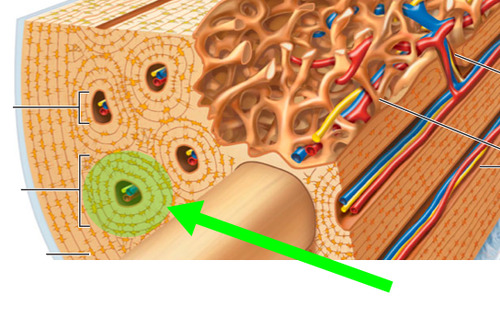
Osteon
functional unit of compact bone, create "pillars"
where are osteons located ?
only in compact bone and parallel to long axis of bone
within the osteon what is there?
openings in the center where vein artery and nerve travel through

Lamellae
Concentric rings made up of groups of hollow tubes of bone matrix, resists twisting and stretching forces

lacunae
small cavities in bone that contain osteocytes

Canaliculi
little channels that connect lacunae
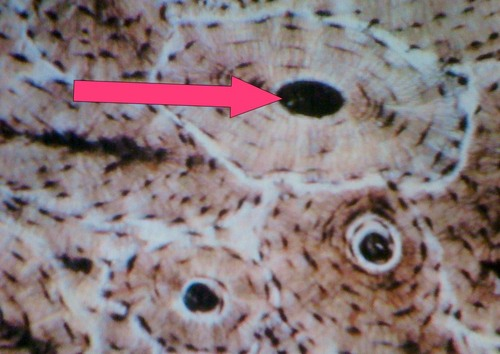
Central (Haversian) Canal
right in center, run parallel with length of osteon
Perforating (Volkmann's) canals (compact bone)
how osteons communicate and how info travels through
architecture of spongy bone
appear poorly organized (actually develop due to stress lines)
irregular arrangement of lamella and osteocytes
nutrients reach the spongy bone by diffusing through the canaliculi

spicules
spikes or branches that are connecting the trabeculae to each other, perpendicular to long axis of bone
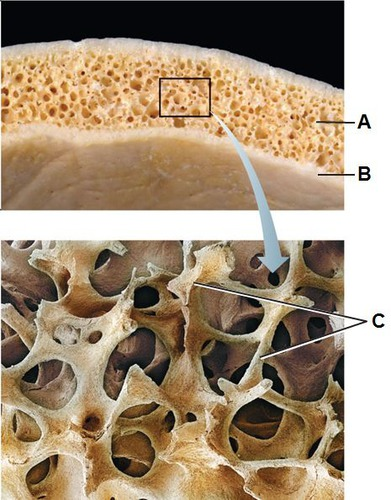
Trabeculae
Tend to run in thicker groupings in parallel ish to long axis of the bone , Provide internal support
organic substances of bone
bone cells and osteoid
what do organic substances do?
help with tension and twisting forces on bone
inorganic substances of bone
mineral salts, calcium phosphate (85%) and calcium carbonate (10%)
what do inorganic substances in bone do?
help resist compression forces