ap bio chapter 7 - cellular respiration and fermentation
 Call Kai
 Learn
Learn Practice Test
 Spaced Repetition
 Match
Match Flashcards
 Knowt Play
1/131

There's no tags or description
Looks like no tags are added yet.
Name | Mastery | Learn | Test | Matching | Spaced | Call with Kai | Chat |
|---|
No analytics yet
Send a link to your students to track their progress
132 Terms
energy powers metabolism, metabolism powers all chemical and physical reactions in the body
what is needed to power the metabolism, and what dies the metabolism itself power?
both heterotrophs and autotrophs
what kinds of organisms go through cellular respiration?
to break down food and turn it into ATP molecules
- food is made from glucose
what's the purpose of cellular respiration?
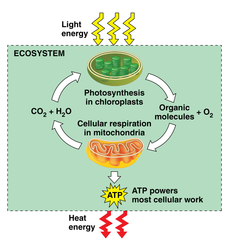
in as sunlight, out as heat
- everything gives off heat
how does energy flow in and out of an ecosystem?
the sun (all living things use the sun in different ways)
- no sun = no energy input into ecosystems
what powers all living things?
oxygen molecules, which are used as fuel for cellular respiration
what does photosynthesis generate?
light energy = sun
CO2 and heat are byproducts
- plants still give off CO2 despite using it first
yes
can protists (like algae) do photosynthesis?
electron transfer
how electrons are moved from one molecule to the next
catabolic pathways involving electron transfer
pathways that are central processes to cellular respiration
exergonic (releases energy for work)
what kind of reaction is breaking down organic molecules?
fermentation
partial degradation of sugars that occurs without oxygen
aerobic respiration
consumes organic molecules and oxygen to yield ATP
exergonic (energy releasing)
what kind of reactions are fermentation and aerobic respiration?
aerobic = requires oxygen
anaerobic = consumes compounds other than O2 (also exergonic)
what's the difference between aerobic and anaerobic respiration?
C6H12O6 + 6O2 ----> 6CO2 + 6H2O + (ATP + heat)
organic compound + oxygen --> carbon dioxide + water + energy + heat
formula for cellular respiration:
cellular respiration
includes both aerobic and anaerobic processes but is often used to refer to aerobic respiration
fats, proteins, and carbs
what can be used as energy molecules in cellular respiration besides glucose?
energy stored in organic molecules
- released energy is ultimately used to synthesize ATP
what does the transfer of electrons during chemical reactions release?
broken down = bonds break
built up = bonds join
what happens to bonds when things are broken down or built up?
redox reactions (oxidation-reduction)
chemical reactions that transfer electrons between reactants
oxidation
substances loses or gives electrons
reduced
substance gains electrons (positive charge is reduced)
e- = electrons
- transferred from x to y

redox reaction of NaCl
- NaCl is neutral because of conflicting charges

reducing agent
electron donor (thing being oxidized)
- reduces for something else
oxidizing agent
electron acceptor (thing being reduced)
- picks up electrons
they change the electron sharing in covalent bonds
ex: reaction between methane and oxygen
what happens if redox reactions don't transfer electrons?
an acceptor and a donor
what must electrons always have?
- unequal sharing of electrons in oxygen
- oxygen is slightly more negative than carbon
- still have the same amount of electrons, just in different places

redox reactions
reactions that tend to be spontaneous (exergonic) and can change where electrons come from
principle of redox
states that this reaction can move electrons from less electronegative atom toward more electronegative one releases chemical energy that can do work
redox reaction
what kind of reaction is cellular respiration?
oxidized = fuel (glucose)
reduced = oxygen
what's oxidized and what's reduced in cellular respiration?
energy is released that can be used in ATP synthesis
what happens as hydrogen (with its electron) is transferred to oxygen?
becoming oxidized = reducing agent
becoming reduced = oxidizing agent

NAD+
coenzyme that electrons from organic compounds are usually first transferred to
electron acceptor and oxidizing agent
what's NAD+'s role during cellular respiration
NADH
represents stored energy that's tapped to synthesize ATP
- reduced from NAD+
NAD+ = 2e- + 2H+ ---> NADH + H+
- arrow = enzyme
- 1 hydrogen (H+) ion released in process
reduction of NAD+ formula:
dehydrogenase
enzyme that facilitate transfer of 2 electrons and 1 hydrogen ion to NAD+ to form NADH
1 ATP = 7.3 kcal.mol
1 ATP = ? kcal/mol
NAD+ as electron shuttle

electron transport chain
when electrons passed to increasingly electronegative carrier molecules down chain through series of redox reactions
- how NADH passes electrons
- energy yielded used to regenerate ATP
1. glycolysis
2. citric acid cycle
3. oxidative phosphorlyation
3 stages of cellular respiration:
glycolysis
breaks down glucose into 2 molecules of pyruvate in cytosol
- 2 water molecules made as byproduct
citric acid cycle (pyruvate oxidation)
completes breakdown of glucose in mitochondrial matrix and requires oxygen (aerobic)
- cycle happens twice, uses the 2 pyruvate molecules made in glycolysis
oxidative phosphorylation
accounts for most (90%) of ATP synthesis and occurs in inner membrane of mitochondria and involves transfer of inorganic phosphate to ADP
overview of cellular respiration

substrate-level phosphorylation
how smaller amount of ATP is formed in glycolysis and citric acid cycle
- enzyme that pulls phosphate off of something to turn ADP into ATP
substrate-level phosphorylation

32 molecules of ATP
how many molecules of ATP can be made at maximum output in cellular respiration?
1. energy investment phase
2. energy payoff phase
2 phases of glycolysis:
2 ATP + 2 NADH per 1 glucose molecule
net energy yield of glucose:
no, oxygen doesn't have to be present for glycolysis to occur (anaerobic)
does glycolysis require oxygen to be present to occur?
O2 present: energy stored in pyruvate and NADH extracted by citric acid cycle and oxidative phosphorylation (moved to ETC)
O2 absent: fermentation occurs (done by archaea and yeasts)
what happens if O2 is present versus when O2 is absent in glycolysis?
glycolysis
what started (now universal) energy harvesting ?
glycolysis
what stage of cellular respiration is the only one that happens outside of the mitochondria?
- hydrogen made os used later
- pyruvate IS NOT a byproduct (used later)
- water IS a byproduct

- 1st ATP molecule being used here
- glucose is phosphorylated (into glucose 6-phosphate)
- hexokinase is the enzyme (arrows = chemical reaction)

to make the glucose more reactive
why is a phosphate added to glucose to make it glucose 6-phosphate in step 1 of glycolysis?
- 2nd ATP molecule used
- fructose 6-phosphate not reactive, then phosphorylized into fructose 1,6-bisphosphate
- DHAP converts into G3P & moves onto next phase (normally) by isomerase (enzyme) immediately
- adolase is split into reversible reaction (1 G3P and 1 DHAP)

the reaction will never reach a chemical equilibirum (can be converted back and forth)
what does it mean to be a reversible reaction?
DHAP sometime stays in its form to move hormones and triglycerides
what happens when DHAP doesn't convert into G3P to be moved onto next phase by isomerase?
- 2 NADH made go to end of cycle
- 1,3 bispho-glycerate is highly reactive
- inorganic phosphate taken off to make ATP (Pi)
- the 2 ATP created makes 2/4 total ATP molecules

between phases 5 and 6
between what phases does the energy investment phase end and the energy pyaoff phase start?
- atoms taken off 2-phospho-glycerate to create water, which is your byproduct
-last 2 ATP made through substrate level phosphorylation with the help of an enzyme (4/4 ATP molecules made)
- pyruvate is end of cycle

in = 2 ATP and glucose
out = 4 total ATP (2 net), 2 pyruvate, 2 NADH (reduced electron carriers), and 2 H20 (water)
what goes in and out of glycolysis?
pyruvate enters the mitochondrion to complete glucose oxidation (start of citric acid cycle)
what happens in eukaryotic cells if O2 is present?
CO2 released and pyruvate converted to acetyl coA
- acetyl coA is highly reactive
what happens before the citric acid cycle can occur?
2 ATP, 6 NADH, 2 FADH2 per 1 glucose molecule
- cycle spins twice (cut each in half for single cycle yield)
what does the citric acid cycle yield?
to complete the breakdown of pyruvate to CO2
what is the goal of the citric acid cycle (krebs cycle)?
NADH and FADH2
- FADH2 catches electrons at lower energy level than NADH
- FADH2 is more reactive then NADH
- FADH2 and NADH drop electrons off at different parts of the ETC (in the citric acid cycle)
what are the two major electron carriers used in cellular respiration, and what's the difference?
CO2
what is the byproduct of the citric acid cycle?
FAD
what is the oxidized version of FADH2?
FAD + 2e- + 2H+ = FADH2
formula for FADH2:
- all CO2 is byproduct becasue atoms are rearranged (CO2 pulled off)
- 1st NADH molecule made is a pre-product (NOT byproduct)
- other 2 NADH molecules, FADH2, and ATP are products

Acetyl CoA
highly reactive coenzyme that boosts proteins (enzymes)
- can be organic or inorganic
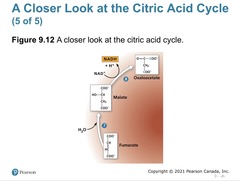
the acetyl group of acetyl CoA joins cycle by combining with oxaloacetate (1st step of CAC)
how is citrate formed?
relay electrons extracted from food to electron transport chain
what do the NADH and FADH2 produced by the citric acid cycle do?
8
- 1st step forms citrate
- last 7 steps decompose citrate back to oxaloacetate to make cycle happen agaian
how many steps are in the CAC?
- carbons removed from acetyl group to react with oxaloacetate to form citrate
- citrate reacts to create CoA-SH
- CoA-SH = CoA-synthetase (enzyme)

- CO2 is discarded to form 1st NADH molecules
- CoA-SH helps build another NADH
- a-Ketoglutarate is intermediate

- CoA-SH comes back off because enzymes are recycled
- inorganic phosphate combines to GDP to form GTP (energy molecule)
- GTP donates last phosphate group to ADP to then form ATP
- (last 2 steps) happen through substrate-level phosphorylation

- atoms rearranged to turn back into oxaloacetate to form NADH
- after this, next (2nd) pyruvate molecules comes in to restart cycle
** citric acid cycle is always running (done twice per cycle)
energy molecules
- in this role, they account for most energy extracted by glucose
what is another role for NADH and FADH2 besides electron carriers?
donate electrons to electron transport chain which powers ATP synthesis via oxidative phosphorlyation (w/o enzymes)
what do NADH and FADH2 do for ATP synthesis?
the plasma membrane (as opposed to inner membrane of mitochondria in eukaryotes)
- prokaryotes still carry out same process, just less efficient
where is the electron transport chain located in prokaryotes
cytochromes
have attached heme groups (proteins with iron on it) that function as electron carriers
alternate between reduced and oxidized states
what do electron carriers do as they accept and donate electrons?
they drop in free energy (each one is less electronegative than last)
what happens to electrons as they transfer between carriers down the chain to oxygen?
release energy in manageable amounts
- done so energy can that's created can be used in ETC
what does breaking the free energy into small and stepwise pieces do?
H2O
- H2O is byproduct of ETC and oxygen accepts electrons to make water
formed as a byproduct when O2 is reduced (given electrons)
NO, it just helps make ATP for later
is ATP produced directly by function of ETC?
oxygen
what's the final electron acceptor (last stop) in ETC?
1 oxygen molecule -- because oxygen is diatomic (2)
what does 1/2 oxygen mean?
- NADH comes from glycolysis and CAC
- chain across proteins is components of proteins that catch electrons
- 4 total proteins (I, II, III, IV)
- NAD+ & FAD are oxidized to then go back and pick more electrons up
- NAD+ ONLY DROPS OFF AT PROTEIN 1
- FAD ONLY DROPS OFF AT PROTEIN 2
- both go straight to protein 3 (1->3 and 2->3, then 3->4)
- things moving down ETC, less electronegative
- is a redox recaction

to pump hydrogen ions into intermembrane space
- establishes H+ gradient across mitochondrial membrane
- hydrogen diffused down its concentration gradient
what is the energy released by electron transfer in ETC used for?
the electron transport chain
what is an example of a proton gradient?
shuttle pyruvate
instead of moving into intermembrane space and eventually through the ATP synthase, what do some hydrogen ions do instead?