Readings
 Call Kai
 Learn
 Practice Test
 Spaced Repetition
 Match
 Flashcards
 Knowt Play
1/18

There's no tags or description
Looks like no tags are added yet.
19 Terms
What are some of signs of classic NEC?
Early clinical
They are usually vague and nonspecific
Slight changes in vital signs
New-onset or increased apneic episodes
Feeding intolerance
Emesis
Disease advancement signs (also non specific)
Hypotonia
Respiratory distress
Cardiovascular instability
Abdominal distention, tenderness, discoloration of
the abdominal wall, and lack of bowel sounds.
Laboratory findings
Neutropenia, thrombocytopenia, and metabolic acidosis.
Blood may be noticed in gastric contents or stool
What is the difference between NEC & SIP?
Classic NEC is differentiated from SIP (spontaneous intestinal perforation) by the age of onset, with SIP occurring earlier in the admission course.
How do we diagnose NEC?
Originally, it was using the staging by bell (see image) but even the staging has its downfall as babies do not always follow the pattern or staging. Most times it can only recognize changes in the late stages of the disease when the intestinal epithelial barrier has already been compromised and the signs of systemic response and deterioration are apparent
Radiologic signs
Pneumatosis intestinalis
Portal venous gas
Free intraperitoneal air
Distended and fixed bowel loops, and a gasless abdomen.
Bloodwork
Complete blood count (CBC) components held promise as a biomarker for early NEC.
Decreasing platelet counts, elevated immature to total neutrophil (I/T) ratio, and elevated or decreased neutrophil counts
C-reactive protein (CRP), procalcitonin, an array of cytokines and chemokines, platelet-activating factor (PAF), and inter-
alpha inhibitory protein (IαIp),
Abdominal ultrasound
The purported advantages over x-ray are real-time imaging, the ability to assess the presence of peristalsis and detect even minimal ascites, accurate detection of intestinal wall thickness, and perfusion.
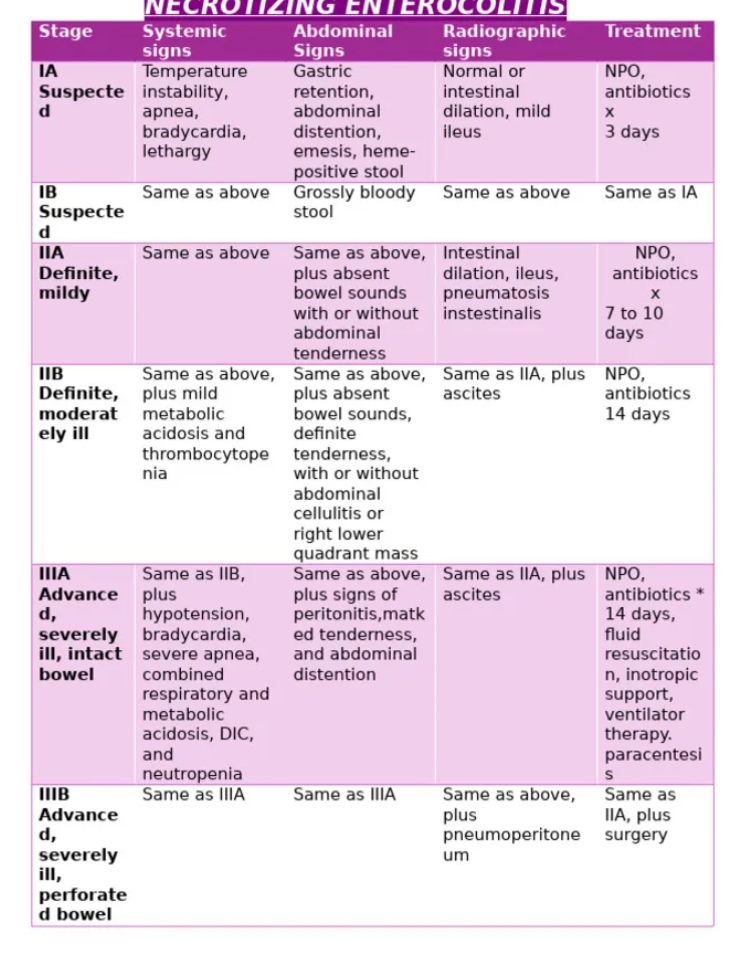
What does medical management of NEC entail?
When NEC is suspected we usually do the following
Stopping enteral feedings
Decompressing the gastrointestinal tract
Broad-spectrum antibiotics
Correcting metabolic (acidosis)
Hematologic (thrombocytopenia, anemia) derangements.
Maintaining normal cardiovascular and respiratory functions
Utlization of mechanical ventilation, vasopressors, and fluid resuscitation.
Two broad-spectrum agents that cover intestinal microorganisms. Anaerobic coverage may be added, as well.
What does surgical management of NEC entail?
The goal of surgery for NEC is to control enteric spillage and maximize the length of the viable intestine if resection is needed.
We absolutely need surgery when pneumoperitoneum is present or when despite maximal medical management, baby’s condition is still not improving
What are the predictors for predicting timing of surgical intervention?
Blood culture
Bandemia
Acidosis
Thrombocytopenia
Hypotension
Hyponatremia
Neutropenia
What are some of the complications that NEC babies even after treated could face?
Increase in adverse neurologic outcomes (especially surgically treated babies)
Elevated rates of intraventricular hemorrhage and periventricular leukomalacia (especially surgically treated babies)
Development of bowel stricture
Short bowel syndrome and intestinal failure.
Failure to thrive
What are the major contributing factors of NEC?
NEC is considered not as one disease but as various disease with different pathophysiologies due to its multifactorial nature of its development
NEC is specific to the developing underdeveloped gut (some most premature under 37 weeks).
It occurs at 2 to 6 weeks of age, with the highest incidence of the disease occurring at 28 to 32 weeks of corrected gestational age.
Prematurity
Formula feeding
Impaired mucosal defenses
Altered immune response
Mucosal development
Intestinal dysbiosis
are major contributing factors for NEC development.
How does altered host defense, inflammatory mediators, and immune response contributes to NEC?
The premature have a few things that makes them more susceptible to NEC
The ability of gastric parietal cells to secrete acid is also diminished in premature infants.
The mature pattern of peristalsis is not developed until around 36 weeks of gestational age.
Physical barriers that prevent intrusion of infectious agents (skin, mucous membranes, epithelium of the intestine with the mucous layer, and biomedical factors) are immature
Innate and adaptive immune systems (including cellular and humoral components)
NEC involves both an overactive inflammatory response and a reduction in protectiveimmune defenses.
This combination can make the premature infant's intestine particularly vulnerableto inflammation,damage, and impaired barrier function.
The defense mechanisms of the intestinal epithelial layer itself are underdeveloped in preterm infants. This includes decreased numbers of Paneth cells. Paneth cells produce several peptides (lysozyme, defensins, and secretory phospholipase A2) that play essential roles in protecting the intestinal epithelium from bacterial invasion and shaping the microbiome.
How does breastmilk support the prem’s gut?
Infants with NEC have an imbalance between pro-inflammatory Th17 cells and anti-inflammatory Treg cells, promoting IL-17-mediated intestinal epithelial and stem cell apoptosis, impaired tight junctions, and compromised barrier integrity. Secretory IgA (sIgA), particularly from breast milk, supports gut microbiota balance and intestinal barrier development; however, immunoglobulin supplementation has not been shown to reduce NEC incidence.
What are some factors that affects gut colonization?
Preterm birth
Mode of delivery
The use of antibiotics
Breast milk versus formula feeding.
What is the role of enteral feedings in the development of NEC?
What is consider fast vs slow advancement of feed?
NEC usually develops days to weeks after initiation of enteral feedings so feeding was considered as an important risk; however delaying initiation and slow advancement of enteral feedings have shown that these methods did not prevent NEC incidence.
Slow advancement was defined as a daily increment of 15 to 20 mL/kg of enteral feeding volume and faster advancement as a daily increment of 30 to 40 mL/kg
What is the role of human milk in the pathogenesis of NEC?
Human milk has associated with a decreased incidence of NEC. An 83% reduction in NEC if the infant feeds more than 50% of MoM in the first 14 days.
Breast milk contains multiple bioactive components that collectively confer protective benefits to the growing premature infant.
It augments the infant’s immune system
Anti-inflammatory effects
Strengthens the mucosal barrier, and enriches beneficialbacterial flora of the gut.
Breast milk components include
EGF
Heparin-binding EGF-like growth factor
Platelet-activating factor acetylhydrolase (PAF-AH), sIgA, lactoferrin
Human milk oligosaccharides (HMOs), nitrates, glutamine
Freezing, thawing, and pasteurization of breast milk affect the content of these components and will likely decrease its protective effect.
an exclusive human milk diet (MoM and HDM+ human milk–based fortifier) significantly reduced the incidence of NEC, late-onset sepsis, ROP, BPD, and mortality when compared with
What is the role of blood transfusion in the pathogenesis of NEC?
Proposed mechanism like that of transfusion related acute lung injury (TRALI), prompting the term transfusion-related acute gut injury (TRAGI) or transfusion-associated NEC (TANEC).
Reperfusion injury due to transfusion
Immunologic reactions and injury of intestinal mucosa triggered by cytokines, fragmented RBCs, and free hemoglobin
Transient mesenteric ischemia after blood transfusion which is why some feed us held sometimes with transfusion
Some studies believe that severe anemia (Hb <8g/dL), but not blood transfusion, was associated with the development of NEC.
What is the commonality between proton pump inhibitors / anti-
reflux medications & NEC?
Prescription of anti-reflux medications leads to undesired effects,
such as alteration of the microbiome
Bacterial overgrowth
Impaired bactericidal properties of gastric secretions
Delayed gastric emptying
Impaired chemotactic response.
Probiotics are live bacteria that confer health ben-
efits on the host when administered in adequate amounts.
What are some clinical scenarios often confused with NEC?
Food Protein Intolerance Enterocolitis Syndrome
Presents mostly in infants outside of the neonatal period presenting with bloody stools, flank discoloration, and abdominal distention, which improve after cow milk protein is excluded from their diets.
Even though there are no diagnostic biomarkers for FPIES; the babies tends to have normal CRP, leukocytosis, hypoalbuminemia lymphocytosis, and thrombocytosis while babies with NEC have high CRP levels, low leukocytes, and thrombocytopenia.
Management of FPIES includes removal of the offending antigen by eliminating it from the diet. With NEC, the patient is usually made NPO for several days, requires parenteral nutrition for extended periods, and is given antibiotics.
Ischemic Intestinal Necrosis
NEC is confused with ischemic intestinal necrosis due to congenital heart disease in these babies but it affects the colon more.
Some of the heart conditions are hypoplastic left heart syndrome, aortic arch obstruction, univentricular heart disease, truncus arteriosus, and aortopulmonary window accounting for ischemic intestinal necrosis.
Congenital Gastrointestinal Anomalies That May Mimic Necrotizing Enterocolitis
Intestinal obstruction due to volvulus, intussusception,
and meconium ileus due to cystic fibrosis may present with
signs and symptoms of NEC, including radiographic fea-
tures such as pneumatosis intestinalis.
Hirschsprung diseasemay develop inflammatory enterocolitis, leading to significant morbidity and mortality. This can present with rectal bleeding, vomiting, loose stools, and abdominal distention, making it sometimes difficult to differentiate it from classic NEC.
Spontaneous Intestinal Perforation
SIP is often an isolated perforation in the terminal ileum in an anti-mesenteric position and the remaining bowel appears normal. SIP also appears with an area of hemorrhagic necrosis without the typical coagulation necrosis seen largely in NEC.
The onset of SIP is usually earlier than that of the more classic form of NEC. SIP appears to be also related to the combined use of nonsteroidal anti-inflammatory agents, such as indomethacin and ibuprofen, and postnatal corticosteroids.
Some suggests that the timing of antenatal corticosteroids in relation to nonsteroidal anti-inflammatory agents, particularly proximity to delivery, is associated with SIP.
NEC shows radiologic features, including pneumatosis intestinalis and portal venous gas, that do not precede SIP. SIP typically presents with a rapid onset of abdominal distention but without predisposing radiological findings except for free air on radiograph.

How did the GI system came to be embryologic wise ?
The alimentary canal (the folding of endoderm and splanchnic mesoderm) forms at week 3
It folds into two sides (a head fold forms and the cranial part of the yolk sac) and forms the forgut