CH 15 Nursing Care During Labor and Birth
 Call Kai
 Learn
 Practice Test
 Spaced Repetition
 Match
 Flashcards
 Knowt Play
1/63

There's no tags or description
Looks like no tags are added yet.
64 Terms
Admission to Birth Facility:
Nursing Responsibilities During Admission
- Focused assessment on:
- Fetal heart rate
- Maternal vital signs
- Impending birth
Fetal heart heart (FHR)
- FHR 110 to 160 bpm.
- Regular rhythm: Presence of acceleration and absence of deceleration.
Maternal vital signs
Identify signs of hypertension and infection
Impending birth
- Grunting sounds
- Bearing down
- Urgency to push
Admission to Birth Facility:
Nursing Responsibility After Admission
- Maternal assessments
- Support person's response
- Fetal assessments
Maternal assessments
- Labor progress.
- Contractions and response to labo.
Fetal assessments
- FHR.
- Fetal membranes and amniotic fluid.
What are the nursing considerations for nursing
- Notify the provider, give report, and obtain orders
- Consent forms
- Laboratory tests
- IV access
- Ongoing assessments
Application of Nursing Process: Intrapartum for both Fetal oxygenation and Discomfort
- Assessment
- Identification of patient problems
- Interventions
- Evaluation
Aminotomy: Artificial Rupture of Membranes (AROM)
- Indications
- Risks
What are the indications for an aminotomy?
- Induces labor
- Augments labor
- Allow internal fetal monitoring
What are the risks for Amniotomy?
- Prolapse cord
- Infection
- Abruptio placenta
Alterations in normal labor: version
Indications for either for external cephalic version or internal version.
External cephalic version
Change the fetal position from a breech, shoulder, or transverse lie, or oblique presentation to cephalic.

Internal Version
- Change the position of a second twin in a vaginal birth
- intravaginal manipulation

Version Contradictions
- Uterine malformations
- Previous cesarean birth
- Placenta abnormalities
- Third trimester bleeding
- Cephalopelvic disproportion
- Multifetal gestation
- Oligohydramnios
- Intrauterine growth restriction
- Uteroplacental insufficiency
- Engagement of the fetal head into the pelvis
Version: Risks
- Complications occur in 1% to 2% of attempted versions.
- Changes to FHR common, but usually return to normal.
- Serious risks to the fetus such as:
-- Umbilical cord entanglement
-- Fetal hypoxia
-- Abruptio placentae
- Maternal sensitization to fetal blood type.
Induction and augmentation of labor indications:
- Hostile intrauterine environment
- Spontaneous rupture of the membranes (SROM)
- Postterm pregnancy
- Chorioamnionitis: infection and inflammation of the amniotic sac
- Hypertension
- Abruptio placentae
- Maternal medical conditions that worsen with continuation of the pregnancy
- Fetal demise
Induction and augmentation of Labor: contraindications
- Placenta previa
- Vasa previa
- Umbilical cord prolapse
- Abnormal fetal presentation
- Active genital herpes
- Previous uterine surgery
- Breech presentation
- Overdistended uterus due to multifetal pregnancy or polyhydramnios
- Severe maternal conditions such as heart disease and severe hypertension.
- Fetal presenting part above the pelvic inlet.
Induction and augmentation of labor: risks
- Excessive uterine activity
- Uterine rupture
- Maternal water intoxication
- Chorioamnionitis
- Cesarean birth
- Postpartum hemorrhage
Induction and augmentation of labor techniques
- Determining whether induction is indicated?
- Cervical ripening
- Oxytocin administration
Determining whether induction is indicated?
Cervical assessment and Bishop score
Cervical ripening
- Pharmacologic methods such as prostaglandins.
- Mechanical methods include: foley balloon, laminaria, stripping membranes.
Oxytocin (Pitocin) classification
Oxytocic
Oxytocin action
Synthetic compound identical to the natural hormone released from the posterior pituitary. Stimulates uterine smooth muscles, resulting in increased strength, duration, frequency of uterine contractions. Uterine sensitivity to oxytocin increases gradually until 34 weeks of gestations and then a rapid increase in sensitivity is noted during labor. It also has vasoactive and antidiuretic properties.
Oxytocin (Pitocin) Indications
Induction or augmentation of labor at or near term. Maintenance of firm uterine contractions after birth to control postpartum bleeding. Management of inevitable or incomplete abortion.
Oxytocin (Pitocin) Dosage and Route
- IV infusion via secondary (piggyback) line.
- IM, inject 10 units after placenta delivery if there is no IV access.
Oxytocin (Pitocin) Onset of action
- IV within 1 minute
- IM 3-5 minutes
Oxytocin (Pitocin) how does one remove the medication in their system?
Excretion by renal (urine).
Oxytocin (Pitocin) Contraindications and precautions
Include but not limited to, placenta previa, vasa previa, indeterminate or abnormal category II or III fetal heart rate patterns, abnormal fetal presentations, prolapsed umbilical cord, previous classic or other fundal uterine incision, active genital herpes infection, and invasive cervical carcinoma.
Oxytocin (Pitocin) adverse reactions
- Hypersensitivity to drug
- Excessive uterine activity (UA) such as tachysystole, hypertonus, inadequate relaxation time.
- Impaired uterine blood flow
- Uterine rupture
- Placental abruption
- Uterine hypertonicity leading to fetal both bradycardia and tachycardia, reduced FHR variability, and late or prolonged decelerations.
- Fetal arrhythmias including: premature ventricular contractions may occur.
- Fetal or maternal trauma or both, may occur from rapid birth.
- Prolonged administration may cause maternal fluid retention, leading to water intoxication.
- Hypotension with rapid IV injection, symptoms include tachycardia, cardiac arrhythmias, and subarachnoid hemorrhage are rare.
Full Intrapatrum nursing considerations in one card
Observe for excessive UA: contractions less than 2 minutes apart, rest interval shorter than 60 seconds in first stage labor and 45 to 50 seconds in second—stage labor, duration longer than 120 seconds, or an elevated resting tone firm by palpation or greater than 20 to 25 mm Hg (if measured with an intrauterine pressure catheter). Observe FHR for patterns such as tachycardia, bradycardia, decreased variability, and pathologic (late, variable, or prolonged) decelerations. If uterine tachysystole or FHR patterns as indicated previously occur, intervene to reduce UA and increase fetal oxygenation: stop the oxytocin infusion, increase the rate of nonadditive solution, position the woman in a side—lying position, and administer oxygen by nonrebreather face mask at 10 L/min. Notify the provider of adverse reactions, nursing interventions, and patient response. Record the maternal blood pressure, pulse rate, and respirations every 30 to 60 minutes or with each dose increase. Record intake and output.
What should be assessed at least 20 minutes before induction of Oxytocin?
Fetal heart rate (FHR) to identify fetal well-being.
What maneuvers or examinations should be performed to verify fetal presentation before Oxytocin induction?
Leopold's maneuvers, a vaginal examination, or both.
What should be done if abnormal FHR patterns or non-cephalic fetal presentation is identified?
Notify the physician and do not begin induction until an ultrasound is done.
What are the signs of effective labor pattern to observe during Oxytocin administration?
Contraction frequency every 2 to 3 minutes, duration of 40 to 90 seconds.
What indicates excessive uterine activity (UA) during labor?
Contractions less than 2 minutes apart, duration longer than 120 seconds, or elevated resting tone.
What FHR patterns should be monitored for during Oxytocin administration?
Tachycardia, bradycardia, decreased variability, and pathologic decelerations.
What interventions should be taken if uterine tachysystole or abnormal FHR patterns occur?
Stop the oxytocin infusion, increase nonadditive solution rate, position the woman side-lying, and administer oxygen.
How often should maternal blood pressure, pulse rate, and respirations be recorded during Oxytocin administration?
Every 30 to 60 minutes or with each dose increase.
What should be recorded in addition to maternal vital signs during Oxytocin administration?
Intake and output.
Oxytocin (Pitocin) postpartum nursing considerations
- Observe the uterus for firmness, height, and deviation.
- Massage until firm if the uterus is soft or "boggy"
- Observe lochia for color, quantity, and presence of clots.
- Notify the provider if the uterus fails to remain contracted or if lochia is bright red or contains large clots.
- Assess for cramping.
- Assess vital signs every 15 minutes or according to protocol for the recovery for the recovery period.
- Monitor intake and output and breath sounds to identify fluid retention or bladder distension.
Oxytocin (Pitocin) inevitable or incomplete abortion
- Observe for cramping, vaginal bleeding, clots, and passage of products of conception (fetus).
- Observe maternal vital signs and intake and output,
Safety checks of signs of excessive uterine activity
- Contraction duration longer than 120 seconds
- Less than 60 seconds relaxation time between contractions in the first stage and 45 to 50 seconds in the second stage labor.
- Uterine resting tone firm by palpation or higher than 20 to 25 mm Hg with intrauterine pressure catheter.
- Montevideo units: MVU, units of measure for uterine contractions intensity exceeding 250 in the first-stage labor to 400 in second-stage labor.
- More than 5 contractions in a 10-minute widow, average over 30 minutes.
Nursing care: responsibilities during preparation and birth
- Preparation of a delivery table with sterile gowns, gloves, drapes, solutions, and instruments.
- Perineal cleansing preparation.
- Supporting the woman and partner with a final pushing efforts.
- Initial care and assessment of the newborn.
- Administration of medications usually oxytocin to contract the uterus and to control blood loos.
Operative Vaginal Birth: Indications
- Shortened second stage of labor
- Maternal indications
- Fetal indications
Maternal indications
- Exhaustion
- Inability to push effectively
- Infection
- Cardiac or pulmonary disease
Fetal indications
- Failure of presenting part to descend in the pelvis
- Partial separation of the placenta
- Non-reassuring FHR patterns
Operative vaginal birth contraindications
- Cesarean birth preferable when there is:
- Severe fetal compromise
- Acute maternal conditions
- High fetal station
- Cephalopelvic disproportion
Operative vaginal birth risks
- Forceps and vacuum extraction can result in truma to maternal and fetal tissues.
- Maternal risks
- Infant risks
Operative vaginal birth: risks maternal
Laceration and hematoma of the vagina, pelvic floor disorders, anal sphincter disruption, and infection.
Operative vaginal birth: infant risks
Facial nerve surgery, cephalohematoma, subgaleal hemorrhage, intracranial hemorrhage, scalp edema from vacuum extractor.
Operative Vaginal Birth Technique
- Forceps: locking blades applied to fetal head
- Vacuum extraction: Cup attached to fetal head and traction applied.
Operative vaginal birth: nursing considerations
- Observe mother for trauma after birth.
- Birth red bleeding with firm fundus
- Observe neonate for trauma after birth, such as facial asymmetry
Episiotomy indications
- Shoulder dystocia
- Vacuum or forceps-assisted births
- Face presentation
- Breech delivery
- Macrocosmic fetus
1st degree perineal laceration
Vaginal mucosa torn

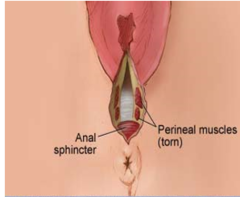
2nd degree perineal laceration
Extends through perineal muscles
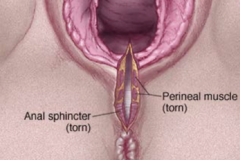
3rd degree perineal laceration
Continues through anal sphincter muscle torn
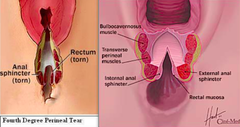
4th degree perineal laceration
Also involves the anterior rectal wall torn
Cesarean birth indications
- Shoulder dystocia
- Cephalopelvic disproportion
- Fetal malpresentations
- Persistent indeterminate or abnormal FHR patterns
- Hypertension
- Maternal diseases
- Active genital herpes
- Previous uterine surgical procedures
- Prolapsed umbilical cord
- Hemorrhagic conditions
- Maternal request
Cesarean Birth: Maternal Risks
- Infection
- Hemorrhage
- Urinary tract trauma or infection
- Thrombophlebitis and thromboembolism
- Paralytic ileus
- Atelectasis
- Endomyometritis
- Anesthesia complications
Cesarean Birth: Fetal Risks
- Lung immaturity greatest risks if the fetus is delivered preterm.
- Inadvertent preterm birth.
- Transient tachypnea.
- Persistent pulmonary hypertension of the newborn.
- Persistent pulmonary hypotension of the newborn.
- Traumatic injury.
Cesarean birth Techniques
- Preparation
- Laboratory studies
- Anesthesia
- Time-out
- Fetal surveillance
- Prophylactic antibiotics
- Skin preparation
- Foley catheter
- Grounding pad
- Incisions
Cesarean birth Incisions technique
- Low transverse
- Low vertical
- Classical, no VBAC allowed due to increased risk of uterine rupture.
