Econ W1
 Call Kai
 Learn
 Practice Test
 Spaced Repetition
 Match
 Flashcards
 Knowt Play
1/68

Earn XP
Description and Tags
Chapters 5, 6, 8, 9, 10
69 Terms
When is demand more elastic
If quantity demanded is more responsive to change in price
How can you see in a demand curve how elastic demand is
The flatter the curve, the more elastic (change in price has more effect on quantity demanded)

What is most important determinant for Elasticity
Substitutes (few subs. = less elastic),
What is more elastic: Necessities or Luxuries
Luxuries are more elastic, necessities are less elastic (necessities are a need, so willingness to buy don’t change that much with price increase)
How to calculate Ed (elasticity of demand) when percentages are given
Percentage change in quantity demanded / percentage change in price

What does Ed > 1 mean
demand is inelastic
What does Ed < 1 mean
demand is elastic
What does Ed = 1 mean
demand is unit elastic
How to calculate Ed when there are no percentages given
(change in quantity demanded/Average quantity) / (change in price/average price)

How to calculate revenue when price and quantity are given
R = P x Q
What happens with revenue when price increases with an inelastic demand curve
Revenue increases
What happens with revenue when price increases with an elastic demand curve
Revenue decreases
What does the elasticity of supply measure
How responsive quantity supplied is to change in price (more elastic = more responsive quantity supplied to price change)
What are determinants for the elasticity of supply
how quickly per-unit costs increase with increase in production (supply is elastic if production can increase w/o much increasing per-unit costs) - raw materials often inelastic, manufactured goods often elastic - local supply elastic, global supply inelastic
How to calculate Es (elasticity of supply) when percentages are given
Percentual change in quantity supplied / percentual change in price
How to calculate Es (elasticity of supply) when percentages are NOT given
(change in quantity supplied / average quantity) / (change in price / average price)

What determines who pays the tax?
The elasticities of demand and supply (so not who writes the check to government)
Does commodity taxation increase or decrease gains from trade
decrease; creates dead-weight loss
What is the difference in effect between a tax on sellers and a tax on buyers
No difference
Who pays more tax when demand is more elastic then supply
Sellers pay more because the tax wedge is bigger on their side
(Elasticity = escape) !

Why do sellers pay more tax when demand is more elastic
When demand is more elastic, consumers have more substitutes; therefor when price increases to much consumers just buy the substitute
Can workers and capital be moved to another industry easily when supply is elastic or inelastic
Elastic
If the demand is inelastic or the supply is inelastic, what happens with the dead-weight loss with taxation?
The tax does not deter many trades, so the dead-weight loss is small
If demand is elastic or supply is elastic, what happens with the dead-weight loss with taxation?
The tax deters many trades, so the dead-weight loss is big
Who pays subsidies
taxpayers
Why does a subsidy create dead-weight loss
non-beneficial trades do occur that would’ve not happened when there was no subsidy
When do suppliers benefit from subsidy, or burdens of a tax
when elasticity of demand is greater than the elasticity of supply
What makes supply more elastic
When producers can easily move production elsewhere (thereby they can avoid a tax)
What is a price ceiling
Maximum price allowed by law
What are the 5 effects of a price ceiling
(1) shortage, (2) reduction in product quality (3) wasteful lines and other search costs (4) a loss of gains from trade (5) misallocation of resources
What is a shortage and why is it created with a price ceiling
Prices are held below market price, therefor quantity demanded exceeds quantity supplied (more people want to buy the product then supplied)

Why do price controls lead to reduction of quality
Sellers cannot profit from the increased demand by raising prices, so they increase profits by reducing quality to cut costs.
Why do price controls lead to wasteful lines and other search costs
Buyers are willing to pay more than the sellers can charge, therefor buyers will line up until the total price of the good (price plus time costs) pass the willingness to pay.

Why do price controls lead to lost from trade (dead-weight loss)
Some buyers and sellers who would have benefited from trading are left out
Why do price controls lead to misallocation of resources
When a producer cannot sell a product above the price ceiling, there is no incentive/signal to produce where it is needed the most
What is a price floor
Minimum price allowed by law
What are the 4 effects of price floors
(1) is creates surpluses (too much of something), (2) is creates a lost gains from trade/dead-weight loss, (3) it wastefully increases quality, (4) misallocation of resources
Why do price floors create surpluses
There is more supply than demand (e.g. minimum wages create unemployment)

What is a good thing about minimum wages
raises wages of young workers, and unemployment leads to more teenagers that stay in school longer
Why do price floors create wasteful increases in quality
Sellers cannot compete by offering lower prices, so they compete by offering higher quality (while buyers prefer less quality at lower price)
Why do price floors misallocate resources
It prevents new competitors from entering a market, which keeps low-cost companies out of the industry
Where does the difference between domestic demand at world price and domestic supply at world price come from
Import
What is protectionism
Economic policy of restraining trade through quotas, tariffs or other regulations that burden foreign producers but not domestic producers
What is a tariff
Tax on imports

What is a trade quota
restriction on quantity of foreign goods that can be imported
What are the 2 costs of protectionism (a tariff)
(1) Increase in domestic production which lead to producers that have higher costs of production than foreign producers (leads to wasted resources) (2) Due to higher costs the price rises and less people buy the product (reduces gains from trade)
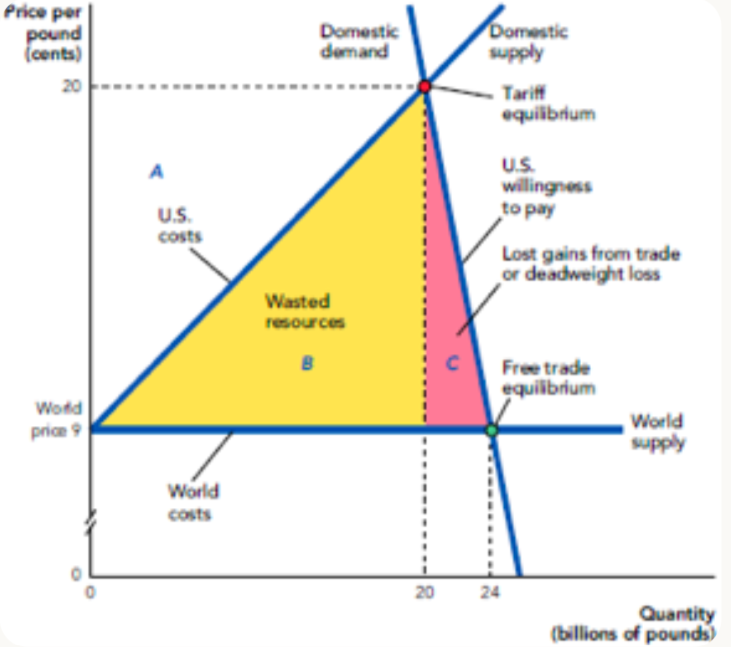
Who gains surplus with a tariff, consumers or producers?
tariff increases price; reduces consumer surplus and increases producer surplus - mainly flow to small number of producers
What are the 5 arguments against international trade
(1) It reduces number of jobs
(2) It supports countries that use child labor
(3) Certain industries need to stay domestic for national security
(4) Key industries need to stay domestically because of beneficial spillovers
(5) It increases domestic well-being
Why does international trade reduce domestic jobs
It moves jobs from import competing industries to export industries
Is child labor a reason to restrict trade? (according to book)
Book: no, after bill in Congress was denied a lot of child workers were still dismissed, but that did not make their life better (many ended up on the streets and sought other work: prostitution etc.)
poverty should be reduced rather than trade
Why do key industries produce spillovers
Spillovers: benefits that go beyond computers chips themselves
it’s better to produce computer chips than potato chips
What is an external cost
Cost paid by people other than the consumer or the producer trading in the market

What is a private cost
Cost paid by consumer or producer
What is the social cost
Cost for everyone: private cost plus the external cost
What are negative externalities
external costs
What are positive externalities
external benefits

What is social surplus
Consumer + producer + everyone elses surplus (it is maximum at efficient equilibrium)
Where is the efficient equilibrium?
When demand intersects with social cost curve (lays above supply curve)
What is a Pigouvian tax
Tax on a good with external cost that reduces dead-weight loss and raises revenue
What curve changes when you include an external cost?
Supply curve moves up
What curve changes when you include and external benefit?
Demand curve moves up
What is a Pigouvian subsidy
Subsidy on a good with an eternal benefit
What are transaction costs
costs necessary to reach an agreement (costs of identifying and brining buyers and sellers together, bargaining, drawing up contracts)
What is the Coase theorem
if transaction costs are low and property rights are clearly defined, private bargains will ensure that the market equilibrium efficient even when there are externalities
What are 4 government solutions for externality problems
(1) taxes, (2) subsidies, (3) command and control, (4) tradeable allowances
What is command and control
Government orders firms to make less goods; e.g. make less use of electricity/pollute less
What are tradeable allowances
(successful application of Coase theorem); rights to emit are tradeable
If we know a certain level of CO2 will cause worldwide disasters, is it better to use tradeable allowance or Pigouvian taxes
Tradeable allowance because these are set equal to the efficient quantity
If we know about the costs a unit of CO2 creates, bit not the quantity, is it better to use tradeable allowance or Pigouvian taxes
Pigouvian taxes because these are set equal to the external costs