Module 9: Psychology of Attention
 Call Kai
 Learn
 Practice Test
 Spaced Repetition
 Match
 Flashcards
 Knowt Play
1/20

There's no tags or description
Looks like no tags are added yet.
21 Terms
William James's Definition of Attention
Taking possession by the mind in clear and vivid form of one out of several simultaneously possible objects or trains of thought.
Selective Attention
The ability to focus on relevant sensory information while tuning out irrelevant sensory information.
Schizophrenia and Attention
Individuals attend to everything with equal weight because they lack an attentional filter.
Cocktail Party Phenomenon
Auditory attention being spontaneously directed to personally relevant conversations.
Spotlight of Attention Theory
Focusing conscious attention on central, most relevant sensory information while tuning out the irrelevant.
Bottom-Up Attention
Stimulus-driven attention directed by salient sensory input.
Top-Down Attention
Attention involving existing knowledge, memory, and experience.
Saccades
Rapid eye movements that adults make 2 to 3 times per second.
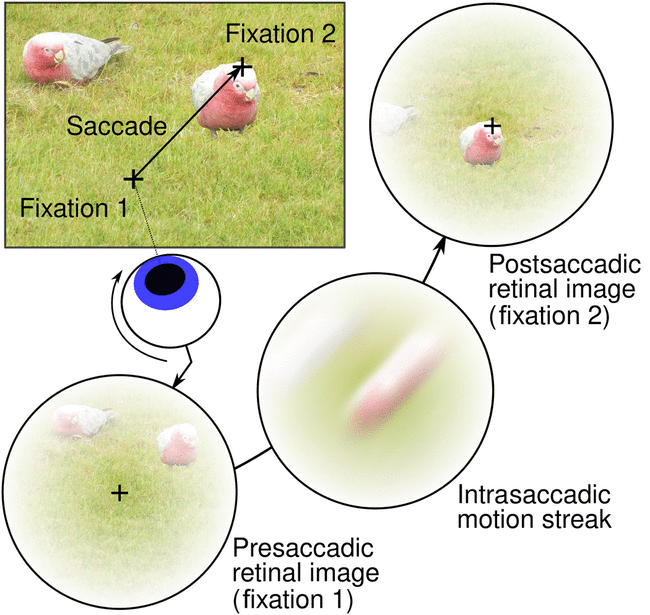
Saccadic Suppression
Neural mechanisms that prevent us from perceiving eye movement sweeps, allowing perceived visual stability.
Featural Search
A visual search for a single feature that produces a flat reaction time via the pop-out effect.
Conjunction Search
A visual search combining two or more features, showing a linear increase in reaction time as display size grows.
Overt Attention
Selective attention paired with active saccades and eye movements.
Covert Attention
Attending to a stimulus in the visual field while maintaining a central fixation without making eye movements.
Posner Cueing Experiment
Demonstrated that information processing is more efficient and faster where our locus of attention is directed.
Sperling's Sensory Memory Task
Required participants to maintain central fixation while items flashed briefly to test visual recall.
Inattentional Blindness
The phenomenon of failing to see visible objects due to distraction, lack of focus, or diverted attention.
Change Blindness
The inability to detect a feature change within a visual scene due to attentional and awareness limits.
Divided Attention
Partial attention given to more than one perceptual or cognitive task, commonly known as multi-tasking.
Hemifield Neglect
Condition caused by parietal lobe lesions where patients cannot attend to one side of the visual field.
Balint's Syndrome
Condition caused by bilateral occipito-parietal damage resulting in simultanagnosia and eye-movement control deficits.
The Stroop Effect
Demonstrates that reporting font color requires inhibiting the automatic response of reading, causing slower performance on incongruent trials.