Carbohydrate structure
 Call Kai
 Learn
 Practice Test
 Spaced Repetition
 Match
 Flashcards
 Knowt Play
1/10

There's no tags or description
Looks like no tags are added yet.
11 Terms
Carbohydrate (Definition)
The term carbohydrate comes from the fact that these molecules consist of carbon atoms, and hydrogen and oxygen atoms, which are found in water.
A more accurate description of carbohydrates is carbon-based molecules that are rich in hydroxyl groups.
Carbohydrates are also known as saccharides, or sugars, because some of them taste sweet.
carbohydrate names
The names of carbohydrates end with a suffix -ose.
glucose
what is its structure
chemical formula
The most important carbohydrate in metabolism is glucose. Here is the structure of glucose, which contains six carbon atoms and five hydroxyl groups. The chemical formula is C6H12O6. Glucose will be used as the basis to explore the structural characteristics and diversity of carbohydrate molecules.

in ring CH2OH and the one OH are in same direction
Carbon Number Classification
Carbohydrates can have different numbers of carbon atoms. Glucose has six carbon atoms and is a hexose.
Carbohydrates with five carbons are called pentoses,
carbohydrates with four carbons are called tetroses,
carbohydrates with three carbons are called trioses.
Carbohydrate classification
Carbohydrates can be aldoses or ketoses
Glucose is an aldose because it contains an aldehyde group.
Fructose is a ketose because it contains a ketone group.
Carbon Numbering
The individual carbons in a carbohydrate are identified by numbers. The carbons are numbered starting with the carbon at the end of the molecule closest to the carbonelle in the aldahyde or ketone group.
The carbons are then numbered sequentially. The carbon with the highest number is farthest from the aldehyde or ketone group.

Stereocenters and Isomers
Carbon atoms with four different groups attached are chiral and form stereocenters. Carbohydrate molecules containing carbon stereocenters have isomers with different arrangements around the stereocenters.
Glucose has four carbon stereocenters and 16 possible isomers. (2#C) Two glucose isomers are shown here with different orientations of the hydroxyl and hydrogen at carbon two and carbon four.

Modifications of Carbohydrates
Carbohydrates can be modified by replacing the hydroxyl groups with other chemical groups. Glucose is shown here with two common types of modifications: amines and phosphates.

Cyclic Forms of Carbohydrates
This structure represents glucose in an open chain form, but many carbohydrates spontaneously adapt a cyclic form, which is predominant in solution. A representation of a cyclic form of glucose is shown here.
The linear form transforms into the cyclic form when an oxygen from a hydroxyl group, indicated in red, attacks the carbonyl carbon, indicated in blue, forming a covalent bond.
To the right of the linear structures of glucose and fructose shown here are simplified representations of the common cyclic form. Note that the carbonyl carbon, circled in blue, is attached to two oxygens in the cyclic form.
For aldoses like glucose, the carbonyl carbon in the cyclic form is attached to two oxygens and a hydrogen atom, which is not shown. For ketoses like frucotose, the carbonyl carbon in the cyclic form is attached to two oxygens and another carbon atom.
for ketose carbonyl carbon is carbon 1
for fructose, its 2?, or just see how many carbons follow off that one and label from there

Mono-, Oligo-, and Polysaccharides
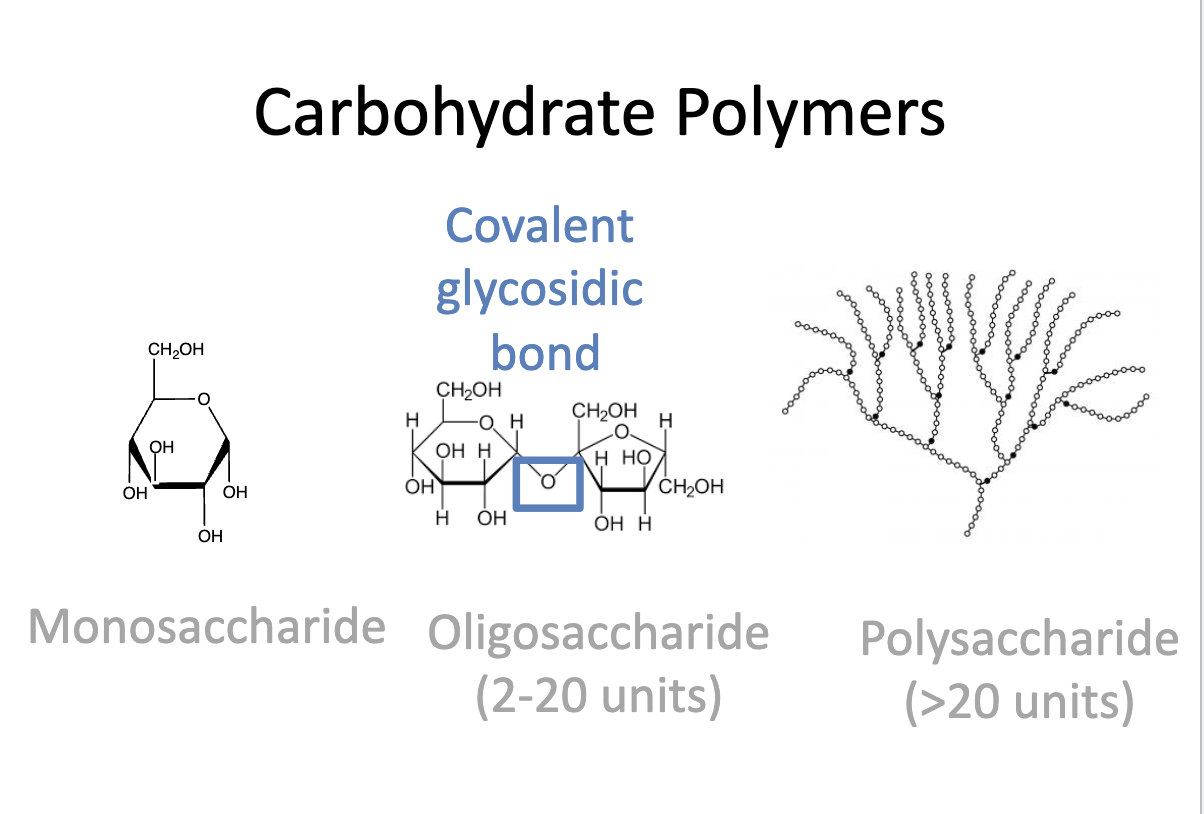
A single carbohydrate molecule is called a monosaccharide. Two monosaccharides can be linked together with covalent glycosidic bonds, in which an oxygen connects the carbons of two different carbohydrates.
Polymers containing 2 to 20 individual carbohydrate units are called oligosaccharides.
Polymers containing more than 20 units are considered polysaccharides.
Polymers can be made of repeating or nonrepeating carbohydrate units. Polymers can have a linear or branch structure as in the molecule shown here.
Summary of Carbohydrate Structure
Carbohydrates…
• Are biomolecules made of carbon, hydrogen, and oxygen
• Contain hydroxyl groups
• Are characterized by the number of carbons, presence of an aldehyde or ketone group, and modifications
• Can spontaneously form stable cyclic structures
• Can covalently attach through glycosidic bonds to form polymers