Biochemistry Exam 3
 Call Kai
 Learn
Learn Practice Test
 Spaced Repetition
 Match
Match Flashcards
 Knowt Play
1/248

There's no tags or description
Looks like no tags are added yet.
Name | Mastery | Learn | Test | Matching | Spaced | Call with Kai | Chat |
|---|
No analytics yet
Send a link to your students to track their progress
249 Terms

Energy storage, membrane structural elements for transport, hormones and drug targets for signaling, cofactors in catalysis, detergents in digestion
also enhanced absorption
What are some functions of biological lipids?

Plaque
Buildup of lipids in blood vessels, especially LDL (bad), leads to __________.

extra LDL and cholesterol buildup causes
heart attack due to blood flow restriction
accumulation of lipids within arterial walls leads to plaque formation known as
atherosclerosis
Storage lipids and membrane lipids
What are the two types of lipids we went over?
Which lipoprotein is responsible for delivering cholesterol to tissues and contributing to plaque formation
LDL
triacylglycerol
What do lipids store energy as?
what are storage lipids stored as?
derivatives of fatty acids, has carboxylic acid groups with long chain of alkane with or without few unsaturated bonds
Saturated have not double bonds, they are single bonds, to kink the chains so they compact on one another. Ex. butter
Unsaturated have at least 1 double bond that kinks and causes them to not compact tightly. Ex. Oil
What is the difference between saturated fatty acids and unsaturated fatty acids?
A fatty acid is designated as 18:0. compared with EPA 20;5, which is most accurate?
Contains no double bonds and is a saturated fatty acid.

fatty acids are mainly hydrophobic or hydrophilic
classified as hydrophobic because it dominates
Aliphatic
Lipids are considered _______ which means they have a polar part and non-polar part.

Trans-fats have a trans double bond so they can pack tight. Unsaturated fats have a cis double bond which kinks them.
Trans-fats have a double bond but are still able to pack tightly, making them harmful. Why are they able to still pack tightly?
the melting point in order is…
saturated acid is the greatest, trans unsaturated fatty acid, lastly cis unsaturated fatty acid.

What is the main structural differences between fatty acid a and fatty acid b
fatty acid a is saturated with a straight hydrocarbon chain, fatty acid b is unsaturated with double bond to create a bend in the chain
Why are oils generally liquid at room temperature whereas fats are often solid?
unsaturated fatty acids in oils contains double bonds that prevents tight packing of molecule
A. Cis. The few natural trans fats are obtained from bacteria in the lumen and end up in dairy and meat products. We do not make any trans-fat.
Most natural fats are
A. Cis
B. Trans
Partial hydrogenation of unsaturated fatty acids to convert into saturated fatty acids
Dietary trans fats are formed by:
Trans fats can pack more regularly and show higher melting points than cis form. This means they will cook hotter when cooking such as in frying. These are have a longer shelf life.
Why are trans-fats created by industry?
Increased LDL and decreased HDL
Consuming trans-fats leads to increased _____________ and decreased ____________. (HDL or LDL)
trans double bond allow a…
given fatty acid to adopt an extended conformation
A food manufacturer partially hydrogenates vegetable oil to increase the
shelf life of a snack product. Which of the following is the most likely
consequence of this process?
Some cis double bonds are converted to trans double bonds, making the
fat more solid and stable at room temperature.
C. Cardiovascular disease. Avoid fried foods, margarine, pie crusts
Trans-fats can lead to:
A. Weight loss
B. Edema
C. Cardiovascular disease
A researcher develops two versions of a snack food. One contains cis-unsaturated
fatty acids, while the other contains trans fatty acids produced by partial
hydrogenation. Both products have the same caloric content. Which outcome is
most likely if a person regularly consumes the snack containing trans fats instead of
the cis-fat version?
B. Increased LDL levels and decreased HDL levels because trans fats pack more
tightly and behave more like saturated fats.
Triacylglycerols
___________ are the major animal fat components.

The triacylglycerol is a glycerol backbone connected to 2 saturated chains and 1 unsaturated chain.
Explain the structure of the triacylglycerol.
Using free fatty acids means we would need lots of free fatty acids. This would make our body much more acidic. Instead, we choose triacylglycerol because it will not make our body more acidic.
Why is triacylglycerol used for storage rather than free fatty acids?
B. Lipase. During long-term fasting, lipase degrades molecule and releases parts to be used for other purposes. In some, lipase does not work due to defect, triacylglycerol in blood will not break down and be increased in blood leading to high cholesterol.
Which enzyme cleaves the bonds of a triacylglycerol?
A. Ligase
B. Lipase
C. Glyase
D. Acylase
True
T/F Triacylglycerols are seen as droplets in adipocytes, serving as a source of metabolic energy.
Glycerol and fatty acids; lipases
the released fatty acids enters the blood and goes to where they are needed
What are Triacylglycerols broken down into and what breaks them down?
triacylglycerols are _and _
nonpolar, hydrophobic
B and C, because the triacylglycerol is unhydrated, no extra water weight is needed
A should say they hold 2x as much energy per gram as glycogen
D should say they reduce acidity by using fatty acids and taking them out of the bloodstream
What are the advantages of using Triacylglycerols as storage? (Select all that apply)
A. Hold 4x as much energy per gram as glycogen
B. Does not require water to be carried since it is non-polar
C. Fat is a good insulator and keeps you warm.
D. They increase acidity allowing for better digestion.
A scientist engineers a mutation that prevents the formation of ester bonds between glycerol and fatty acids. Based on the structure of triacylglycerols shown in the figure,
what would be the most likely consequence of this mutation?
Formation of triacylglycerols would be impaired, reducing the organism's ability to store large amounts of energy in adipose tissue
Which of the following is an advantage of storing energy as
triacylglycerols (fat) rather than glycogen?
C. Triacylglycerols provide more than twice as much energy per gram as
glycogen.
B. Plasma membrane
Lipid is the structural component of which part of the cell
A. DNA
B. Plasma membrane
C. RNA
D. Both DNA and RNA
B. abnormally high levels of fats (lipids)
What is considered Hyperlipidemia?
A. abnormally high levels of proteins
B. abnormally high levels of fats (lipids)
C. abnormally high levels of carbohydrates
D. Both a glycerol backbone and 3 fatty acids
Triacylglycerols are composed of:
A. A glycerol backbone
B. A glycol backbone
C. Amide linkages b/w the fatty acids and the glycerol
D. Both a glycerol backbone and 3 fatty acids
E. A glycerol backbone, 3 fatty acids, and amide linkages b/w fatty acids and the glycerol
Phosphatidic acid
One type of membrane lipid we went over was glycerophospholipids. What are these derivatives of?

Glycerol backbone bound to a saturated fatty acid, unsaturated fatty acid, and a phosphate group that is usually bound to an -OH.
What does the structure of a glycerophospholipid have?

The backbone is a long-chain amino alcohol called a sphingosine. (it is not glycerol)
Another type of membrane lipid we went over was the sphingolipids. What is the backbone of this?
B. Amide linkage
Sphingosides are attached to the fatty acids by what type of bond?
A. Glycosidic
B. Amide linkage
C. Sphingosidic
D. Alcoholic
sphingolipids are found in
brain cells
the polar head group is connected to sphingosine by a _
glycosidic or phosphodiester linkage

A ceramide
What is the sphingolipid structure containing the sphingosine and fatty acid chain called?
Formula of X is -H
True. This is an important function of sphingolipids.
T/F Carbohydrate moieties of some sphingolipids define the human blood groups.

sphingolipids are derivatives of
sphingosine
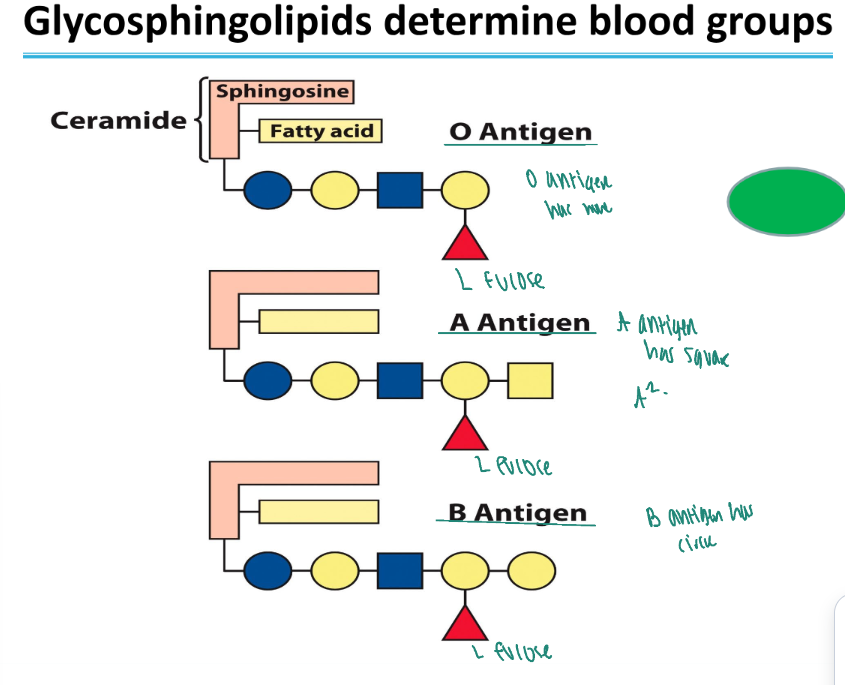
Oligosaccharide chain. Each blood type antigen has a different oligosaccharide sequence.
Glycosphingolipids determine blood groups because of the ____________ that are attached to the ceramide molecule.
sphingolipids have a known function to
help define the human blood groups thru the carbohydrate moieties of some sphingolipids
Sphingosine
Glycerol is to triacylglycerol as _______________ is to sphingolipids.
False. glycerophospholipids and sphingolipids are continually degraded and replaced
T/F Most cells rarely degrade and replace membrane lipids.
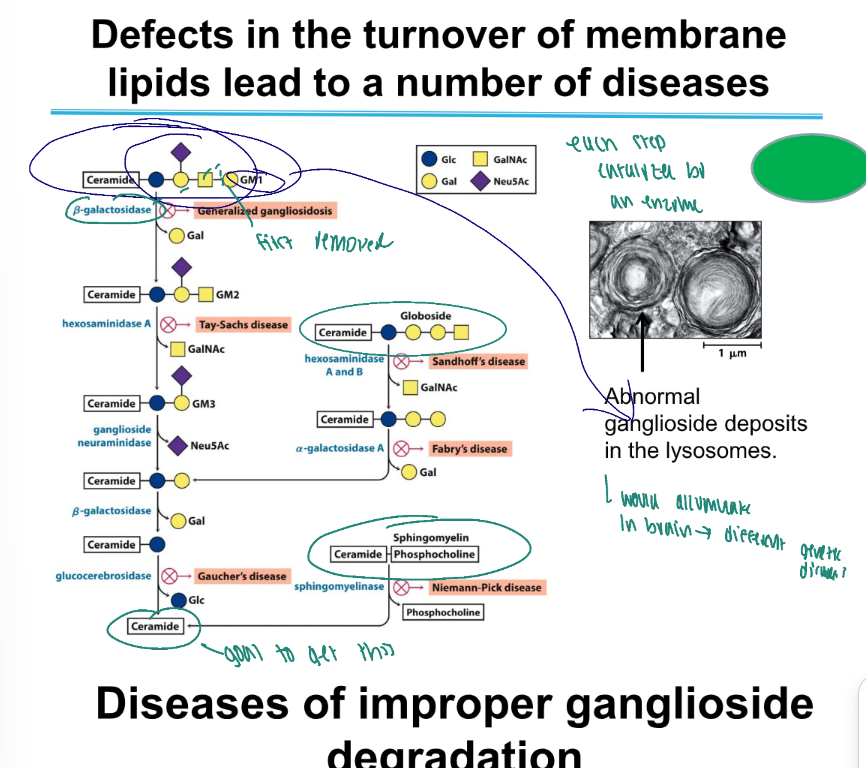
Lysosomal
If complex membrane lipids are not degraded and replaced, they can lead to _________ diseases. Because of the accumulation of gangliosides in the cell.
This is the most complex sphingolipid and have oligosaccharides as polar group, 1 or more N-acetylneuraminic acid (sialic acid)

A. Beta galactosidase. This is an error in the 1st step of degradation.
Symptoms include: hepatospleenomegaly (enlarged spleen and liver) and curved spine
Generalized gangliosidosis is caused by a deficiency in which enzyme.
A. Beta-galactosidase
B. Glucocerebrosidase
C. Sphingomyelinase
D. Hexosaminidase A and B
E. Hexosaminidase A
F. Alpha-galactosidase A


E. Hexoaminidase A.
This disease slow development; usually survive 1-4 years
Important: cherry-red spot on retina
Tay-Sachs disease is caused by a deficiency in which enzyme.
A. Beta-galactosidase
B. Glucocerebrosidase
C. Sphingomyelinase
D. Hexosaminidase A and B
E. Hexosaminidase A
F. Alpha-galactosidase A


F. Alpha-galactosidase A Cardiac, brain, and kidney damage by 30.
Death by 40; symptom= chronic burning and tingling of hands and feet.
Treatment costs $250000/year
Fabry's disease gangliosidosis is caused by a deficiency in which enzyme.
A. Beta-galactosidase
B. Glucocerebrosidase
C. Sphingomyelinase
D. Hexosaminidase A and B
E. Hexosaminidase A
F. Alpha-galactosidase A

Niemann-Pick disease is caused by a rare genetic defect in the enzyme sphingomyelinase, the enzyme that cleaves phosphocholine from sphingomyelin. Sphingomyelin accumulates in the brain, spleen, and liver. The disease becomes evident in infants and causes mental retardation and early death.
What happens in Niemann-Pick disease and what enzyme defect is responsible?

gauchers diesase
most common for lysosomal storage diseases

defects for both these diseases occur later in the sphingolipid degradation pathway
gaucher’s and Niemann pick diease
genetic counseling
What can predict and avert many inheritable disease?

Arachidonic acid. This is the result of the hydrolysis of the ester bonds.
Phospholipases degrade glycerophospholipids and the fatty acids released form an inflammatory mediator called

Phospholipase A2
Steroids prednisone and prednisolone inhibit what indirectly?

All.
Prostaglandins produce inflammation, pain, and fever.
Thromboxanes increase blood clotting ability of platelets.
Leukotrienes can cause asthma attacks. (Lung smooth muscle contracts)
NSAIDs block prostaglandin and thromboxane production.
Enzymatic oxidation of arachidonic acid yields (select which)
A. Prostaglandins
B. Thromboxanes
C. Leukotrienes
D. Phospholipases
What enzyme degrades glycerophospholipids?
A. Lysomerases
B. Polymerases
C. Glycerases
D. Phospholipases

It is the 3 products together that arachidonic acid breaks down to. These 3 together are called the eicosanoid. POWERFUL SIGNALING MOLECULES, 20 CARBON FATTY ACIDS
What does eicosanoid mean?
Eicosanoids
lipid-based signaling molecules that play a unique role in innate immune responses
It means 20 as in they are a class of molecules derived from 20-carbon polyunsaturated fats. They are usually about 20 carbon long.
What is the origin of the portion of the word, "eicosa"?
True
T/F Some lipids act as signaling molecules. An example of these is hormones.

Sterol nucleus has 4 fused rings (almost planar)
Hydroxyl group (polar head) in A ring
Various non-polar side chains (non-polar part)
What are sterols composed of?
Sterols. Steroids have the sterol nucleus but do not have alkyl side chains found in cholesterol.
Steroids are oxidized derivatives of _________.
False. Steroids are more polar cause they lack non-polar chains.
T/F Cholesterol is more polar than steroids.
Gonads and adrenal glands
Steroids are synthesized from cholesterol in the __________ and __________.
Through the bloodstream, they are attached to carrier proteins
How are steroids carried in the body?
many of steroid hormones are
male and female sex hormones

Hydrocortisone
What medication containing a hormone suppresses localized inflammation such as after a bee sting?
To calm down your body's immune response to reduce pain, itching, and swelling (inflammation).
What is hydrocortisone typically used for?

They inhibit the release of arachidonic acid by phospholipase A2 which does not allow the synthesis of eicosanoids. like prostaglandins thrmoboxane’s and leukotrianes
How do prednisone and prednisolone work?
Cortisol
Chronic stress leads to high amounts of _______ which is bad for our health because it destroys the epithelial lining. A symptom can be heart burn.
Vit D and A
Ex. Vitamin D3 (cholecalciferol) creates calcitrol, a hormone that helps in calcium absorption.
Ex. Vitamin A1 (retinol) is oxidized to cis-retinal; visible light turns cis to trans and we can see by sending neuronal signal to brain; retinal also becomes retinoic acids which is a hormone that helps with dry eyes, send hormonal signals to epithelial cells
What 2 vitamins act as a hormone precursor?

In a derivative of cholesterol, 7-dehydrocholesterol, a bond is broken to make it into cholecalciferol (Vit D3), which is then activated in the liver to hormone calcitriol. Calcitriol then helps with Ca2+ absorption
How is Vit D produced in our bodies?

Cleaving of beta-carotene
Where does Vit A come from?
A. Cardiolipin
Sphingosine is NOT a component of:
A. cardiolipin
B. ceramide
C. cerebrosides
D. gangliosides
E. sphingomyelin
C. Vitamin D
Which vitamin is derived from cholesterol?
A. A
B. B12
C. D
D. E
term with proper definition

Define cell boundaries, divide cells into compartments, organize complex reaction sequences, act in signal reception and transmission, platform to move solute in and out of cell
What are some functions of biological membranes?

Where is the outer and inner layer
Amphotericin B
Which drugs target ergosterol in fungal and yeast infections?

Proteins = 52%
Phospholipids = 7%
Sterol = 4% (ergosterol)
What percentage by weight are proteins, phospholipids and sterols in yeast?

proteins= 30%
phospholipid= 30%
sterol= 19% (cholesterol)
What percentage by weight are proteins, phospholipids and sterols in human myelin sheath

proteins= 55%
phospholipid= 40%
sterol= 4% (stigmasterol)
What percentage by weight are proteins, phospholipids and sterols in paramecium (ciliated protist)

proteins= 75%
phospholipid= 25%
sterol= 0% (no sterol type)
What percentage by weight are proteins, phospholipids and sterols in E.coli
A patient is prescribed a drug that targets ergosterol in the fungal cell membrane. Based on the table, why would this drug be expected to have a greater effect on yeast cells than on human myelin membranes?
Yeast membranes contain ergosterol, whereas human membranes primarily contain cholesterol
D. None of the above
it is covalently bound to lipids, on outer,
Peripheral membrane proteins
A. Are generally non-covalently bound to membrane lipids
B. Penetrate deeply into the lipid bilayer
C. Are usually denatured when released from membranes
D. None of the above
True
T/F Glycoproteins, Cholesterol, or Channel proteins can be drug targets in the plasma membrane.
High protein; no sterol type
E. coli has __________ protein content because they have lots of enzymes in their membrane. They also contain ____________ sterol type.
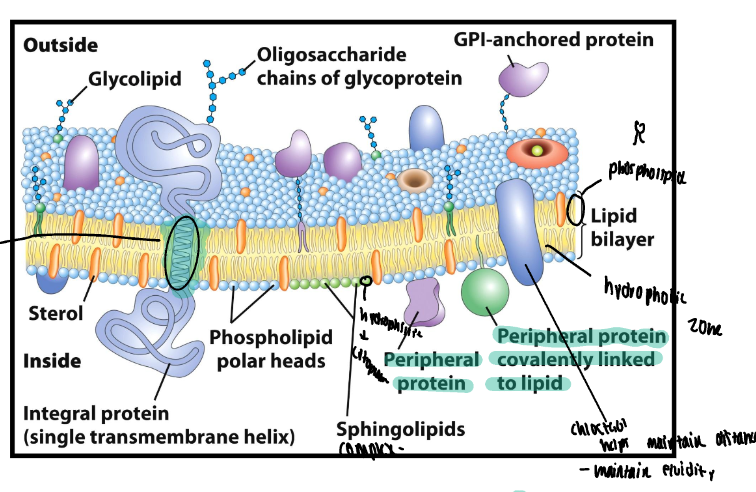
Integral goes fully through membrane and can be glycoconjugate.
Peripheral is covalently linked to lipid bilayer on either side.
What is the difference between integral proteins and peripheral membrane proteins?
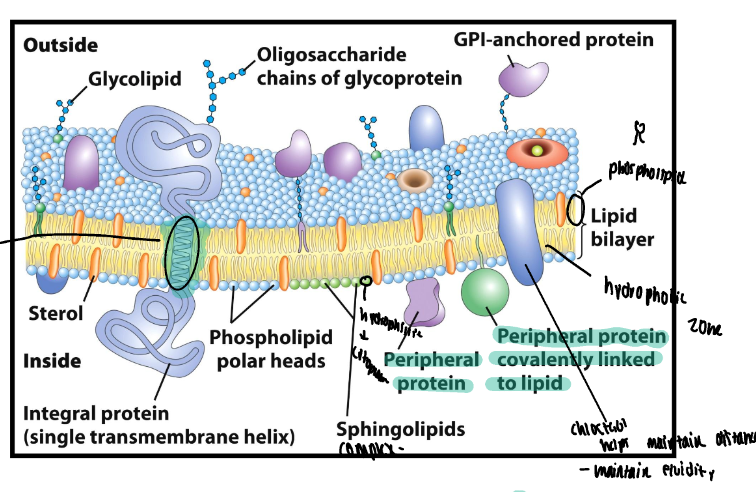
Important for membrane fluidity. They can actually move around the membrane laterally (not static)
What is the purpose of cholesterol in the plasma membrane?
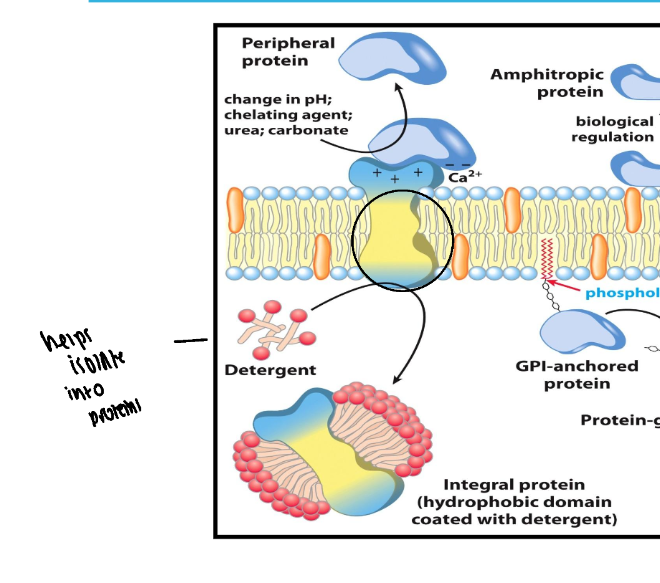
Peripheral- use change in pH, clearing agent, urea, carbonate
Integral- use detergent
How can you isolate peripheral and integral proteins from the plasma membrane?

A researcher finds that a membrane protein is attached to the extracellular
surface of the plasma membrane but has no transmembrane domain.
Which mechanism most likely anchors this protein?
B. Attachment through a GPI anchor

A researcher treats isolated plasma membranes with a high-pH
carbonate solution. Which class of membrane protein is most
likely to be released from the membrane without disrupting the
lipid bilayer?
C. Peripheral membrane protein

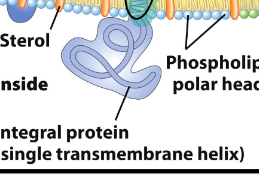
A protein that spans the entire membrane and contains a
transmembrane helix is classified as a
integral protein
A mutation drastically reduces sterol (cholesterol) content in the plasma membrane.
What is the most likely consequence?
Membrane fluidity and stability become altered.