Exam 2: Motor Learning --> Lecture 09 The learning experience
 Call Kai
 Learn
 Practice Test
 Spaced Repetition
 Match
 Flashcards
 Knowt Play
1/19

There's no tags or description
Looks like no tags are added yet.
20 Terms
learning is:
a change in the capability of a person to perform a skill that must be inferred from a relatively PERMANENT improvement in performance as a result of practice or experience
Improvement
Consistency
Persistence
Adaptability

Linear Curve

Negatively Accelerated Curve

Positively Accelerated Curve

S-Shaped Curve
In the S-Shaped Curve, What could cause performance plateau?
slow improvement
person has hit their physical capacity
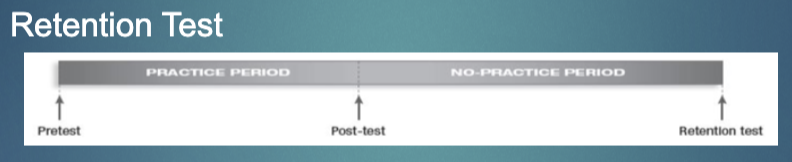
Retention Test
I used to be able to do this thing; can I do it years later?
Transfer Test
ex. I know how to surf; can I use what I know and apply it to snowboarding?
Fitts and Posner’s Three Stage Mode
Verbal-Cognitive Stage
Learner LISTENS and UNDERSTANDS
Motor (Associative) Stage
The learner does what they're asked to do
Autonomous Stage
The learner performs the task efficiently
Gentile’s Two Stage Model
“Getting the Idea of the Movement”
Fixation/Diversification
Learner at the Cognitive Stage
Introduced to a new motor skill
Develops an understanding of the movement’s requirements
Attempts numerous techniques and strategies: a trial-and-error approach
Reformulates past movement experiences in an effort to solve the current movement problem
Needs guidance to detect and correct errors
Learner at the Associative Stage
is committed to refining one particular movement pattern
Performs more consistently, with fewer errors
is better at detecting errors and developing strategies to eliminate them
Needs constructive practice experiences and effective feedback from practitioner
Learner at the Autonomous Stage
Can perform a skill proficiently
Can perform multiple tasks simultaneously
Performs consistently and confidently, with few errors
Can detect and correct those errors that are made
May become discouraged and unmotivated if proficiency comes slowly
Practitioner serves as motivator
Fixation/Diversification Stage: FIXATION
Closed skills—fixed, stable environment
Example: Shooting a free throw
Fixation/Diversification Stage: DIVERSIFICATION:
Open skills—unpredictable environment
Example: Shooting a hockey puck from various angles and positions; golf putting
Declarative vs Procedural
Describes what to do (Can i repeat it back?)
TELL ME
Declarative vs Procedural
Understand the STEPS of the process (Can I do it?)
SHOW ME
Muscles Used: Co-Contraction
Keeps us stiff and protected
Freezing degrees of freedom
limiting movement to make a skill easier to control
Freeing degrees of freedom
allowing more joints and body parts to move and work together