Outer and Middle Ear Disorders
 Call Kai
 Learn
 Practice Test
 Spaced Repetition
 Match
 Flashcards
 Knowt Play
1/20

There's no tags or description
Looks like no tags are added yet.
21 Terms
Idiopathic disorders
arise spontaneously, unknown cause
Genetic disorders
due to alteration of genotype of individual
can be syndromic: seemingly unrelated to the constellation of symptoms
all syndromes are genetic
Non genetic disorders
not related to the genotype of the individual
Genetic hearing loss with external and middle ear abnormalities will result in…
conductive or mixed hearing loss
Microtia
underdeveloped pinna (graded I-IV)
Stenosis
ear canal narrows to nothing, no tympanic membrane
Anotia
absence of ear canal entirely (grade IV)
Brachio-oto-renal syndrome (BOR)
Autosomal dominant with varied expressivity, chromosome 8
90% with HL
80% with pre-auricular pits
60% branchial cysts or fistulas (skin bulges out)
25% kidney abnormalities

CHARGE Association
C: coloboma (clefting of eye)
H: heart defects
A: atresia of choanae (opening of nasal cavity to nasopharyx
R: Regression; delayed growth and development
G: genital hypoplasia
E: Ear abnormalities (pinnae)

Treacher Collins syndrome
Phenotypes:
Corners of eyes slope down
depressed cheekbones
eye clefting
malformations of ossicles

Apert syndrome
Autosomal dominant or sporadic mutation
Phenotypes:
developmental delays
wide set eyes
flat facial profile
fused digits

Stickler syndrome
Autosomal dominant
Phenotypes (different types exist)
midfacial flattening
long extremities
loose joints, arthritis in older age
progressive myopia
Low percentage with SNHL

Vernix caseosa
white film that newborns have on body, can get trapped in ear canal and cause screen failure
Exostoses or osteoma
Non cancerous bony growths
Otitis externa
Inflammation/infection of the outer ear
Otitis media
inflammation of the middle ear
can be with or without effusion (fluid)

Bullous myringitis
blister develops between layers of the TM often during upper respiratory infection
rarely results in HL but is painful

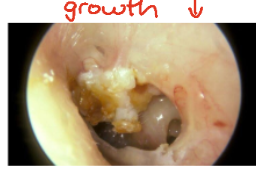
Cholesteatoma
growth of skin from external ear that invades middle ear through a retraction pocket in the tympanic membrane
bacteria is trapped, foul smelling drainage
aural fullness
requires surgery
Mastoiditis
Acute: inflammation of mucosa
Chronic: affects bone structure

Tympanosclerosis
Calcified scar tissue on the TM
related to chronic otitis media
can cause CHL

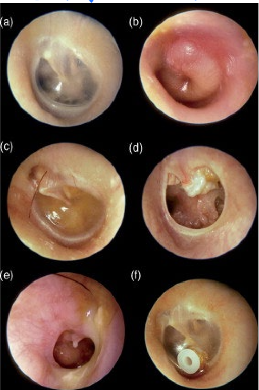
Identify the following pathologies:
a. healthy TM
b. acute otitis media
c. chronic serious otitis media
d. cholesteatoma
e. TM perforation
f. myringotomy with PE tube placement