Hort100 Exam 1 Shannon Mason
 Call Kai
 Learn
 Practice Test
 Spaced Repetition
 Match
 Flashcards
 Knowt Play
1/105

There's no tags or description
Looks like no tags are added yet.
106 Terms
What is horticulture?
The science, art, hobby, technology, business of producing, fruits, nuts, herbs, vegetables for consumption and producing flowers, plants, grasses for aesthetic, landscaping and recreational use
pericarp
the fruit wall, which developed from the ovary wall
Composed of 3 layers:
Exocarp: outer layer of the pericarp
Mesocarp: middle layer of the pericarp
Endocarp: inner layer of the pericarp
Dicot secondary growth
Pith is remnant and surrounded by rings of xylem
(one ring each year)
▪ Cambium
▪ Phloem is riged
▪ Rays transverse the xylem and into the phloem
▪ Outer surface is covered by the periderm or bark.
How do monocots and dicots differ in venation?
Most dicots have branched leaf veins (network venation)
Monocots have parallel leaf veins (parallel venation)
Define a plant mutation
Individual in a species will change to a different color, size, or growth habit. Population of plants exists with the same scientific name, but a subgroup will show different characteristics
Stomata
designed for gas exchange
CO2 in and O2 out for photosynthesis
CO2 out and O2 in for respiration
H2O out during transpiration
What is not horticulture?
Forestry and Agronomy (growing and improving field crops)
Horticultural crops vs Agronomic Crops
Hort smaller, higher maintenance, difficult post harvest storage, no processing for human consumption vs the exact opposite
Olericulture
growing vegetables and culinary herbs

Pomology
growing fruit and tree nut crops

Viticulture
study of grapes

Arboriculture
study of trees, shrubs, vines, and other perennial woody plants

Floriculture
cultivation of flowering and ornamental plants

Nursery Production
production of ornamental trees, shrubs, fruits, flowers, - often in CONTAINERS

Landscape or Environmental Horticulture
Create aesthetically pleasing, functional and environmentally sound outdoor spaces.

Taxonomy
science of identifying, naming and classifying organisms
Taxonomy order
Domain, Kingdom, Phylum, Class, Order, Family, Genus, Species
Health Benefits of Gardening
Increase flexibility
Strengthen joints
Decrease blood pressure
Angiosperm
Flowering plants
covered seed
Most have broad leaves
Gymnosperm
Conifers and Ginkgo (trees)
Naked seed
Often narrow leaves
The family names of most angiosperms often end in what suffiix?
aceae
Monocots
1 Cotyledon
Flower parts in multiple of 3s
Parallel venation
Dicot
2 cotyledons
flower parts in multiples of 5s
Network venation
Sympetalae flowers
flower parts are fused at base

Chloripetalae flowers
flower parts separate and not fused together

Annual Growth Pattern
Only one growing season to complete life
Biennial Growth Pattern
Completes life cycle in two growing seasons
Hardy Perennials
live for at least 2 growing seasons, potentially many years
Tender Perennials
cold temp may kill it but under good growing temp can live for awhile
Summer Annual
killed by frost or cold
Winter Annual
killed by heat
Herbaceous Ornamental Perennials
soft primary tissue bendable
Epiphytes
herbaceous plants that grow on branches of trees and shrubs
Shrub
many stems, close to ground, without defined trunk
Trees
single defined main trunk
Vegetative Organs
Root, Stem, Leaf
Dicot leaf
branched leaf veins
Monocot leaf
parallel leaf veins (parallel venation)
Cross section of a leaf
Cuticle, Epidermis, Mesophyll
Cuticle
Outermost layer of up and low surface of leaf
clear and waxy to prevent water loss
Epidermis
One layer of cell that give protection for inner tissues
Mesophyll
Palisade parenchyma and Spongy Mesophyll
Stoma
an open aperture in teh epidermis
What opens and closes Stomata
2 guard cells
Open stoma
turgid guard cells
Close stoma
flaccid guard cells
Sun Grown Leaf
thicker due to thicker palisade layer
Shade Grown Leaf
thinner to thinner palisade layer
larger in size
more pliable
Label a leaf
tip, blade, margin, midrib, lateral veins, petiole, stipules

opposite
two leaves attached per node
Alternate
one lead attached per node staggered
Whorled
three or more leaves attached per node
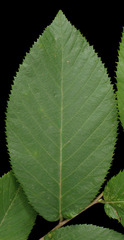
Simple Leaf
blade of lead occurs as one unit
Tip: the terminal point on the leaf
Blade or lamina: flattened, green, expanded portion of a leaf
Margin: edge of the leaf
Midrib: the most prominent central vein in the leaf
Lateral veins: secondary veins in a leaf
Petiole: the leaf stalk (monocots lack)
Stipules: leaf-like appendages at the base of the petiole on some leaves
Big thick leathery leaves
Compound leaf
blade of lead is divided into leaflets
Leaflet: secondary leaf of a compound leaf
Rachis: an extension of the petiole that bears leaflets
Petiolule: the leaflet stalk
Petiole: the leaf stalk
Stipules: leaf-like appendages at the base of the petiole on some leaves

Palmately Compound Leaf
leaflets start from same location on petiole

Pinnately Compound Leaf
leaflets start from both sides of rachis

Function of leaves
Photosynthesis
Label stem
bud, terminal bud, node, internode

Main functions of stem
Support
Conduction: move water and minerals through their xylem and phloem
Food storage
Protection
Crown (modified stem)
compressed stem

Stolons (modified stem)
stem growing horizontally above ground

primary growth
vascular bundles are in ring between cortex and pith
Phloem outside xylem inside

Secondary Growth
Pith is remany and surrounded by rings of xylem

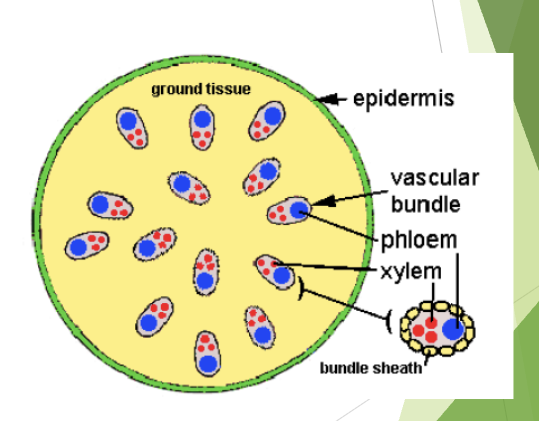
Monocot Primary Growth
Vascular Bundles – randomly scattered in the ground tissue
▪ Each vascular bundle is surrounded by a bundle sheath and contains xylem oriented towards the inside and
▪ Phloem towards the outside of the stem
▪ Outer layer is the epidermis
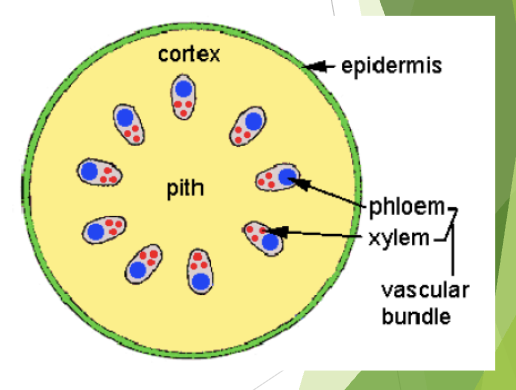
Dicot Primary Growth
Uniform bundles in a ring surrounding parenchyma cells in a pith region
Xylem on the inside
Phloem on the outside
Outer surface covered by epidermis
Dicot and Monocot Similarity in primary Growth
stem is mostly composed of ground tissue
Label a diagram of a woody dicot
bark, cambium, phloem, xylem, and rays

Annual Rings made of
xylem by vascular cambium
Main function of roots
water absorption
nutrient absorption
Energy storage
Anchoring and stability
Production of plant hormones
Tap Root
One big root

Fibrous Root
many different roots

Root hairs
Tubular extensions of epidermal cells (the most functional roots)
where are vascular bundles
randomly scattered in the ground tissue
Nomenclature
Genus + specific epithet for each plant
Carl von Linne
Who developed the system of binomial nomenclature?
Variety
given when the mutation occurs in nature
Cultivar
mutation occurs due to human influences
Label complete flower
Stigma
ovary
ovule

Female reproductive parts
stigma, style, ovary
Male reproductive parts
stamens, filament, anther
Complete Flower
A flower containing sepals, petals, stamens, and at least one pistil.

Incomplete Flower
A flower that lacks one or more of the four organs: sepals, petals, stamens, or pistils.
Perfect Flower
has both male/female reproductive parts

Imperfect Flower
flower that is only male or only female

Monoecious Plant
male and female flowers on the same plant
Dioecious plant
staminate and pistillate flowers on separate plants
Dicot Flowers
multiples of 4 or 5
Monocot flowers
multiples of 3
A fruit develops from an
ovary
A seed develops from an
ovule
Monocot Seed Structure
Cotyledon
Endosperm
Plumule
Radicle
Seed coat
Cotyledon
helps convert starches stored in the endosperm to useable form
Endosperm
foot storage for seedling
Plumule
embryonic leaf
Radicle
embryonic root
Seed coat
protects seed
Dicot Seed Structure
Cotyledon: provides food for germinating seedling
plumule/epictoly: embryonic leaf
Hypocotyl: embryonic seed
Radicle: embryonic root
Seed coat: protects the seed
cyme inflorescence
Inflorescence that is usually broad and often flat-topped with little florets on it

Solitary inflorescence
single flower

corymb inflorescence
flat-topped or convex inflorescence in which the individual flower stalks grow upward from various points on the main stem to approximately the same height
