Topic 6: Depression and Deglobalization
 Call Kai
 Learn
 Practice Test
 Spaced Repetition
 Match
 Flashcards
 Knowt Play
1/65

There's no tags or description
Looks like no tags are added yet.
66 Terms
The Great Depression
The most severe economic downturn of the modern era
Began with a stock market crash in New York
Global contraction, 1929–1932
Huge drop in industrial production
Steep decline in prices: deflation
Unprecedented levels of unemployment
Collapse of international trade
Spread through currency and banking crises as gold standard broke down
Economic recovery from 1933
Slow in many countries
Unemployment remained high
Political radicalisation and growing international tensions
Wall Street Crash
Stock prices fell by more than 80% between 1929 and 1932
After the crash and a brief rally in 1930, the index was back at its 1926 level by early 1931
The trough came in mid-1932, more than 80% below the peak
Partial recovery from 1933, by 1935 prices were still about half their 1929 peak
World Trade falling
World trade fell by 61% in value from 1929 to 1932, mostly because prices halved
The value of world trade fell by 20% in 1930, a further 29% in 1931 and 32% in 1932
By 1932 its gold value was 39% of the 1929 level
Export volume fell by about a quarter; export prices by about half
Falling prices and falling quantities reinforced each other
Industrial output, Primary-products, and exports falling
World industrial production fell to 64% of its 1929 level: worse in North America (54) than in Europe (72)
Food output stayed stable, but raw-material output fell with industry
All prices fell: raw materials to 44, food to 50, manufactures to 63
1929 - 1932: world industrial production fell by 36%
North America (46%) and Germany (39%)
Japan (2%) and UK (11%)
European exports fell from $15.6 billion to $6.3 billion
Industrial Unemployment in 1932
Germany (44%) and US (36%) highest rates
UK (22%)
France (15%) lowest but still high
Deflation spread —> between industrial and primary-producing countries
Gold standard = central banks keep money supply tight (high interest rate) to maintain convertibility
Gov. spending or loose monetary policy can’t stimulate economy
In a crisis, this generates deflation
Deflation cuts industrial output and exports
Industrial countries then bought less coal, cotton, metal ores, and other raw materials
Primary producers, with falling export earnings, cut their imports of manufactures
Lower exports than imports means currency and hence gold flows out
Monetary policy is tightened further, aggravating deflation
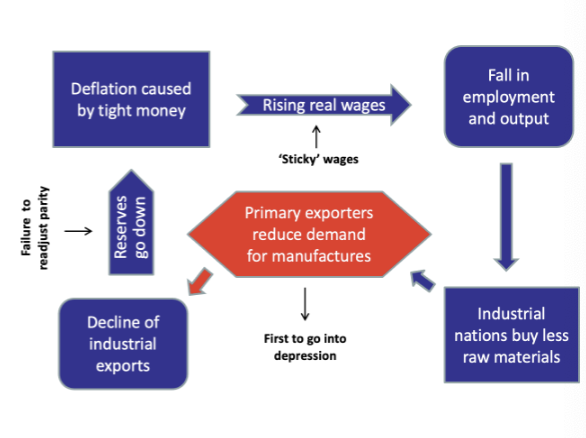
Four patterns of depression around the world
United States
Depression deeper and longer than elsewhere
Domestic banking crisis and industrial depression
Industrial exporters: Germany, Austria, Belgium
Hit by falling demand for manufactures: industrial output down c. 40%
Austria and Germany: banking and currency crises in 1931
Other European countries
Recession more moderate, but still significant
Banks stable in Britain and France; crises in Hungary and Romania
Periphery
Primary exporters hit by the sharp fall in export prices: severe balance-of-payments problems and currency crises
US Banking Crisis (1930 - 1933)
Causes
Burst of stock market bubble of 1929 reduced investor confidence
Real-estate market (2. bubble) collapsed in large cities
Banks most active in mortgage lending failed
Bank of United States (New York), December 1930
Chicago and New York banks, 1931–1932
Consequences
Depositors switched from deposits to cash: the money supply fell
Bank failures raised the cost of credit intermediation (Bernanke, 1983)
Macroeconomic shocks
Falling money stock: a demand shock
Rising cost of credit intermediation: a supply shock
Banking crises in the 1930s occurred only in gold-standard countries (Grossman,1994)
The Monetarist View: the Fed let the money supply collapse
Monetarist theory
Large changes in the money stock have large effects on prices and output
Friedman’s rule: central banks should target a small, constant rate of growth in the money supply
Friedman & Schwartz (1963), A Monetary History of the United States
The Fed broke Friedman’s rule during the Depression: it tightened the money supply when it should have provided liquidity
Evidence: US money supply fell by 30% between 1929 and 1933
Temin’s Critique
The fall in the money stock was a consequence, not a cause
Temin (1976), Did Monetary Forces Cause the Great Depression?
Fall in output → lower demand for money → decline in money stock
Weak banks
Banks failed because they were insolvent (bad loans, especially 1920s mortgages), not because they were illiquid
Providing liquidity to insolvent banks would not have helped
Missing international perspective
Friedman and Schwartz’s analysis is US-centred
International payments played a key role in the global depression
Austria 1931
The collapse of the Creditanstalt brought down the schilling
Background
From 1929 US lending to Europe dried up; the US and France accumulated reserves and refused to help
1929: the Bodencreditanstalt failed and was merged into the Creditanstalt under government pressure
Vienna banks operated as if the Habsburg Empire still existed, with heavy loans to unprofitable industry
Crisis
May 1931: the Creditanstalt, Austria’s largest bank, collapsed after an auditor’s report
Bank run spread to currency: central bank reserves exhausted (people change money for gold), foreign-exchange controls too late
The central bank is broke, panic spreads to Germany
Germany 1931
‘Twin’ crisis (Schnabel, 2004)
Failure of large banks (e.g. Danat Bank) provoked a bank run
Currency crisis and loss of gold reserves
Contagion?
Traditional view: crisis caused by over-extended industrial lending by big banks, like Austria
Recent view (Ferguson and Temin, 2003): Weimar budget problems brought down the currency and with it the banks
Brüning’s statements on reparations (June 1931) dried up foreign loans
The Austrian crisis probably did not “cause” the German one
Government response
Government nationalised several bank (e.g. Commerzbank)
Germany effectively left the gold standard in July–August 1931
Austria, Germany and Hungary introduced foreign-exchange controls and moratoria on foreign loans (“frozen in Germany”) to stop the outflow of gold
Further contagion
Foreign credits frozen in Germany forced other creditors to restrict withdrawals
Severe crises in Hungary, Romania and Switzerland
Britain leaving gold (September 20 1931)
Further contagion
German suspension of gold payments put pressure on the pound; £70 million of British loans frozen in Germany
Insufficient gold reserves spurred a run on the Bank of England; gold convertibility suspended on 20 September 1931
Balance of payments reasons: Britain had 2 deficits
Current account: trade deficit due to pound overvalued at the pre-war parity ($4.86) + liquidation of overseas assets during WW1 (no interest/dividends)
Capital account: long-term lending abroad (e.g. infrastructure investments) financed by short-term borrowing (from foreign central banks)
Mid-1930: reserves of £175 million plus £150 million liquid assets, against £750 million short-term liabilities → £425 million cash missing → panic
Consequence: UK extremely dependent on world trade and growth in the periphery
New macroeconomic policy after gold was abandoned in 1931
Expansion of liquidity through lower interest rates (from 1932)
Introduction of the General Tariff
October 1931: the Fed raised interest rates to defend the dollar
September 1931: panic spread to the US; bank failures rose and the Fed lost gold (internal and external drains)
October 1931: the Fed raised interest rates sharply in the middle of the depression
Not a technical mistake: the standard central-bank response under the gold standard
The Fed chose international stability over domestic prosperity; the Bank of England had chosen the reverse
Result: deflation intensified; the US decline lasted another year and deepened deflation in Europe
Gold Standard Collapse: mid-1932
Before Britain (September 1931): seven countries off gold, including Australia, New Zealand and Argentina
After Britain: 24 more followed rapidly, including Sweden, Denmark, Norway, Finland, the Irish Free State, Greece and Portugal
Exchange controls made gold ineffective in Germany, Austria, Hungary, Bulgaria, Czechoslovakia, Romania, Estonia and Latvia
Mid-1932: still on gold only the US, France, Belgium, the Netherlands, Switzerland, Italy, Poland and Lithuania
Only the US, France, Belgium and the Netherlands kept to its spirit (no exchange controls)
Leaving gold was seen as a failure, but those who left did much better than those who stayed
Gold standard caused and deepened the depression
Deflation was global
Monetary contraction in all countries, not just the US
Key question: Why was monetary policy so similar everywhere?
The gold standard both caused and deepened the depression!
A dysfunctional gold standard promoted worldwide deflation: ‘the primary transmission mechanism of the Great Depression’ (p. 106)
During the depression, monetary and fiscal policy pushed for austerity instead of expanding aggregate demand
Recovery started when first Britain, then the US left the gold standard
Why blame the gold standard when it worked well before 1914?
Before 1914
Gold-exchange system: British sterling was ‘just as good as gold’, so bullion rarely had to be shipped
Trust in sterling was very high worldwide → global trade currency
Central banks held sterling as reserves (instead of gold)
Gold production grew rapidly, mostly from British dominions, supporting a steady increase in the world money supply
Britain had a huge current-account surplus but exported capital, i.e. other countries did not lose gold net
Major central banks cooperated to avoid running out of reserves
In the 1920s
The US had a huge current-account surplus but sterilised (hoarded) it, i.e. other countries lost gold creating deflationary pressure there
Gold reserves accumulated in the US and France, causing a shortage of credit in the world economy: no effective gold-exchange system
Major central banks did not cooperate to relieve gold hunger
Two major problems with Gold Standard
1. Incorrect exchange rates
The US returned to gold (1919) at pre-war rate despite wartime inflation
Insufficient gold cover, so Fed sterilised its current-account surplus
Sterilisation = central bank sells securities equal to gold inflow (e.g. from exports surplus), absorbing liquidity → monetary base unchanged
Other countries returned to gold at parities that were too high (UK) or too low (France), leading to large trade imbalances
2. Misallocation of gold (Bernanke; Eichengreen)
Fed and Banque de France sterilised gold inflows to prevent inflation
The US and France were not penalised for breaking the ‘rules of the game’
High US tariffs (Hawley-Smoot, 1930) pushed other countries into current-account deficits
Deficit countries had only one way to keep their gold parity: deflation
Exiting the trilemma
Fixed exchange-rate systems face a ‘trilemma’
Macroeconomic policy can include only two of these three:
Full capital mobility
Fixed exchange rate
Independent monetary policy
Gold standard (or Eurozone): capital mobility and fixed exchange rates
3 solutions to the trilemma
UK and Sterling Bloc abandoned gold in 1931, US in 1933
Germany and Central Europe: capital controls to prevent gold outflow
France and Gold Bloc: no devaluation, so high tariffs to avoid imports
Countries that devalued more had recovered more by 1935
Across ten European countries, more depreciation against gold by 1935 goes with higher industrial production in 1935
Slope of the fitted line: 10-point fall in exchange-rate index: 7 points more industrial output
Early devaluers (Finland, Denmark, Sweden, the UK, Norway) above 1929 output by 1935
France and Belgium were about 30% below

Positive and Negative Effects of Devaluation
Positive effects of devaluation
Governments could boost aggregate demand
Improved competitiveness
Central banks could act as lender of last resort (i.e. print money)
But British devaluation hurt other countries’ balance of payments; other financial centres protected themselves against it
Restrictions on imports
Increased tariff rates: Hawley-Smoot tariff (US, 1930); Britain abandoned free trade (end of 1931); France, Italy, the Netherlands, Norway, Spain, Portugal, Greece and others followed
Import quotas and exchange restrictions
Gold Bloc countries increased tariffs more than others
Downside: global protectionism prevented the recovery of world trade
1929-1938 countries that left gold in 1931 grew fast than gold bloc
Countries that left gold in 1931 grew 1.9–3.9% a year in 1929–1938
Gold-bloc countries between –0.4% and 1.6%
France (–0.4%) and Belgium (0.0%) had a lost decade
The US had the lowest growth of all countries shown (–0.6%)
Germany, which kept its parity but imposed exchange controls, grew 2.5% a year
Spain: Gold
stayed off gold
Only major European economy with a flexible exchange rate in 1929
Government could boost aggregate demand: deficits monetized by healthy banks
Bank of Spain acted as lender of last resort, lending freely as Bagehot (1873) advised
Portugal and Greece: Gold
mild recessions, no banking crises
Italy and Poland: Gold
Remained on the gold standard until mid-1930s: deflation and falling output similar to other gold countries
Banks exposed to poorly performing loans to industry and agriculture
Banking crises avoided by direct government intervention
Japan: Gold
Restored the gold standard (1930) after substantial deflation
Unable to maintain parity during the depression: left gold in late 1931 and depreciated the yen sharply
Like Spain, avoided the worst of the depression
Argentina: Gold
first country in depression
Went off gold in December 1929
Managed to recover by 1935 and avoided default on foreign debt, unlike almost all of South America (1931)
Africa and Asia: Gold
primary exporters hurt by the sharp fall in agricultural prices
Infant industries could not develop without foreign capital and markets
Colonies (India) could not conduct independent monetary policies
The Failure of International Cooperation: Attempts at international cooperation (1931 - 1933)
A coordinated reflation was needed, but every country had its own agenda
Attempts at a global solution
Hoover moratorium on reparations (July 1931)
BIS Special Advisory Committee (Dec. 1931): adjust all intergovernmental debts
Lausanne Conference on Reparations (June 1932)
World Economic Conference in London (June-July 1933)
Old political obstacles
Reparations
War debts
New political obstacles
Roosevelt
Hitler
Lausanne 1932: the end of reparations
January 1932: German Chancellor Brüning demands complete cancellation of reparations
Britain and Italy support Germany; France isolated
US indifferent to reparations but opposes repudiation of war debts
Elections in France and Germany delay the conference
Lausanne Conference (June 1932) ends reparations
Face-saving deal for France: Germany deposits bonds worth 3 bn marks with BIS, to be issued only if Germany could pay
The bonds were never issued
War debts remain unresolved
Hoover refuses to postpone the December 1932 payment; France and others default
US formally ends inter-Allied war debts only in 1934
London 1933: Roosevelt’s bombshell
June 1933:
British, French, and US central banks secretly agree to keep currencies within +- 3% (stabilize currencies)
3 July 1933: Roosevelt’s message wrecks the conference
Negotiations about re-introduction of Gold Standard, reduction of trade barriers, solution for war debts
Keynes: Roosevelt was “magnificently right”
Feinstein et al.’s verdict
Conference failure is usually blamed on Roosevelt
But conditions for cooperation were absent: each power defended domestic interests and built its own currency and trading bloc
Countries left out (much of Latin America) retreated into protectionism
Countries turning to Protectionism
Devaluation helped the devaluer
Governments could boost aggregate demand
Competitiveness improved
Central Banks could act as “lender of last resort”
But countries that stayed on gold still had to keep the balance of payments in equilibrium
Restrictions on imports
Higher tariffs
Supplemented by import quotas and exchange restrictions
Gold Bloc countries raised tariffs more than others
The Sterling Area: Britain (devaluation, tariffs, and cheap money)
Rebuilding competitiveness
Devaluation (September 1931)
Import Duties Act (General Tariff), February 1932: 10% on all imports except basic foodstuffs, raw materials, and goods already dutiable; most manufactures soon raised to 20%
Preferential trade within the Sterling Bloc
Freed from the strait-jacket of the gold standard
Bank of England could lower interest rates
Cheap borrowing caused a housing boom (1932-35)
Unemployment only eliminated by rearmament after 1937
No systematic anti-cyclical policy
Cheap money —> fuelled a British building boom
British building activity rose steadily after 1932, raching about 55-60% above 1929 by 1935-36
The pattern matches the reading: lower interest rates after leaving gold revived “the construction sector” in Britain
Keynes and the case for demand management
Output and employment depend on aggregate demand
Demand management
moderate the “boom and bust” cycle
Fiscal and monetary policy should be anti-cyclical
Government spending has a multiplier effect
Difficult to implement
Hard to forecast whent he economy turns
Policy lags can make spending pro-cyclical
Hard to make governments save in a boom: risk of overheating
Keynes’ General Theory (1936) gave a theoretical case for the policies that leaving gold made possible
Keynes backed Roosevelt’s choice of domestic reflation over exchange stability
The Sterling Area takes shape (1931-1933)
British devaluation put pressure on countries exporting to the UK and holding reserves in sterling (worth less)
Scandinavian countries left gold with the pound, later pegged to sterling
By January 1932, Japan, Bolivia and Venezuela had moved towards a sterling peg
British imperial policy
Colonies and India were pegged to sterling automatically
Dominions (except Canada) held reserves in sterling
Dominions: white settler colonies with increasing political autonomy
Colonies: no independence, governed by Colonial Office
The Bank of England provided credits to countries pegging to sterling (Finland £500,000; Denmark £250,000, Dec. 1931; standby credits to Australia)
British Commonwealth Declaration (27 July 1933): commitment to raise prices, keep money cheap and keep sterling exchange rates stable → the Sterling Area formalized
Why and how countries pegged to sterling
Why peg?
India and the colonies: compelled by Britain
Australia, New Zealand, South Africa: stay competitive in the British market
Smaller European and Latin American countries: UK was their main market
How was the peg maintained?
If the local currency was too strong: The local “central bank” would print its own currency and use it to buy British pounds on the market.
If the local currency was too weak (trade deficit or capital flight): The local central bank would use its sterling reserves in London to buy back its own currency from the market, propping up its value.
Currency boards (not independent CBs), e.g. in colonies, Egypt, Iraq, held equivalent of home currency in sterling reserves
Rigid peg backed by large sterling reserves: India, Australia, New Zealand, South Africa, Portugal
Target parity without large reserves: Scandinavia
Ottawa 1932: Imperial preference
Commonwealth Conference in Ottawa (1932)
Commonwealth goods given preferential treatment in the UK after the General Tariff
British goods given preferential access in the Commonwealth and sterling area
The deal was asymmetric, disadvantageous for colonies and dominions
Dominions refused to expose their young manufacturing industries
Instead they raised tariffs on non-Commonwealth manufactures
Britain gave preferential access to Commonwealth food and raw materials
Colonies had to accept, not independently represented at the conference
“Buy British”: the Empire as a trading bloc
The red territories show the reach of the bloc: dominions, India and colonies across every continent.
The bloc spanned complementary economies: British manufactures out, food and raw materials in.
Trade within the bloc grew while trade with the rest of the world shrank
UK trade shifted towards the Empire and sterling area
The biggest shift was towards the dominions on both sides: their share of UK imports nearly doubled
Every major economy outside the bloc lost share: gold bloc, exchange- control group, US, Argentina.
Exchange-rate Stability and Cheap money in the Sterling Area
Exchange-rate Stability
A stable sterling rate let members stabilize their currencies and support recovery with cheap money
From late 1933 to 1938, a stable sterling-dollar rate freed much of world trade from exchange-rate volatility
London supplied the sterling reserves members needed
Gold from South African production and Indian dishoarding kept the system convertible, to settle trade deficits with countries outside the sterling-block (ex: US)
Most sterling-area countries recovered faster and absorbed more unemployment than gold-standard countries
India: an overvalued peg and deflation blocked recovery
India was the exception within the Sterling Area
Major primary exporter hit by falling raw-matertial prices
As a British colony, it had to stay pegged to sterling
Falling terms of trade (value of exports go down) called for devaluation against the pound
An overvalued rupee
Rupee fixed in 1927 at 1s 6d, 12% above the pre-war rate
London rejected Colonial Finance Minister Schuster’s proposalt o float the rupee in 1931
Tight money and austerity prevented recovery
Bank rate 7% until July 1932, then 4%
Cuts to public health, education, and irrigation; few public works
Outcome
Per capita GDP fell 6% between 1929 and 1939
Rising discontent: some historians date the start of decolonization to the Depression
Latin America: devaluation and default
Legacies of the Great Depression
Falling prices for primary exports forced early devaluations
Lower export prices meant countries did not receive foreign exchange, but had to pay for imports in foreign exchange —> reserves were exhausted quickly
Devaluations raised the burden of external debt —> forced defaults (most countries by 1934; Argentina the main exception)
US capital exports stopped
Consequences
Devaluation let central banks increase liquidity
Default freed governments to spend more and promote domestic investment
Markets took the defaults “surprisingly lightly”
Argentina stayed tied to Britain (Roca-Runciman Treaty 1933) and recovered slowly
Latin America: import-substituting industrialization
Import-Substituting Industrialization (ISI)
The terms-of-trade shock made a model based on primary exports and manufactured imports unsustainable
High tariffs to protect domestic industry, but preferential tariffs on imported capital goods (machinery, fuel)
Active governments
Import quotas and tariffs in Brazil and Chile; Vargas in Brazil promoted inward-looking growth
Colombia: expansionary fiscal policy
Rapid recovery
Brazil and Colombia regained 1929 GDP by 1932, before exports recovered
Manufacturing grew faster than GDP: Argentina 3% p.a., Colombia 8%
The Gold Bloc: Two ways to stay on gold: exchange controls or deflation
Continental Europe (except Scandinavia) stayed on gold, in two different ways
Nazi Germany and its trading partners: exchange controls to limit capital movements; the mark kept its formal value, but monetary and fiscal policy were freed
France and the Gold Bloc: full capital mobility at pre-Depression parities, maintained through continued deflation and austerity
Gold Bloc countries saw exchange controls as against the spirit of the gold standard → deflation was the only option
The Gold Bloc: a symbolic organization
Origins
Bult on the 19th century Latin Monetary Union (1865), joined by Holland, Poland, Lithuania, and Czechoslovakia
Declared adherence to the gold standard after the World Economic Conference (July 1933); central banks pledged mutual support in Paris on 8 July
A symbolic organization
No further cooperation between central banks banks or governments
A long depression
Gold partities had to be defended by conservative fiscal policy and higher tariffs
France: deflation, deficits, and political instability
Sluggish recovery
Tariffs could not prevent a trade deficit after 1933
Falling prices and demand reduced government revenue
Fear of inflation from rising deficits alarmed voters (memories of the mid-1920s)
Political turmoil
Four governments in 1932, three in 1933, four in 1934
Cutting payments to pensioners, veterans and civil servants – whose real incomes had risen with deflation – was deeply unpopular
The French "new deal" of 1936
The Popular Front brought left-wing parties to power in 1936
Higher public salaries and enforced wage increases in the private sector (Matignon Accords) to boost consumption and end labour unrest
End of deflation, but no devaluation → loss of gold reserves
Tripartite Agreement (1936) ends the Gold Bloc
To stop the gold outflow, France agreed with the UK and US to stabilise currencies at realigned exchange rates
An informal, provisional agreement
No agreement, no understanding, only day-to-day cooperation
Flexible cooperation between treasuries and central banks
Exchange rates
Full gold convertibility restored between signatories
Commitment to refrain from competitive devaluations
End of the Gold Bloc
France devalued the franc against the dollar and sterling (Sept. 1936)
Remaining Gold Bloc members joined the agreement
Comparing Recoveries: Japan, Britain, Germany, US, and France
Japan barely contracted and reached about 170% of 1929 output by 1937
Britain's fall was mild and output was 25% above 1929 by 1937.
Germany and the US fell hardest; Germany recovered above 1929 by 1936, the US was still below in 1937
France fell later and kept falling, the only economy with no recovery.
Ranking mirrors exchange-rate policy: early devaluation (Japan, UK), capital controls (Germany), late devaluation (US), Gold Bloc (France)
Countries off gold in 1931 grew; the Gold Bloc stagnated
1929–38: countries off gold in 1931 grew 1.9–3.9% a year.
The Gold Bloc grew between −0.4% (France) and 1.6% (Italy) a year
Outside these groups: Germany 2.5% and Japan 3.6%, while the US shrank (−0.6%).
Germany: Nazi trading —> Germany left gold in 1931 in all but name
July 1931 banking and currency crisis: banks reopened only after
Foreign deposits were frozen (de facto default)
Foreign-exchange transactions were restricted to the Reichsbank
September 1931, after sterling's devaluation: tighter exchange controls
Owners of gold and foreign currency had to sell them to the Reichsbank
The Reichsbank rationed foreign exchange for importers
Exporters had to surrender foreign-exchange earnings to the Reichsbank
The mark was not devalued: gold parity kept formally, behind controls
Expansionary policy behind the controls (summer 1932)
Reichsbank interest rates cut
Work-creation programmes financed by central government
Output and employment already improving by January 1933
Nazi Recovery: from work creation to rearmament
Hitler came to power in January 1933
Inherited Weimar policies – exchange control, work creation, state intervention in banking, the agricultural programme – and added terror to enforce compliance
Moratorium on all reparations (already suspended)
Fight against unemployment
Public works, e.g. national motorways (Autobahn)
Jews and women forced out of employment
Capital controls and clearing trade (next slides) within the Reichsmark bloc
Clearing: trade between two countries in which no foreign currency changes hands
Four Year Plan (1936)
Rearmament to prepare Germany for a new war
New investment allocated to heavy industry
Financed largely through deficit spending
Result: real GDP per person grew 6.6% a year, 1932–38
The New Plan: autarky and bilateral trade
Hjalmar Schacht: President of the Reichsbank; minister from 1934
National autarky
Import restrictions and export subsidies (from 1935) to offset the overvalued Reichsmark
"Extended economic space": secure supplies of raw materials and food in case of war
Bilateral trade agreements
Private-compensation: German importers and exporters matched deal by deal; paid each other in Reichsmarks, so no foreign exchange used
Bilateral exchange clearing (next slide)
By 1936, clearing agreements with most of central and south-eastern Europe: Hungary, Estonia, Latvia, Bulgaria, Greece, Yugoslavia, Romania, Czechoslovakia, Turkey
How bilateral exchange clearing worked
Importers paid their own central bank in domestic currency; the central bank used those funds to pay domestic exporters. No foreign exchange changed hands for each transaction.
Only the net balance needed settling – here Germany owes Italy 20 m $ – so scarce gold and hard currency were economised.
If a clearing account ran short, exporters waited until imports rose (and vice versa): trade was pushed towards bilateral balance.
The system let Germany keep an overvalued mark and still trade, at the cost of multilateral trade.

Reichsmark bloc: half of German trade was bilateral by 1938
By 1938, half of German foreign trade ran through bilateral agreements
Geographic shift
towards southern and eastern Europe, away from Britain and the gold bloc
Towards Latin America, away from the US
Reichsmark bloc
Exporting to Germany was profitable for the European periphery: Germany paid 20-40% above world prices for farm goods
Strategic motive for Germany: a reliable source of essential imports in wartime
Causes: lack of foreign exchange, and high tariffs in the US and France
Germany had no empire: other powers (UK, France, Netherlands, Belgium, Japan, Italy) traded more within theirs, so Germany built a currency bloc instead
German trade shifted to southeastern Europe and Latin America
Southern and eastern Europe roughly doubled its share:
imports 9.8% → 18.7%, exports 11.2% → 20.8%.Latin America also gained (imports 12.1% → 16.8%; exports 7.8% → 12.1%), as did Scandinavia.
The gold bloc and Czechoslovakia lost most (exports 35.2% → 26.0%)
The US share of German exports fell from 7.4% to 2.8%
Italy: in the gold bloc, but recovering like Germany
1931: sterling floated → the lira became overvalued against sterling
Mussolini tried to deflate: wages and salaries cut by decree (as in 1927)
Less successful this time: real wages stable 1929–32, then rising
Capital controls
From 1932, to stem the outflow of gold reserves
July 1935, during the Abyssinian (Ethiopia) campaign: gold exports prohibited
Clearing agreements
After tensions in 1934–35, trade reoriented towards Germany – became Italy's largest market after League of Nations sanctions over Abyssinia
Clearing agreements also with Argentina and Britain
The lira stayed on gold only formally – through exchange controls, tariffs, quotas and clearings
From 1935, recovery driven by war spending; sanctions → autarky (import substitution) programme
Japan: early exit from gold, recovery through military spending
Depression mild and short-lived: Japan rejoined gold only in January 1930 (at the pre-war parity) and left again in January 1932
Expansionary impulses
Yen depreciation 60% in 1932
Cheap yen boosted exports and protected against imports
Militarist Industrialization
Manchuria occupied 1931-32; empire already included Korea and Taiwan; new campaign in China from 1937
Empire = inner circle of a yen trade area: industrial core, primary-producing periphery
Industry driven by military demand
Dual economy: fast-growing heavy industry and mining (the zaibatsu) alongside low-wage consumer industry and peasant agriculture
Japan’s empire expanded with its yen trade area
Before 1931 empire already sizeable: Taiwan (1895), Korea (1905/1910), Karafuto and Port Arthur (1905)
1931–36: Manchuria (1931) and Jehol (1933) – the core of the yen bloc.
1937–39: war with China brought Peiping, Shanghai, Nanking (1937), Wuhan and Canton (1938) and Hainan (1939) under Japanese control.
1940–41: move into French Indochina
Territorial expansion and the trade area grew together.
United States: The New Deal: banks, money, farms, and industry
March 1933: bank runs – partly because Roosevelt would not commit to gold – met with a national "bank holiday” used to reshape macroeconomic policy
Monetary and financial policy
Gold standard abandoned in April 1933; Fed allowed money stock to grow with gold inflows
Glass–Steagall Act: separation of commercial and investment banking
Federal Deposit Insurance against bank runs
Agricultural Adjustment Act (AAA)
Production restricted by government to raise farm prices
Goal: "parity" – farm purchasing power of 1914
National Industrial Recovery Act (NIRA)
Firms encouraged to raise wages and spread work by shortening the working week
In exchange, they could raise prices
But US recovery remained incomplete until WW2 began
US employment in 1930s
Unemployment rose from about 3% in 1929 to over 20% in 1933 – far above any other peak in 120 years.
It stayed above roughly 14% throughout the 1930s, even during recovery.
It fell below 5% only with wartime mobilization (1942–45).
Pre-1940 figures are estimates, not survey data – treat the exact levels with caution.
A quarter of US workers were jobless in 1933
1937: 14% then rose again in 1937-1938 recession
1941: Unemployment 10% in 1941 when US entered the war
US Policy Timeline
Wisconsin’s unemployment insurance (1932)
Roosevelt sworn in (March 1933)
Works Progress Administration and Social Security Act (1935)
Soviet Union
Fastest- growing economy in the world (1929-1938)
Forced industrialization
Over the long run (1913 - 50), Soviet growth (1.1%) was unremarkable; the 1930s stand out
Soviet income per head rose by half in 1929-1938 and the gap with western Europe narrowed
War, revolution, and civil war cut GDP per head by almost 2/3 (1913-1921)
By 1929, it had only regained the pre-war level
Socialism in Russia (1917-1928)
February 1917: bourgeois revolution
Constitutional monarchy with parliamentary rule
Provisional Government during the war
Radical parties increasingly powerful
October 1917: Bolshevik coup d'état
1918–21: Russian Civil War
1922: Soviet Union (USSR) established
Formally a federation of "independent" republics
In reality a single-party state: dictatorship of the Bolshevik Party (especially the Politburo)
1924–28: after Lenin's death, Stalin consolidated power
Stalinist Growth Strategy
Socialism in one country: development in near-isolation from the world economy, relying on Russia’s farm and natural-resource wealth
First Five-Year Plan (1929)
Aimed to more than double industrial output by 1932
Collectivisation
Industrialization financed from the expropriated farm surplus
Peasants forced into collective farms so the state could control that surplus
Investment Planning
Consumption cut to raise the investment rate
Priority for producer goods (heavy industry)
Output maximization
Modest plan targets in agriculture and light industry
Ambitious targets in heavy industry, especially machinery
Collectivisation: productivity collapse famine
1928 - 1933: peasants forced into collective farms
Aim: optimal farm size for mechanized production + release labor for urban industry
Why collectivize? Peasants would not sell grain because there was little to buy with their earnings
Results disappointingly poor
Too little investment in agriculture for rapid mechanization
Wealthier peasants (kulaks) resisted by slaughtering livestock and horses
Chain of effects:
Capital per worker in agriculture falls → productivity collapses after 1930 → mass famine in Ukraine and southern Russia → more farm animals killed
Terror: the first developmental dictatorship
Stalinism was the first developmental dictatorship
Police state
State monitored all economic agents
Sabotage of production was a criminal offence
Anyone "opposed" to super-industrialisation was liquidated
Forced labour
Farm labourers forced into collective farms, or resettled to new industrial cities in new occupations
Millions who refused were deported to labour camps
Human cost
Total deaths from Stalin's terror (including famine): about 10 million
Economic growth "the only idol, to which everything else had to be sacrificed" (FTT, p. 158)
Soviet Union: Militarization of the Economy
Soviet arms output rose fifteen-fold in 1928-1940
Defense spending: 1% of GNP (1928) —> 18% (1940)
War industries’ share of total investment: 3% —> 30%
The USSR became the world’s largest munitions producer
Tanks x16; Artillery x16; Combat aircraft x4
Part of the 1930s growth was military output - similar to Germany and Japan