Biology A- Level #7: Transport In Plants
 Call Kai
 Learn
 Practice Test
 Spaced Repetition
 Match
 Flashcards
 Knowt Play
1/18

There's no tags or description
Looks like no tags are added yet.
19 Terms
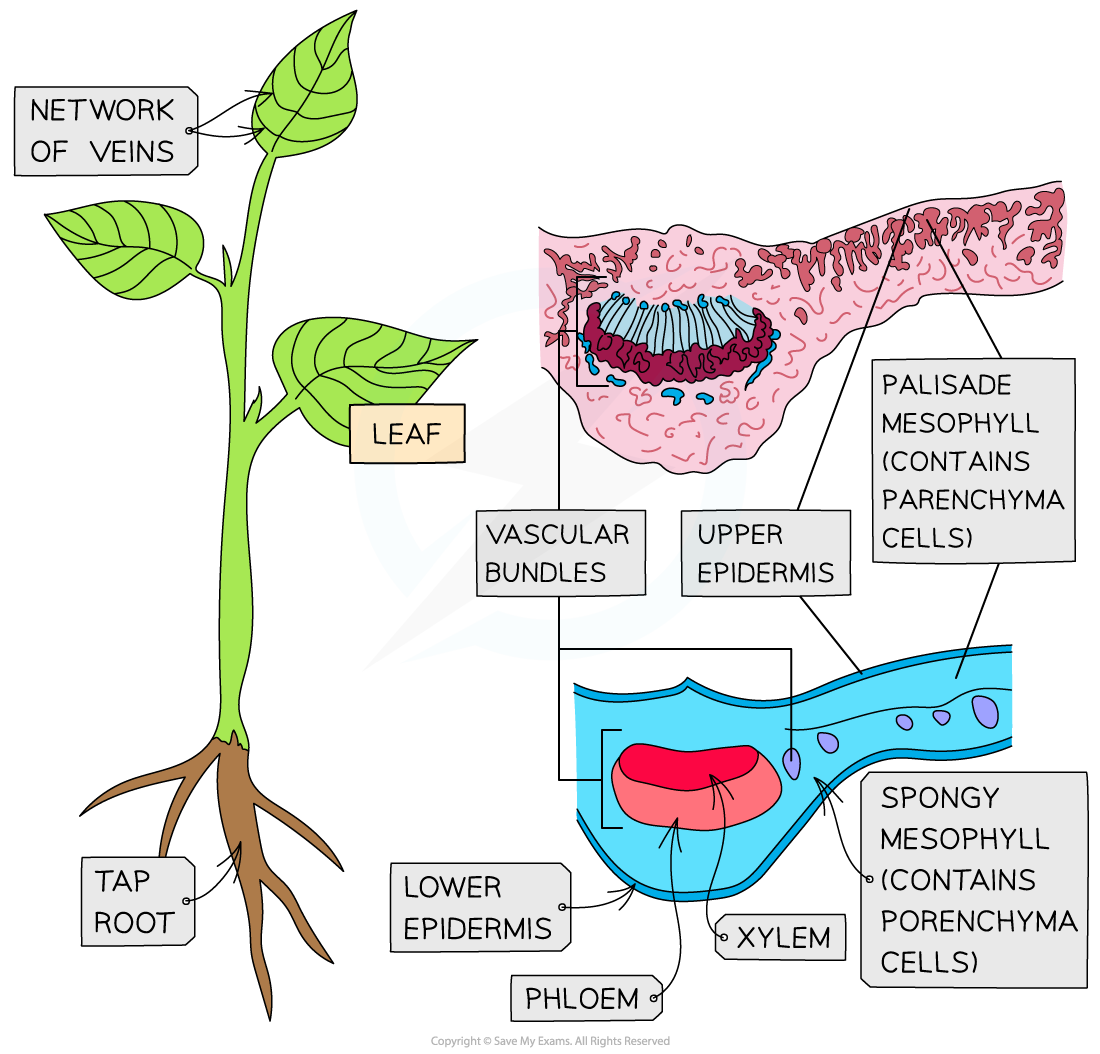
Draw a plant diagram of transverse sections of a leaf?
Leaf x
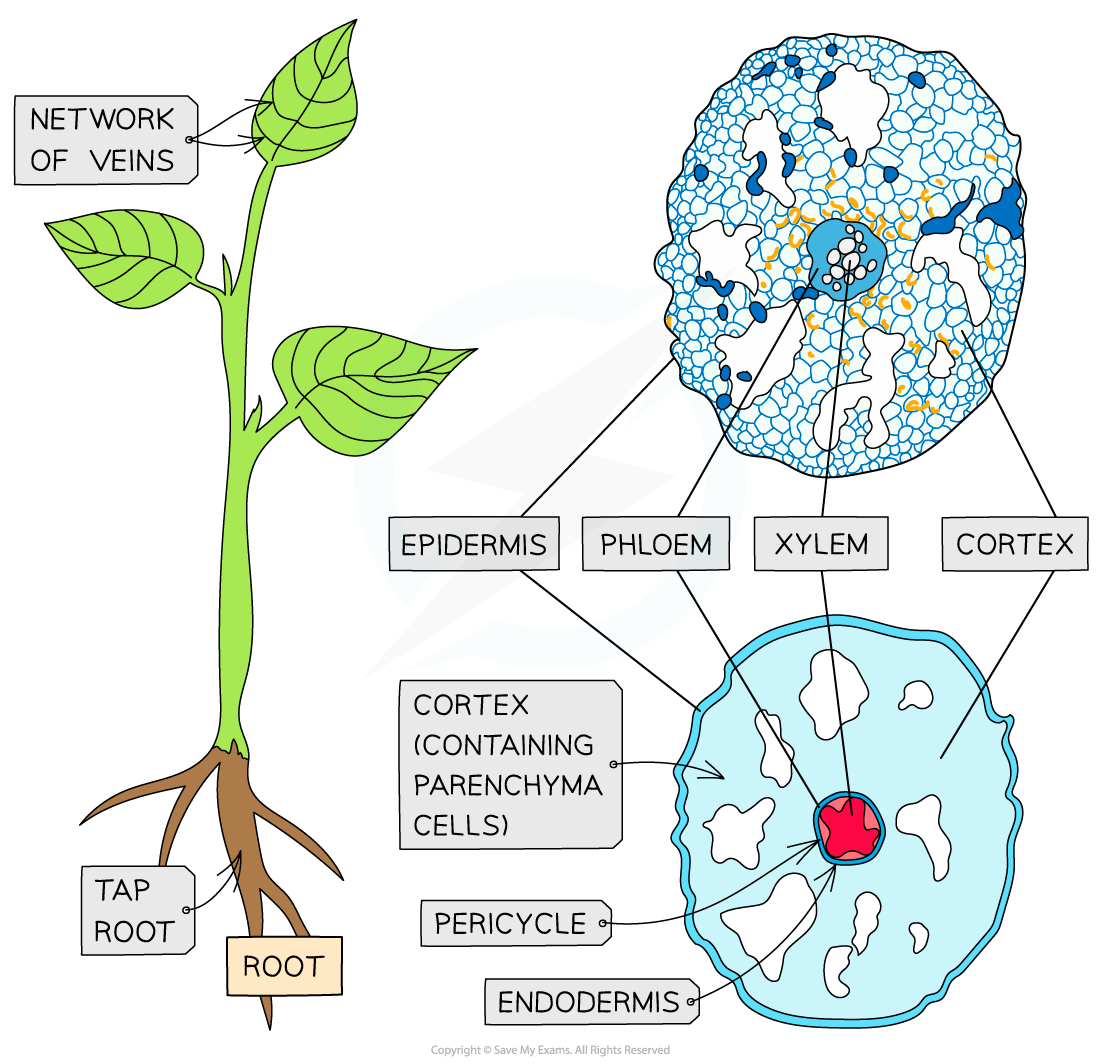
Draw a plant diagram of transverse sections of a root?
Root x
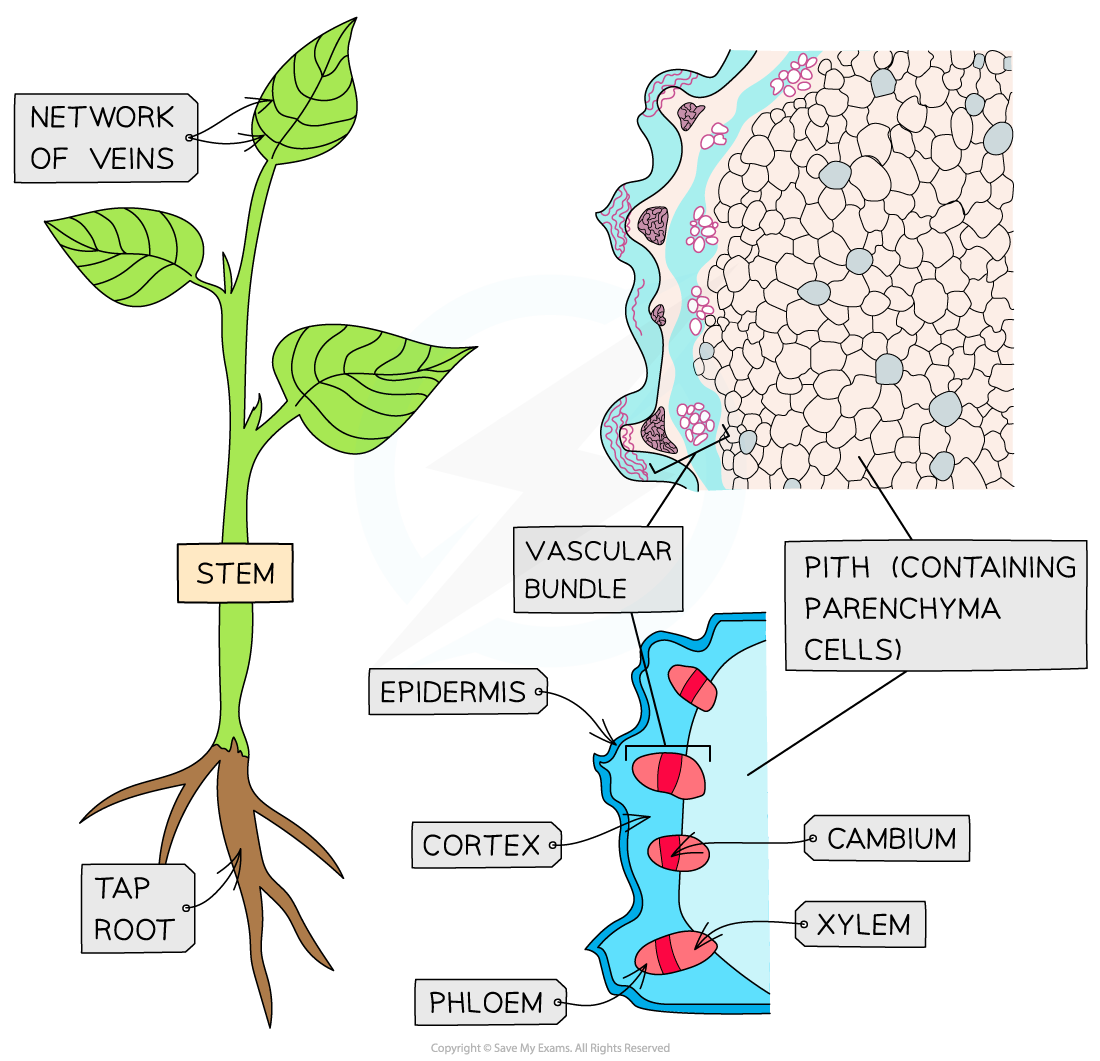
Draw a plant diagram of transverse sections of a stem?
Stem x
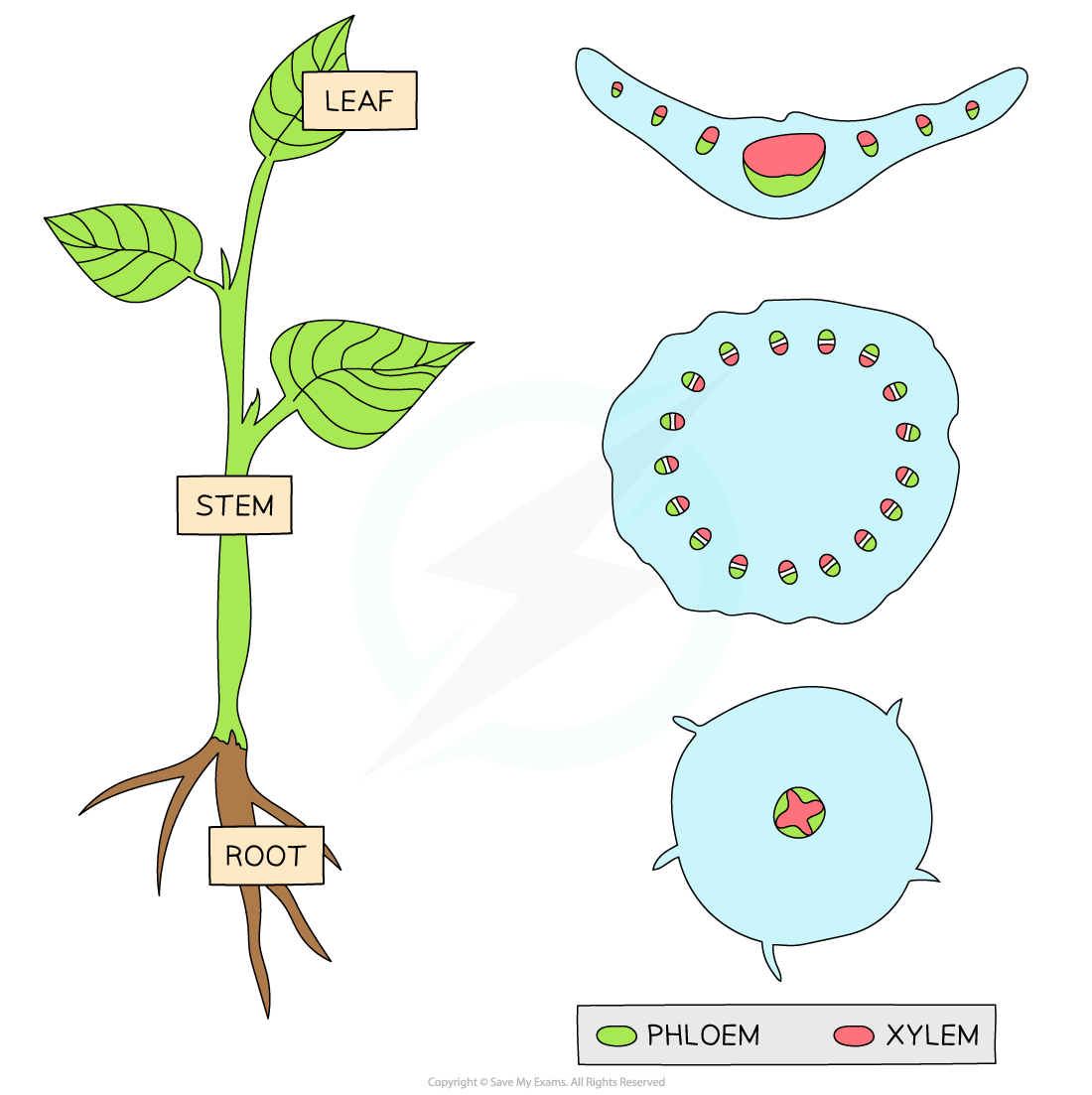
What is the distribution of xylem and phloem in tranverse sections of roots, stems, and leaves?
Roots: Vascular tissue is located in the center of the root. Xylem forms a central, star-shaped core, with phloem located between the arms of the xylem.
Stems: Vascular bundles are arranged in a ring around the outside of the stem. Xylem is found on the inside of each bundle, while phloem is on the outside, closest to the epidermis.
Leaves: Vascular bundles form the midrib and a branching network of veins. Xylem is found on the upper side of each bundle, while phloem is on the lower side, closest to the lower epidermis.

Draw and label xylem vessel elements?
What to recognize:
Long, hollow tubes formed from dead cells joined end to end.
Thick, lignified walls.
No nucleus or cytoplasm.
Pits in the walls.
No end walls between mature vessel elements.
Labels to learn:
Lignified cell wall
Lumen (hollow interior)
Pits
End wall (if visible in an immature vessel element)
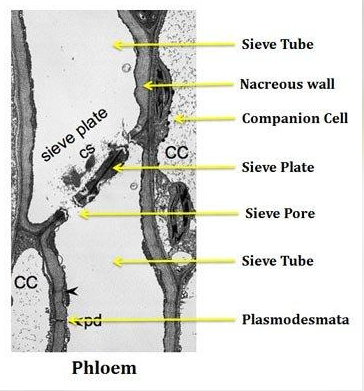
Draw and label phloem sieve tube.
What to recognize:
Elongated living cells arranged end to end.
Sieve plates between adjacent sieve tube elements.
Pores in the sieve plates.
Very little cytoplasm.
No nucleus in mature sieve tube elements.
Labels to learn:
Sieve tube element
Sieve plate
Sieve plate pores
Cell wall
Cytoplasm

Draw and label companion cells.
A small, elongated cell located alongside a sieve tube element.
Contains a nucleus.
Contains dense cytoplasm.
Has numerous mitochondria.
Connected to sieve tube elements through plasmodesmata.
Labels to learn:
Nucleus
Mitochondria
Cytoplasm
Cell wall
Plasmodesmata
Sieve tube element (adjacent cell)
How does the structure of xylem vessel elements relate to its function?
Its lignified cell walls add strength to withstand hydrostatic pressure so vessels do not collapse. Its impermeable to water.
It has no end plates allowing for mass flow of water and dissolved solutes as cohesive (between water molecules) and adhesive (between water molecules and xylem wall) forces are not impeded.
No protoplasm (cells are dead when mature) as to not impede the mass flow of water and dissolved solutes.
The pits in walls (in non-lignified sections) creates lateral movement of water, allowing for continuous flow in case of air bubbles forming in the vessel.
The small diameter of vessels helps prevent the water column from breaking.
How does the structure of phloem sieve tube relate to its function?
The sieve plates with sieve pores allows for continuous movement of organic substances.
The cellulose cell wall strengthens the wall to withstand the hydrostatic pressures that move assimilates.
No nucleus, ribosomes or vacuole in mature cells maximizes space for movement of assimilates.
It has a thin cytoplasm to reduce friction to facilitate movement of assimilates.
How does the structure of companion cells relate to its function?
It has a nucleus and other organelles present to provides metabolic support to sieve tube elements and helps with loading and unloading of assimilates.
They transport proteins in plasma membranes to move assimilates into and out of sieve tube elements.
They have large numbers of mitochondria to provide ATP for the active transport of assimilates.
They have plasmodesmata (channels in the cell wall) to make a link to sieve tube elements, allowing organic compounds to move from the companion cells into the sieve tube elements.
Some ome mineral ions and organic compounds can be transported within plants…
Dissolved in water.
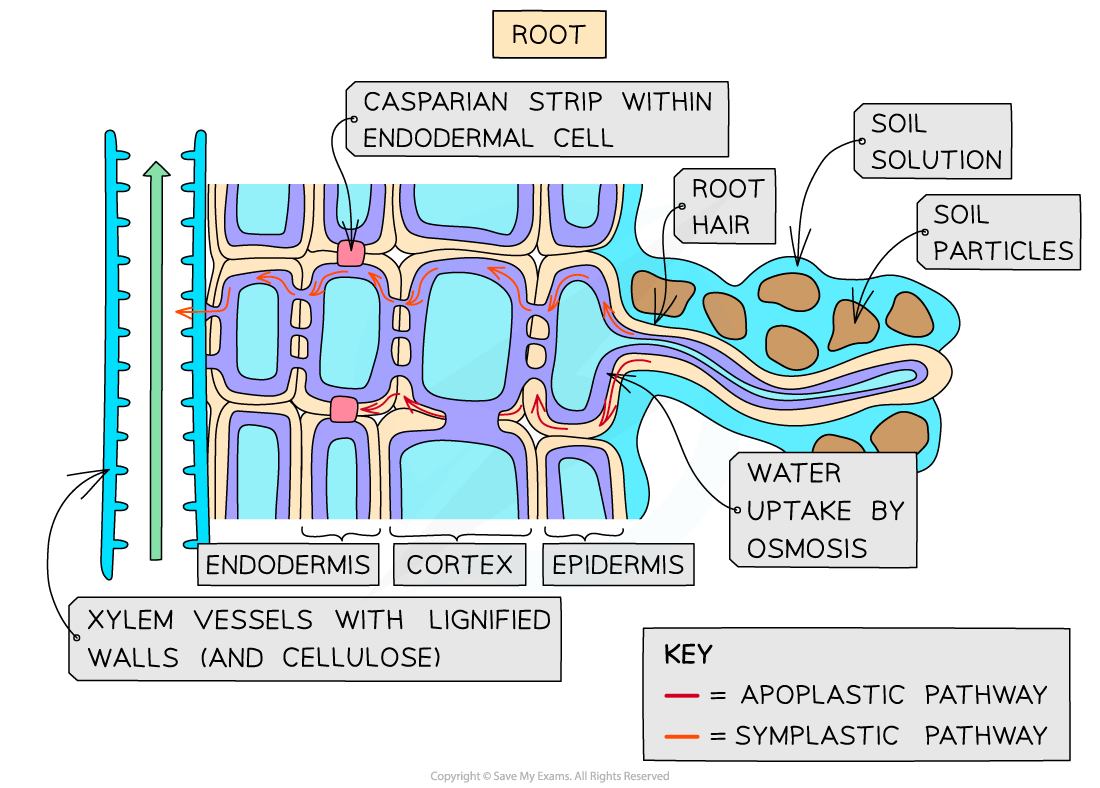
How does water move from the soil to the xylem through the apoplast pathway?
Most water moves by diffusion through the spaces in cellulose cell walls, which form continuous channels between cells, without crossing partially permeable membranes. At the endodermis, the waterproof Casparian strip, containing suberin, blocks this pathway and forces water and dissolved mineral ions into the symplast pathway. Lignin in the xylem vessel walls waterproofs and strengthens them, preventing water from leaking out.

How does water move from the soil to the xylem through the symplast pathway?
Water moves by osmosis across partially permeable cell membranes into the cytoplasm and vacuoles, then by diffusion through plasmodesmata connecting adjacent cells, before entering the xylem.
What is transpiration?
Transpiration is the loss of water vapour from the leaves, mainly through the stomata, by diffusion. Water evaporates from the moist internal surfaces of the mesophyll cell walls into the air spaces within the leaf, lowering the water potential and creating a water potential gradient between the leaf and the atmosphere. Water vapour then diffuses out through the stomata, from a higher to a lower water potential. This evaporation creates a transpiration pull, which draws water from the xylem through the mesophyll cells and up the xylem vessels to replace the water lost. Cohesion between water molecules and adhesion between water molecules and the xylem walls help maintain a continuous column of water.
What is the role of hydrogen bonding of water molecules with movement of water in the xylem by cohesion-tension in transpiration pull and by adhesion to cellulose in cell walls?
The movement of water through the xylem occurs by the cohesion-tension mechanism. Water molecules form hydrogen bonds with each other, creating cohesion, which maintains a continuous column of water with high tensile strength. Water molecules also form hydrogen bonds with cellulose in the xylem cell walls, creating adhesion, which prevents the water column from pulling away from the walls. The lignified xylem walls prevent the vessels from collapsing under tension. Evaporation of water from the mesophyll cell walls during transpiration creates tension (negative pressure) in the xylem, creating a water potential gradient, pulling water upwards from the roots to the leaves. This movement is called the transpiration stream.
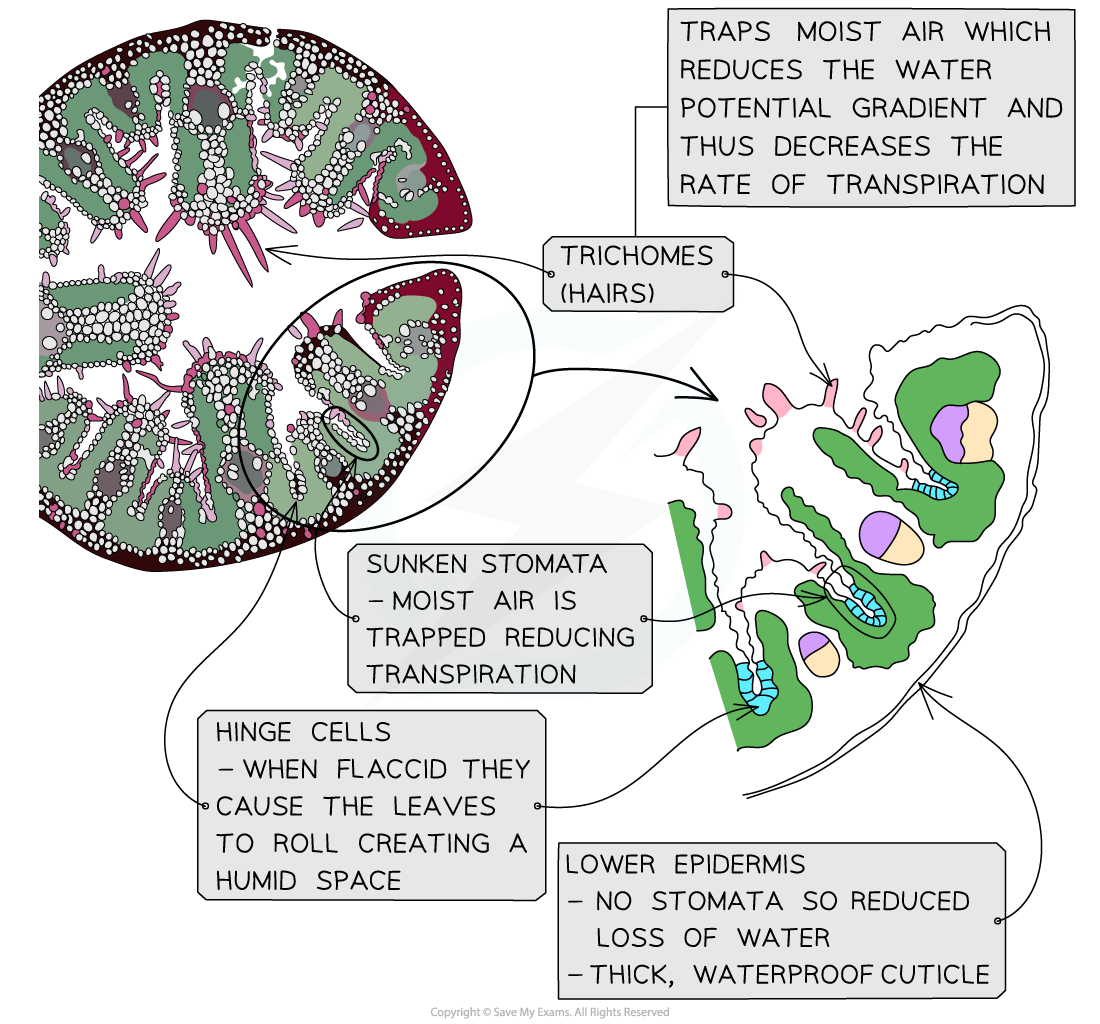
How have xerophytic plants adapted to reduce water loss by transpiration?
They have fleshy succulent leaves to store water for times of low availability.
The "hinge cells" shrink when flaccid causing leaves to roll, exposing thick cuticles to the air and creating a humid space in the middle of the rolled leaf.
Their leaves are reduced to scales, spines, needles or are curled, rolled or folded when flaccid causing reduced transpiration due to reduced surface area exposed.
Their stomata closes during daylight and opens during night to minimize daytime water loss and carbon dioxide is fixed at night.
They have a sunken stomata and their leaf surface is covered in fine hairs, causing minimized water loss as moist air is trapped and diffusion gradient reduced.
They have a reduced number of stomata causing less water loss as they are fewer pores.
They have thick waxy cuticles causing reduced water loss via cuticle distance.
Assimilates dissolved in water, such as…?
sucrose and amino acids, move from sources to sinks in phloem sieve tubes
How does companion cells transfer assimilates to phloem sieve tubes?
Assimilates, such as sucrose, are actively loaded into the phloem sieve tubes by companion cells. Proton pumps in the companion cell surface membrane use ATP to actively transport hydrogen ions (H⁺) out of the companion cells into the cell walls, creating a high concentration of hydrogen ions outside the cells. Hydrogen ions then diffuse back into the companion cells down their concentration gradient through cotransporter proteins, which simultaneously transport sucrose into the companion cells against its concentration gradient. Sucrose then moves into the sieve tube elements through plasmodesmata. Companion cells contain numerous mitochondria to provide ATP for the proton pumps and have membrane infoldings to increase surface area for transport.