Parisitc gut disease II: porcine and poultry
 Call Kai
 Learn
 Practice Test
 Spaced Repetition
 Match
 Flashcards
 Knowt Play
1/24

There's no tags or description
Looks like no tags are added yet.
25 Terms
important gut helminths of pigs
STOMACH
• Hyostrongylus rubidus
SMALL INTESTINE
• Ascaris suum
• Strongyloides ransomi
• Trichinella spiralis
LARGE INTESTINE
• Trichuris suis
• Oesophagostamum spp.

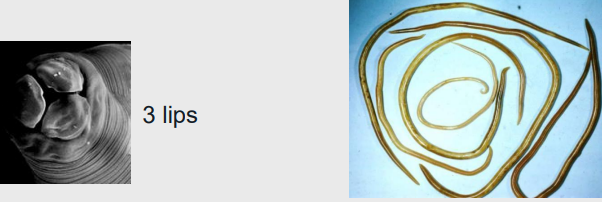
ascaris suum - giant roundworm
ADULTS
• Creamy-white roundworms
• Males up to 25 cm long; females up to 40 cm long
• Live several months
ascaris lifecycle
EGGS:
• Resistant to low temperatures, desiccation & strong chemicals
• Survive for up to 10 years in soil
• Female worm can produce ~200,000 eggs/day
• Earthworms and dung beetles can ingest eggs → L3 larvae, infective to pigs


trichuris suis - whipworm
• Adults 30-50 mm long
• Whip-like appearance – thin head & fat bottom
• Adults live several months
• Female lays 2,000 – 10,000 eggs per day
• PPP ~ 3 months
• Eggs can survive for long periods in soil
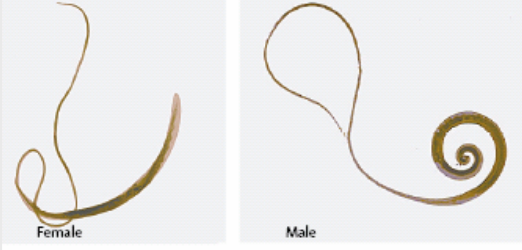
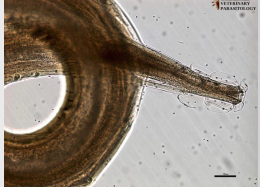
hyostrongylus rubidus and oesophagostamum spp
Hyostrongylus rubidus
(red stomach worm)
• Thin reddish worms
• 5-10 mm long
• Stomach
Oesophagostamum spp.
(nodular worm)
• White worms
• 8-14 mm long
• Large intestine

epidemiology I
For all species – infections from eggs contaminating the environment
Ascaris
• Sows & boars – reservoirs of light infection
• Highest infection at 3-6 months, partial immunity from 4 months
• Seasonality – greatest incidence in summer
Trichuris
• Most heavy infection at 2-4 months of age

epidemiology II
Oesophagostamum spp. & Hyostrongylus rubidus
• Infection more prevalent in older pigs (O) & breeding stock e.g. gilts,
sows (Hr)
• Survival of L3 larvae on pasture over autumn & winter (O)
• Hypobiotic L4 in host over autumn & winter
• Free-living larvae sensitive to desiccation & low temperatures (Hr)
clinical consequences of infection
Ascaris suum
• Production losses – depressed weight gain & feed conversion rates
• Occasionally intestinal obstruction
• Pulmonary phase – transient pneumonia
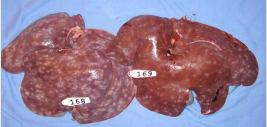
• Migrating larvae cause “milk spot” lesions in liver, fade after 6 weeks
Trichuris suis
• Occasionally disease due to heavy infections
• Inflammation of caecal mucosa → watery diarrhoea, with blood and mucus
Both generally asymptomatic - can be associated with “thin sow” syndrome
Hyostrongylus rubidus
• Heavy infections → inappetence, vomiting, anaemia, loss of condition &
bodyweight, +/- diarrhoea
• Pathogenesis similar to Ostertagia
Oesophagostamum spp.
• Occasional diarrhoea, depressed weight gain & feed conversion
• Pregnant sows – inappetence, become very thin, milk production reduced

importance of pig helminth infections
Estimates of effects of gut helminths on pig production:
• Sow endoparasites: ↑ required feed by 10%
• Ascaris: growth rates slow by ≤50 gm/day between weaning &
slaughter. Parasites ↓ lean meat % in carcass & liver condemnation
• Trichuris: Heavy infections slows growth by 15% between 30 kg & sale
weight
In developing countries helminths among most important pathogens of
pigs after ASF [ILRI]

diagnosis
• Clinical signs
• Production history
• Faecal egg counts
• Postmortem
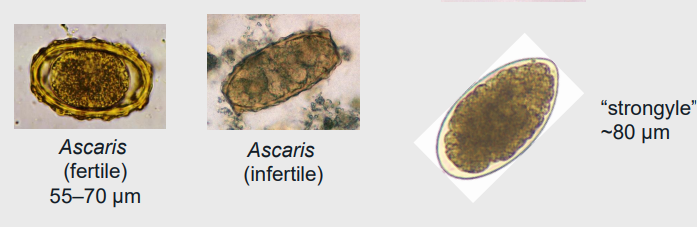
ascaris and trichuris in humans
• Ascaris lumbricoides ~445 million people infected
• Trichuris trichiura ~360 million people infected
• Known as “soil-transmitted helminths”
• School children particularly at risk
• Control in humans based on regular deworming
• Zoonotic transmission of A. suum and T. suis – soil, fruit and vegetables contaminated with pig faeces

treatment of helminths in pigs
Two classes of products licensed in UK
• Avermectins – ivermectin, doramectin
• Benzimidazoles – flubendazole, fenbendazole

monitoring of helminths in pigs
• Herd monitoring using faecal eggs counts can be useful – some limitations:
o Disease can be seen before patent infection in growing animals
o Intermittent shedding of eggs by Ascaris
• Abattoir surveillance for milk spots – classify based on number of affected livers & number of lesions on each liver
control of pig helminths
• Hygiene extremely important
• Intensive production with slatted floors
• Less intensification, straw-based systems & outdoor production → more worms
“All-in, all-out”
• Ensure that site is properly cleaned, disinfected & dried
Outdoor/non-concrete floors
• Regular strategic deworming – NB withdrawal periods
• Movement of pigs to clean ground e.g. 2-3 year rotation around arable paddocks
Backyard pigs
• Routine deworming if kept on same ground

helminths of poultry
• Nematode & cestodes
• Nematodes most significant economic impact – weight gain & egg production
• Birds in free-range and organic systems at risk
• Stress can lead to increased infection/disease
• Vectors for other infections e.g. Histomonas meleagridis & Salmonella enterica serovar Typhimurium

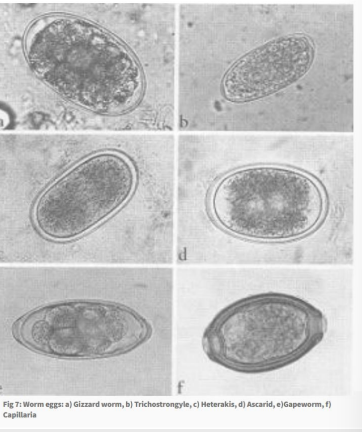
ascaridia galli
• By far the most common poultry worm
• Nematodes
• Hosts include chicken, turkey, goose, guinea fowl
• Eggs take three weeks to become infective
• Hatch in proventriculus, larvae in duodenal lumen for 9 days
• Penetrate mucosa, causing haemorrhages
• Return to SI lumen by 17–18 days
• Larvae reach maturity at 28 –30 days
• Worms mate and females pass out eggs in faeces

epidemiology and clinical effects
• Effects in young birds (1-2 months), adult birds carriers
• Reservoir of infection: eggs on ground, can survive several months
• Not highly pathogenic
• Larvae can cause enteritis, intestinal occlusion if lots of adults
• Heavy infections → anaemia, intermittent diarrhoea, anorexia, become unthrifty & emaciated, decrease in egg production
heterakis gallinarum
• Whitish worms, ~1.5 cm long
• Generally non-pathogenic
• Heavy infections → thickening, inflammation, or nodulation in caecal walls
• May carry Histomonas meleagridis
• Larvae develop to adults in caeca, do not invade
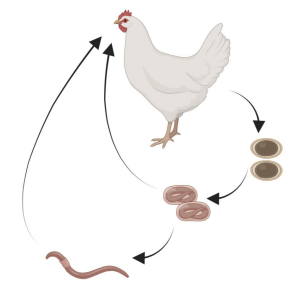
• Eggs take 2 weeks to become infective, can survive up to 1 year in soil
• Earthworms may ingest eggs and be a source of infection
capillaria spp
• Tiny, threadlike worms
• Adults live in the intestine
• Take 20-26 days to mature in host
• Larval development in the egg takes 8-15 days
• Direct lifecycle or via paratenic/intermediate host (e.g. earthworm)
• C. contorta in mucosae of crop and oesophagus, C. obsignata in small intestine
• Can cause thickening and inflammation of organs
• Large numbers of worms can lead to weakness, emaciation and death

poultry cestodes
• Infection through ingestion of intermediate host
• Adult worm in small intestine
• Low-moderate infections – reduction in growth rate & decreased egg production
Davainea proglottina – minute tapeworm, 3-4 mm long
• Intermediate hosts – gastropod molluscs
• Heavy infections – emaciation, dyspnoea, haemorrhagic enteritis, may be fatal in young birds
• Birds can harbour 1000s of parasites

raillietina spp
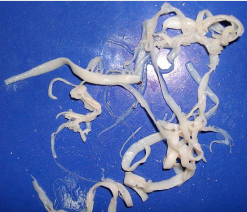
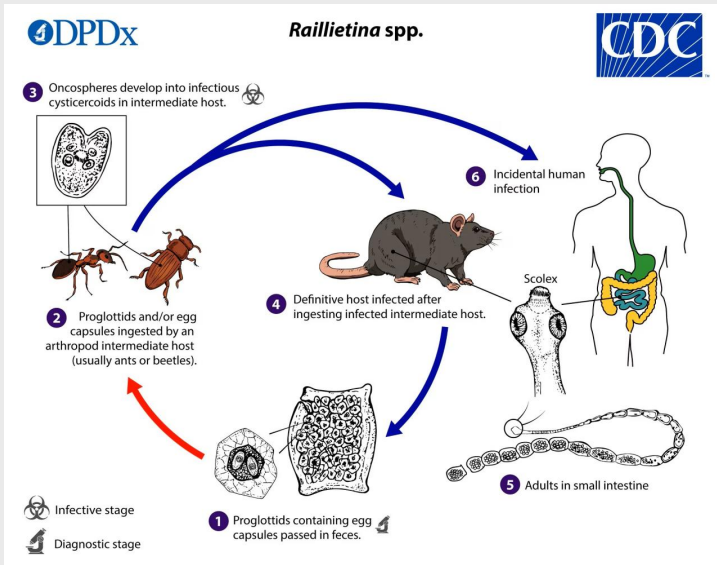
• Up to 25 cm long (depending on species)
• Intermediate hosts – beetles, ants, flies, slugs & snails
• Heavy infections – emaciation & weakness
• May be large caseous nodules at the attachment sites
poultry helminth epidemiology
• Birds kept under back-yard, free-range and organic systems more at risk
• Increasing prevalence in Europe over time – linked to ban on battery cages
and shift to free-range and organic production
• Systematic review of published papers from across the world (Shifaw et al.,
2021):

poultry helminths in the uk

diagnosis
• Eggs in faeces (nematodes)
• Post-mortem examination to look for larvae & worms – often necessary to take mucosal scrapings

treatment and control
Treatment
• Flubendazole is the only licensed product in the UK
Control
• Improvements in hygiene in indoor production –
cleaning, fresh litter & bedding
• Move to new pasture if possible
• Use of anthelmintics – NB resistance reported in
Ascaridia dissimilis, Asc. galli & Heterakis gallinarum
• Avoid areas with wild pheasants
