Bio - Module 2
0.0(0)
Studied by 8 people Call Kai
 Learn
 Practice Test
 Spaced Repetition
 Match
 Flashcards
 Knowt Play
Card Sorting
1/63

Earn XP
Description and Tags
64 Terms
1
New cards
ecology
The study of how organisms interact with the biotic and abiotic environment
2
New cards
1st law of thermodynamics
Energy cannot be created or destroyed
3
New cards
2nd law of thermodynamics
when energy is transformed from one for to another some energy is lost as heat or entropy
4
New cards
Ecosystem
A biological community of interacting organisms and their physical environment.
5
New cards
Photosynthesis
Conversion of light energy from the sun into chemical energy.
6
New cards
producer
An organism that makes its own food
7
New cards
Consumer
An organism that obtains energy by feeding on other organisms
8
New cards
Autroph
organism that is able to capture energy from sunlight or chemicals and use it to produce its own food from inorganic compounds; also called a producer
9
New cards
Heterotroph
organism that obtains energy from the foods it consumes; also called a consumer
10
New cards
tertiary level
highest level on the energy pyramid ex: hawk
11
New cards
secondary level
second highest level on the energy pyramid with only one level above ex: snake
12
New cards
primary level
3rd highest level on the energy pyramid or 2nd from the bottom, multiple predators ex: rats
13
New cards
producer level
bottom on the energy pyramid, has the most energy ex: grasses
14
New cards
food chain
A series of steps in which organisms transfer energy by eating and being eaten
15
New cards
food web
A community of organisms where there are several interrelated food chains
16
New cards
food chain vs food web
all chains, complex vs. 1 system/relationship
17
New cards
detritivores
Organisms that eat dead organic matter
18
New cards
Gross Primary Productivity (GPP)
The total amount of solar energy that producers in an ecosystem capture via photosynthesis over a given amount of time
19
New cards
Net Primary Productivity (NPP)
The energy captured by producers in an ecosystem minus the energy producers respire
20
New cards
trophic levels
The hierarchical levels of the food chain through which energy flows from primary producers to primary consumers, secondary consumers and so on.
21
New cards
biogeochemical
process in which elements, chemical compounds, and other forms of matter are passed from one organism to another and from one part of the biosphere to another
22
New cards
biogeochemical cycle
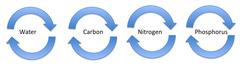
23
New cards
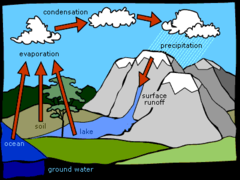
Water Cycle (Hydrologic Cycle)
The continuous movement of water on, above, and below the surface of the Earth.
24
New cards
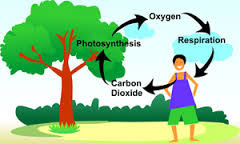
carbon cycle
The organic circulation of carbon from the atmosphere into organisms and back again
25
New cards
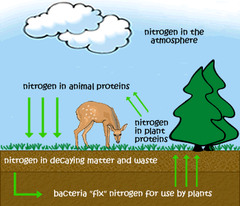
nitrogen cycle
The transfer of nitrogen from the atmosphere to the soil, to living organisms, and back to the atmosphere
26
New cards
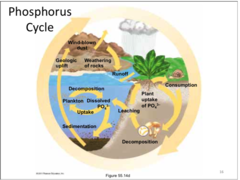
phosphorus cycle
The movement of phosphorus atoms from rocks through the biosphere and hydrosphere and back to rocks.
27
New cards
Biome
A group of ecosystems that share similar climates and typical organisms
28
New cards
Population
A group of individuals that belong to the same species and live in the same area
29
New cards
population ecologists
focus on how the numbers of individuals in a population change over time
30
New cards
per capita growth rate (r)
the number of individuals added during some interval divided by the initial population size
31
New cards
r=0
no change
32
New cards
r>0
positive change
33
New cards
r<0
negative change
34
New cards
exponential growth equation
G=rN
35
New cards
per capita growth rate
r=(B-D)/N
36
New cards
b
birth rate
37
New cards
d
death rate
38
New cards
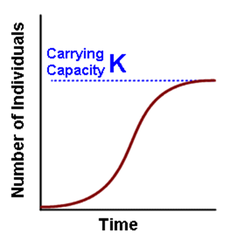
carrying capacity
Largest number of individuals of a population that a environment can support
39
New cards
logistic population growth equation
G=rN((K-N)/K)
40
New cards
density dependent factors
limiting factor that depends on population size
41
New cards
density-independent factors
limiting factors whose influence is not affected by population density
42
New cards
competition
the struggle between organisms to survive in a habitat with limited resources
43
New cards
ecological community
A group of populations of different species living in the same area with varying degrees of interactions with others
44
New cards
community ecology
The study of how interactions between species affect community structure and organization
45
New cards
intraspecific interactions
interactions between members of the same species
46
New cards
interspecific interactions
relationships between species in a community
47
New cards
Predation
a relationship between two species in which one species, the predator, feeds on the other species, the prey
48
New cards
Parasitism
A relationship between two organisms of different species where one benefits and the other is harmed
49
New cards
Mutualism
A relationship between two species in which both species benefit
50
New cards
Commensalism
A relationship between two organisms in which one organism benefits and the other is unaffected
51
New cards
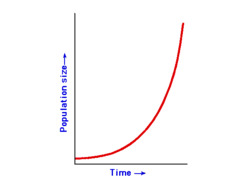
exponential growth
Growth pattern in which the individuals in a population reproduce at a constant rate
52
New cards
logistic growth
Growth pattern in which a population's growth rate slows or stops following a period of exponential growth
53
New cards
G
growth rate
54
New cards
Succession
The series of predictable changes that occur in a community over time
55
New cards
primary succession
succession that occurs on surfaces where no soil exists
56
New cards
secondary succession
Succession following a disturbance that destroys a community without destroying the soil
57
New cards
Coevolution
Process by which two species evolve in response to changes in each other
58
New cards
ecosystem ecology
emphasizes energy flow and chemical cycling among the various biotic and abiotic components
59
New cards
Eutrophication
A process by which nutrients, particularly phosphorus and nitrogen, become highly concentrated in a body of water, leading to increased growth of algae, and the eventual drying up of said body of water
60
New cards
biological magnification
increasing concentration of a harmful substance in organisms at higher trophic levels in a food chain or food web
61
New cards
qualitative data
Information describing color, odor, shape, or some other physical characteristic
62
New cards
quantitative data
Data associated with mathematical models and statistical techniques used to analyze spatial location and association.
63
New cards
point sources
discharge pollutants at specific locations through drain pipes, ditches, or sewer lines into bodies of surface water
64
New cards
non-point sources
Large or dispersed land areas such as crop fields, streets, and lawns that discharge pollutants into the environment over a large area.