Psych 210 - Exam 2
 Call Kai
 Learn
 Practice Test
 Spaced Repetition
 Match
 Flashcards
 Knowt Play
1/44

There's no tags or description
Looks like no tags are added yet.
Name | Mastery | Learn | Test | Matching | Spaced | Call with Kai | Chat |
|---|
No analytics yet
Send a link to your students to track their progress
45 Terms
Industrial-Organizational Psychology: (general + individual defintions)
the application of psychological principles, theory, and research to the work setting
Industrial Psychology (micro/task focus): Recruitment, selection, training, performance, appraisal, promotion, transfer, termination
Organizational Psychology (macro/social focus): Attitudes, fairness, motivation, stress, leadership, teams, broader aspects of organizational and work design
SCIENTIST-PRACTITIONER MODEL
Scientists: Theory & Research
Understand individual, group and organizational behavior through research
Focus on generating knowledge
Practitioner: Practice
Apply I/O Psychology to organizations, externally or internally
Consumer of and applier of knowledge
Walter Dill Scott & Walter Van Dyke Bingham
Applied psychology to organization (military)
Helped with testing and placement for the Army during WWI
Adapted the Stanford-Binet for large group testing
Army Alpha & Army Beta
WWI mass mental tests:
Alpha for literate recruits
Beta (non-verbal) for illiterate/non-English recruits.
Scientific Management:
A movement based on principles developed by Frederick W. Taylor
Suggested that there was one best and most efficient way to perform various jobs; also known as “Taylorism’
Time and Motion Studies: Frank & Lillian Gilbreth
Studies that broke every action into its constituent parts, timed those movements with a stopwatch, and developed more efficient movements to increase productivity.
Hawthorne Studies
1930’s set of studies by Harvard researchers at
Western Electric Company
Interested in the relationship between lighting with employee morale and efficiency
Hawthorne Effect:
the alteration of behavior by subjects due to awareness of being observed
Human Relations Movement:
conceptual shift toward increased focus on employee emotion and motivation
Goal of Selection
Identify the individual(s) amongst a pool of applicants who would be most likely to succeed in a given job role
Organizational attraction
Applicants’ overall evaluation of the appeal of working at that organization in that role
Job analysis:
Systematic study of a job or role to determine the activities, responsibilities, and attributes needed to perform required tasks successfully
KSAO’s
Knowledge: collection of discrete, related facts and information about a particular domain
Skill: Practiced act
Ability: Stable capacity to engage in a specific behavior
“Other” Characteristics: Personality, interests, etc
Reliability and Validity
• Reliability: The consistency and stability of a psychological measure over time.
• Validity: The accuracy and appropriateness of a measure, or whether the tool actually measures the specific psychological construct it claims to measure.
Person-Organization Fit:
alignment and compatibility in characteristics between an individual and their environment (in this case, the organization)
AI in Selection
Automated resume parsing and video screening; often perceived as less fair by applicants than human evaluation.
Oddball Questions
Unconventional interview questions: decrease perceived job fairness and organizational attractiveness.
Mediator Variable
variable explaining the process through which two variables are related
Moderator Variable
variable affecting the strength and direction to the relationship between two variables
Disparate Treatment + Impact
Disparate Treatment: intentional discrimination based on protected group membership
Disparate Impact: inequity in group outcomes regardless of intention
Motivation
a psychological force that energizes, directs and sustains behavior
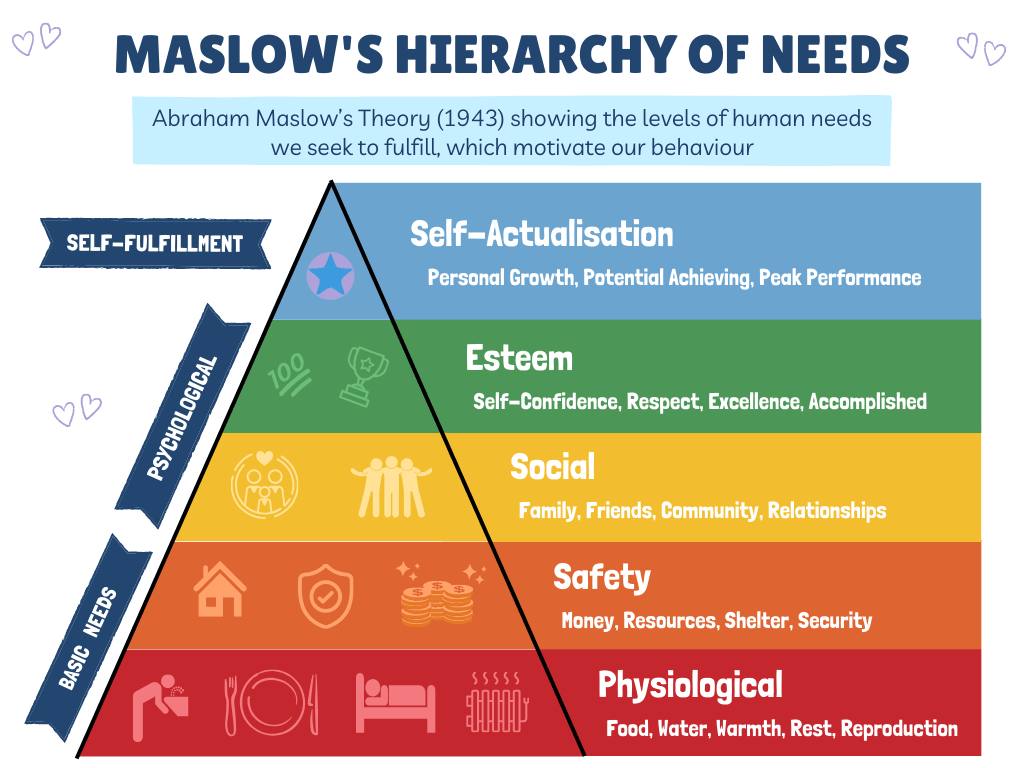
Maslow’s Need’s Hierarchy
Intrinsic and Extrinsic Motivation
Intrinsic: engaging in behavior due to genuine interest and satisfaction
Extrinsic: engaging in behavior due to external rewards
Self Determination Theory + CAR
Modern “needs-based theory” focused on fostering intrinsic motivation, suggests three fundamental human needs: CAR
competence
autonomy
relatedness
Goal-Setting Theory
Specific and difficult (challenging) goals yield higher performance than vague or easy goals.
SMART Goals
Goals that are Specific, Measurable, Attainable, Relevant, and Time-bound.
Causal Mechanisms of Goal-Setting
1. Diverts attention to goal-relevant activities
2. Energizes people; encourages application of greater effort
3. Prolongs effort over time
4. Motivate use of existing or needed knowledge
Goal Conditions
Goal effectiveness requires feedback, commitment, adequate resources, and self-efficacy.
Stress, Stressor, Strain
Stress: process
Stressor: source
Strain: outcome
Acute vs. Chronic Stressor
Acute = short-term/sudden demand
Chronic = long-term/ongoing condition
Role Stressors
Strain caused by unclear/conflicting role demands:
Ambiguity (unclear)
Conflict (opposing)
Overload (too much).
DEMAND-CONTROL MODEL
Demands: workload or intellectual requirements of a job
Control: combination of autonomy in the job and discretion for using different skills
High Demands & Low Control > Job Stress
Primary, Secondary, and Tertiary Intervention
Primary Intervention: Prevention, removes or reduces stressors at the source (e.g., job redesign).
Secondary Intervention: Management, builds employee coping skills and resilience (e.g., stress management training).
Tertiary Intervention: Treatment, treats existing health or strain problems (e.g., Employee Assistance Programs).
Absenteeism and Presenteeism:
Absenteeism: employee unplanned workplace absences
Presenteeism: lost productivity due to suboptimal employee functioning given an illness, injury, or other condition
Schedule Vs Location Flexibility
Schedule flexibility is control over when work gets done,
Location flexibility control over where work gets done.
Trait Approach (Leadership)
consider the traits and characteristics that make up a good leader.
Behavioral Approach (Leadership)
consider the behaviors leaders enact (usually people- or task-focused).
Contingency/Situational Approach Leadership
both the leader and the situation should be considered for effectiveness
Consideration
behavior indicating mutual trust, respect, and a certain warmth and rapport between the supervisor and group.
Initiating Structure:
behavior in which the supervisor organizes and defines group activities and his/her relation to the group
The Big 5
(O)peneness
(C)onscientiousness
(E)xtraversion
(A)greeableness
(N)eurotisicm
Role congruity theory:
Prejudice is formed when individual/social group stereotypes and role stereotypes don’t align :
For example, feminine stereotypes don’t align with the leadership role
DOUBLE BIND PHENOMENON
When individual stereotypes and role stereotypes don’t align, an underrepresented leader can choose to:
Behave in alignment with their stereotyped identities.
OR
Behave in alignment with role expectations.
Glass Ceiling
An invisible systemic barrier that prevents certain people from rising to senior-level positions within an organization
Glass Cliff
a phenomenon where women are promoted to leadership roles in difficult times, when risk of failure is high